
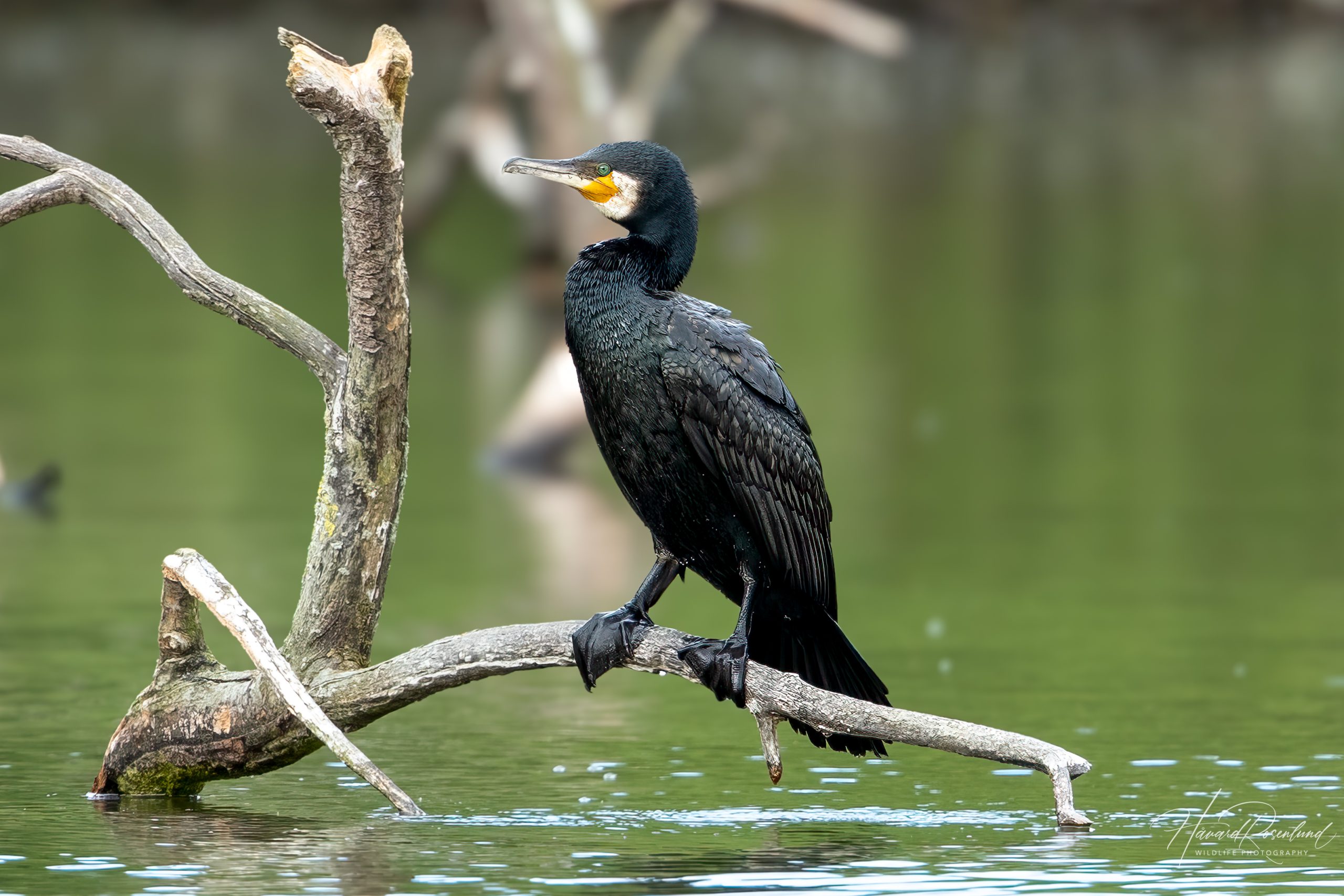
Great Cormorant
Phalacrocorax carbo
At a glance
Habitat
- Coasts, estuaries, lakes, rivers and reservoirs with abundant fish and suitable roosting or nesting sites
Diet
- Primarily fish, with prey species and size varying strongly between habitats and seasons
Activity
- Diurnal
Size
- Length: 80–100 cm Weight: 2.1–2.5 kg
Range
- Widely distributed across Europe, Asia, Africa and Australasia, with a smaller population in northeastern North America
Description
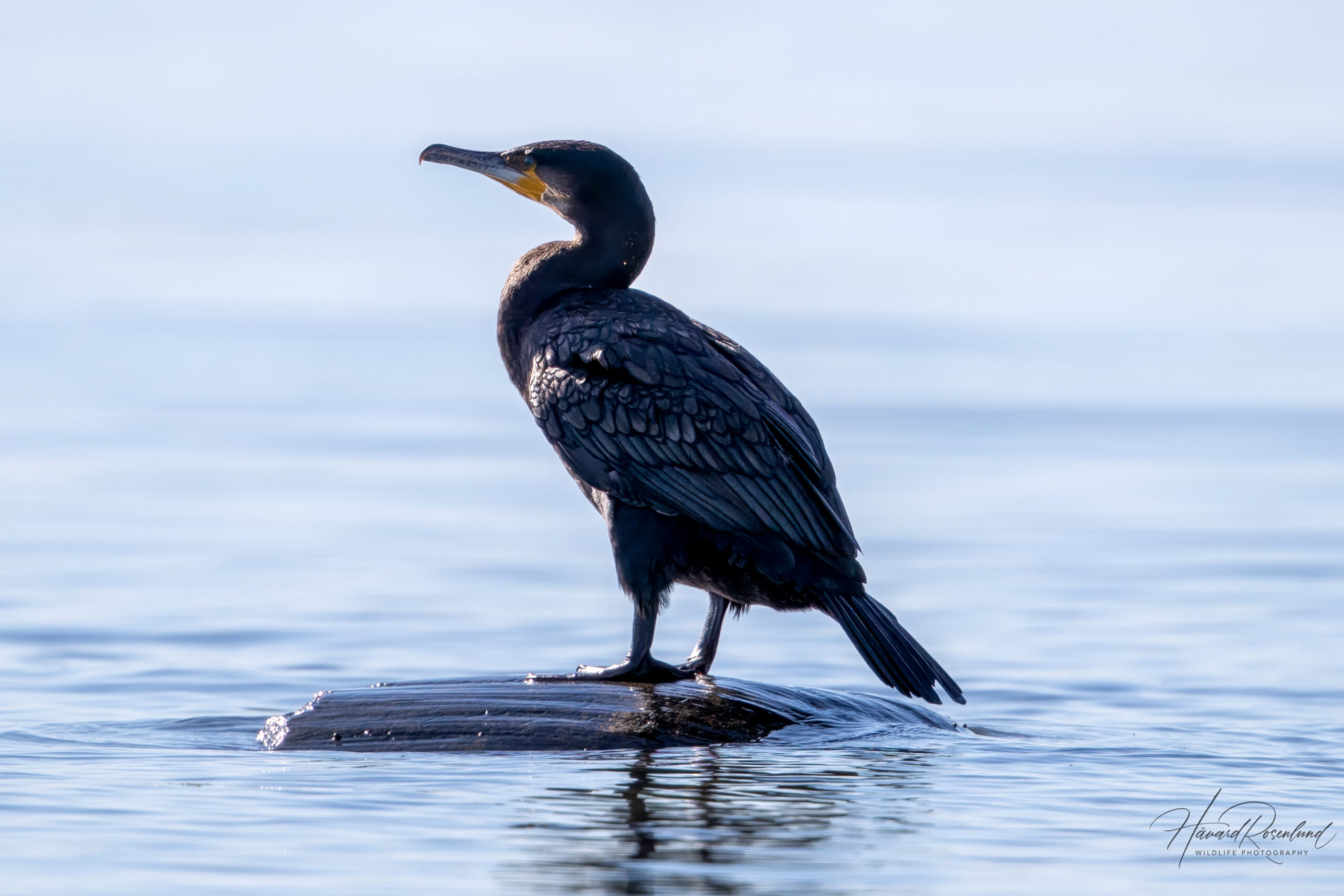
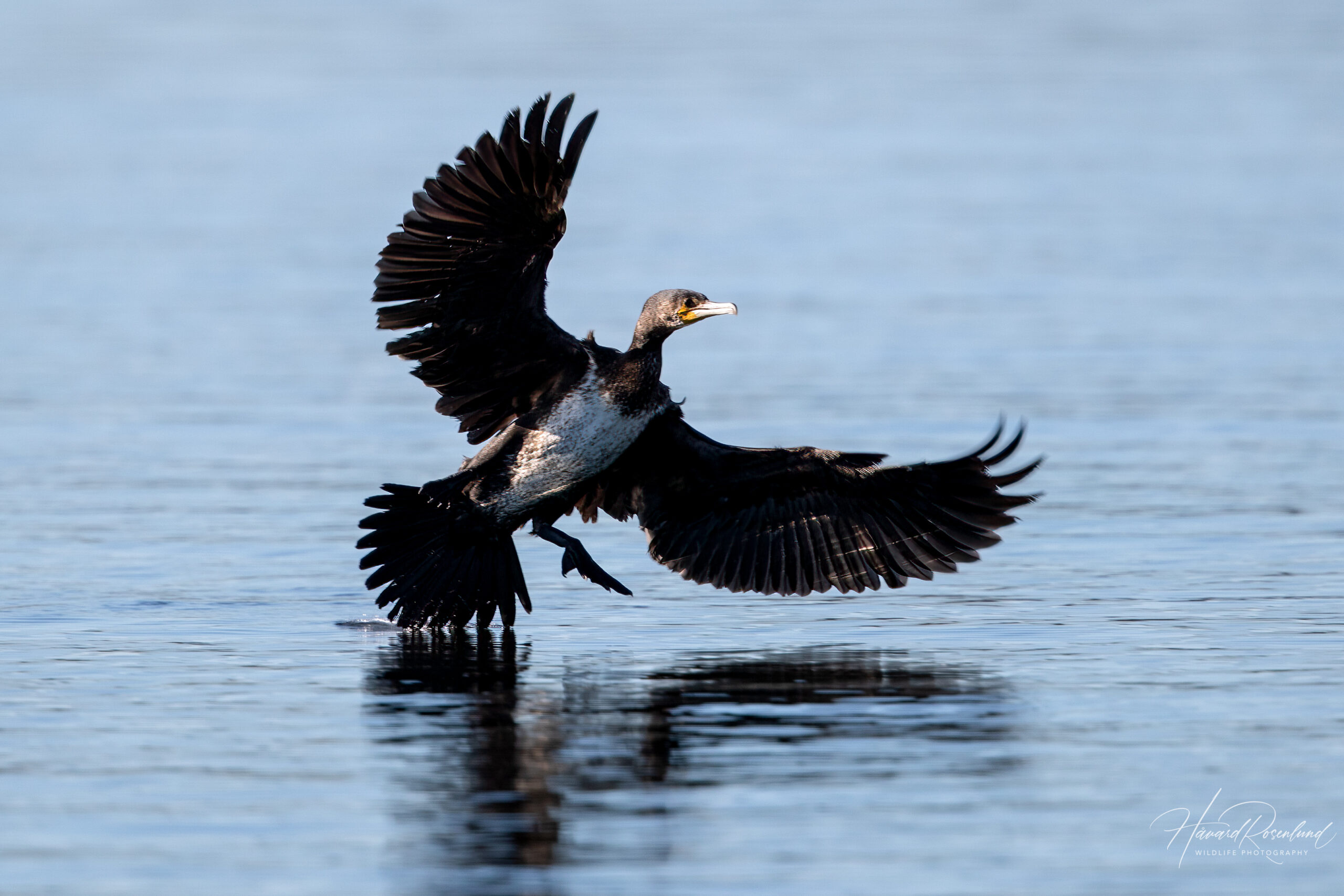
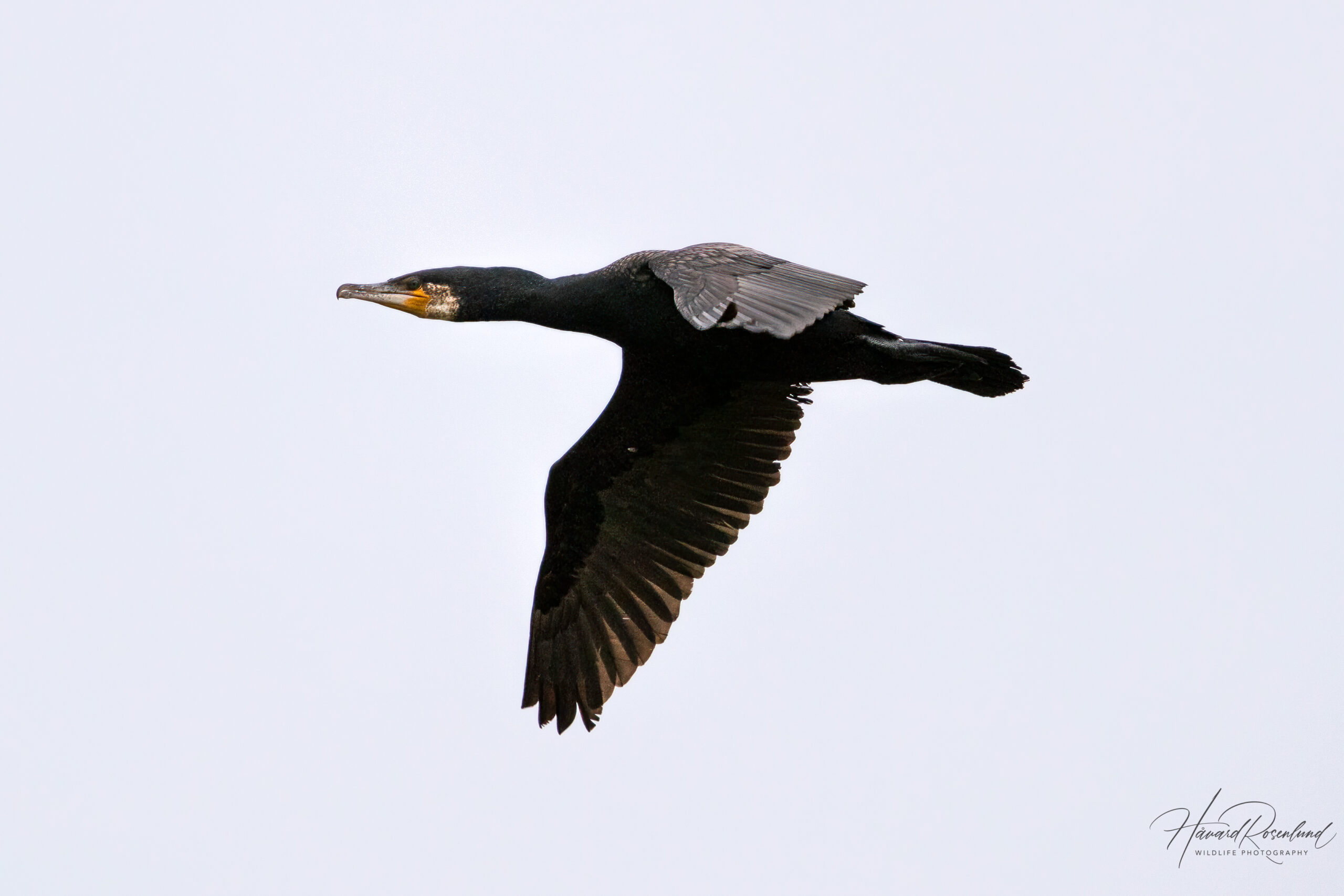
The great cormorant (Phalacrocorax carbo) is a large, long-necked waterbird with a heavy hooked bill and predominantly dark plumage. Adults are roughly 80–100 cm long and commonly weigh a little over 2 kg. In breeding plumage they develop a white thigh patch and variable white or silvery feathering on the head and neck, while juveniles are browner and often much paler below.
The species can be confused with smaller cormorants and shags where ranges overlap, but its heavy build, broad head and strong bill are useful clues. Plumage and body size also vary geographically, reflecting several recognised subspecies.
Taxonomy
Several geographical forms of the great cormorant are recognised. The nominate P. c. carbo is the large North Atlantic form, breeding from northeastern North America through Greenland and Iceland to northwestern Europe. The somewhat smaller continental form P. c. sinensis occurs across much of continental Europe and Asia and has been responsible for much of the expansion into inland breeding sites in western Europe.
The distinction is especially relevant in northern Europe because the forms differ in distribution and habitat use while meeting and mixing in parts of their ranges. Their history also helps explain why trends at coastal and inland colonies can move in different directions even within the same country.
The African white-breasted form P. c. lucidus has sometimes been treated as a separate species. The IOC World Bird List returned it to the great cormorant as a subspecies in 2025.
Habitat
Great cormorants use an exceptionally broad range of aquatic habitats, including rocky coasts, estuaries, sheltered bays, rivers, lakes and reservoirs. Suitable resting and nesting sites nearby are important, whether these are cliffs and islands or trees around inland waters.
Habitat use varies among populations and subspecies. Some remain strongly coastal, while others have colonised inland lakes, rivers and artificial reservoirs, particularly in Europe. This flexibility has helped the species expand into many human-modified water systems.
Diet
Fish dominate the diet, but prey species and size vary with what is locally abundant and catchable. Great cormorants are therefore flexible fish predators rather than specialists on one particular group. Crustaceans and other aquatic prey are taken occasionally.
Individuals can shift feeding areas and prey as conditions change, and local diet may differ greatly between coastal, riverine and lake populations. The ecological effect of cormorant predation therefore also differs strongly among water bodies.
Hunting
Great cormorants are specialised pursuit-divers that chase fish underwater, propelled mainly by their webbed feet. Many foraging dives are relatively shallow, but field studies have recorded dives to around 35 m. Their plumage is often described simply as non-waterproof, but the structure is more sophisticated: the loose outer portions of the contour feathers wet readily while the denser central portions remain strongly water-repellent. This retains a thin insulating layer of air close to the body while reducing the trapped air that would otherwise increase buoyancy. Water retained during repeated dives can reduce buoyancy further and improve underwater performance, although at the cost of greater heat loss.
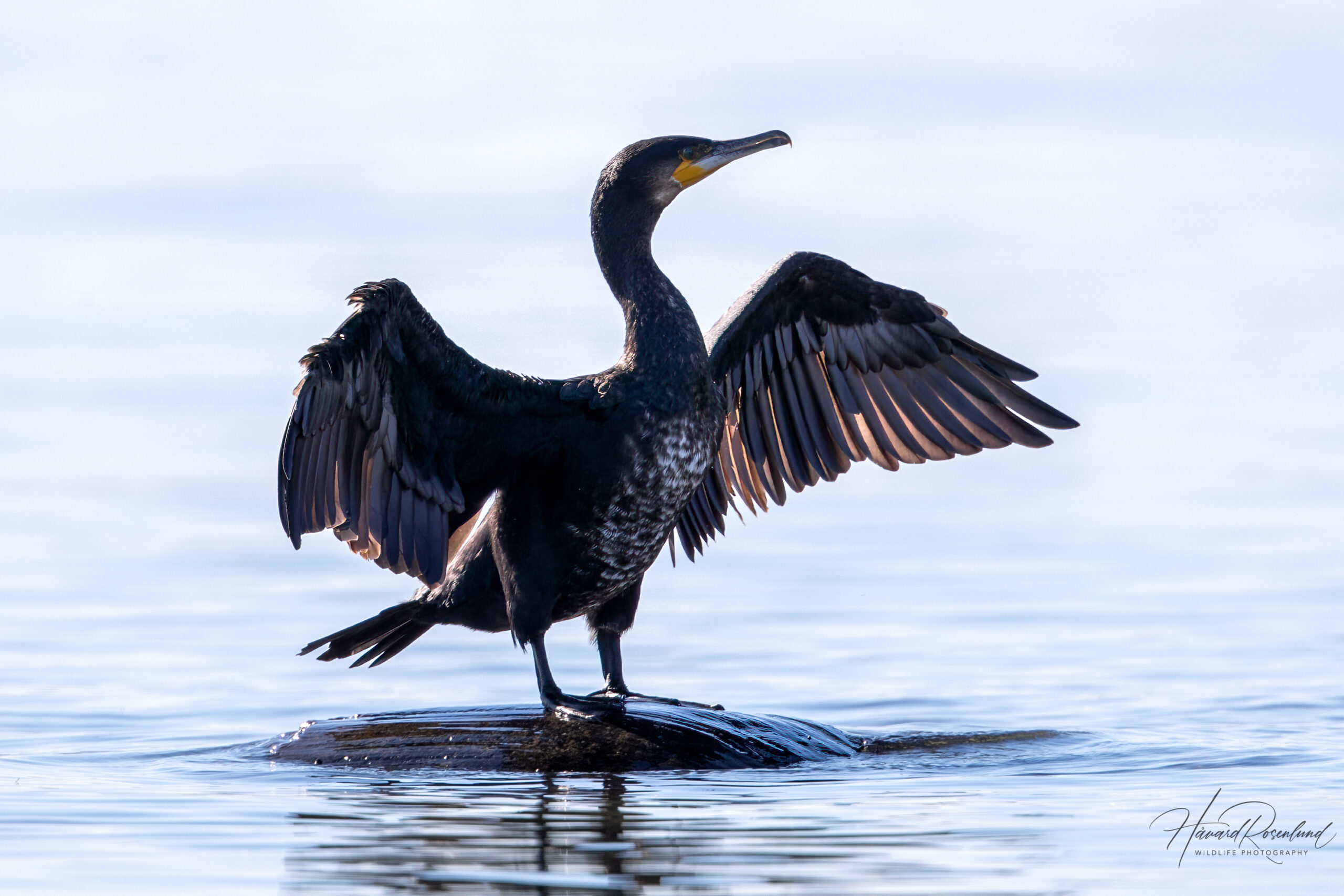
The eyes are also adapted to the rapid transition between air and water. Changes in lens shape compensate for the reduced refractive power of the cornea when submerged, allowing the birds to track moving prey. After feeding, they frequently perch with the wings spread; drying the wetted outer plumage is an important part of this behaviour, although heat balance and other factors also contribute.
Migration
Movement patterns vary widely across the range. Many birds in mild coastal climates are resident or make only local movements, whereas populations exposed to freezing inland waters or severe northern winters are more migratory. Continental European birds can move hundreds or thousands of kilometres between breeding and wintering areas, while many Atlantic coastal birds remain nearer their breeding regions.
Juveniles often disperse particularly widely. These movements connect colonies and help cormorants find newly available feeding waters and breeding sites, contributing to the rapid colonisation of inland habitats seen in parts of Europe.
Breeding
Great cormorants breed colonially, but colony position varies greatly with geography. Nests may be placed on offshore rocks, cliffs and low islands or high in trees beside inland waters. Pairs often return to established colonies and may reuse the same nesting area in successive years.
A typical clutch contains three to four eggs. Both adults incubate for about 28–31 days and later feed the naked, helpless chicks. The young normally fledge after roughly 48–52 days. Large, long-used colonies can accumulate enough guano to alter vegetation and nutrient conditions around the nest site, especially where many nests are concentrated in trees.
Relationship with humans
Few aspects of great-cormorant biology generate more debate than their relationship with fisheries. The expansion of inland populations in Europe has brought birds into regular contact with aquaculture, recreational angling and commercial freshwater fisheries. A global meta-analysis published in 2021 found no significant overall effect of cormorant predation across fish populations, but effects differed among prey groups and could be negative for some fish taxa.
Management ranges from non-lethal deterrence and habitat measures to licensed shooting. A British study found no evidence that licensed winter shooting reduced local cormorant numbers the following winter, while modelling suggests that measures aimed directly at reducing fishery damage can be more cost-effective than broad population reduction. The scale of conflict depends on local fish stocks, habitat and management goals as well as bird numbers.
Status
The great cormorant is classified as least concern on the IUCN Red List. Its enormous range and ability to use both coastal and inland waters keep global extinction risk low.
In parts of Europe the species recovered and expanded after earlier persecution declined and legal protection improved. Population trends nevertheless differ among regions and even between coastal and inland colonies.
Image gallery
Loading map and observations…
Have you seen this species?
Independent species archive
Did you find this species page useful?
Wildlife Vagabond is independently built and maintained. Voluntary support helps cover hosting, maps, data storage and continued improvements to the species archive.
Support Wildlife VagabondSpecies content will remain freely available.
References
Information about the species’ global distribution and status is based primarily on global Red List data. See the references below for details.
- AviList. (n.d.). v2025b – The Global Avian Checklist. https://www.avilist.org/checklist/v2025b/
- BirdLife International. (n.d.). Great Cormorant species factsheet. https://datazone.birdlife.org/species/factsheet/great-cormorant-phalacrocorax-carbo
- British Trust for Ornithology. (n.d.). BirdFacts – Cormorant. https://www.bto.org/learn/about-birds/birdfacts/cormorant
- Grémillet, D., Chauvin, C., Wilson, R. P., Le Maho, Y., & Wanless, S. (2005). Unusual feather structure allows partial plumage wettability in diving great cormorants Phalacrocorax carbo. Journal of Avian Biology, 36(1), 57-63. https://doi.org/10.1111/j.0908-8857.2005.03331.x
- Holste, J., Mügge, C., Distler, C., & Schulz, S. (2023). The uropygial gland of the Great Cormorant (Phalacrocorax carbo): II. Biochemical analysis of the uropygial secretion. Journal of Ornithology, 164(3), 605-619. https://doi.org/10.1007/s10336-023-02073-9
- International Union for Conservation of Nature. (n.d.). Great Cormorant. The IUCN Red List of Threatened Species. https://www.iucnredlist.org/species/22696792/155523636
- Marzano, M., Carss, D. N., & Cheyne, I. (2013). Managing European cormorant‐fisheries conflicts: problems, practicalities and policy. Fisheries Management and Ecology, 20(5), 401-413. https://doi.org/10.1111/fme.12025
- Ovegård, M. K., Jepsen, N., Bergenius Nord, M., & Petersson, E. (2021). Cormorant predation effects on fish populations: A global meta‐analysis. Fish and Fisheries, 22(3), 605-622. https://doi.org/10.1111/faf.12540
- Ribak, G., Weihs, D., & Arad, Z. (2005). Water retention in the plumage of diving great cormorants Phalacrocorax carbo sinensis. Journal of Avian Biology, 36(2), 89-95. https://doi.org/10.1111/j.0908-8857.2005.03499.x
- Royal Society for the Protection of Birds. (n.d.). Cormorant. https://www.rspb.org.uk/birds-and-wildlife/cormorant