
Burchell’s Coucal
Centropus burchellii
At a glance
Habitat
- Dense thickets, reedbeds, wetlands, riparian vegetation, forest edge and gardens
Diet
- Invertebrates, frogs, reptiles, small mammals, birds, eggs and occasional fruit
Activity
- Mostly early morning, crepuscular and active in overcast or rainy weather
Size
- Length: 36–42 cm Weight: 142–180 g
Range
- Southeastern Tanzania south through Mozambique and Zimbabwe to eastern Botswana, Eswatini and South Africa
Description
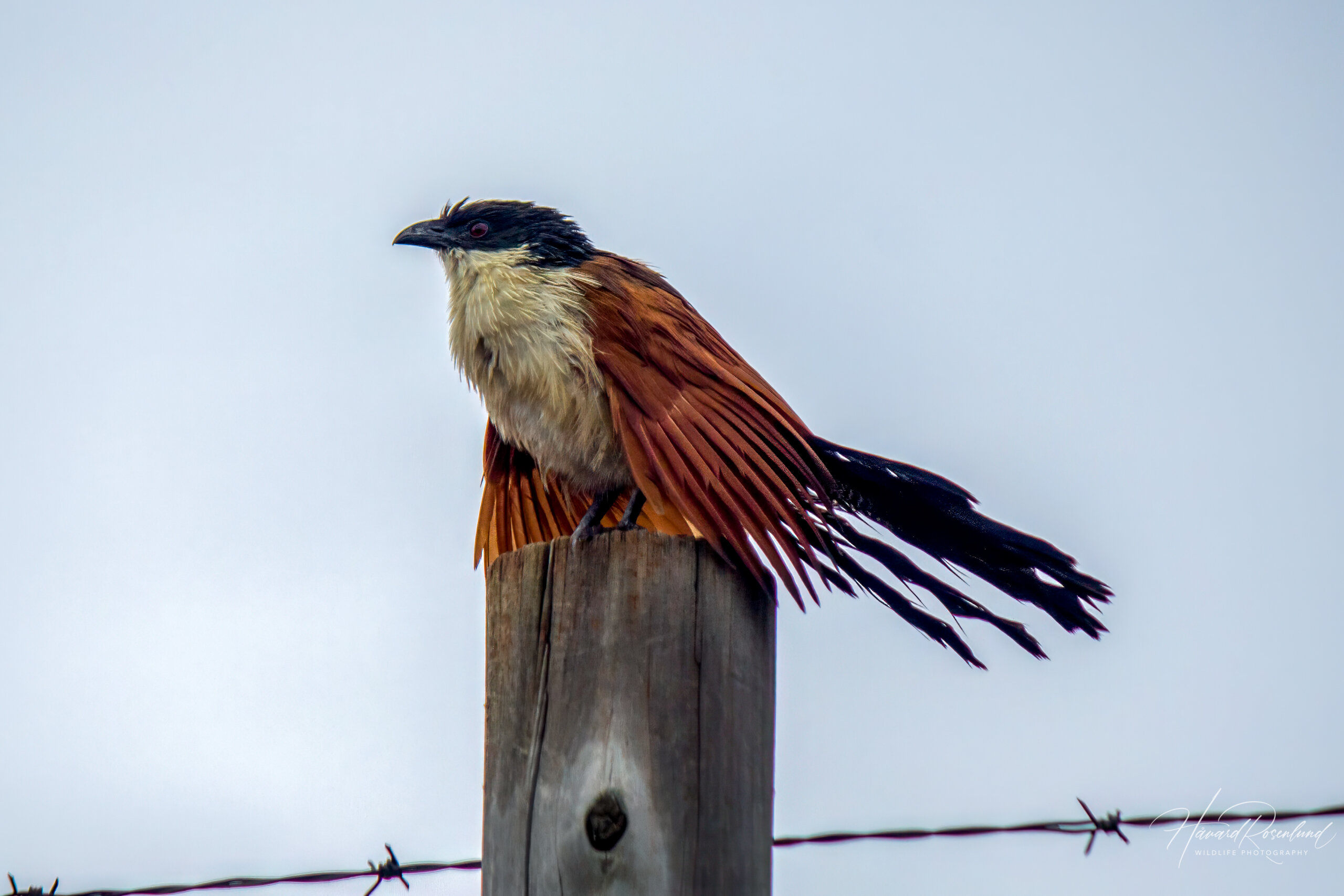
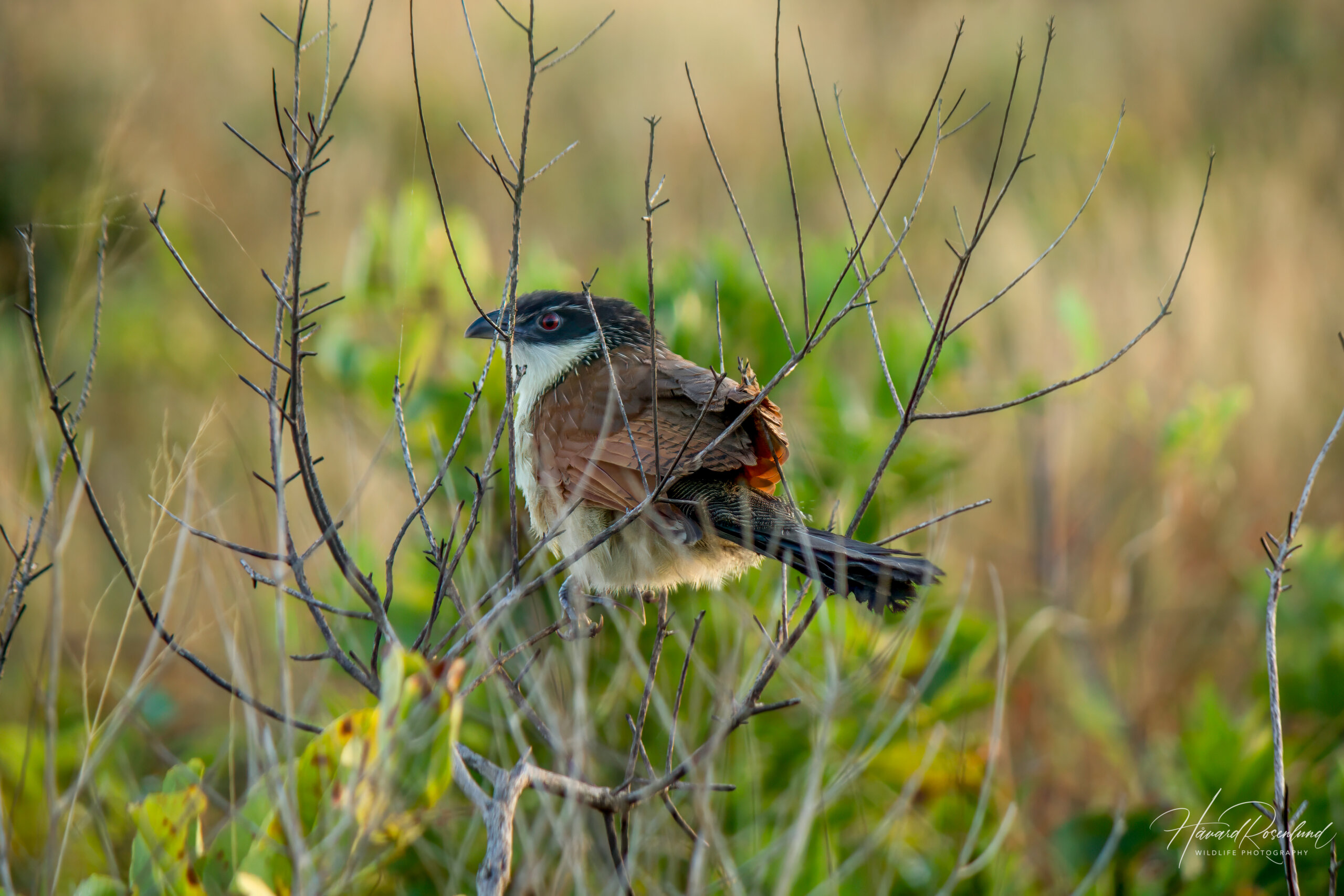
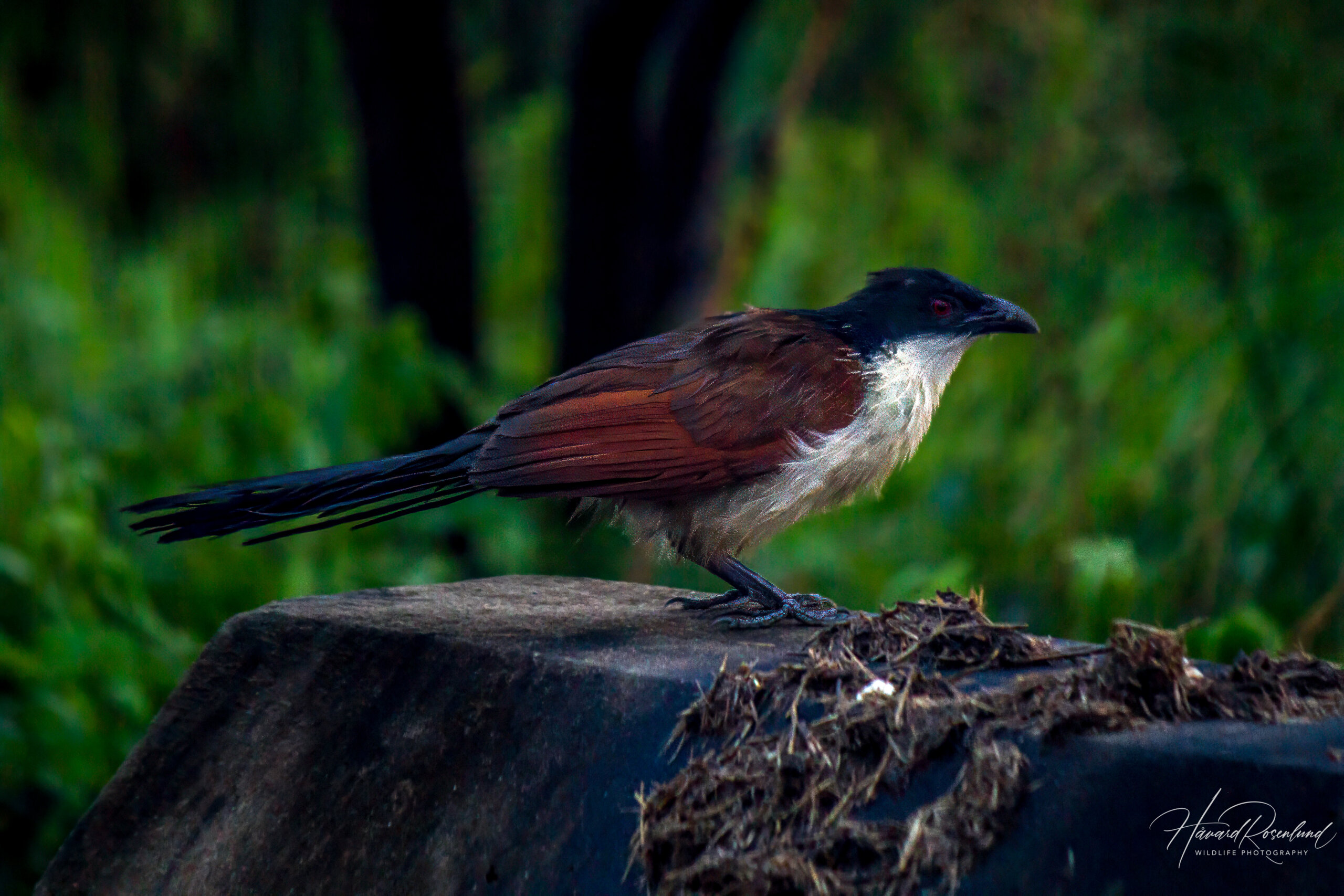
Burchell’s coucal (Centropus burchellii) is a large cuckoo of southeastern Africa, measuring about 36–42 cm and weighing roughly 142–180 g. Adults have a black head and neck, white throat and underparts, chestnut back and wings, a long black tail and deep red eyes.
Unlike the brood-parasitic cuckoos familiar to many people, coucals build their own nests and raise their own young. Their feet have two toes pointing forwards and two backwards, and a long hind claw helps them move through dense, tangled vegetation.
Taxonomy
Burchell’s coucal was formerly included within the white-browed coucal (Centropus superciliosus) complex. The eBird/Clements Checklist separated it as a full species in 2024, and AviList adopted the same treatment when the unified global checklist was launched in 2025.
Two subspecies are recognised: the nominate C. b. burchellii and the more northerly C. b. fasciipygialis. Burchell’s and white-browed coucals meet and hybridise across a relatively broad area where their ranges approach one another. Vocal differences within the complex remain relatively poorly studied.
Habitat
Burchell’s coucal favours dense, rank vegetation in wetter parts of southeastern Africa. Typical habitats include thickets, reedbeds, marsh edges, riparian vegetation, coastal bush, forest margins, sugar-cane fields and well-vegetated gardens.
It is much less typical of the dry interior and is usually associated with places where dense ground or shrub cover remains available throughout much of the year.
Diet
The diet is broad and mainly animal-based. Burchell’s coucals take insects, spiders, centipedes, snails, crabs, frogs, reptiles, small mammals, birds, eggs and nestlings, while fruit and berries are eaten occasionally.
They search slowly through vegetation and on the ground. They pick prey from leaves and branches, search through leaf litter or drop down onto prey detected below. The broad diet helps explain why the species can use both natural wetlands and heavily vegetated gardens or farmland.
Behaviour
Burchell’s coucals are often most active in the early morning and late afternoon and become particularly conspicuous in overcast or rainy weather. They usually keep low in dense vegetation, moving by climbing, hopping and short flights rather than spending long periods in the open.
The deep descending call has a bubbling quality that has long given the species the name “rainbird”. Calling often increases before or during rain, reinforcing the traditional idea that the call heralds wet weather.
Breeding
Pairs are usually monogamous. Both sexes may contribute to building the bulky domed nest, although males can do much of the construction. The nest is concealed in dense grass, reeds, shrubs, creepers or thorny trees, usually about 1–3 m above the ground.
Egg-laying occurs mainly during the austral spring and summer. A clutch commonly contains two to five eggs, incubated for roughly 14–18 days. The chicks develop strong feet early and can clamber in nearby vegetation before they can fly. They leave the nest after about three weeks but remain dependent on their parents for longer.
Status
Burchell’s coucal has not yet received its own global IUCN Red List assessment following the recent species split and is therefore still Not Evaluated (NE) as a separate species. The older IUCN assessment applies to the former, broader white-browed coucal complex, which was listed as Least Concern.
Burchell’s coucal remains common in many suitable habitats. Loss or drainage of wetlands and removal of dense vegetation can affect local populations, but there is currently no evidence that the newly recognised species is undergoing a range-wide decline severe enough to suggest a threatened global status.
Image gallery
Loading map and observations…
Have you seen this species?
Independent species archive
Did you find this species page useful?
Wildlife Vagabond is independently built and maintained. Voluntary support helps cover hosting, maps, data storage and continued improvements to the species archive.
Support Wildlife VagabondSpecies content will remain freely available.
References
Information about the species’ global distribution and status is based primarily on global Red List data. See the references below for details.
- Avibase. (n.d.). Centropus burchellii. https://avibase.bsc-eoc.org/species.jsp?avibaseid=6C342FFF20D08A84
- AviList. (n.d.). Centropus burchellii. https://www.avilist.org/checklist/v2025b/
- Biodiversity and Development Institute. (2025). Burchell’s Coucal. https://thebdi.org/2025/01/15/burchells-coucal-centropus-burchellii/
- BirdLife International. (n.d.). White-browed Coucal assessment covering the former broader taxon. https://datazone.birdlife.org/species/factsheet/white-browed-coucal-centropus-superciliosus
- eBird/Clements Checklist. (2024). Burchell’s Coucal split from White-browed Coucal. https://www.birds.cornell.edu/clementschecklist/updates-and-corrections-october-2024/
- Oiseaux.net. (n.d.). Burchell’s Coucal. https://www.oiseaux.net/en/oiseaux/burchell.s.coucal.html