
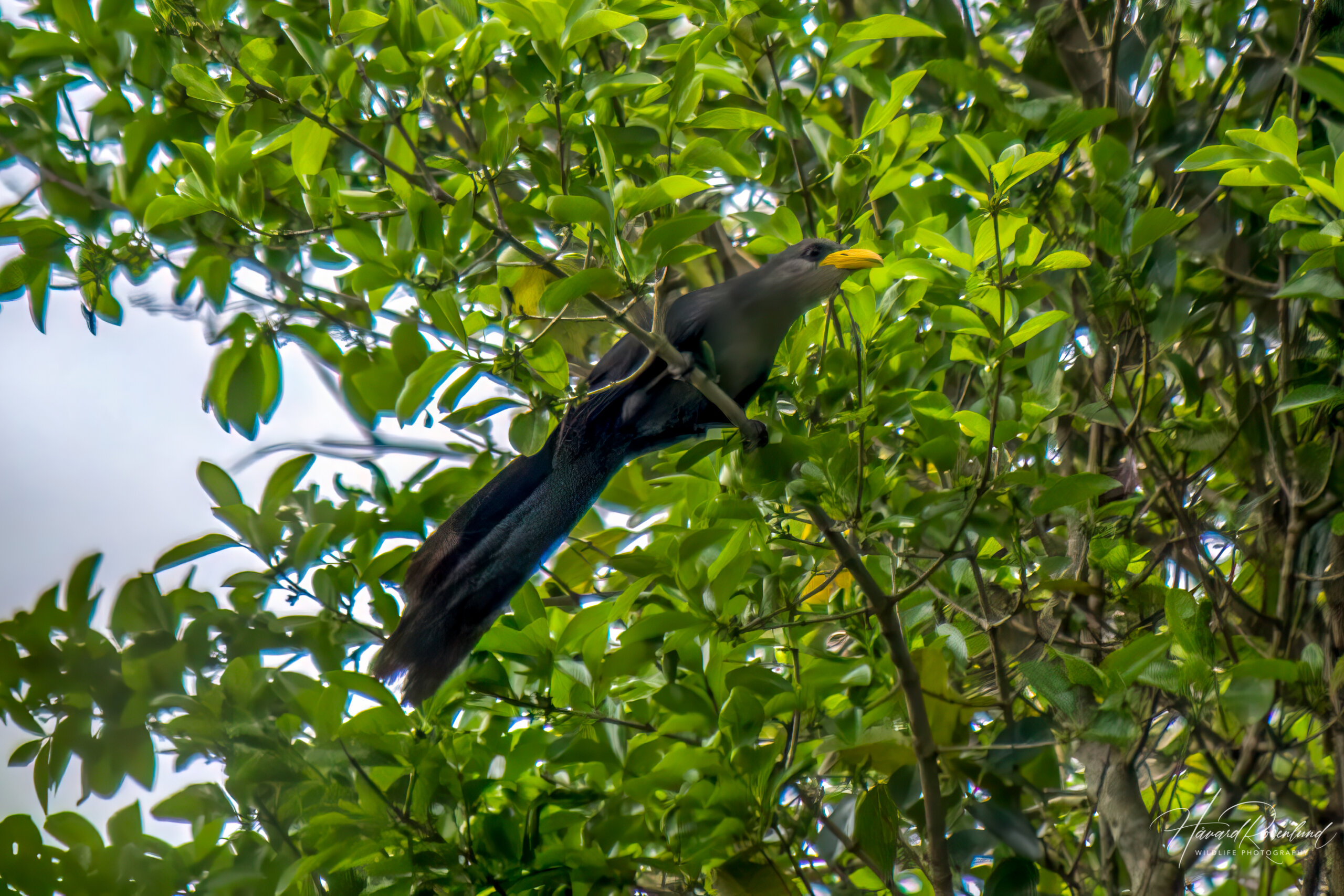
Green Malkoha
Ceuthmochares australis
At a glance
Habitat
- Dense forest, riverine woodland, thickets and well-vegetated forest edges
Diet
- Insects and other invertebrates; also frogs, other small vertebrates and some fruit
Activity
- Diurnal
Size
- Length: About 33 cm Weight: 52–79 g
Range
- Eastern and southeastern Africa from Ethiopia and Kenya south to eastern South Africa
Description
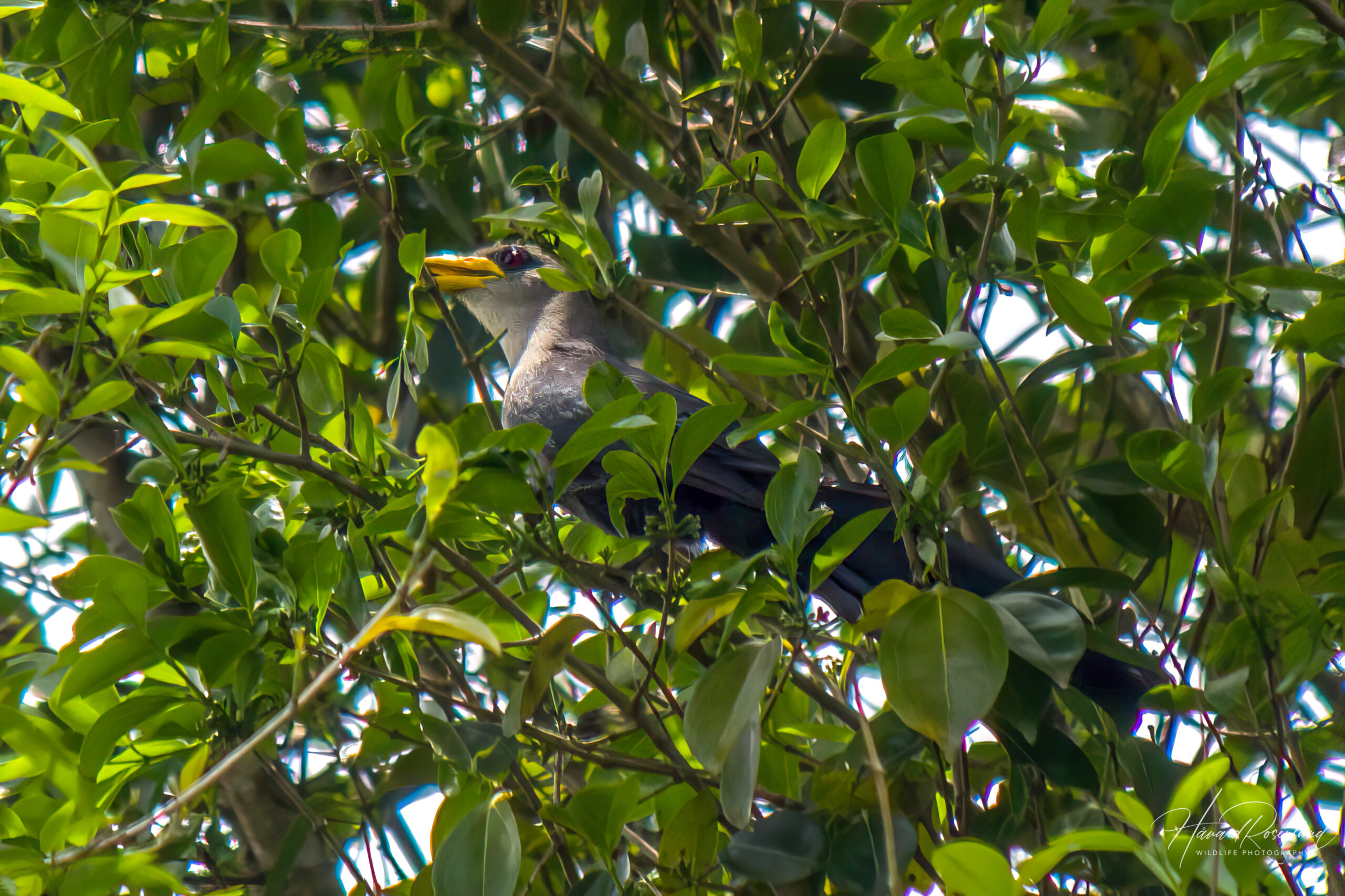
The green malkoha (Ceuthmochares australis), also known as the whistling yellowbill, is a secretive African cuckoo. It is about 33 cm long and weighs roughly 52–79 g. The head and underparts are slate-grey, while the back, wings and long tail have a green sheen. Its bright yellow bill and deep red to chestnut eye are especially distinctive, and the sexes look alike.
Taxonomy
The green malkoha was formerly treated as the same species as the blue malkoha (Ceuthmochares aereus), the two together being known as the yellowbill. Current major world checklists, including AviList v2025b, recognise them as separate species.
Green malkoha occupies eastern and southeastern Africa and is greener above, while blue malkoha occurs farther west and north and has a more bluish gloss. The split therefore reflects both geographical separation and consistent differences in appearance.
Habitat
Green malkohas live in dense forest, riverine woodland, thickets and well-vegetated forest edges. They are strongly associated with tangled cover, especially vines, creepers and dense foliage in and just below the canopy, and are rarely seen sitting exposed for long.
Diet
The diet is dominated by insects and other invertebrates, including caterpillars, beetles, grasshoppers, crickets and slugs. Frogs and other small vertebrates, including occasional small birds, are also taken, together with some fruit, seeds and other plant material.
Foraging
Food is searched for inside dense vegetation rather than from exposed perches. Green malkohas move through vines and tangled foliage with short hops and clambering movements, picking prey from leaves, branches and other surfaces as they go.
They may also accompany squirrels, birds or other active animals and seize insects or other small prey flushed from hiding by their movements. This use of other animals makes the species' foraging more flexible than its secretive way of life might suggest.
Behaviour
Green malkohas are diurnal but very difficult to observe because they spend so much time concealed in dense vegetation. They are usually encountered alone or in pairs and tend to move through cover by climbing, hopping and creeping rather than making long flights between exposed perches.
The long tail is used conspicuously as the bird manoeuvres through vegetation and also features in social and courtship displays. Much of the species' everyday activity therefore takes place out of sight even in areas where it is regularly present.
Breeding
Green malkohas are not brood parasites, as many other cuckoos: they do not lay their eggs in the nests of other birds, but build their own nest and care for their own young. Pairs are monogamous, and courtship includes conspicuous tail movements and food presentation by the male.
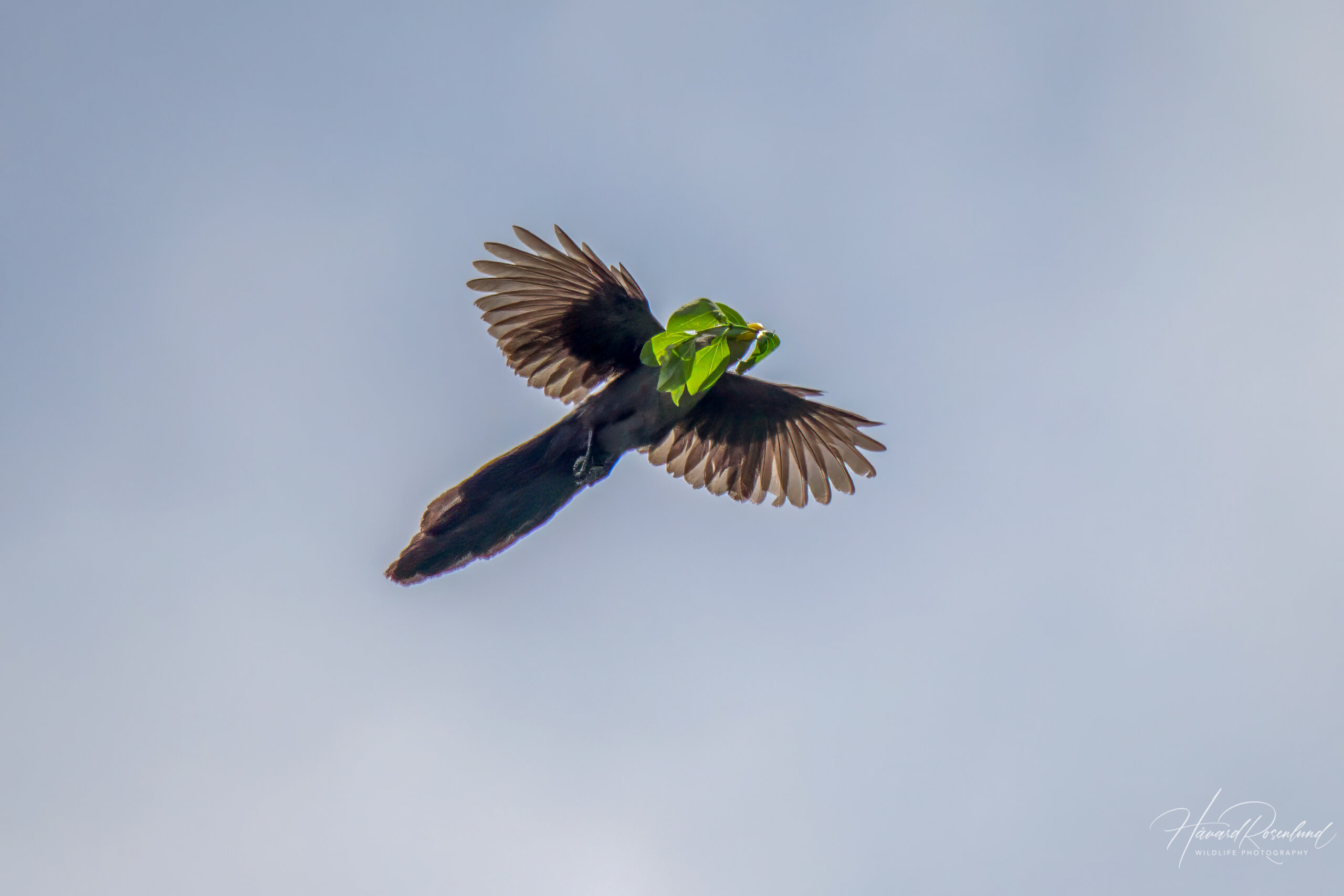
The nest is a rough platform or shallow cup of twigs and plant debris, hidden in dense vegetation, often around 2–5 m above the ground. Fresh leaves may be added to the lining during incubation. Breeding timing varies geographically; in southern Africa most records fall in spring and early summer, especially around October–December.
Clutches are small, usually two or three creamy-white eggs, although four have been reported. Both parents take part in caring for the young.
Status
The green malkoha is often difficult to detect because it spends so much time inside dense vegetation. Sparse sightings therefore should not be confused with true rarity. The species remains listed as Least Concern on the IUCN Red List and has a very large range.
BirdLife International nevertheless considers the overall population trend to be decreasing as forest habitat is lost or degraded in parts of the range. Protection of riverine, coastal and other dense forest habitats is therefore the main long-term conservation concern.
Image gallery
Loading map and observations…
Have you seen this species?
Independent species archive
Did you find this species page useful?
Wildlife Vagabond is independently built and maintained. Voluntary support helps cover hosting, maps, data storage and continued improvements to the species archive.
Support Wildlife VagabondSpecies content will remain freely available.
References
Information about the species’ global distribution and status is based primarily on global Red List data. See the references below for details.
- AviList. (n.d.). Ceuthmochares australis (Green Malkoha), current world-checklist treatment. https://explore.avilist.org/
- BirdLife International. (n.d.). Whistling Yellowbill / Green Malkoha Ceuthmochares australis species factsheet. https://datazone.birdlife.org/species/factsheet/whistling-yellowbill-ceuthmochares-australis
- International Union for Conservation of Nature. (n.d.). Ceuthmochares australis (Green Malkoha). The IUCN Red List of Threatened Species. https://www.iucnredlist.org/species/22725637/94897862
- Kirwan, G. M., del Hoyo, J., Collar, N., & Boesman, P. F. D. (2021). Green Malkoha (<i>Ceuthmochares australis</i>), version 2.0. In Birds of the World. Cornell Lab of Ornithology. https://doi.org/10.2173/bow.yellow6.02