
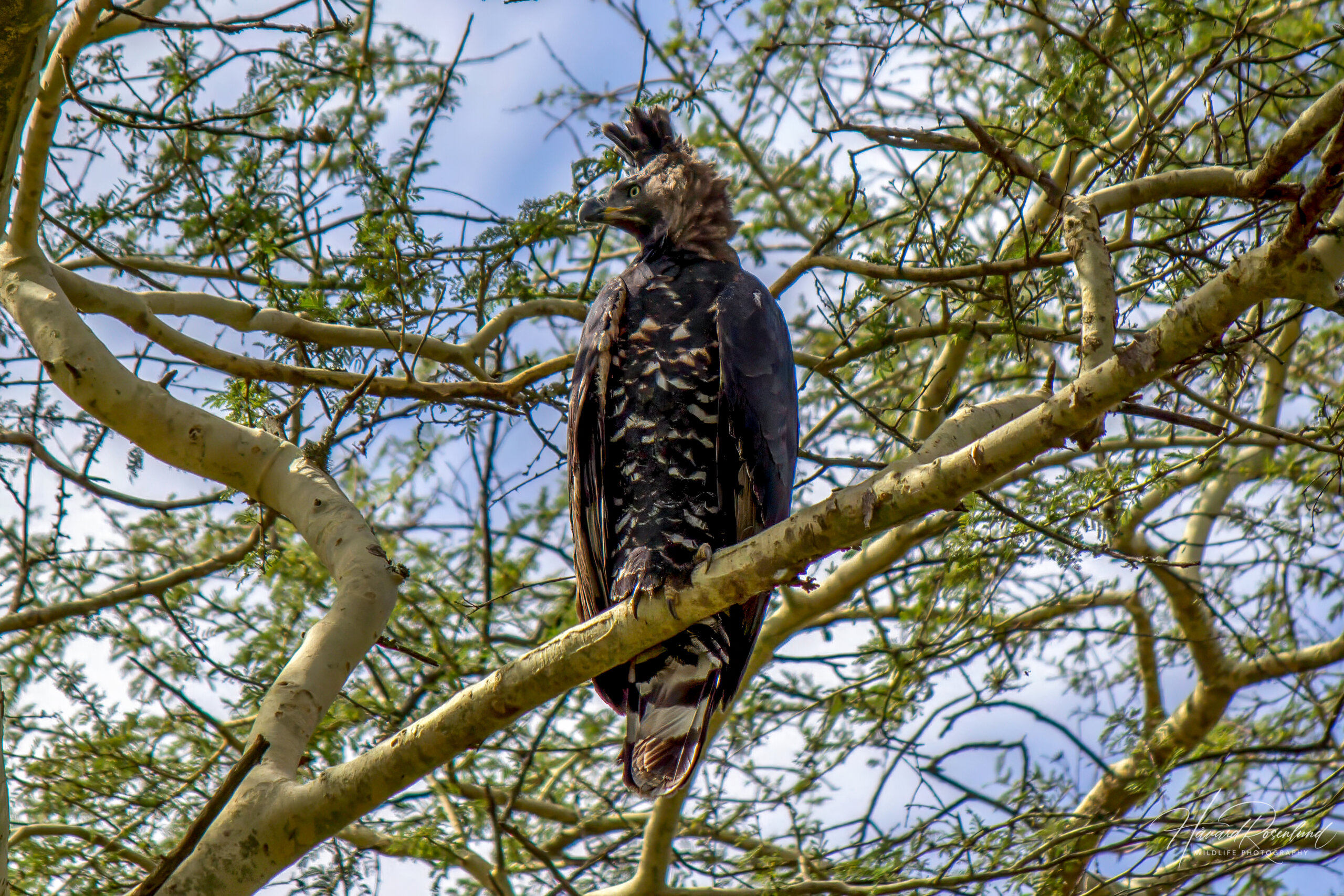
Crowned Eagle
Stephanoaetus coronatus
At a glance
Habitat
- Rainforest, montane forest, dense woodland, riverine forest and wooded urban greenspace
Diet
- Mainly medium-sized mammals, especially monkeys, hyraxes and small antelopes
Activity
- Diurnal; primarily an ambush hunter within forest cover
Size
- Length: About 80–92 cm Weight: About 2–4.3 kg
Range
- Patchily distributed through forested parts of sub-Saharan Africa
Description
The crowned eagle (Stephanoaetus coronatus) is a large forest eagle and one of Africa's most powerful mammal-hunting raptors. Adults are about 80–92 cm long and weigh roughly 2–4.3 kg. The species shows clear sexual size dimorphism, meaning females are considerably larger than males. The wingspan is relatively modest for such a large eagle, about 1.5–1.8 m. Short, rounded wings and a long barred tail allow rapid manoeuvres through gaps in the canopy.
Adults have dark upperparts, a prominent crest, pale eyes and heavily barred or spotted underparts. The feet are exceptionally large, with massive dark talons. Juveniles are strikingly paler and can be confused with young martial eagles (Polemaetus bellicosus); the longer barred tail and shorter, rounder wings are important distinctions.
Habitat
Crowned eagles are strongly associated with dense, varied forest and woodland. They occur in lowland rainforest, montane forest, wooded ravines, riverine forest and forest–savanna mosaics, but can also persist in plantations and suburban landscapes where mature trees and connected wooded corridors remain.
A good territory needs large nest trees, dense cover for ambush hunting and enough medium-sized mammal prey. Forest fragmentation, where continuous forest is broken into smaller and more isolated patches, can therefore reduce habitat quality even where individual large trees remain standing.
Diet
Mammals dominate the diet, but the main prey varies among habitats. Primates are especially important in many forests, while hyraxes, duikers and other small antelopes can dominate elsewhere. Mongooses, genets and other medium-sized mammals are also taken, with birds and reptiles forming a smaller part of the diet.
Urban and suburban eagles show the same broad mammal specialisation, although local prey can include pets and other domestic animals as well as abundant wild species such as monkeys and hyraxes.
Hunting
Crowned eagles are specialised ambush hunters. They usually watch from concealment within the canopy before launching a short, explosive attack, using compact wings to accelerate and turn among trees. Their enormous feet and talons are adapted for seizing and overpowering relatively large mammalian prey.
Prey may be taken on the ground, in trees or during a rapid strike through broken canopy. Large animals that cannot be carried whole may be eaten at the kill site or dismembered and transported in sections to a tree or nest.
Exceptionally large prey can also lead to prolonged encounters. In one documented observation in Kenya, a female crowned eagle followed a half-grown bushbuck for two days, repeatedly attempting attacks before eventually inflicting a serious flank wound and watching the injured animal from a distance. The case shows how persistent an individual eagle can be, but it is best treated as an unusual field observation rather than a normal hunting method.
Behaviour
Adult crowned eagles form long-term pairs and generally remain within the same territory throughout the year. Much of their daily activity is inconspicuous beneath the canopy, but pairs become far more obvious when calling and performing undulating display flights above the forest.
These aerial displays also help mark the territory. Young birds range much more widely before securing a territory of their own.
Home ranges
Breeding crowned eagles are relatively settled compared with many large open-country eagles, but each pair still needs a substantial area of prey-rich woodland. GPS work around Durban measured annual home ranges averaging about 13 km², with defended territories of roughly 6.3 km² per pair.
These urban and suburban ranges can be comparatively compact because prey and large nest trees are concentrated within connected green-space networks. In less productive or more fragmented forest, pairs may need larger areas. The species therefore shows how a large forest raptor can persist surprisingly close to a city when enough connected wooded habitat remains.
Breeding
The crowned eagle has an exceptionally slow reproductive cycle. Across much of the range, pairs breed only once every two years, repeatedly enlarging a massive stick nest in a tall tree.
The female lays one or two eggs and performs most of the incubation. Incubation lasts about 49–51 days. When two chicks hatch, siblicide occurs: the older chick attacks and normally kills the younger, so only one young is reared.
The surviving young fledges after about three to four months but can remain dependent on its parents for another nine to eleven months. This exceptionally long period of parental care, combined with breeding only every second year, means repeated nesting failure or the loss of a breeding adult can affect the population for years.
Relationship with humans
Crowned eagles have shown remarkable flexibility in parts of KwaZulu-Natal. Around Durban and Pietermaritzburg, pairs use indigenous forest patches, urban greenspace and exotic plantations, and in some areas breeding territories lie only a few kilometres apart.
A study published in 2020 on the urban population around Durban found that pairs bred more frequently in urban landscapes, but breeding success was lower where development was more intense. Eagles are killed in collisions with buildings, vehicles and power infrastructure and may be persecuted after taking pets or domestic animals. Successful coexistence therefore depends on connected wooded habitat, retention of large nest trees and tolerance from residents.
Status
Globally, the crowned eagle is classified as Near Threatened by BirdLife International and the IUCN, and the population is considered to be declining. The global population is estimated at roughly 5,000–50,000 mature individuals.
The situation is more serious in South Africa, Lesotho and Eswatini. BirdLife South Africa's 2025 regional assessment classifies the species as Vulnerable, estimates about 900–1,000 mature individuals and considers the regional population to be declining.
Threats
Forest loss, fragmentation and degradation remain major threats, together with depletion of the wild mammal prey on which the species depends. Large nest trees can disappear even where some forest cover survives, and disturbance near long-used nests can reduce breeding success.
Persecution, collisions with buildings, vehicles and electrical infrastructure, and conflict over domestic animals add mortality in human-dominated landscapes. The exceptionally slow breeding cycle makes the population particularly sensitive to the loss of established adults.
Conservation
Conservation depends on protecting large nest trees, maintaining connected forest and woodland corridors and retaining enough prey-rich habitat around breeding territories. This applies both in natural forests and in cities where green-space networks can support breeding pairs.
Known nests should be protected from unnecessary disturbance, and avoidable collision hazards should be reduced where possible. Public awareness can also reduce persecution after eagles take pets or other domestic animals. Long-term monitoring is especially important because population changes can take a long time to become visible in such a long-lived, slowly reproducing species.
Image gallery
Loading map and observations…
National Red List status
| Country | Status | Assessment | Source |
|---|---|---|---|
| South Africa | VUVulnerable | Regional Red Data Book of Birds of South Africa, Lesotho and Eswatini 2025 | BirdLife South Africa – Regional Red Data Book 2025 |
Have you seen this species?
Independent species archive
Did you find this species page useful?
Wildlife Vagabond is independently built and maintained. Voluntary support helps cover hosting, maps, data storage and continued improvements to the species archive.
Support Wildlife VagabondSpecies content will remain freely available.
References
Information about the species’ global distribution and status is based primarily on global Red List data. See the references below for details.
- BirdLife International. (2026). IUCN Red List for birds. BirdLife DataZone. https://datazone.birdlife.org
- BirdLife South Africa. (2025). Crowned Eagle Stephanoaetus coronatus, Regional Red Data Book assessment. https://www.birdlife.org.za/red-list/crowned-eagle/
- International Union for Conservation of Nature. (2018). Stephanoaetus coronatus (Crowned Eagle). The IUCN Red List of Threatened Species. https://www.iucnredlist.org/species/22696201/129914678
- McPherson, S. C., Brown, M., & Downs, C. T. (2016). Crowned eagle nest sites in an urban landscape: Requirements of a large eagle in the Durban Metropolitan Open Space System. Landscape and Urban Planning, 146, 43-50. https://doi.org/10.1016/j.landurbplan.2015.10.004
- McPherson, S. C., Brown, M., & Downs, C. T. (2016). Diet of the crowned eagle (Stephanoaetus coronatus) in an urban landscape: potential for human-wildlife conflict? Urban Ecosystems, 19(1), 383-396. https://doi.org/10.1007/s11252-015-0500-6
- McPherson, S. C., Sumasgutner, P., Hoffman, B. H., Padbury, B. D. L., Brown, M., Caine, T. P., & Downs, C. T. (2021). Surviving the Urban Jungle: Anthropogenic Threats, Wildlife-Conflicts, and Management Recommendations for African Crowned Eagles. Frontiers in Ecology and Evolution, 9, 662623. https://doi.org/10.3389/fevo.2021.662623
- Muller, R., Amar, A., Sumasgutner, P., McPherson, S. C., & Downs, C. T. (2020). Urbanization is associated with increased breeding rate, but decreased breeding success, in an urban population of near-threatened African Crowned Eagles. The Condor, 122(3), duaa024. https://doi.org/10.1093/condor/duaa024
- Newman’s Birds. (n.d.). Newman's Birds of Southern Africa – Crowned Eagle. https://newmansbirds.com/crowned-eagle/
- Shultz, S. (2002). Population density, breeding chronology and diet of Crowned Eagles Stephanoaetus coronatus in Taï National Park, Ivory Coast. Ibis, 144(1), 135-138. https://doi.org/10.1046/j.0019-1019.2001.00005.x
- Thomsett. (n.d.). Observations on African Crowned Eagle hunting behaviour, including a prolonged bushbuck encounter. https://www.africanraptors.org/simon-thomsett-on-the-african-crowned-eagle-part-3/