
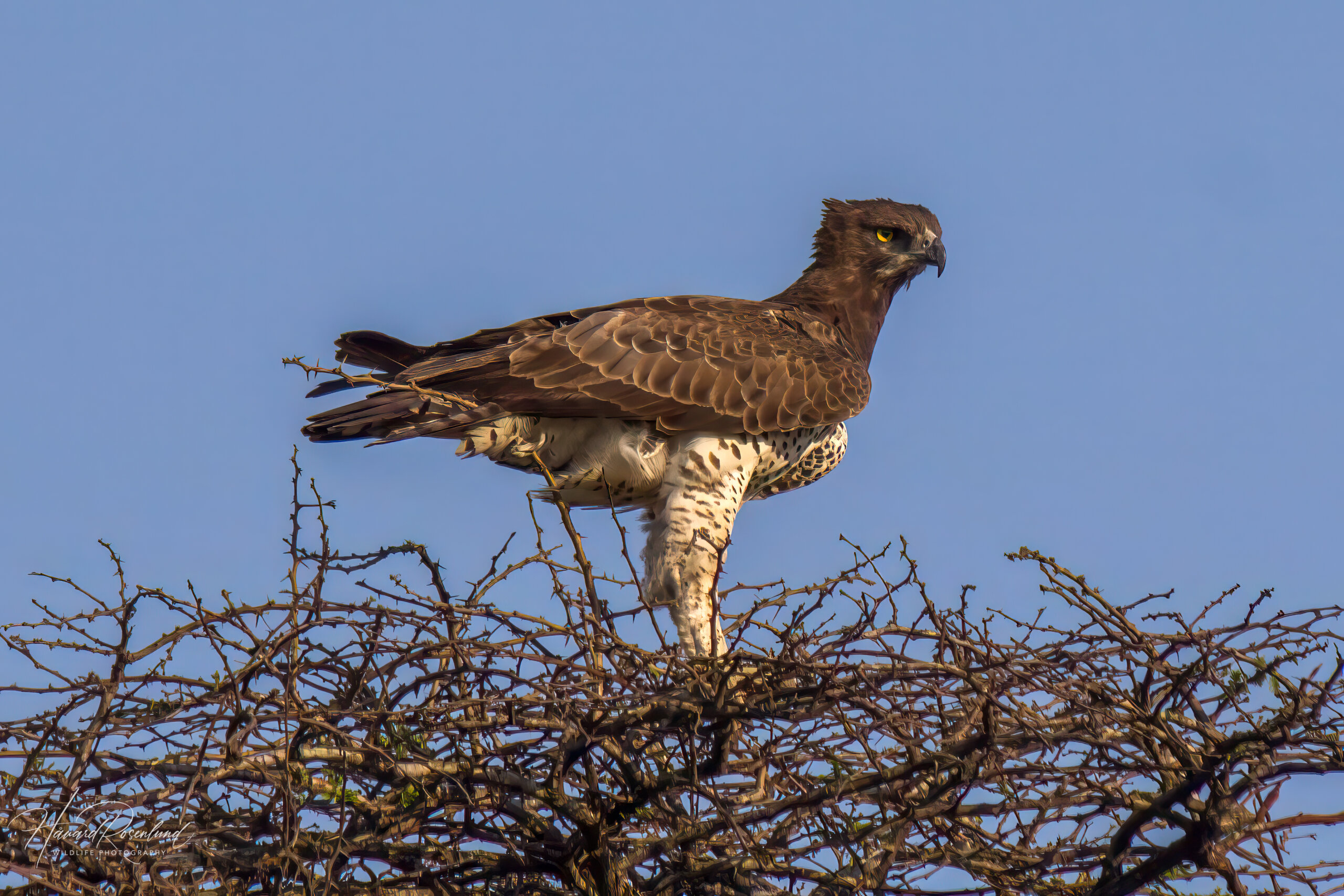
Martial Eagle
Polemaetus bellicosus
At a glance
Habitat
- Savanna, open woodland and shrubland with large trees or pylons for nesting
Diet
- Mostly vertebrates around 1–5 kg, including gamebirds, reptiles and medium-sized mammals
Activity
- Diurnal; often hunts while soaring high over large areas
Size
- Length: 78–96 cm Weight: 3.3–6.2 kg
Range
- Widespread but increasingly scarce across much of sub-Saharan Africa
Description
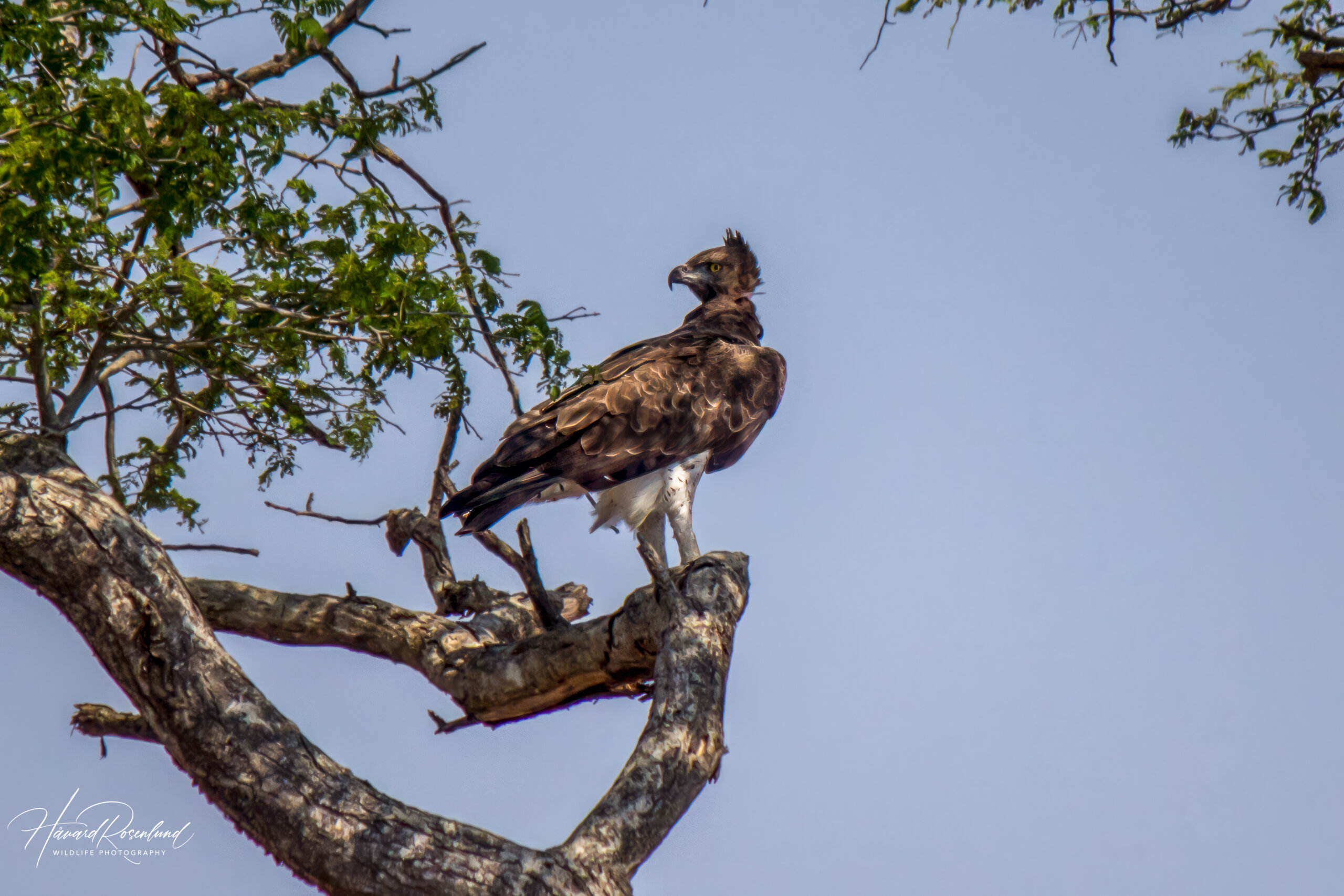
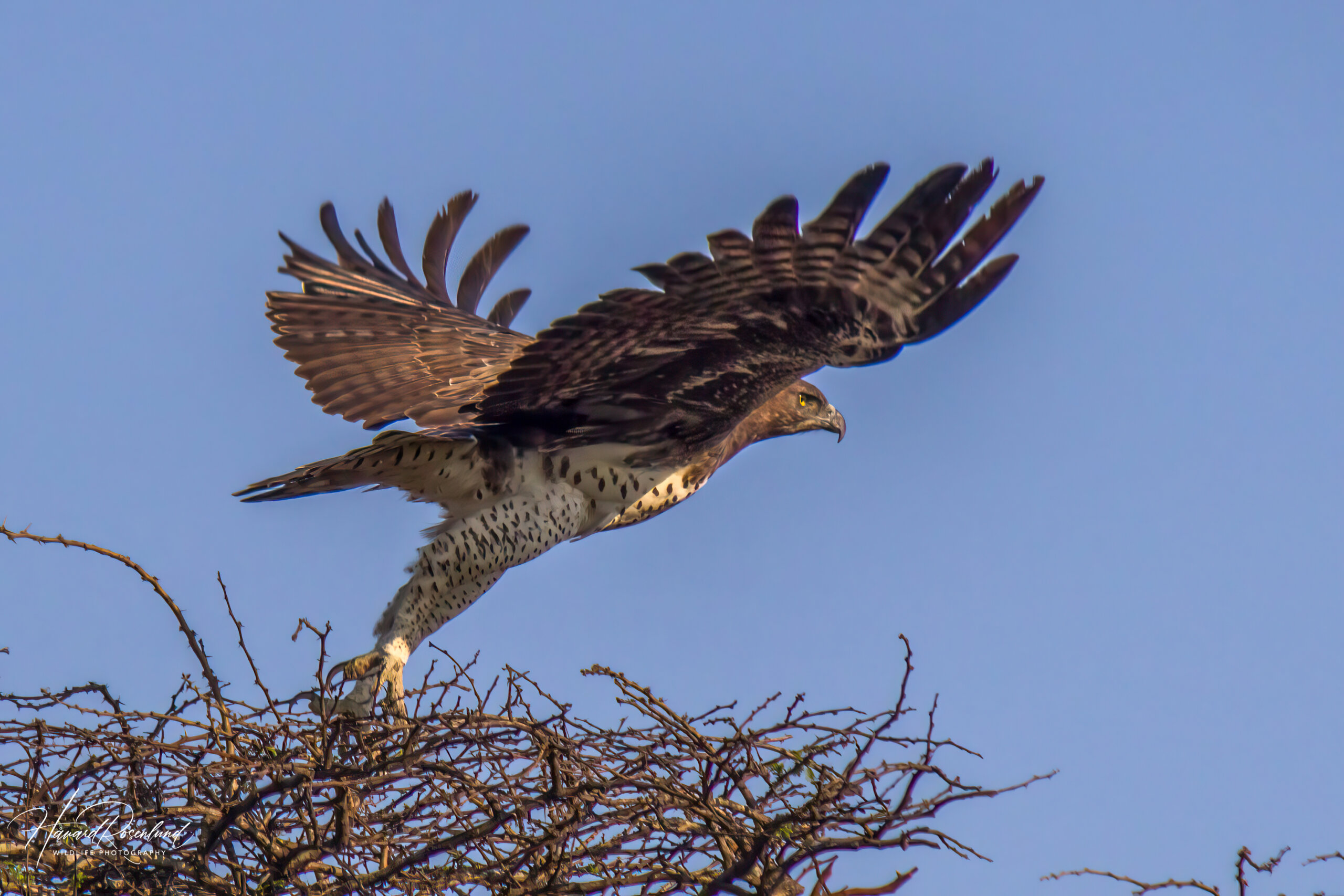
The martial eagle (Polemaetus bellicosus) is among Africa's largest and most powerful eagles. Adults are 78–96 cm long, weigh about 3.3–6.2 kg and have a wingspan of roughly 188–227 cm. The species shows clear sexual size dimorphism, meaning females are considerably larger than males. Adults have dark brown upperparts, head and upper breast, contrasting with white underparts marked by dark spots. The eyes are bright yellow to orange and the head is unusually broad and massive.
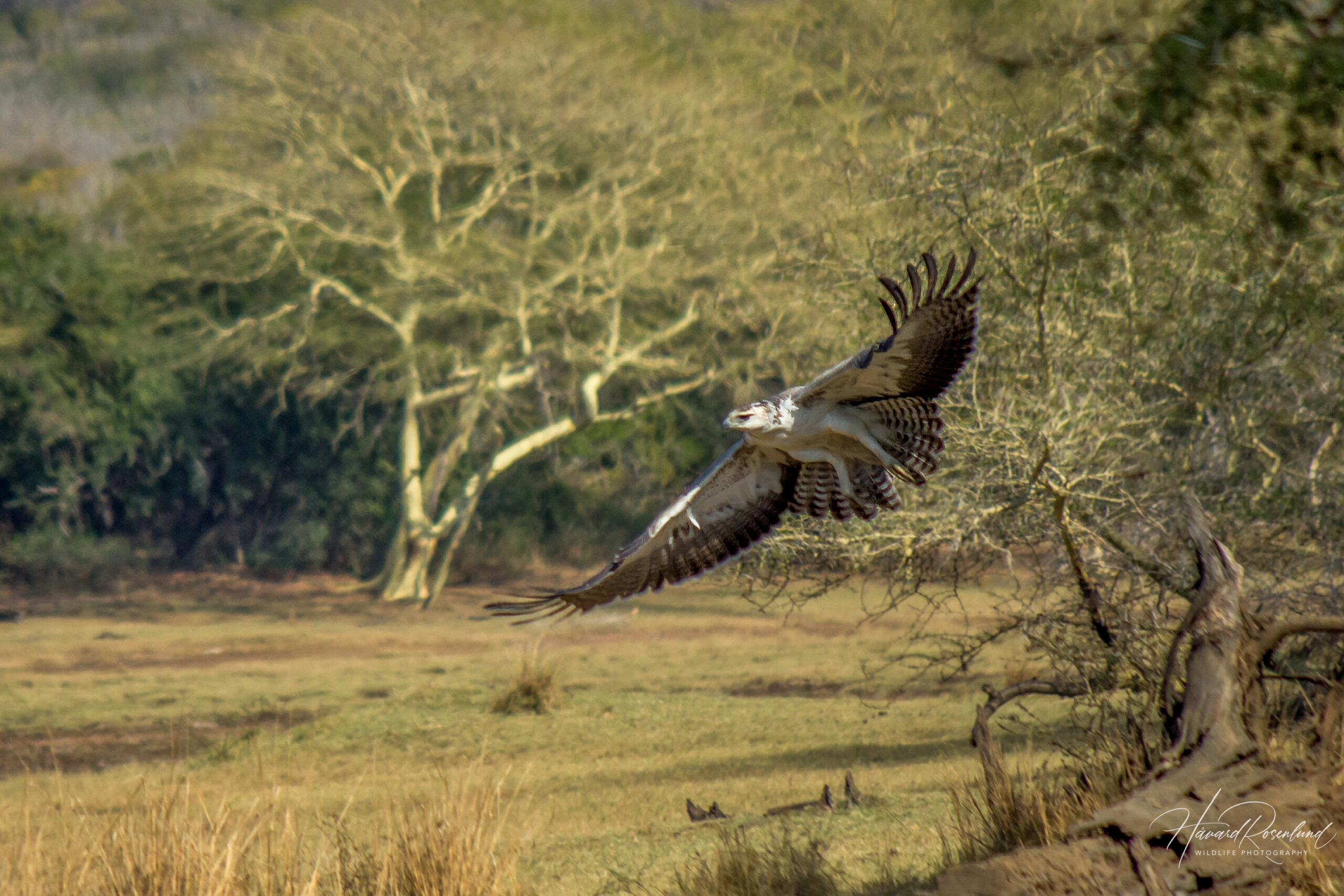
Juveniles are much paler, with a greyish upper side, whitish head and largely white underparts. They can resemble young crowned eagles (Stephanoaetus coronatus), but martial eagles have proportionally longer wings and a shorter tail. No subspecies are currently recognised.
Habitat
Martial eagles inhabit savanna, open woodland and shrubland across much of sub-Saharan Africa, generally avoiding closed lowland forest. Productive territories combine extensive open or semi-open hunting country with tall trees, cliffs or, in some regions, pylons that can support large nests.
Habitat quality depends on more than vegetation structure alone. These eagles need abundant medium-sized vertebrate prey and exceptionally large hunting areas, so overgrazing, agricultural conversion and prey depletion can greatly reduce the value of landscapes that may still appear superficially suitable.
Diet
Most prey are vertebrates weighing roughly 1–5 kg, but diet varies strongly with habitat, sex and individual opportunity. Gamebirds and other large birds, monitor lizards and snakes, hares, hyraxes, mongooses, monkeys and small antelopes are all important in different parts of the range.
Work in the Maasai Mara also found an interesting difference between the sexes: gamebirds were the most frequent identified prey of males, whereas small ungulates were the most frequent category for females. Poultry and small livestock are taken occasionally, but form only a small part of a much broader wild-prey diet.
Hunting
Martial eagles often hunt from high in the air, soaring for long periods while scanning enormous areas before entering a long, shallow stoop toward detected prey. They also hunt from prominent perches and can occasionally hover while searching. Waterholes and game trails may be watched where prey movements become predictable.
Attacks can cover a considerable horizontal distance, allowing the eagle to approach without remaining directly above its target. Small prey may be killed by the impact and grip of the feet, while larger animals are subdued with the exceptionally powerful talons. Prey that can be lifted may be carried to a tree or nest; larger kills are eaten on the ground or dismembered before portions are transported.
Behaviour
Martial eagles form long-term territorial pairs and adults are generally resident once established. Even breeding birds can make long excursions beyond the area immediately surrounding the nest.
Territorial display flights and calling help advertise occupancy of these exceptionally large breeding areas.
Home ranges
Martial eagles require unusually large areas. In a GPS study in Kruger National Park, territorial adults used home ranges averaging about 108 km². Requirements can become even larger in dry or human-modified landscapes where prey is more dispersed.
Adults without fixed territories can move on a completely different scale. Two such birds in the same study ranged across about 44,000 km² and travelled far beyond the national park. Young birds can likewise disperse across thousands of square kilometres before settling. This wide-ranging phase connects populations but also exposes birds to hazards far beyond protected areas.
Breeding
Martial eagles build enormous stick nests, usually high in tall trees with a commanding view and clear flight access. Pairs may maintain and reuse the same nesting territory for many years. A single egg is usual, with two very rare.
Incubation lasts about 47–53 days. The chick remains in the nest for roughly 96–104 days and may depend on its parents for another eight to twelve months after fledging. Breeding can occur annually when conditions are favourable, but pairs often skip years. This slow reproductive rate leaves the species poorly able to replace breeding adults that are lost.
Relationship with humans
Conflict arises most often where martial eagles are believed to threaten poultry, lambs or other small domestic animals. Livestock is taken occasionally, especially where natural prey has been depleted, but persecution can be disproportionate to the actual losses, and shooting, trapping and poisoned baits have all contributed to mortality on farmland.
Human infrastructure has a more complex relationship with the species. Pylons can provide important nest sites in treeless landscapes and are used by many breeding pairs in South Africa. The same infrastructure can also kill eagles through electrocution, meaning fatal electric shock, and collisions. Wind-energy development adds another collision risk that needs to be considered when facilities are sited.
Status
The martial eagle remains globally Endangered on the IUCN Red List. BirdLife South Africa's 2025 regional assessment also classifies it as Endangered, estimates about 950–1,100 mature individuals in South Africa, Lesotho and Eswatini and considers the decline to be around 60% over three generations.
The decline is not confined to one area. Severe losses have been documented in several major South African protected areas and in long-term surveys in West Africa, Kenya and northern Botswana. The enormous range therefore conceals a species that has declined sharply across much of Africa.
Threats
Direct persecution and poisoning remain major threats, particularly outside protected areas. Loss and degradation of prey-rich habitat, depletion of natural prey, nest disturbance and removal of large nesting trees add further pressure.
Power lines and other energy infrastructure are also important sources of mortality through electrocution and collision. Wind turbines add further collision risk, while steep-sided artificial reservoirs can cause drowning. Because the species ranges so widely, even birds breeding inside large reserves regularly encounter hazards beyond protected boundaries.
Conservation
Conserving martial eagles requires action both inside and outside protected areas. Persecution and poisoning need to be reduced, electrical infrastructure made safer, and large nesting territories with abundant natural prey maintained.
Tracking data are used to identify areas that eagles use heavily and can help steer developments such as wind-energy facilities away from the highest-risk landscapes. Long-term monitoring of nests, adults and dispersing young is particularly important because the slow reproductive rate means population losses can have effects lasting many years.
Image gallery
Loading map and observations…
National Red List status
| Country | Status | Assessment | Source |
|---|---|---|---|
| South Africa | ENEndangered | Regional Red Data Book of Birds of South Africa, Lesotho and Eswatini 2025 | BirdLife South Africa – Regional Red Data Book 2025 |
Have you seen this species?
Independent species archive
Did you find this species page useful?
Wildlife Vagabond is independently built and maintained. Voluntary support helps cover hosting, maps, data storage and continued improvements to the species archive.
Support Wildlife VagabondSpecies content will remain freely available.
References
Information about the species’ global distribution and status is based primarily on global Red List data. See the references below for details.
- BirdLife International. (2026). IUCN Red List for birds. BirdLife DataZone. https://datazone.birdlife.org
- BirdLife South Africa. (2025). Martial Eagle, Regional Red Data Book assessment. https://www.birdlife.org.za/red-list/martial-eagle/
- FitzPatrick Institute of African Ornithology. (n.d.). Conserving Martial Eagles: current research, tracking and conservation work. https://science.uct.ac.za/fitzpatrick/research-maintaining-biodiversity-species-level-conservation/conserving-martial-eagles
- Hatfield, R. S., Davis, A. G., Buij, R., Cox, J. J., Kapila, S., Parmuntoro, L., Thomsett, S., Virani, M. Z., Njoroge, P., & van Langevelde, F. (2024). Africa's overlooked top predator: Towards a better understanding of martial eagle feeding ecology in the Maasai Mara, Kenya. Wildlife Biology, 2024(4), e01223. https://doi.org/10.1002/wlb3.01223
- International Union for Conservation of Nature. (2020). Polemaetus bellicosus (Martial Eagle). The IUCN Red List of Threatened Species. https://www.iucnredlist.org/species/22696116/172287822
- Shaw, P., Ogada, D., Dunn, L., Buij, R., Amar, A., Garbett, R., Herremans, M., Virani, M. Z., Kendall, C. J., Croes, B. M., Odino, M., Kapila, S., Wairasho, P., Rutz, C., Botha, A., Gallo-Orsi, U., Murn, C., Maude, G., & Thomsett, S. (2024). African savanna raptors show evidence of widespread population collapse and a growing dependence on protected areas. Nature Ecology & Evolution, 8(1), 45-56. https://doi.org/10.1038/s41559-023-02236-0
- South African National Biodiversity Institute. (n.d.). ecology, threats and human interactions. https://www.sanbi.org/animal-of-the-week/35981/
- van Eeden, R., Whitfield, D. P., Botha, A., & Amar, A. (2017). Ranging behaviour and habitat preferences of the Martial Eagle: Implications for the conservation of a declining apex predator. PLOS ONE, 12(3), e0173956. https://doi.org/10.1371/journal.pone.0173956