
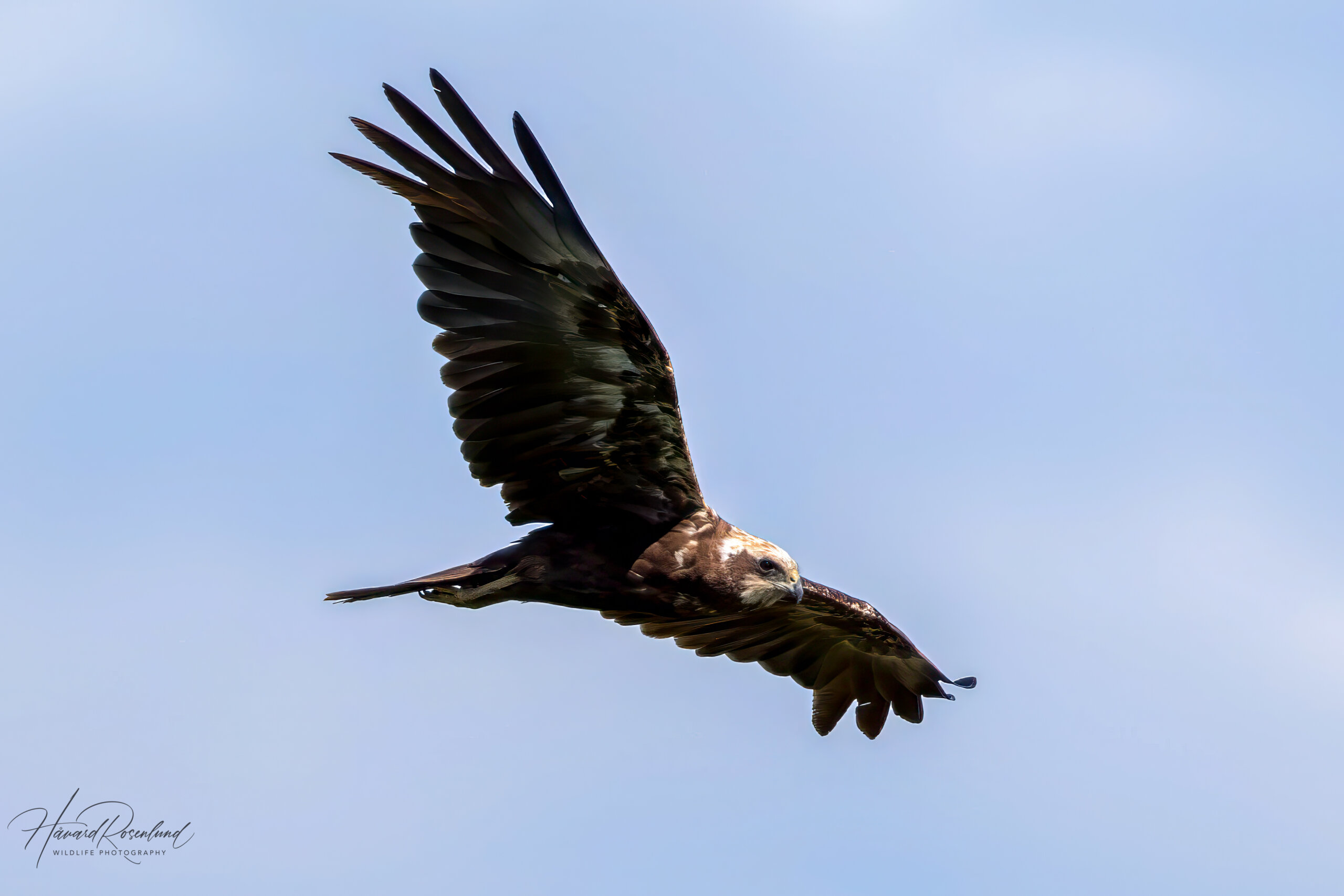
Western Marsh Harrier
Circus aeruginosus
At a glance
Habitat
- Reedbeds, marshes, lake margins, wet meadows and farmland near wetlands
Diet
- Small mammals, birds, eggs, amphibians, reptiles, fish and large invertebrates
Activity
- Diurnal
Size
- Length: 43–54 cm Weight: males about 320–670 g; females about 540–1,270 g
Range
- Breeds across Europe and western and central Asia; winters from southern Europe through Africa, Arabia and South Asia
Description
The western marsh harrier (Circus aeruginosus) is the largest harrier in Europe. Adults measure about 43–54 cm and have a wingspan of roughly 115–145 cm. Females are substantially larger and heavier than males.
The sexes usually differ strongly in plumage. Adult females are mostly dark chocolate-brown with a creamy crown, throat and leading edge of the wing. Adult males are more variable, usually combining brown body plumage with grey tail and wing panels and black wingtips. Juveniles resemble dark females but often have a warmer brown body and a more restricted pale crown.
Not every adult male develops the typical grey-and-brown male plumage. In some populations, a proportion of sexually mature males retain a predominantly female-like plumage throughout life. Long wings, a long tail and buoyant flight with the wings held in a shallow V remain useful identification features across the different plumages.
Habitat
Western marsh harriers are closely associated with extensive reedbeds, marshes, lake margins and other wetlands, especially for nesting and roosting. They also use wet meadows, saltmarsh, grassland and farmland several kilometres from water while hunting.
Diet
Small mammals and birds form much of the diet. Eggs, nestlings, amphibians, reptiles, fish, carrion and large invertebrates are also taken, and prey composition changes with habitat and season.
Hunting
The characteristic hunting method is a slow, low quartering flight over reeds, marsh edges and open ground. The harrier repeatedly turns across the landscape, watching and listening for prey before dropping rapidly to the ground or vegetation when an opportunity appears.
This low search flight allows the bird to cover large areas efficiently and exploit prey hidden in dense vegetation. Hunting is usually solitary, although several individuals can use the same productive area.
Behaviour
Western marsh harriers are diurnal and usually spend much of the day alone outside the breeding territory. They rest and roost in dense wetland vegetation, particularly reedbeds.
Outside breeding, several birds may share communal night roosts, especially in winter. These gatherings do not form stable social groups, and individuals normally disperse to hunt separately during the day.
Migration
The species is a partial migrant. Many birds around the Mediterranean, western Europe and the Middle East remain resident or move only short distances, while populations from northern and eastern Europe and Asia migrate farther south.
European birds winter in southern and western Europe, sub-Saharan Africa and parts of the Middle East and South Asia. Tracking studies show that individuals often reuse similar routes and wintering areas, while migration timing and distance vary with age, sex and breeding origin.
Breeding
Nests are platforms of reeds, grasses and sticks placed close to the ground or over shallow water in dense reeds, sedges or other tall wetland vegetation. The female does most of the nest building and incubation, while the male supplies food.
Breeding begins in spring and timing varies geographically. Across much of western and central Europe, birds return to breeding areas around late March and early April, with egg-laying occurring mainly in April and May.
Pairs are usually seasonally monogamous, but polygyny occurs. One male may pair with and provision two or occasionally three nesting females when food and nesting habitat are favourable. The clutch normally contains four or five eggs, with a broader range of three to ten. Incubation lasts about 31–38 days.
The chicks remain at or near the nest for approximately 35–40 days before fledging. They continue to depend on the adults while learning to hunt, and the male often transfers prey to the female or young in flight.
The female-like plumage of some adult males also appears to affect interactions during breeding. A study published in 2012 in the Marais de Brouage wetlands of western France found that about 40% of breeding adult males in the study population had a permanent female-like plumage. Typical males were less aggressive towards these female-like males than towards typical male intruders, suggesting that the alternative plumage can reduce energy-intensive competition between males.
Status
The western marsh harrier is classified as least concern on the IUCN Red List. The European Red List assessment published in 2021 estimated approximately 303,000–485,000 mature individuals in Europe and classified the European population as stable.
The species recovered strongly in many European countries after legal protection, reduced persecution and restrictions on persistent pesticides. In Britain it disappeared as a breeding bird in 1899, began recolonising from 1927 and was down to a single breeding pair in 1971 before the population began to recover strongly.
Wetland drainage, loss or intensive cutting of reedbeds, poorly timed water-level changes, disturbance, illegal killing and collisions with infrastructure can still affect local populations, so large productive wetlands remain important throughout the range.
Image gallery
Loading map and observations…
Have you seen this species?
Independent species archive
Did you find this species page useful?
Wildlife Vagabond is independently built and maintained. Voluntary support helps cover hosting, maps, data storage and continued improvements to the species archive.
Support Wildlife VagabondSpecies content will remain freely available.
References
Information about the species’ global distribution and status is based primarily on global Red List data. See the references below for details.
- Agostini, N., Panuccio, M., Pastorino, A., Sapir, N., & Dell’Omo, G. (2017). Migration of the Western Marsh Harrier to the African wintering quarters along the Central Mediterranean flyway: a 5-year study. Avian Research, 8(1), 24. https://doi.org/10.1186/s40657-017-0081-6
- Artsdatabanken. (2021). Sivhauk Circus aeruginosus – Norsk rødliste for arter 2021. https://lister.artsdatabanken.no/rodlisteforarter/2021/28414
- BirdLife International. (2021). European Red List of Birds: Circus aeruginosus. https://www.birdlife.org/wp-content/uploads/2022/05/BirdLife-European-Red-List-of-Birds-2021.pdf.pdf
- BirdLife International. (n.d.). Western Marsh Harrier Circus aeruginosus species factsheet. https://datazone.birdlife.org/species/factsheet/western-marsh-harrier-circus-aeruginosus
- BirdLife Norge. (n.d.). Norske navn på verdens fugler: sivhauk Circus aeruginosus. https://www.birdlife.no/fuglekunnskap/navn/
- British Trust for Ornithology. (n.d.). Marsh Harrier bird facts, nesting and longevity. https://www.bto.org/learn/about-birds/birdfacts/marsh-harrier
- EURING/CMS. (n.d.). Eurasian-African Bird Migration Atlas: Western Marsh Harrier. https://migrationatlas.org/node/1698
- German Federal Agency for Nature Conservation (BfN). (n.d.). Circus aeruginosus species profile. https://www.bfn.de/artenportraits/circus-aeruginosus
- International Union for Conservation of Nature. (n.d.). Circus aeruginosus. The IUCN Red List of Threatened Species. https://www.iucnredlist.org/species/22695344/93503491
- Sternalski, A., Mougeot, F., & Bretagnolle, V. (2012). Adaptive significance of permanent female mimicry in a bird of prey. Biology Letters, 8(2), 167-170. https://doi.org/10.1098/rsbl.2011.0914