
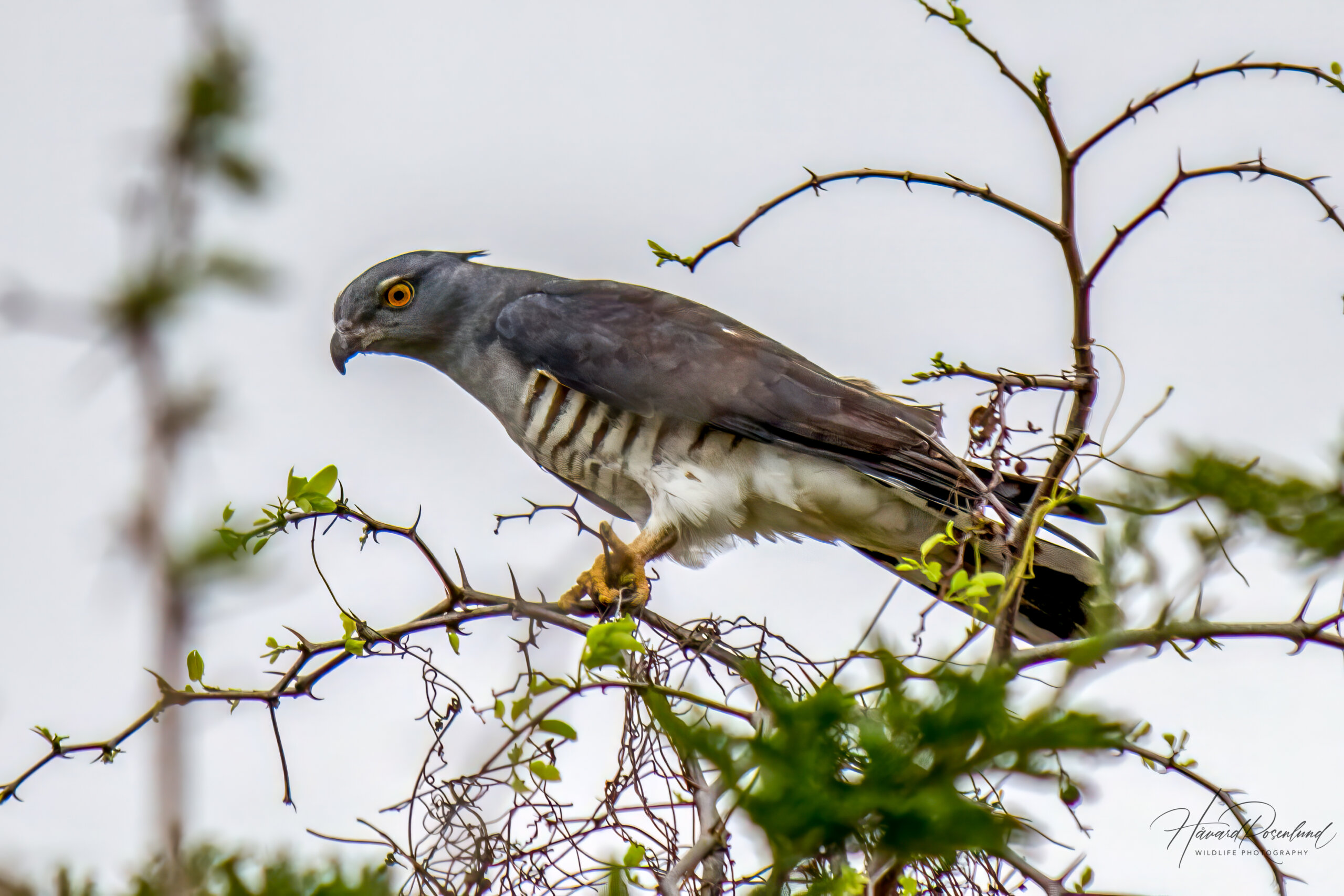
African Cuckoo-Hawk
Aviceda cuculoides
At a glance
Habitat
- Forest, dense woodland, plantations, riparian woodland and wooded edges
Diet
- Mainly reptiles and large insects; also frogs, fish and occasional small birds or mammals
Activity
- Diurnal and secretive
Size
- Length: About 38–43 cm Weight: About 280 g
Range
- Sub-Saharan Africa
Description
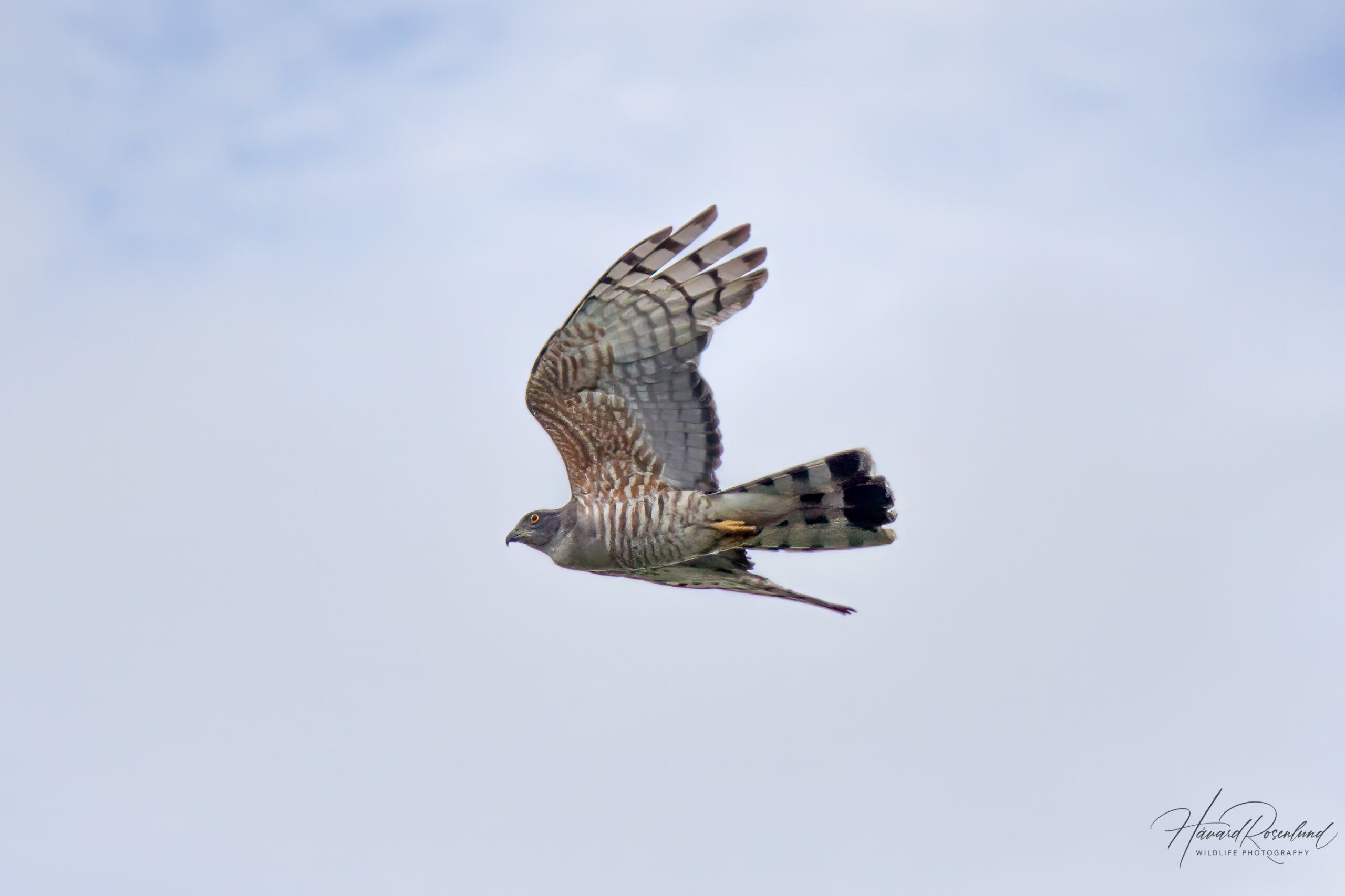
The African cuckoo-hawk (Aviceda cuculoides) is the only member of the genus Aviceda native to mainland Africa. It is a slender, long-winged raptor about 38–43 cm long and around 280 g. Its long tail, barred underparts and soft flight give it a striking cuckoo-like appearance.
Adult males are darker grey above with strong chestnut barring below and dark red eyes. Females are browner, with paler barring and yellow eyes, while juveniles are mainly brown above and heavily streaked or spotted below. A small crest and reddish nape patch may be visible, and the upper bill has two tooth-like notches typical of bazas.
Three subspecies are generally recognised: A. c. cuculoides in West and northeastern Africa, the darker A. c. batesi in the central African forest belt and the larger A. c. verreauxii from East Africa south to Namibia and South Africa.
The cuckoo-like resemblance has an unexpected explanation: research suggests that some cuckoos evolved to resemble the African cuckoo-hawk, not the other way around. This is an example of Batesian mimicry, in which one species resembles a more dangerous or intimidating species and may gain an advantage when other animals mistake the two. For the cuckoo, looking like a raptor can make it easier to approach other birds, while the African cuckoo-hawk acts as the model being copied.
Habitat
African cuckoo-hawks use forest, dense woodland, riverine forest and woodland, plantations and wooded edges. They are especially associated with tall vegetation and uneven canopy cover, where they can move between concealed perches while still having access to openings and lower vegetation.
The species is easily overlooked because much of its activity takes place inside or close to the canopy rather than over open country.
Diet
Reptiles and large insects are especially important, including chameleons, lizards, snakes, grasshoppers, caterpillars and other large arthropods. Frogs, fish, freshwater crabs and occasional small birds or mammals are also recorded.
Hunting
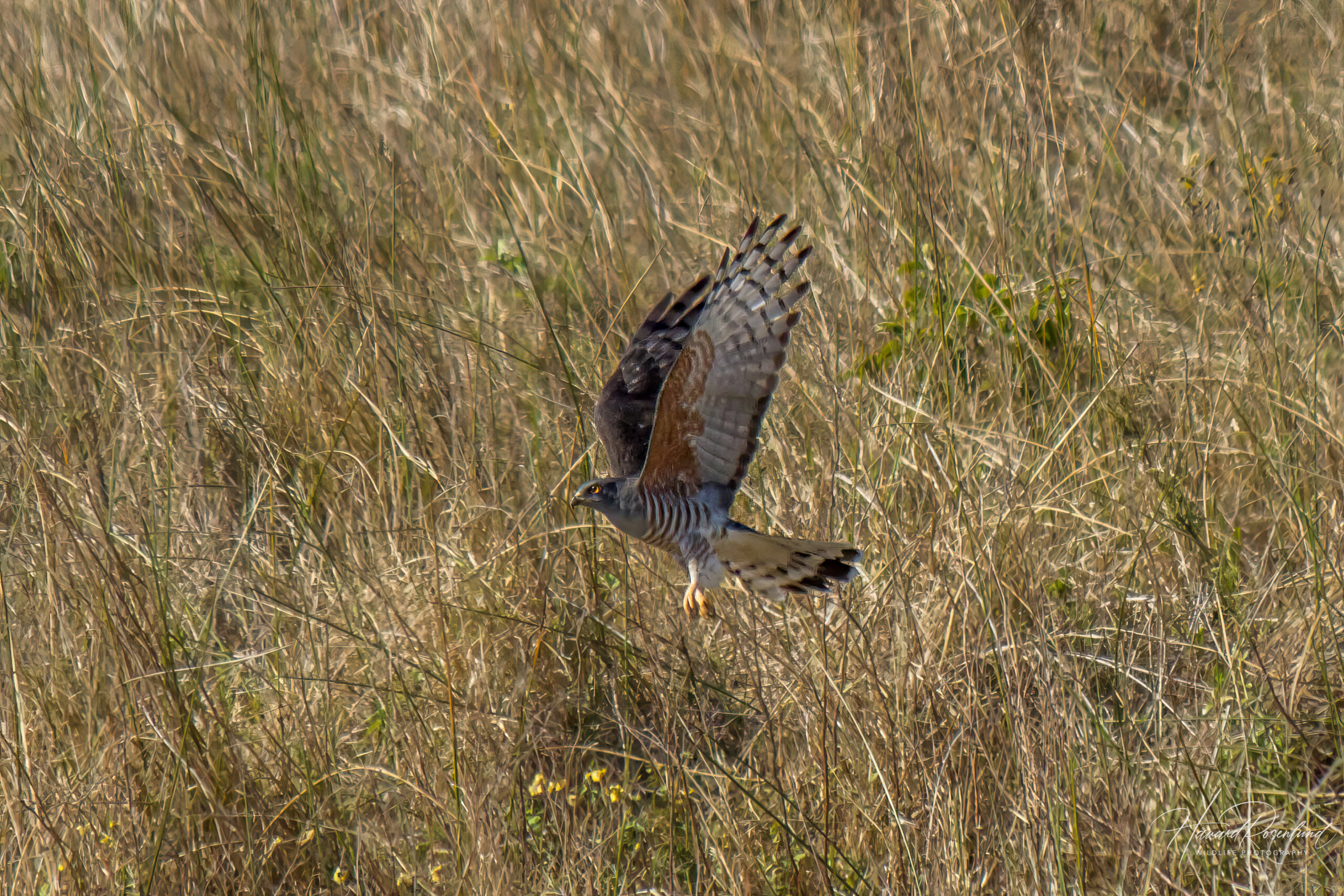
The African cuckoo-hawk usually hunts from within cover. It moves from tree to tree, scans foliage, branches and the ground from a perch and then makes short flights to seize prey.
Prey may be plucked directly from the canopy or low vegetation, or taken on the ground in grass and other openings. This flexible perch-hunting style allows the bird to exploit prey at several levels of the forest and woodland structure.
Behaviour
African cuckoo-hawks are usually solitary and secretive, spending much of their time within or close to the tree canopy. Their flight can look surprisingly soft for a raptor, with short glides between trees and relatively little prolonged soaring.
Most populations are broadly resident, but local seasonal movements occur, especially in eastern and southern parts of the range. Birds can become easier to notice during these movements and during aerial display flights.
Breeding
African cuckoo-hawks form monogamous pairs that nest separately from other pairs. Timing varies geographically and often follows local rainfall; in southern Africa egg-laying is concentrated from spring into summer, with most activity around October–December.
Both adults build an untidy platform of twigs, creepers and leafy material high in a tree, often 10–30 metres above the ground. The clutch usually contains one or two eggs, rarely three. Incubation lasts about 32–33 days and may be shared by both adults. Both parents feed the chicks, which leave the nest after about four weeks and remain dependent for a short period afterwards.
Status
The African cuckoo-hawk remains classified as Least Concern on the IUCN Red List and has a very large range across sub-Saharan Africa. It is often described as uncommon, but its quiet, secretive life in dense vegetation makes it easy to overlook.
Forest loss and fragmentation can reduce local populations, but there is currently no evidence that the species is at global risk. Connected wooded corridors and mature trees are especially valuable where natural forest has become fragmented.
Image gallery
Loading map and observations…
Have you seen this species?
Independent species archive
Did you find this species page useful?
Wildlife Vagabond is independently built and maintained. Voluntary support helps cover hosting, maps, data storage and continued improvements to the species archive.
Support Wildlife VagabondSpecies content will remain freely available.
References
Information about the species’ global distribution and status is based primarily on global Red List data. See the references below for details.
- AviList. (2026). v2025b. https://www.avilist.org/checklist/v2025b/
- Biodiversity Explorer – Aviceda cuculoides. (n.d.). distribution, movements, diet and breeding. https://www.biodiversityexplorer.info/birds/accipitridae/aviceda_cuculoides.htm
- BirdLife International. (n.d.). African Cuckoo-hawk Aviceda cuculoides species factsheet. https://datazone.birdlife.org/species/factsheet/african-cuckoo-hawk-aviceda-cuculoides
- Gluckman, T.-L., & Mundy, N. I. (2013). Cuckoos in raptors' clothing: barred plumage illuminates a fundamental principle of Batesian mimicry. Animal Behaviour, 86(6), 1165-1181. https://doi.org/10.1016/j.anbehav.2013.09.020
- International Union for Conservation of Nature. (n.d.). Aviceda cuculoides (African Cuckoo-hawk). The IUCN Red List of Threatened Species. https://www.iucnredlist.org/species/22694944/93480370