
African Fish-Eagle
Icthyophaga vocifer
At a glance
Habitat
- Freshwater lakes, rivers, reservoirs, wetlands, estuaries and lagoons with open water and suitable perches
Diet
- Mainly fish; also waterbirds, reptiles, amphibians, small mammals, carrion and stolen prey
Activity
- Diurnal and resident; much time spent watching water from prominent perches
Size
- Length: About 63–75 cm Weight: About 2–3 kg
Range
- Widespread across sub-Saharan Africa wherever suitable open water is available
Description
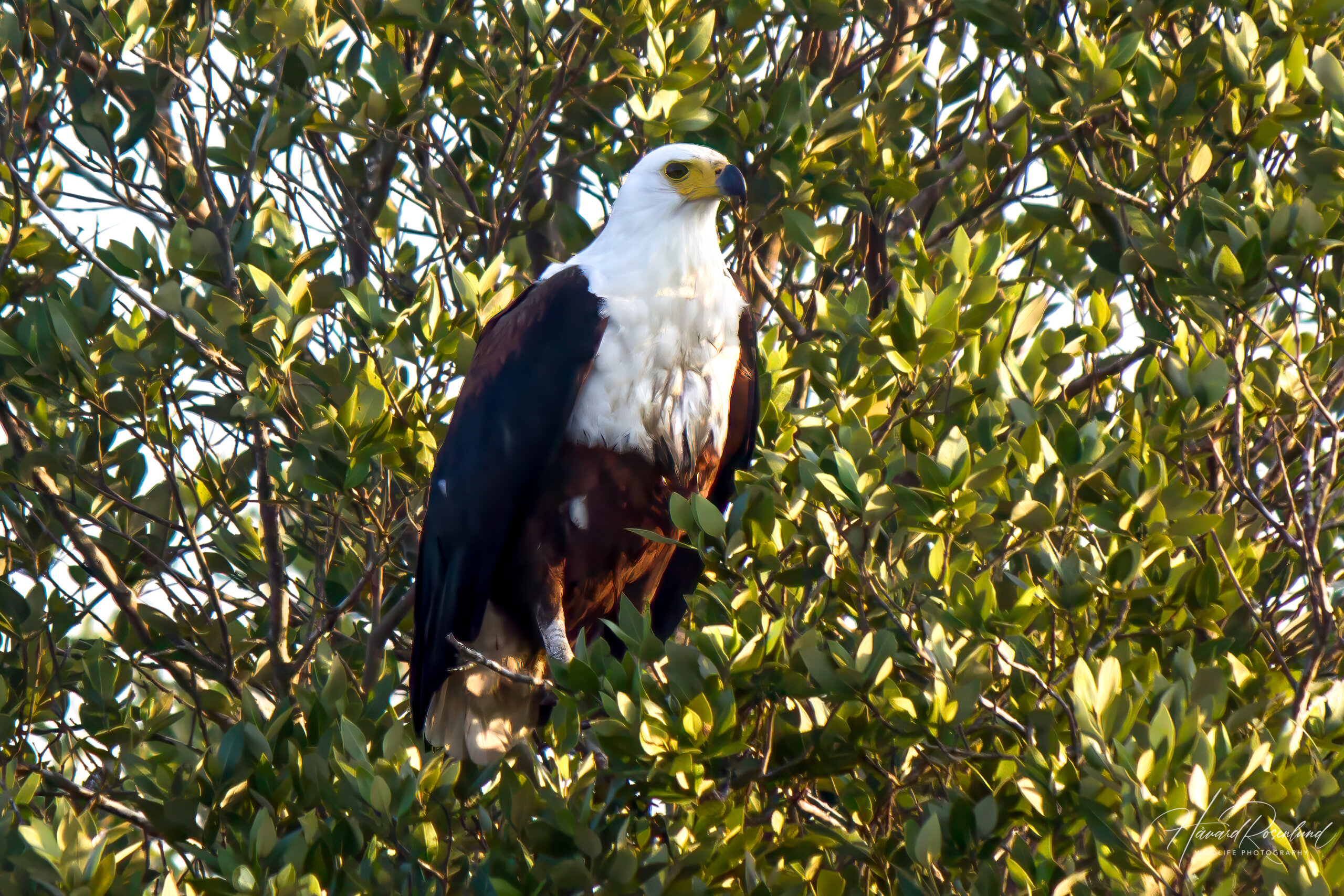
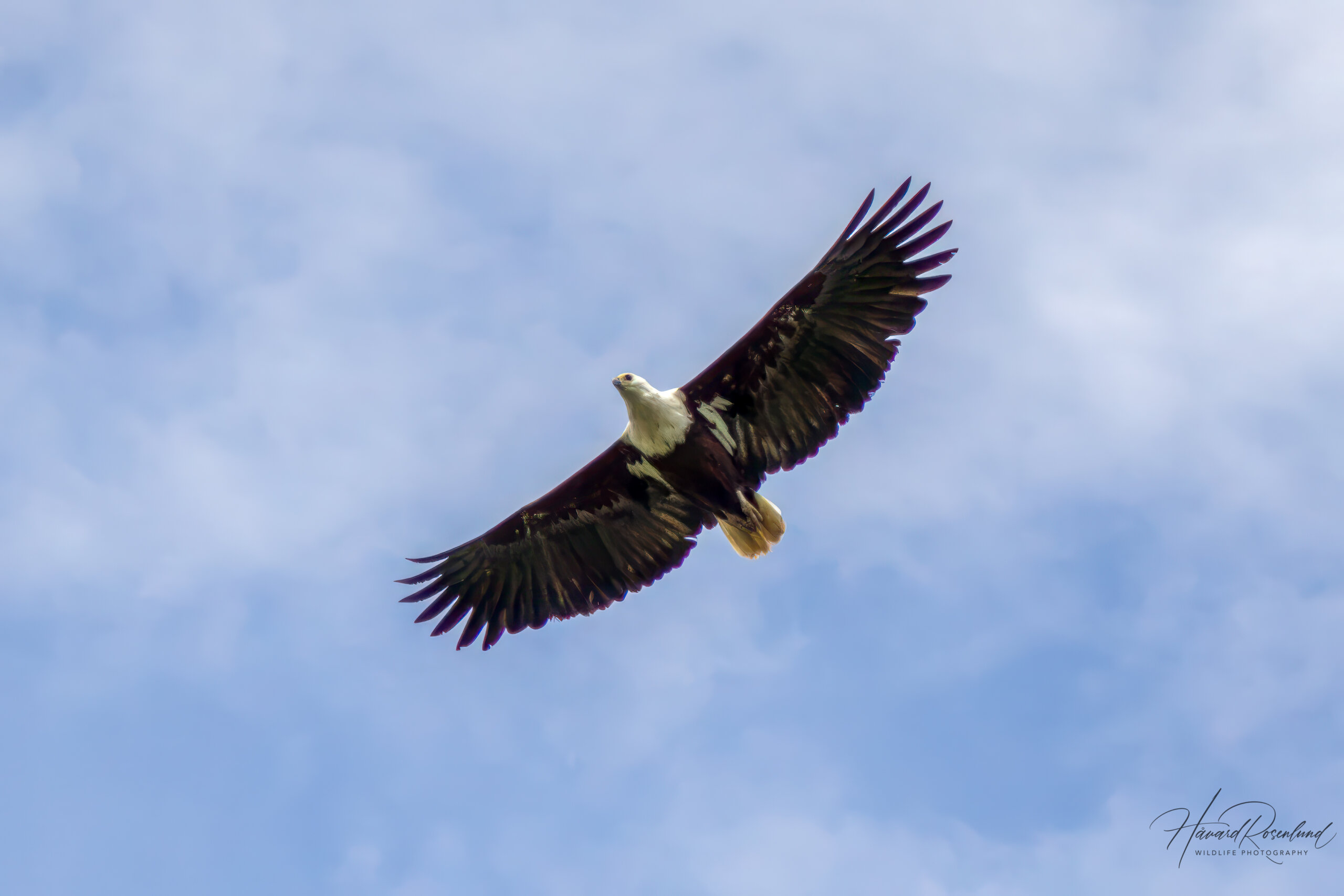
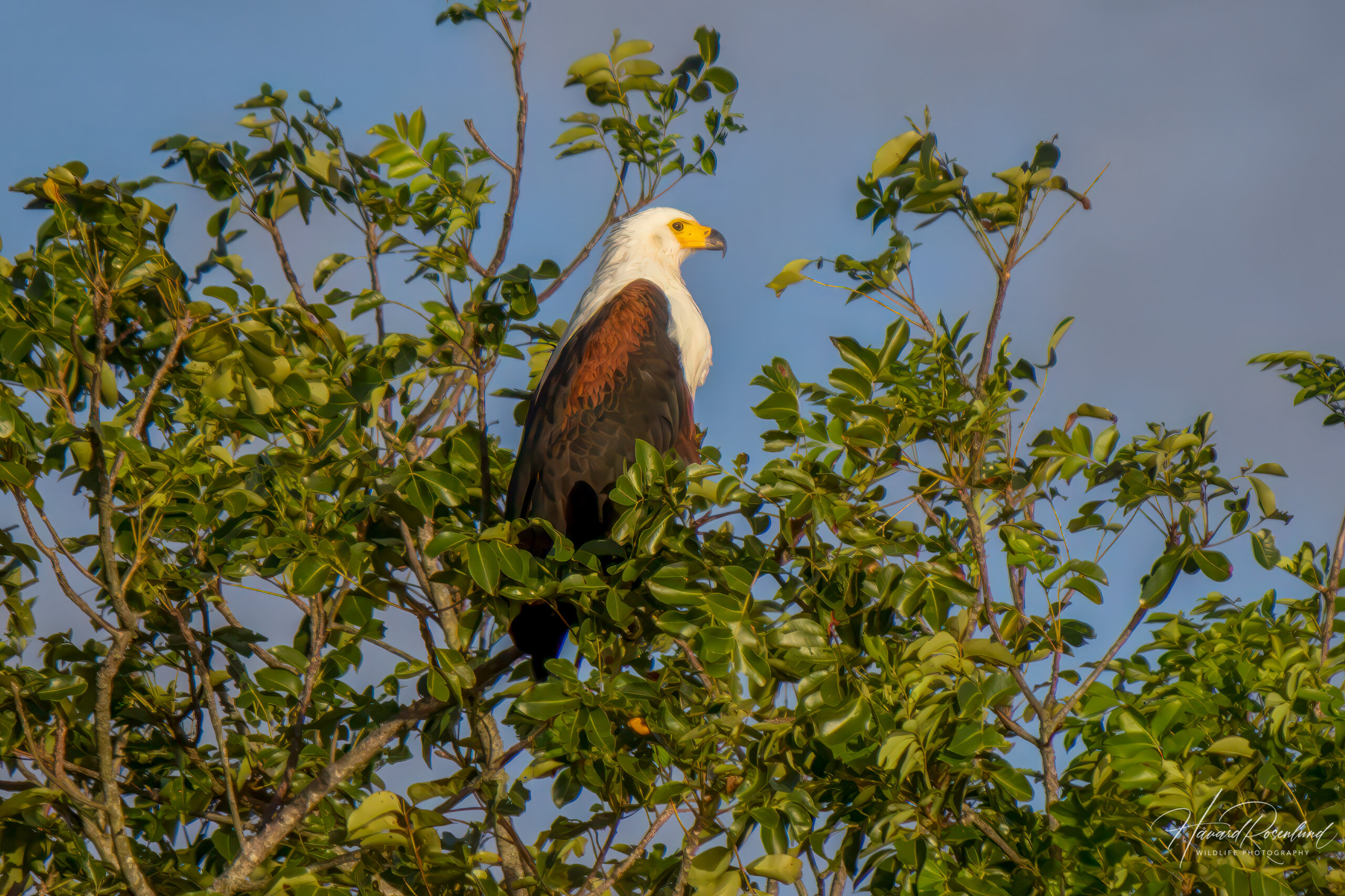
The African fish-eagle (Icthyophaga vocifer) is one of Africa's most familiar birds of prey. Its far-carrying, yodelling call is among the characteristic sounds of African lakes and rivers. Adults are unmistakable, with a white head, breast and tail, chestnut-brown body and black flight feathers. The bare face, cere at the base of the bill and feet are yellow, while juveniles are mottled brown and take several years to acquire full adult plumage.
The species shows clear sexual size dimorphism, meaning females are larger than males. Adults are about 63–75 cm long and weigh roughly 2–3 kg. The broad wings and powerful feet suit a bird that spends much of its life around open water.
Taxonomy
Older literature and the BirdLife/IUCN global assessment use Haliaeetus vocifer. Genetic studies led to the African fish-eagle and several close relatives being transferred to the genus Icthyophaga, so modern world checklists use Icthyophaga vocifer. No subspecies are currently recognised.
Habitat
African fish-eagles are tied to open water with suitable hunting perches and large trees for nesting. They occur along freshwater lakes, rivers, reservoirs and wetlands, as well as estuaries, lagoons and sheltered coastal waters.
The richest territories combine productive shallow water with exposed branches or other vantage points overlooking the surface. Artificial reservoirs can also provide good habitat where fish populations and nesting trees are sufficient.
Diet
Fish dominate the diet, but African fish-eagles are opportunistic predators. Waterbirds, reptiles, amphibians, small mammals and large insects are also taken, and carrion is used when readily available.
The importance of alternative prey increases when fish become harder to catch because of changing water levels, turbidity or seasonal shifts in availability.
Hunting
Fishing usually begins from an exposed perch. The eagle launches into a shallow swoop and extends its feet just before contact with the surface, gripping the fish with powerful talons. Roughened skin and small projecting structures on the soles improve purchase on slippery prey, and smaller fish may be carried away without the eagle landing.
The species also practises kleptoparasitism, meaning it steals prey captured by other animals. A study in western Tanzania documented African fish-eagles robbing even large shoebills, showing that this behaviour is not limited to smaller fish-eating birds. African fish-eagles therefore combine active hunting with opportunistic theft.
Behaviour
Adult African fish-eagles are generally resident and defend stretches of shoreline or other feeding areas as long-term, monogamous pairs. Their famous call helps advertise territory and maintain contact between partners, and paired adults often answer or duet with one another.
A study in Uganda's Kyambura Game Reserve documented exceptionally high breeding densities where prey was abundant, with territories sometimes containing only a few hundred metres of shoreline. Juveniles and non-breeding birds are less tied to fixed territories and can move considerable distances, gathering where temporary feeding conditions are favourable.
Breeding
Pairs usually maintain long-term bonds and often reuse one of several large stick nests in tall trees close to water, adding material over successive years. Breeding commonly occurs during the dry season, although timing varies geographically.
The female lays one to four eggs and performs most of the incubation. Incubation lasts about 42–45 days, while the male supplies food and takes shorter turns on the eggs. Young fledge after about 70–75 days but remain dependent on their parents for several more months. Breeding success varies with local food supply and water conditions.
Cultural significance
The African fish-eagle has an unusually prominent role in African national symbolism. In Zambia it is a national symbol associated with freedom and hope for the future. Namibia's national coat of arms carries an African fish-eagle as its crest, and South Sudan's coat of arms also features an African fish-eagle with raised wings.
Together with its unmistakable call, these formal uses have helped make the species one of the most recognisable wildlife symbols associated with African rivers and lakes.
Status
The African fish-eagle remains globally classified as Least Concern. BirdLife South Africa's 2025 regional assessment also classified it as Least Concern and regarded the regional population as broadly stable, with more than 10,000 mature individuals in South Africa, Lesotho and Eswatini used as the regional order of magnitude.
Wetland degradation, disturbance, loss of nesting trees, entanglement in fishing gear and contaminants can nevertheless affect local populations. The species responds strongly to changes in water conditions and food supply, so productive wetlands and large nesting trees remain important even for a globally secure species.
Image gallery
Loading map and observations…
Have you seen this species?
Independent species archive
Did you find this species page useful?
Wildlife Vagabond is independently built and maintained. Voluntary support helps cover hosting, maps, data storage and continued improvements to the species archive.
Support Wildlife VagabondSpecies content will remain freely available.
References
Information about the species’ global distribution and status is based primarily on global Red List data. See the references below for details.
- AviList. (2026). v2025b. https://www.avilist.org/checklist/v2025b/
- BirdLife International. (2026). IUCN Red List for birds. BirdLife DataZone. https://datazone.birdlife.org
- BirdLife South Africa. (2025). African Fish Eagle Icthyophaga vocifer, Regional Red Data Book assessment. https://www.birdlife.org.za/red-list/african-fish-eagle/
- International Ornithologists’ Union. (n.d.). IOC World Bird List – taxonomic update transferring African Fish Eagle from Haliaeetus to Icthyophaga. https://www.worldbirdnames.org/new/updates/taxonomy/
- International Union for Conservation of Nature. (2020). Haliaeetus vocifer (African Fish-eagle). The IUCN Red List of Threatened Species. https://www.iucnredlist.org/species/22695115/174556979
- John, J., & Lee, W. (2019). Kleptoparasitism of Shoebills Balaeniceps rex by African Fish Eagles Haliaeetus vocifer in Western Tanzania. Tanzania Journal of Science, 45(2). https://doi.org/10.65085/2507-7961.1705
- Kemp, A. C., & Marks, J. S. (2023). African Fish-Eagle (Icthyophaga vocifer). Birds of the World. https://doi.org/10.2173/bow.affeag1.01.1
- Krueger, O. (1997). Population density and intra‐ and interspecific competition of the African Fish Eagle Haliæeetus vocifer in Kyambura Game Reserve, southwest Uganda. Ibis, 139(1), 19-24. https://doi.org/10.1111/j.1474-919X.1997.tb04499.x
- NamibLII. (n.d.). National Symbols of the Republic of Namibia Act, 2018. https://namiblii.org/akn/na/act/2018/17/eng@2018-12-28
- State House Zambia. (n.d.). National Symbols. https://www.sh.gov.zm/national-symbols/