
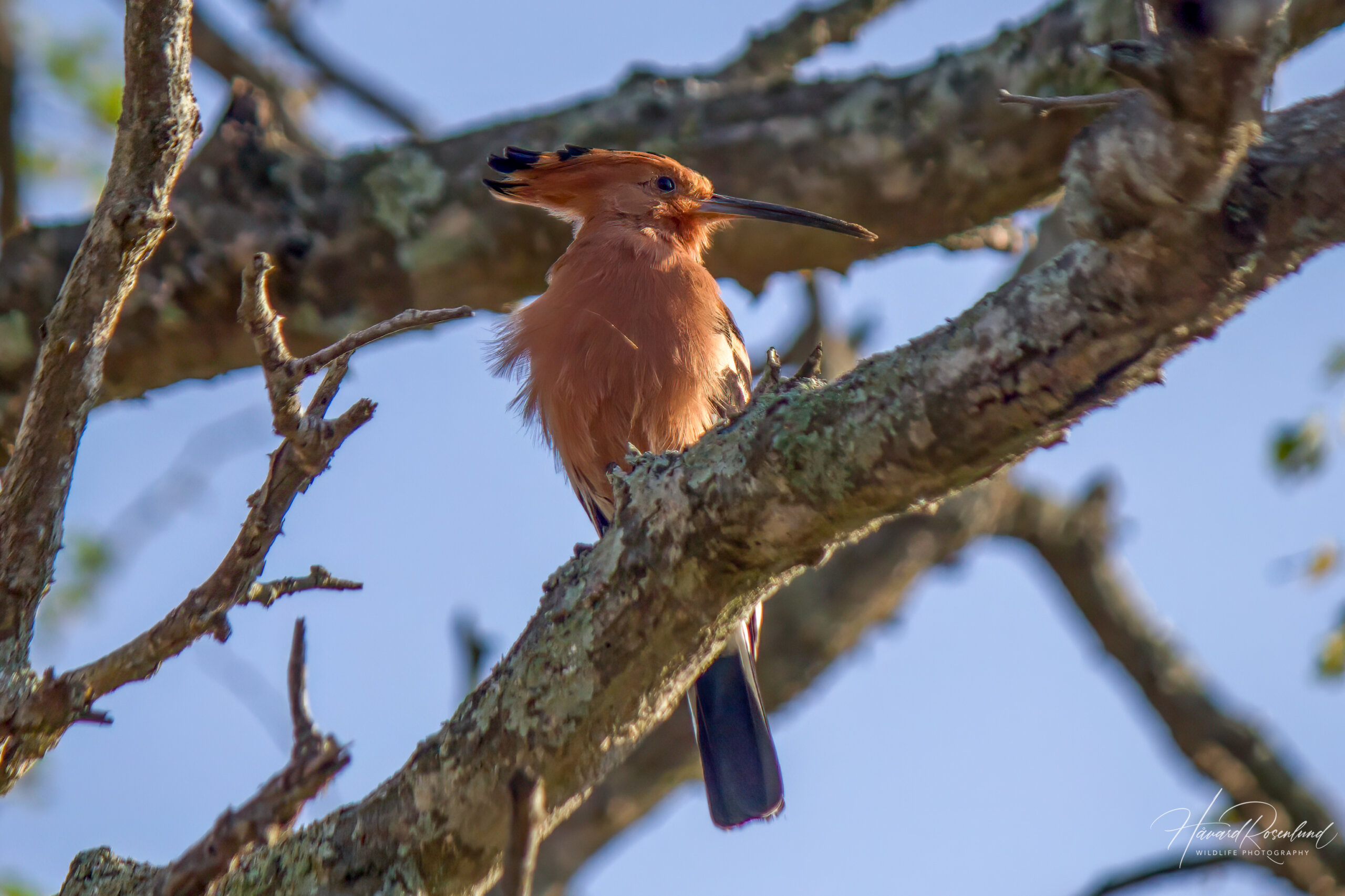
African Hoopoe
Upupa africana
At a glance
Habitat
- Open woodland, savanna, grassland, farmland, parks and gardens with short ground vegetation
Diet
- Mostly insects, larvae and pupae found in or on the ground; occasional small vertebrates
Activity
- Diurnal; spends much of the day walking and probing the ground
Size
- Length: 25–29 cm Weight: about 50–70 g
Range
- Sub-Saharan Africa, especially eastern and southern regions; avoids dense rainforest and extreme desert
Description
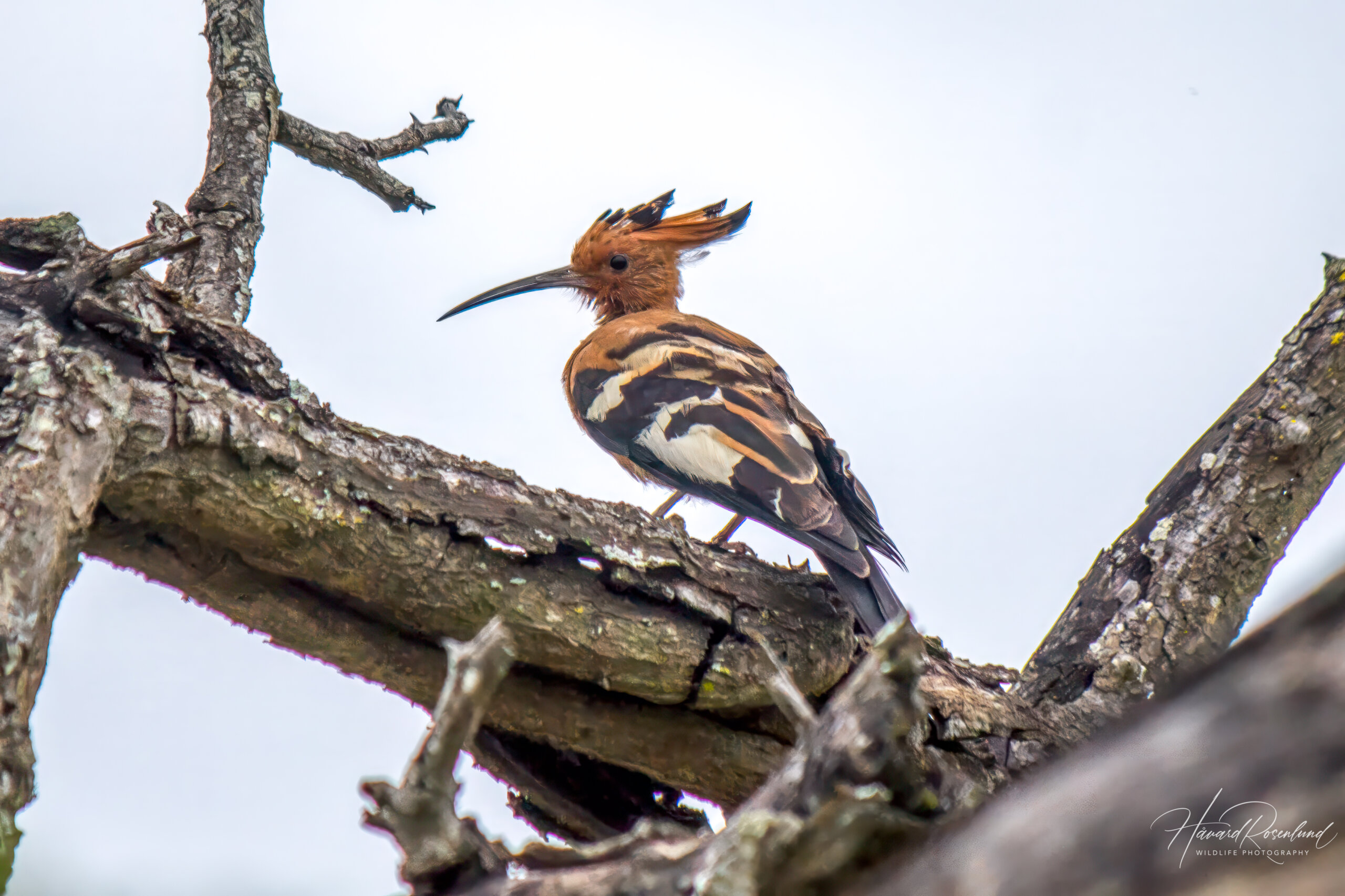
The African hoopoe (Upupa africana) is an unmistakable bird with rich cinnamon plumage, a long down-curved bill, a prominent black-tipped crest and boldly striped black-and-white wings and tail. It is about 25–29 cm long and weighs roughly 50–70 g. Males are generally richer cinnamon in colour, while females tend to be slightly duller and greyer around the face and breast.
Taxonomy
Most current global taxonomies include the African form within the hoopoe (Upupa epops), usually as the subspecies U. e. africana, rather than recognising Upupa africana as a separate species. The African form is generally darker and richer cinnamon than Eurasian birds, but the differences are relatively modest and the vocalisations are very similar.
Habitat
African hoopoes favour open woodland, savanna, grassland and other landscapes where scattered trees or cavities provide nesting opportunities and short vegetation or bare ground gives access to prey. They also adapt well to farmland, orchards, parks and gardens.
Dense rainforest and extreme desert are generally avoided. The combination of open feeding ground and nearby trees or other structures with cavities is more important than any single vegetation type.
Diet
Insects dominate the diet, especially beetles and their larvae, caterpillars, pupae and other invertebrates found in or on the ground. Earthworms and occasional small vertebrates such as frogs or small reptiles may also be taken. Flying termites are sometimes caught in the air.
The African hoopoe obtains much of its water from food and is not dependent on regular visits to open water for drinking.
Foraging
Most feeding takes place while walking over bare soil or short grass. The long, slender bill is pushed into soil, leaf litter and dry animal dung to find hidden prey. The tip can remain slightly open below the surface, allowing an insect or larva to be grasped underground.
Because prey is often caught at the narrow bill tip, it is commonly tossed upward and caught farther back in the mouth before being swallowed. Larger items may first be beaten against the ground and broken into manageable pieces.
Behaviour
African hoopoes are usually encountered alone or in pairs, with small family groups appearing after breeding. Some populations are resident, while others move locally with the seasons as rainfall and food availability change.
Individuals may return repeatedly to favoured feeding areas and night roosts. The species also responds readily to alarm calls from other birds and may join them in driving away predators such as snakes.
Breeding
African hoopoes are monogamous and strongly territorial while nesting. Rival males display with raised crests and spread wings, chase one another and may escalate to direct fights in which they lock bills. Courtship includes the male offering food to the female.
They use existing cavities in trees, termite mounds, earth banks, walls, nest boxes and other natural or artificial structures rather than excavating their own nest hole. Four to seven eggs are typical in southern Africa. The female incubates for about 15 days and is fed by the male. She remains in the cavity during the early nestling period before later joining him in feeding the chicks. The African hoopoe has also been recorded as a host of the greater honeyguide (Indicator indicator), a brood parasite that lays its eggs in the nests of other birds.
Hoopoe nests are famous for their powerful smell. Nesting females and chicks produce a dark secretion from the preen gland, and nestlings can hiss and eject foul-smelling faeces when threatened. Studies of the hoopoe (Upupa epops) have shown that symbiotic bacteria in the gland produce antimicrobial compounds. The female spreads the secretion over the eggs, and tiny depressions in the eggshell help retain it. This appears to reduce harmful bacterial contamination and protect the developing embryos.
Status
The IUCN includes the African form within the hoopoe Upupa epops, which is globally classified as Least Concern on the IUCN Red List.
The African hoopoe remains widespread and locally common across much of sub-Saharan Africa. It tolerates considerable human modification where open feeding ground and nest cavities remain available, and parks, gardens and agricultural landscapes can provide suitable habitat. Local declines can nevertheless occur where old trees and other cavities disappear or open feeding habitats are heavily altered.
Image gallery
Loading map and observations…
Have you seen this species?
Independent species archive
Did you find this species page useful?
Wildlife Vagabond is independently built and maintained. Voluntary support helps cover hosting, maps, data storage and continued improvements to the species archive.
Support Wildlife VagabondSpecies content will remain freely available.
References
Information about the species’ global distribution and status is based primarily on global Red List data. See the references below for details.
- AviList. (2026). v2025b. https://www.avilist.org/checklist/v2025b/
- Biodiversity and Development Institute. (2024). African Hoopoe (Upupa epops africana). https://thebdi.org/2024/05/09/african-hoopoe-upupa-africana/
- Biodiversity Explorer. (n.d.). African Hoopoe. Iziko Museums of South Africa. https://www.biodiversityexplorer.info/birds/upupa_africana.htm
- BirdLife International. (2026). IUCN Red List for birds. BirdLife DataZone. https://datazone.birdlife.org
- International Union for Conservation of Nature. (2020). Upupa epops (Hoopoe), Least Concern. The IUCN Red List of Threatened Species. https://www.iucnredlist.org/species/22682655/181836360
- Martín-Vivaldi, M., Peña, A., Peralta-Sánchez, J. M., Sánchez, L., Ananou, S., Ruiz-Rodríguez, M., & Soler, J. J. (2010). Antimicrobial chemicals in hoopoe preen secretions are produced by symbiotic bacteria. Proceedings of the Royal Society B: Biological Sciences, 277(1678), 123-130. https://doi.org/10.1098/rspb.2009.1377
- Martín‐Vivaldi, M., Soler, J. J., Peralta‐Sánchez, J. M., Arco, L., Martín‐Platero, A. M., Martínez‐Bueno, M., Ruiz‐Rodríguez, M., & Valdivia, E. (2014). Special structures of hoopoe eggshells enhance the adhesion of symbiont‐carrying uropygial secretion that increase hatching success. Journal of Animal Ecology, 83(6), 1289-1301. https://doi.org/10.1111/1365-2656.12243
- Soler, J. J., Barón, M. D., Martínez-Renau, E., Zhang, L., Liang, W., & Martín-Vivaldi, M. (2024). Nesting hoopoes cultivate in their uropygial gland the microbial symbionts with the highest antimicrobial capacity. Scientific Reports, 14(1), 30797. https://doi.org/10.1038/s41598-024-81062-1