
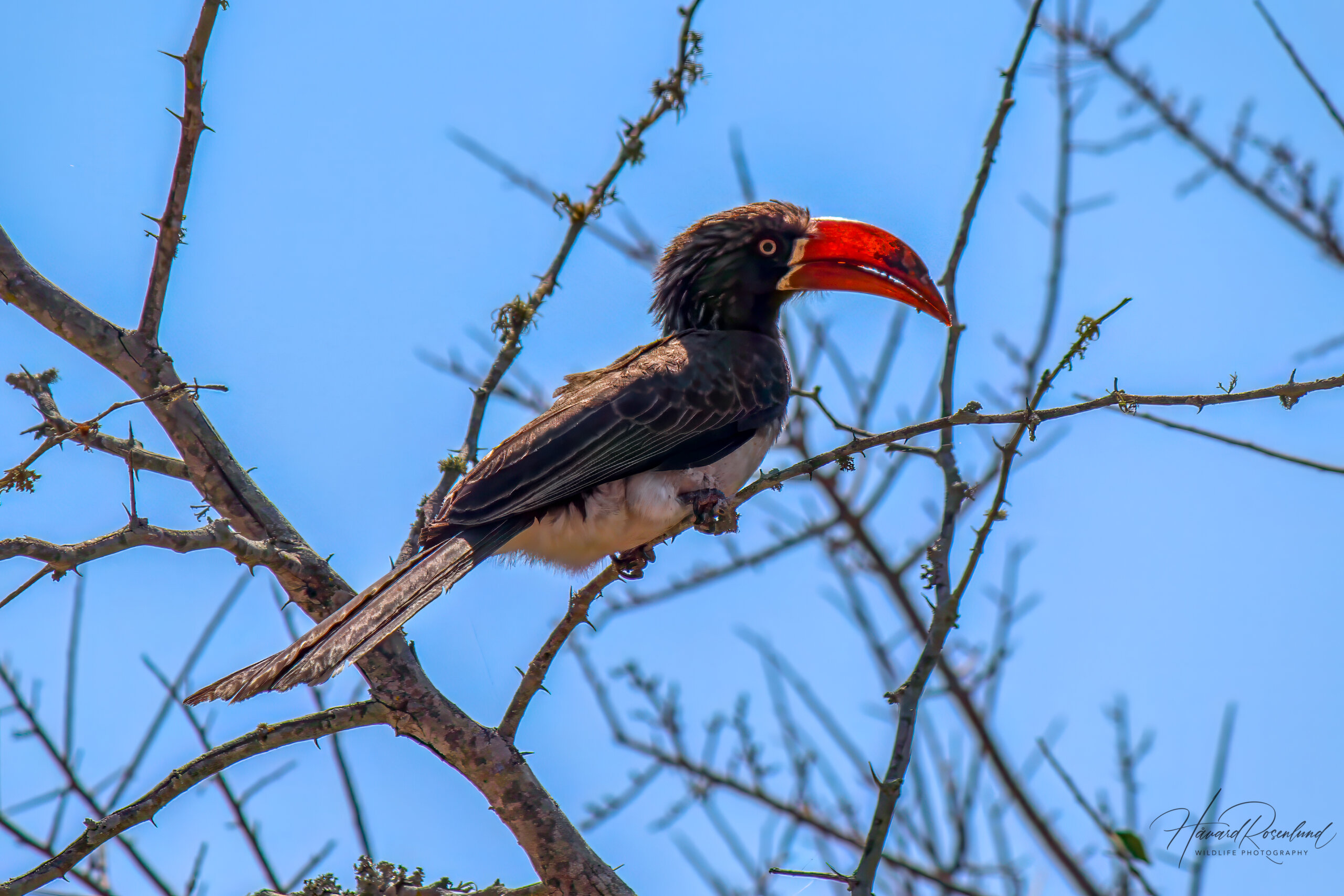
Crowned Hornbill
Lophoceros alboterminatus
At a glance
Habitat
- Forest, forest edge, riverine woodland, wooded savanna and well-wooded gardens
Diet
- Insects and other invertebrates, fruit, seeds and occasional small vertebrates
Activity
- Diurnal; feeds mainly in trees but also hawks insects and drops to the ground for food
Size
- Length: About 50 cm Weight: 180–332 g
Range
- Eastern and southern Africa, extending west into parts of Central Africa
Description
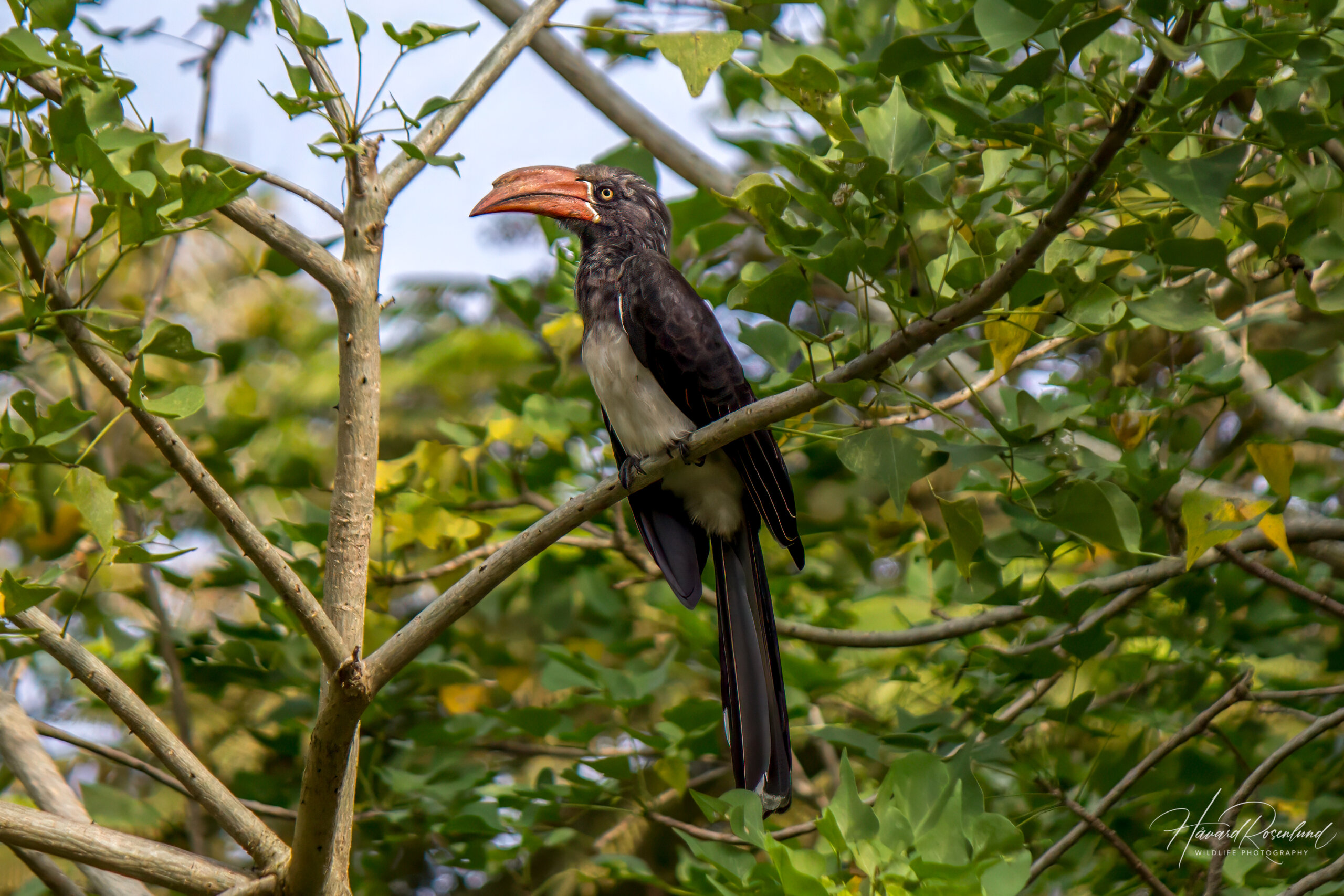
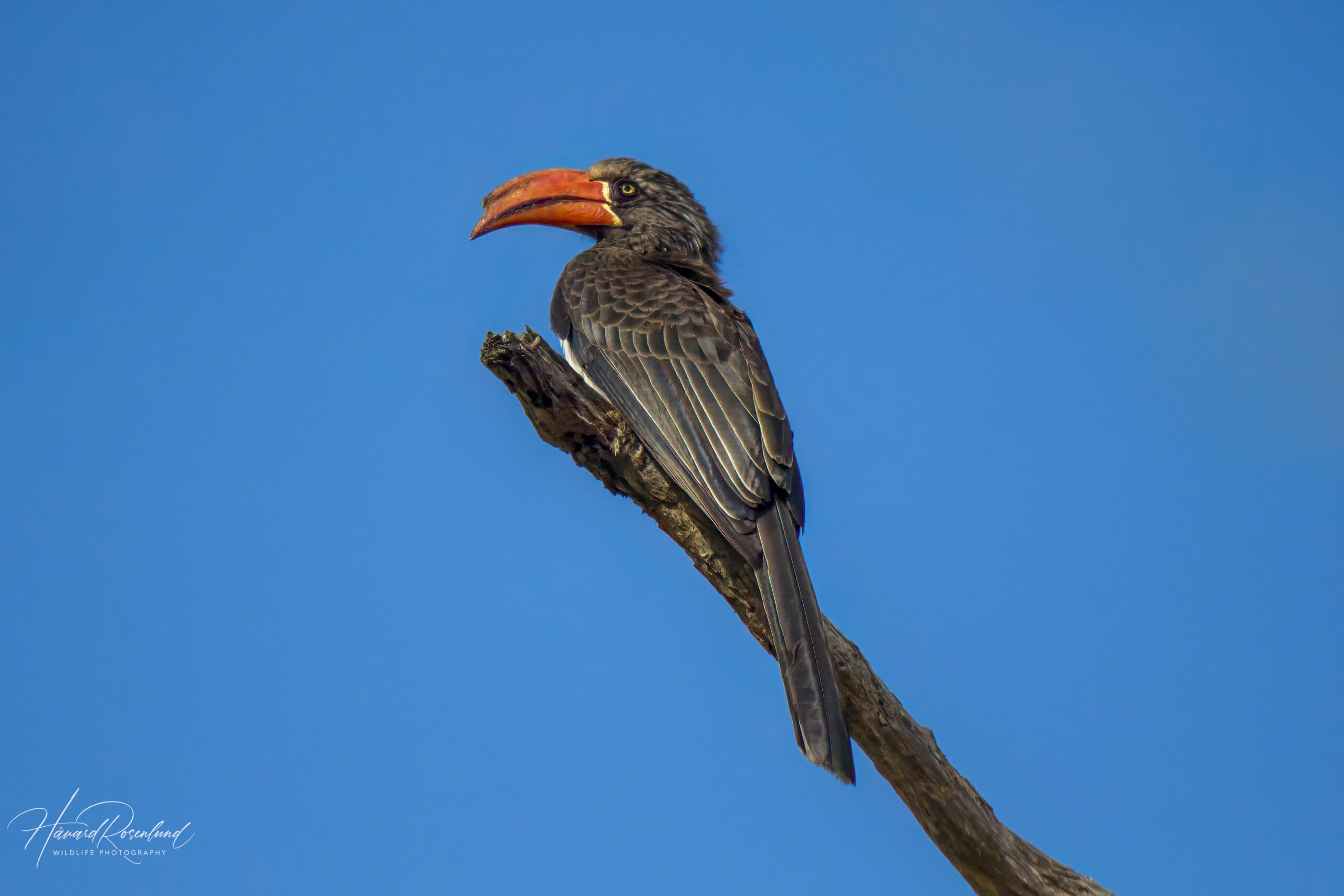
The crowned hornbill (Lophoceros alboterminatus) is a medium-sized African hornbill, about 50 cm long. Males weigh roughly 191–332 g and females about 180–249 g. The plumage is mostly sooty brown to black with a white eyebrow and belly, while the bill and the low casque, a helmet-like structure along the top of the bill, are orange-red with a paler line near the base.
Females are smaller and have a lower casque, yellow rather than reddish eyes and a small patch of greenish bare skin on the throat. The species can overlap geographically with the larger trumpeter hornbill (Bycanistes bucinator), but crowned hornbills are slimmer, darker and have a far less developed casque.
Habitat
Crowned hornbills use a broad range of wooded habitats, including coastal and riverine forest, forest edges, deciduous woodland, wooded savanna and montane forest. In parts of the range they occur up to about 3,000 m above sea level.
They also enter cultivation, parks and well-wooded gardens, particularly where mature trees provide both feeding opportunities and natural cavities for nesting. This flexibility allows them to persist in some modified landscapes as long as enough tree cover remains.
Diet
The species is an adaptable omnivore. Animal prey includes locusts, cicadas, mantids, butterflies, moths, caterpillars, ants, termites, snails, centipedes and spiders, together with occasional lizards, eggs and nestling birds. Fruit becomes especially important when animal prey is less available; figs, cycad seeds and a range of wild and cultivated fruits are eaten.
Most feeding takes place in trees, where birds actively pursue prey among branches and foliage. They also make short flights to catch insects in the air and sometimes drop to the ground for fallen fruit or terrestrial prey. Fruits are often swallowed whole, allowing seeds to be carried away from the parent plant.
Behaviour
Crowned hornbills are territorial and largely resident in moist woodland, where they are most often seen in pairs or family groups of up to several birds. Their loud, high-pitched whistles carry far through the trees, and rising and falling series of notes are used in territorial advertisement.
In drier regions, birds range more widely outside the breeding season as food availability changes, including movements between different elevations and feeding areas. Flocks of up to about 80 have been reported. The same species can therefore live as territorial family groups in wetter woodland and form much larger, more mobile flocks where food is more seasonal.
Breeding
Crowned hornbills breed as territorial pairs and use natural cavities, usually in mature trees. The same cavity may be reused over many breeding seasons. About one to two weeks before egg-laying, the female seals herself inside using material that includes her own droppings and nest debris until only a narrow vertical feeding slit remains. The male then passes food through the opening while she incubates and during the early nestling period.
The clutch contains two to five eggs, usually three or four. The female incubates alone for about 25–27 days while the male supplies food. The chicks hatch naked and blind. During her confinement the female moults her flight and tail feathers; she leaves the cavity when the oldest chick is roughly 25–30 days old and her flight feathers have regrown enough for her to fly, after which the young reseal the entrance and remain inside.
The chicks stay in the nest for about 46–55 days. They can feed for themselves roughly a month after fledging but remain around the natal area and dependent to some degree for several more months, becoming fully independent about five to seven months after fledging. This long family period means that successful breeding extends well beyond the weeks spent inside the sealed nest.
Status
The crowned hornbill is globally classified as Least Concern on the IUCN Red List. It has a broad distribution across eastern, central and southern Africa and remains common in many suitable wooded habitats.
Because the species depends on trees both for food and for natural nesting cavities, local forest clearance and removal of mature trees can reduce habitat quality even where the global population remains secure.
Image gallery
Loading map and observations…
Have you seen this species?
Independent species archive
Did you find this species page useful?
Wildlife Vagabond is independently built and maintained. Voluntary support helps cover hosting, maps, data storage and continued improvements to the species archive.
Support Wildlife VagabondSpecies content will remain freely available.
References
Information about the species’ global distribution and status is based primarily on global Red List data. See the references below for details.
- Biodiversity Explorer. (n.d.). Crowned Hornbill life history, based on Roberts – Birds of Southern Africa VII. Iziko Museums of South Africa. https://www.biodiversityexplorer.info/birds/bucerotidae/tockus_alboterminatus.htm
- BirdLife International. (n.d.). Crowned Hornbill species factsheet. https://datazone.birdlife.org/species/factsheet/crowned-hornbill-lophoceros-alboterminatus
- International Union for Conservation of Nature. (n.d.). Crowned Hornbill. The IUCN Red List of Threatened Species. https://www.iucnredlist.org/species/22682396/92943440
- IUCN SSC Hornbill Specialist Group. (n.d.). Crowned Hornbill. https://iucnhornbills.org/crowned-hornbill/