
Helmeted Guineafowl
Numida meleagris
At a glance
Habitat
- Savanna, grassland, open woodland and mixed farmland with trees for roosting
Diet
- Omnivore: seeds and other plant material, plus insects and other invertebrates
Activity
- Diurnal; roosts communally in trees at night
Size
- Length: 53–58 cm Weight: About 1.3 kg
Range
- Much of sub-Saharan Africa; domestic and feral populations occur worldwide
Description
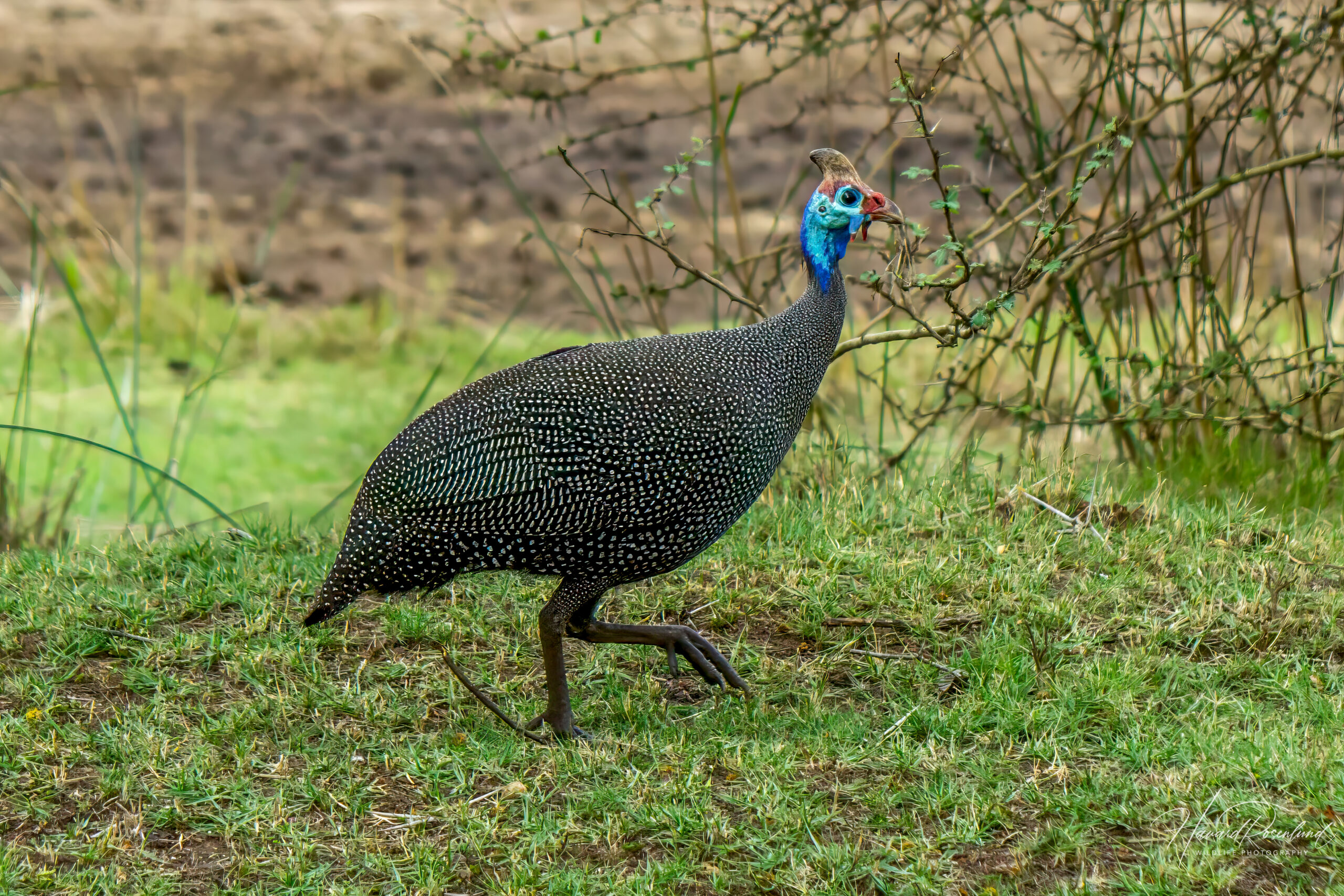
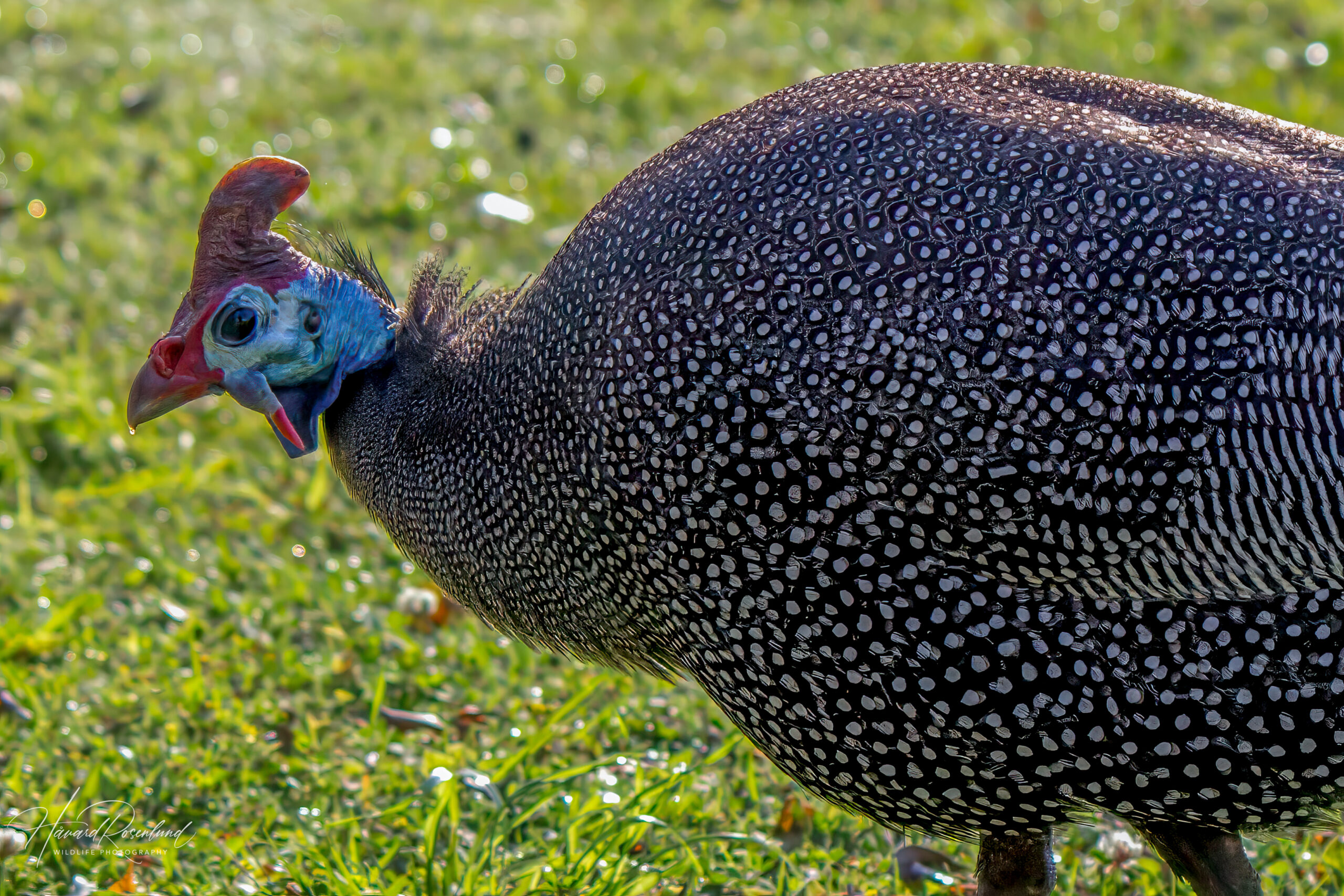
The helmeted guineafowl (Numida meleagris) is the most widespread wild guineafowl in Africa and the wild ancestor of domestic guineafowl. It measures about 53–58 cm and typically weighs around 1.3 kg. The dark grey to black body is densely covered with small white spots, while the head and upper neck are largely bare.
A hard, helmet-like casque crowns the head. Blue and red facial skin, a loose bare throat area and paired wattles create the species’ distinctive appearance. These structures vary markedly among geographic subspecies. The bare throat skin appears to play an important role in thermoregulation, meaning the control of body temperature: its size varies with temperature and other climatic conditions and may help with both heat loss and heat gain. In two subspecies, throat-sack size also shows sexual dimorphism—a difference between males and females—suggesting that it may also function in signalling between individuals.
Habitat
Helmeted guineafowl use savanna, grassland, open woodland, farmland and suburban landscapes. They do best where open feeding ground lies close to cover, water and trees suitable for night roosting. This helps explain why populations can thrive in varied agricultural landscapes yet decline where land use becomes too uniform.
Diet
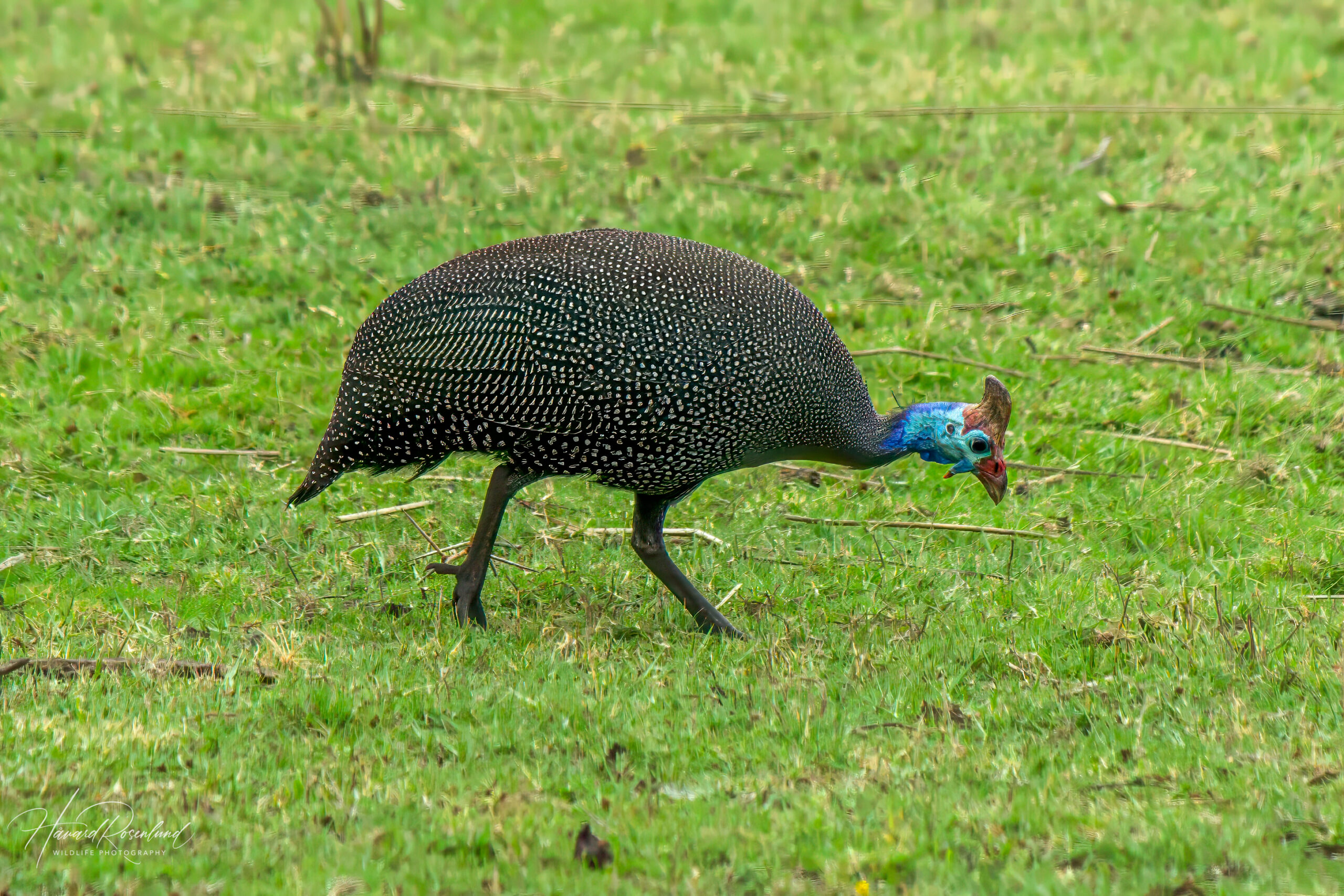
They are adaptable omnivores. Seeds, berries, fruit, bulbs, roots, shoots and other plant material are eaten alongside termites, grasshoppers, beetles, spiders, snails and other invertebrates. Small vertebrates may occasionally be taken.
They find most of their food while walking and scratching on the ground. Protein-rich invertebrates become especially important for breeding females and growing chicks during the rainy season.
Social behaviour
Helmeted guineafowl are highly social. Outside the breeding season they live in close-knit groups, often of roughly 8–15 birds, and neighbouring groups may merge into much larger gatherings. Communal night roosts can contain dozens or even more than a hundred birds. During the breeding season these large associations break down as pairs spread out around nesting areas.
The flock is also a defence system. A 2024 South African study documented loud alarm calling, tight group formation, mobbing—several birds collectively approaching and harassing a predator—and coordinated escape when guineafowl encountered predators such as black-backed jackals (Lupulella mesomelas) and raptors. Birds frequently run first and take flight when necessary, but their short, rounded wings can produce fast, direct bursts into trees or across obstacles. Grouping allows many individuals to watch for danger while others continue feeding.
Breeding
The mating system is more flexible than lifelong monogamy. The species usually shows seasonal monogamy: males may first form short associations with several females before one male and one female form a close pair that remains together through the breeding season. Breeding timing varies widely across Africa and usually follows seasonal rainfall and the resulting increase in food and ground cover.
The female lays a clutch, commonly around six to fifteen eggs, in a shallow concealed scrape on the ground and incubates alone; incubation lasts roughly 24–30 days. The male stays nearby, guards the female and may feed her during courtship. After hatching, both parents brood, guard and lead the chicks.
The chicks are precocial, meaning they hatch well developed and mobile. Their brown-striped down provides camouflage, they leave the nest almost immediately and quickly begin feeding for themselves.
Relationship with humans
Domestic guineafowl descend from the helmeted guineafowl, making this species an important part of African domestication history. Genetic analyses point to domestication beginning in West Africa roughly 1,300–5,500 years ago. Domestic populations from Africa, Asia and Europe are genetically more similar to one another than to nearby wild populations, fitting a shared domestication history.
From Africa, domestic guineafowl were spread widely by people and are now kept for meat and eggs across much of the world. Feral populations have also become established outside the native range. Wild African populations still retain the geographic and behavioural diversity of the original species.
Status
The helmeted guineafowl is listed as Least Concern on the IUCN Red List. BirdLife International continues to treat the global population trend as stable, and the species remains widespread and locally abundant across much of sub-Saharan Africa.
The secure global status can nevertheless mask substantial local declines. Research in the KwaZulu-Natal Midlands found that guineafowl did best in varied agricultural landscapes where feeding areas and cover occurred close together. More intensive farming, loss of nesting cover and pesticide use that reduces weeds and invertebrates were associated with declining populations. Hunting, poorly managed burning and habitat degradation can add further local pressure.
Image gallery
Loading map and observations…
Have you seen this species?
Independent species archive
Did you find this species page useful?
Wildlife Vagabond is independently built and maintained. Voluntary support helps cover hosting, maps, data storage and continued improvements to the species archive.
Support Wildlife VagabondSpecies content will remain freely available.
References
Information about the species’ global distribution and status is based primarily on global Red List data. See the references below for details.
- AviList. (n.d.). Numida meleagris: current species and subspecies treatment. https://explore.avilist.org/
- BirdLife International. (n.d.). Helmeted Guineafowl Numida meleagris species factsheet. https://datazone.birdlife.org/species/factsheet/helmeted-guineafowl-numida-meleagris
- Elbin, S. B., Crowe, T., & Graves, H. (1986). Reproductive behavior of Helmeted Guinea Fowl (Numida meleagris): Mating system and parental care. Applied Animal Behaviour Science, 16(2), 179-197. https://doi.org/10.1016/0168-1591(86)90110-3
- International Union for Conservation of Nature. (2018). Numida meleagris. The IUCN Red List of Threatened Species. https://www.iucnredlist.org/species/22679555/132052202
- Malan, G., & Benn, G. A. (1999). Agricultural land-use patterns and the decline of the helmeted guineafowl Numida meleagris (Linnaeus 1766) in KwaZulu-Natal, South Africa. Agriculture, Ecosystems & Environment, 73(1), 29-40. https://doi.org/10.1016/S0167-8809(99)00011-0
- Ratcliffe, C., & Crowe, T. (2001). Habitat utilisation and home range size of helmeted guineafowl (Numida meleagris) in the Midlands of KwaZulu-Natal province, South Africa. Biological Conservation, 98(3), 333-345. https://doi.org/10.1016/S0006-3207(00)00176-2
- Shen, Q.-K., Peng, M.-S., Adeola, A. C., Kui, L., Duan, S., Miao, Y.-W., Eltayeb, N. M., Lichoti, J. K., Otecko, N. O., Strillacci, M. G., Gorla, E., Bagnato, A., Charles, O. S., Sanke, O. J., Dawuda, P. M., Okeyoyin, A. O., Musina, J., Njoroge, P., Agwanda, B., … Zhang, Y.-P. (2021). Genomic Analyses Unveil Helmeted Guinea Fowl (Numida meleagris) Domestication in West Africa. Genome Biology and Evolution, 13(6), evab090. https://doi.org/10.1093/gbe/evab090
- van Niekerk, J. H., Forcina, G., & Megía-Palma, R. (2024). Grouping Behaviour and Anti-Predator Responses in the Helmeted Guineafowl Numida meleagris. Birds, 5(4), 685-702. https://doi.org/10.3390/birds5040047
- Van Niekerk, J. H., Megía-Palma, R., & Forcina, G. (2022). Thermoregulatory function and sexual dimorphism of the throat sack in Helmeted Guineafowl (Numida meleagris) across Africa. Avian Research, 13, 100047. https://doi.org/10.1016/j.avrs.2022.100047