
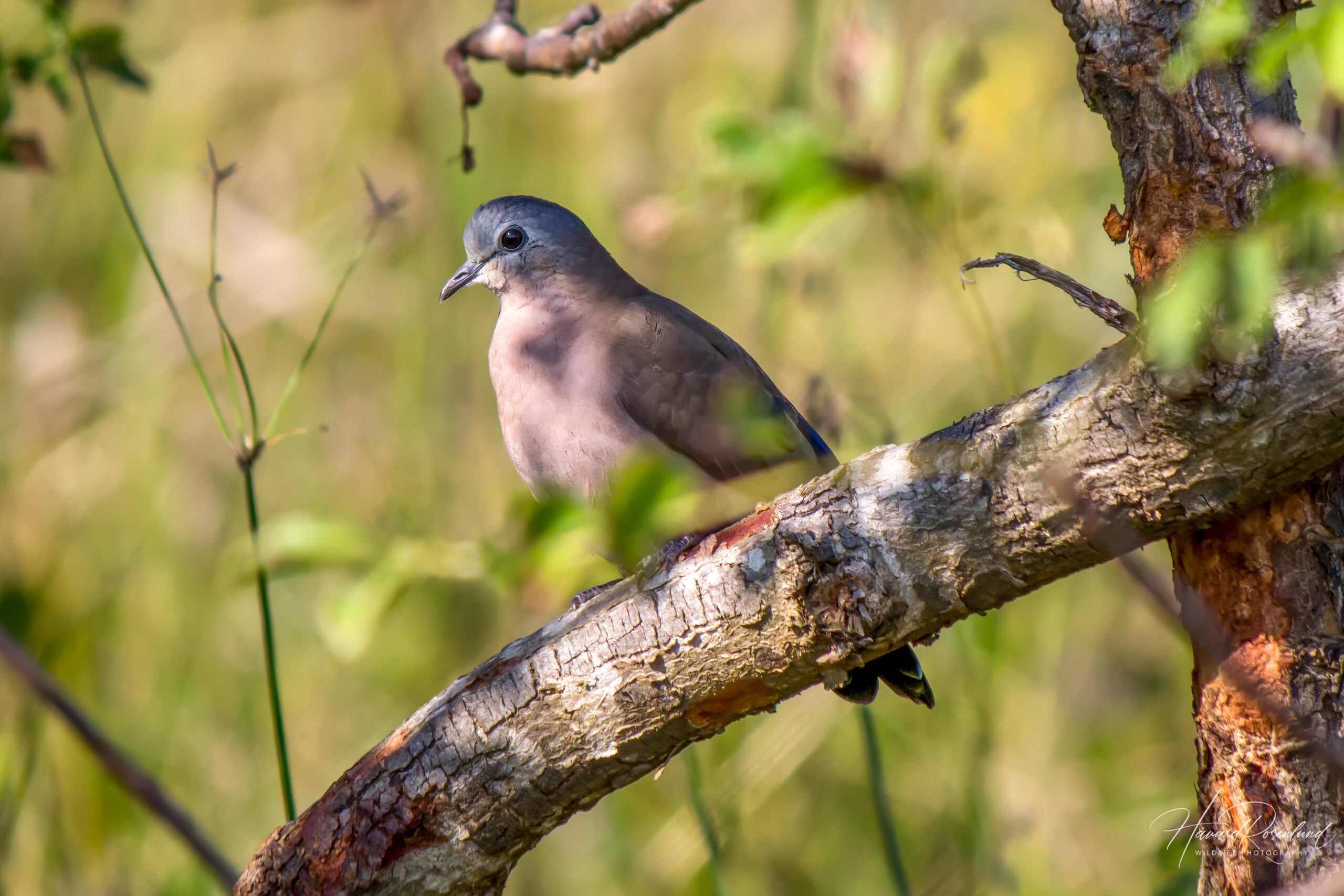
Emerald-spotted Wood-dove
Turtur chalcospilos
At a glance
Habitat
- Dry woodland, sand forest, savanna, thickets and second growth
Diet
- Mainly seeds; also fallen fruit and small invertebrates
Activity
- Diurnal; feeds mainly on the ground
Size
- Length: 16–20 cm Weight: 55–65 g
Range
- Eastern and southern Africa
Description
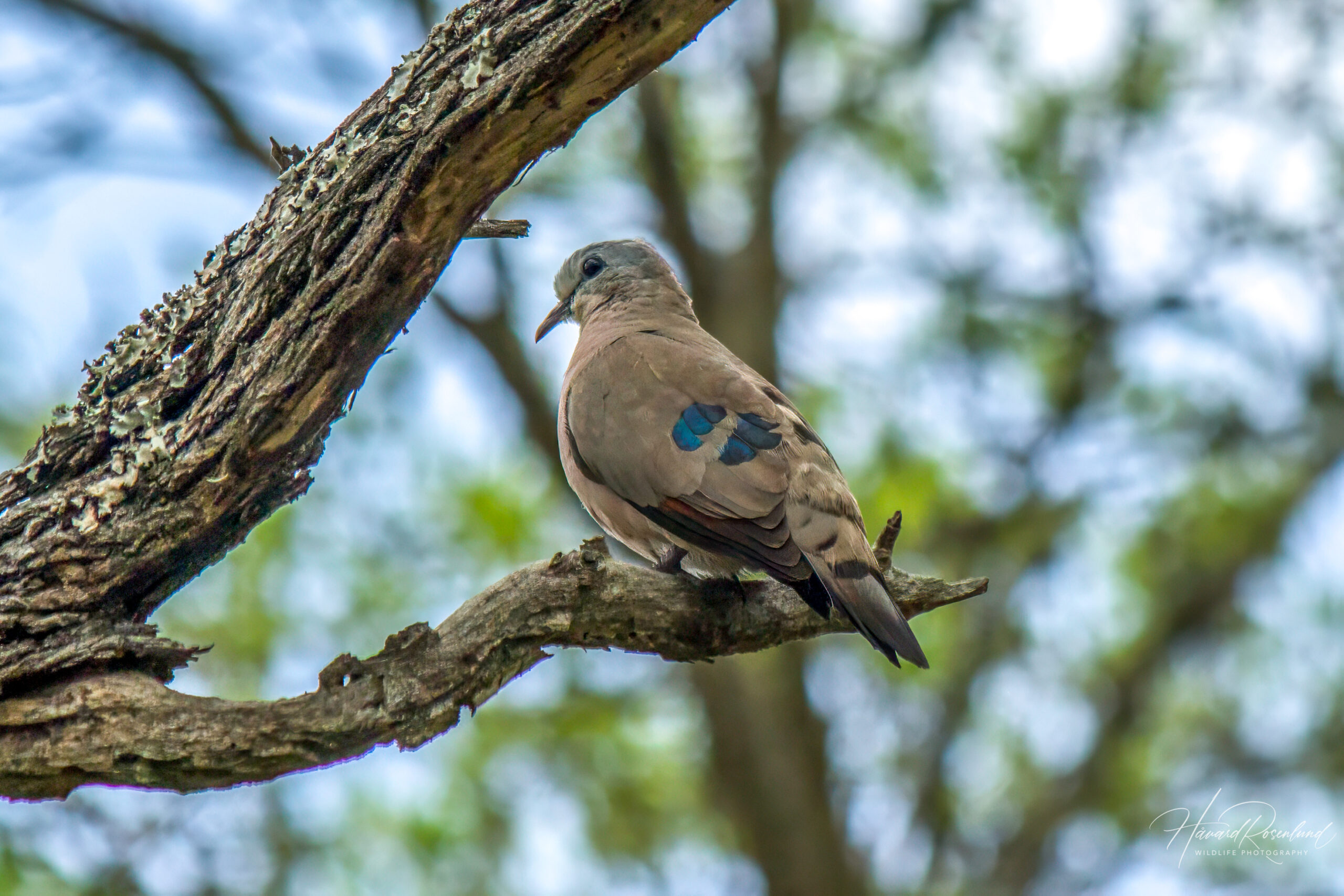
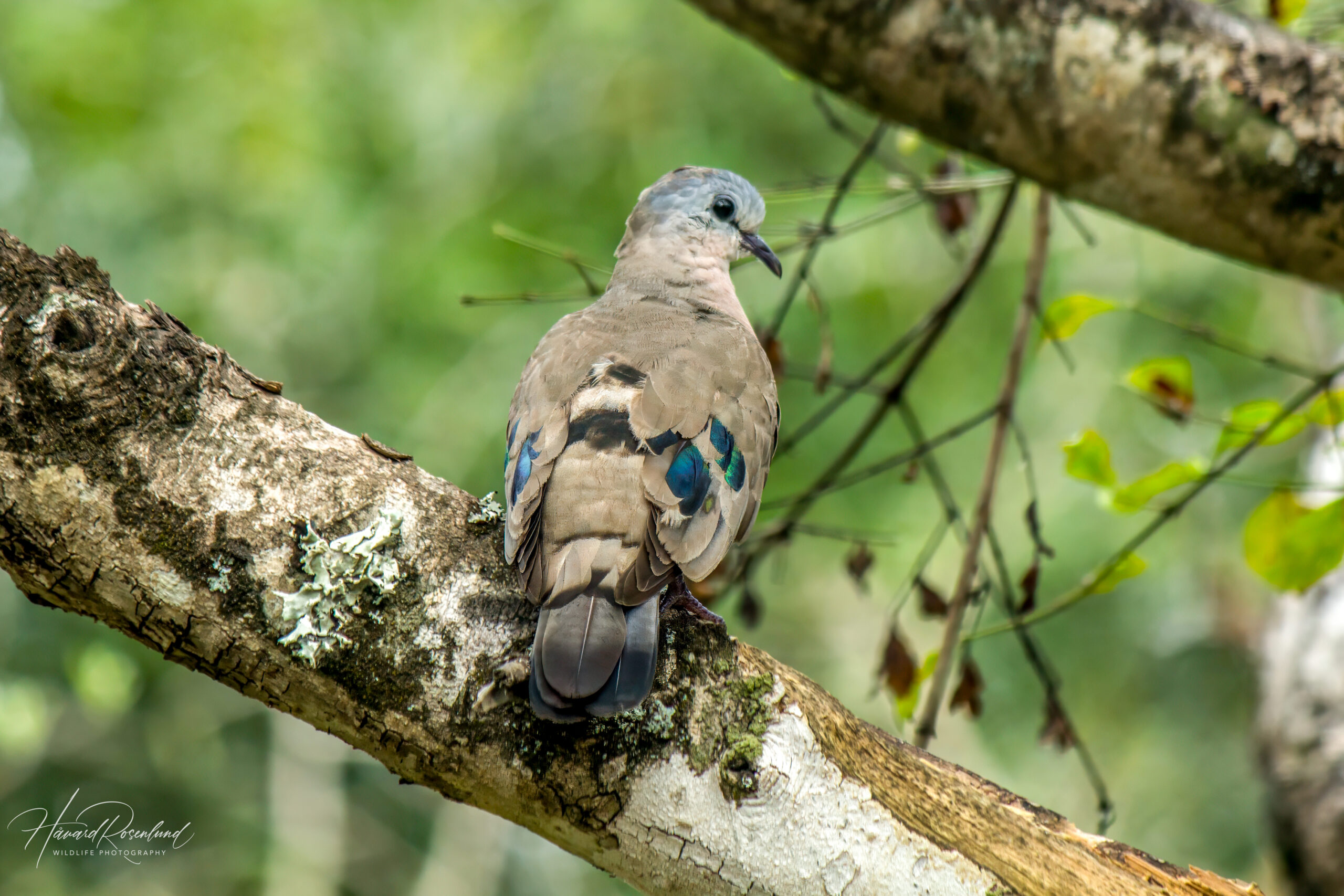
The emerald-spotted wood-dove (Turtur chalcospilos) is a small dove of eastern and southern Africa. It is about 16–20 cm long and usually weighs 55–65 g. The folded wings carry metallic emerald-green patches that change with the light, while the back, hindneck and wings are grey-brown. The head is bluish-grey and the breast and throat are mauve-pink, fading paler on the belly. Two conspicuous dark bars cross the lower back between the folded wings and become especially noticeable when the bird moves or takes flight.
The sexes are similar, although females may be slightly duller. Juveniles have less glossy wing spots and buff-edged feathers. The closely related blue-spotted wood-dove (Turtur afer) can be very similar in shape and general colour pattern, but its iridescent wing spots are blue rather than emerald green.
Habitat
This wood-dove favours dry deciduous woodland, open woodland, sand forest, savanna, thickets and regenerating woodland. It also uses orchards, gardens and other lightly modified habitats but generally avoids continuous evergreen rainforest and the driest semi-desert and desert landscapes.
Diet
The diet consists mainly of grass seeds and other small seeds, supplemented by fallen fruit and small invertebrates. Most food is collected while the dove walks on sparsely vegetated ground beneath trees and bushes, picking items directly from the soil and low vegetation.
Behaviour
Emerald-spotted wood-doves are usually encountered alone or in pairs, although several birds may gather at water or a productive feeding site. Males advertise and defend territories with a low, repeated song, and neighbouring birds can respond strongly to one another.
Although wood-dove songs can sound simple to human ears, males clearly recognise the song of their own species. In an experiment published in 2024, researchers played recordings of emerald-spotted wood-doves, the closely related blue-spotted wood-dove (Turtur afer) and mixtures of the two. Males approached and sang more strongly when they heard their own species but reacted much less to the other recordings. The birds therefore distinguish subtle differences in song rather than responding equally to every similar-sounding wood-dove.
Breeding
Breeding can occur over much of the year, with local peaks linked to rainfall and food conditions. The nest is a small, rather flimsy platform of twigs, stems and roots, placed in a tree, bush or sometimes an aloe, usually about 0.5–6 m above the ground.
One or two cream-coloured eggs are laid. Both sexes incubate, although the female may take the larger share, and incubation lasts about 13–17 days. The young remain in the nest for roughly 15–17 days before fledging.
Status
The emerald-spotted wood-dove is widespread and common in suitable habitat and is listed as Least Concern on the IUCN Red List. The current population trend is considered stable, and no severe range-wide threat has been identified.
Local populations can still be affected by clearance of woodland and thicket, disturbance and predation, but the species uses a broad range of wooded and partly modified habitats.
Image gallery
Loading map and observations…
Have you seen this species?
Independent species archive
Did you find this species page useful?
Wildlife Vagabond is independently built and maintained. Voluntary support helps cover hosting, maps, data storage and continued improvements to the species archive.
Support Wildlife VagabondSpecies content will remain freely available.
References
Information about the species’ global distribution and status is based primarily on global Red List data. See the references below for details.
- Baptista, L. F., Trail, P. W., Horblit, H. M., Boesman, P. F. D., & Kirwan, G. M. (2020). Emerald-spotted Wood-Dove (<i>Turtur chalcospilos</i>). In Birds of the World. Cornell Lab of Ornithology. https://doi.org/10.2173/bow.eswdov1.02
- BirdLife International. (n.d.). Emerald-spotted Wood-dove Turtur chalcospilos species factsheet. https://datazone.birdlife.org/species/factsheet/emerald-spotted-wood-dove-turtur-chalcospilos
- International Union for Conservation of Nature. (n.d.). Turtur chalcospilos (Emerald-spotted Wood-dove). The IUCN Red List of Threatened Species. https://www.iucnredlist.org/species/22690621/93280268
- Niśkiewicz, M., Szymański, P., Zampa, L., Budka, M., & Osiejuk, T. S. (2024). Response of the emerald‐spotted wood‐dove to the song of conspecific males and sympatric congeners. Ethology, 130(10), e13498. https://doi.org/10.1111/eth.13498