
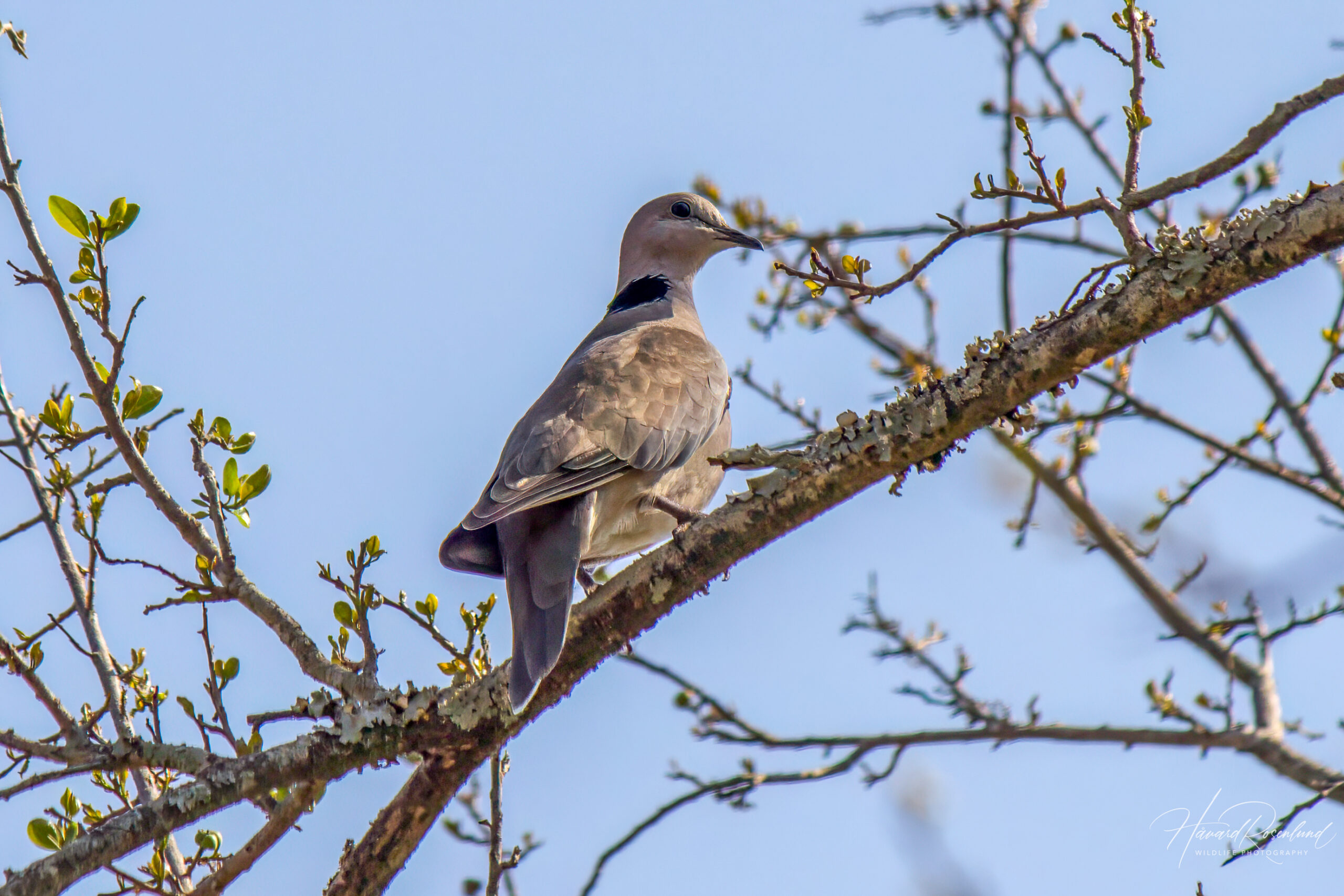
Ring-necked Dove
Streptopelia capicola
At a glance
Habitat
- Open woodland, savanna, grassland, farmland, parks and urban areas
Diet
- Mainly seeds; also fruit, berries and small invertebrates
Activity
- Diurnal; feeds mainly on the ground
Size
- Length: 25–26.5 cm Weight: 92–188 g
Range
- Eastern and southern Africa
Description
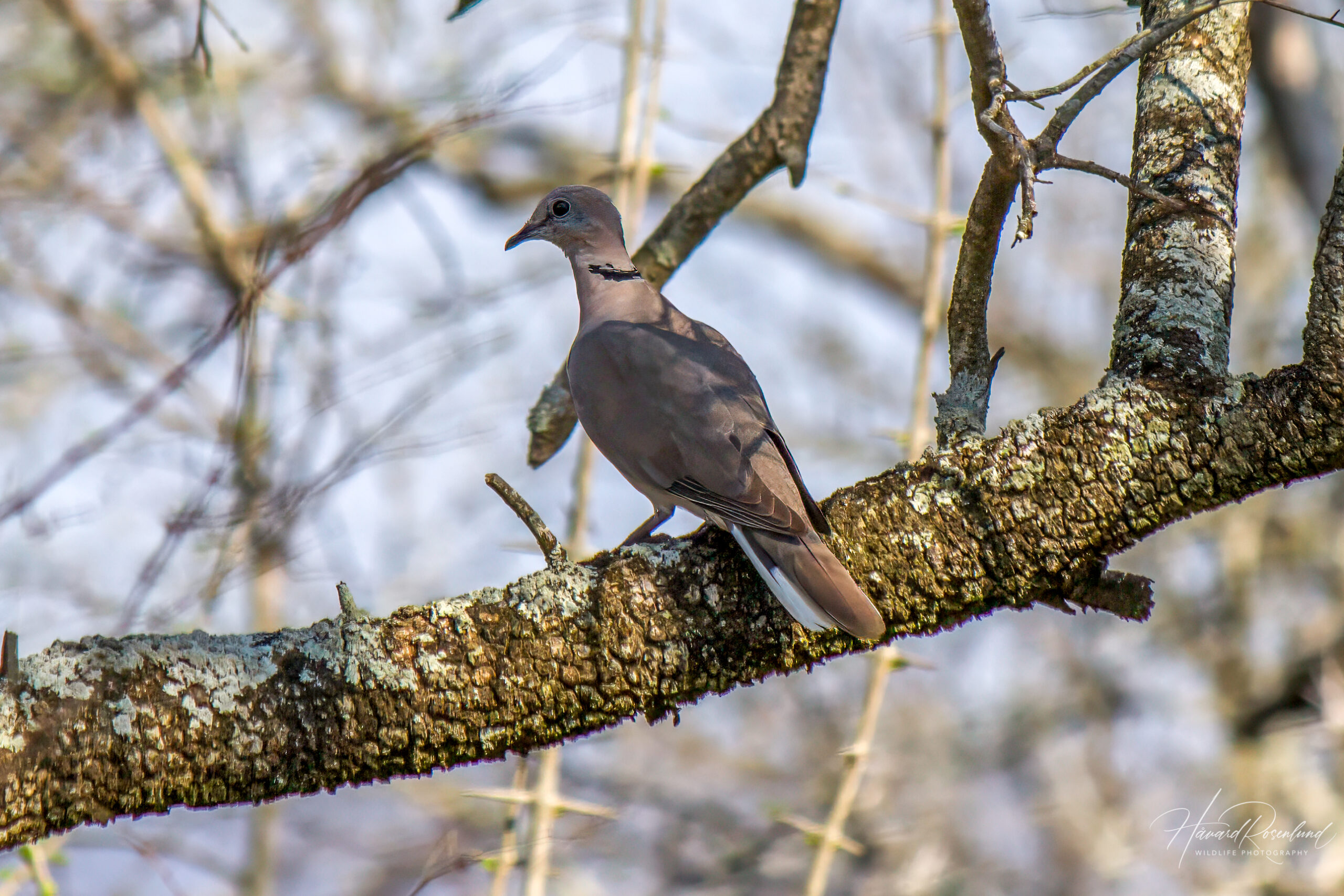
The ring-necked dove (Streptopelia capicola), also widely known as Cape turtle dove, is a familiar dove of eastern and southern Africa. It measures about 25–26.5 cm and weighs roughly 92–188 g. The plumage is pale brownish-grey, darker above and paler below, with a black half-collar on the hindneck and white outer tail feathers. The eye is dark rather than red.
It resembles several related collared doves. The larger red-eyed dove (Streptopelia semitorquata) has a red eye, darker plumage and a different tail pattern, in addition to its noticeably larger size.
Habitat
Ring-necked doves occupy open woodland, grassland, savanna, farmland, parks and gardens. They avoid closed forest and waterless dune desert but otherwise tolerate a broad range of open and lightly wooded habitats, including towns and cities.
Heat tolerance
Ring-necked doves are well adapted to the heat of African savannas and semi-arid landscapes. Like other pigeons and doves, they can lose large amounts of heat by evaporating water through both the respiratory system and the skin.
In controlled experiments on southern African doves, ring-necked doves were briefly exposed to air temperatures around 60°C and above. Even under such extreme heat, the birds could keep body temperature below dangerous levels for a time by evaporating very large amounts of water. This impressive cooling ability comes with rapid water loss, making access to drinking water increasingly important during severe heat.
Diet
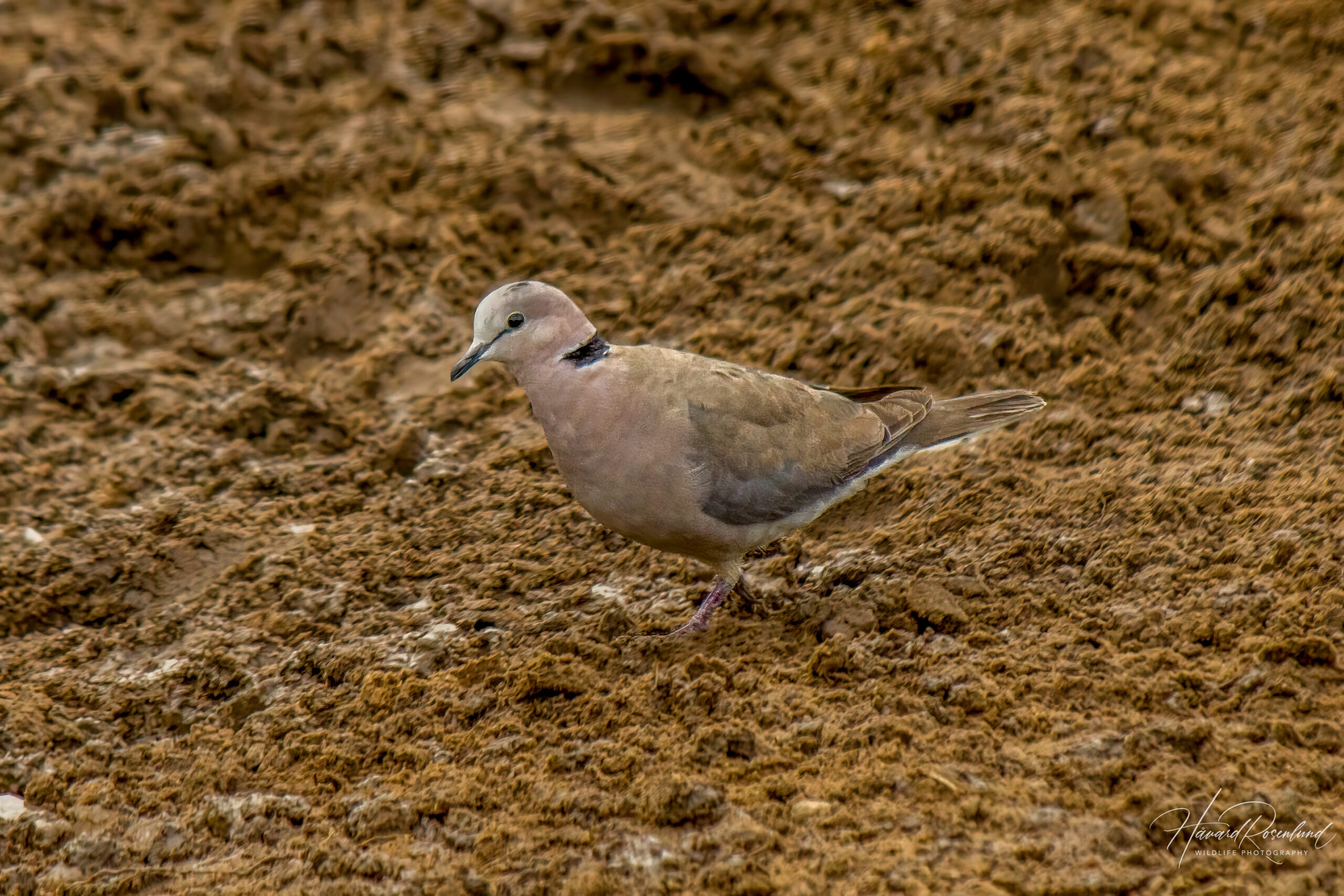
Seeds dominate the diet, with fruit, berries, other plant material and small invertebrates taken occasionally. Most food is collected while walking on the ground, where the birds pick seeds and other small items from bare soil or short vegetation.
Behaviour
Ring-necked doves are often encountered alone or in pairs, but larger numbers can gather around communal roosts, water and rich feeding sites. Outside concentrated resources they are not strongly flocking birds.
The familiar three-part song is one of the easiest ways to recognise the species: a repeated kuk-COORRRR-uk, commonly rendered in English as “work harder” or “how’s father”. Calling is especially conspicuous around dawn, and neighbouring birds may answer one another across open woodland and savanna.
Breeding
Ring-necked doves form monogamous pairs and defend breeding territories. Breeding can occur throughout the year when food and weather are favourable, with several nesting attempts possible in a good year.
The nest is a loose platform of twigs, grass and roots, sometimes with pine needles, usually placed in a well-covered tree fork. Old nests from an earlier attempt or nests built by other birds may also be reused. A clutch normally contains one or two eggs, although clutches of up to four have occasionally been recorded.
Both parents incubate for about 13–16 days. The chicks are first fed crop milk, a nutrient-rich fluid produced in the parents’ crops, before softened food is gradually added to the diet. The young leave the nest after roughly 16–17 days but remain dependent on their parents for about another 12 days before becoming fully independent.
Status
The ring-necked dove is listed as Least Concern on the IUCN Red List and remains widespread and often abundant. The global population trend is considered increasing.
Its success is partly linked to its ability to use farmland, parks, gardens and other modified landscapes as well as natural savanna and woodland. Local populations can still be affected by habitat changes, persecution and drought, but no major range-wide threat is currently evident.
Image gallery
Loading map and observations…
Have you seen this species?
Independent species archive
Did you find this species page useful?
Wildlife Vagabond is independently built and maintained. Voluntary support helps cover hosting, maps, data storage and continued improvements to the species archive.
Support Wildlife VagabondSpecies content will remain freely available.
References
Information about the species’ global distribution and status is based primarily on global Red List data. See the references below for details.
- Baptista, L. F., Trail, P. W., Horblit, H. M., Kirwan, G. M., & Boesman, P. F. D. (2021). Ring-necked Dove (<i>Streptopelia capicola</i>), version 1.1. In Birds of the World. Cornell Lab of Ornithology. https://birdsoftheworld.org/bow/species/rindov/cur/introduction
- BirdLife International. (n.d.). Ring-necked Dove Streptopelia capicola species factsheet. https://datazone.birdlife.org/species/factsheet/ring-necked-dove-streptopelia-capicola
- International Union for Conservation of Nature. (n.d.). Streptopelia capicola (Ring-necked Dove). The IUCN Red List of Threatened Species. https://www.iucnredlist.org/species/22690488/132061633
- McKechnie, A. E., Whitfield, M. C., Smit, B., Gerson, A. R., Smith, E. K., Talbot, W. A., McWhorter, T. J., & Wolf, B. O. (2016). Avian thermoregulation in the heat: efficient evaporative cooling allows for extreme heat tolerance in four southern Hemisphere columbids. Journal of Experimental Biology, jeb.138776. https://doi.org/10.1242/jeb.138776