
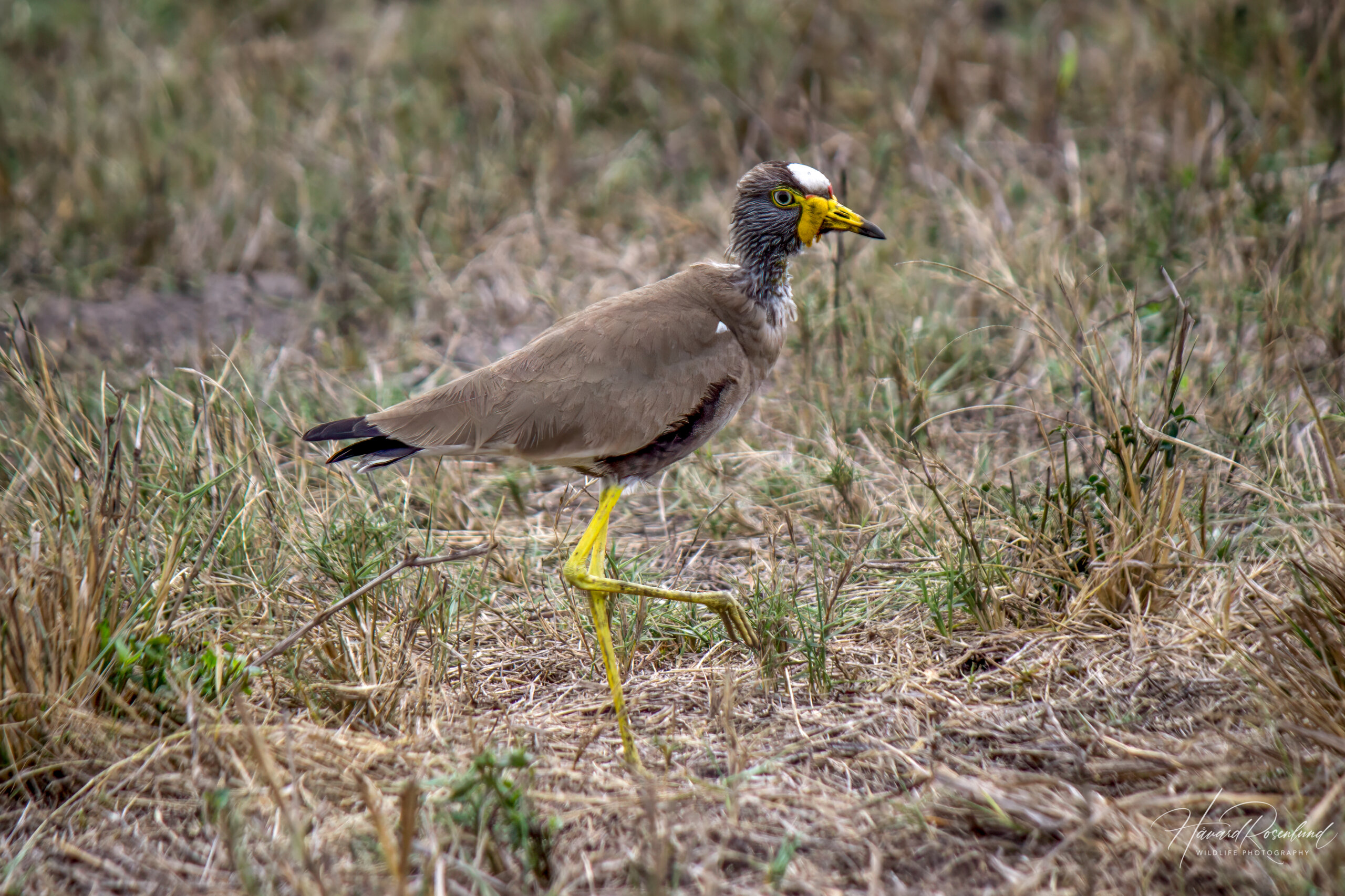
Wattled Lapwing
Vanellus senegallus
At a glance
Habitat
- Moist grassland, floodplains, wetland edges, burnt ground and other open areas
Diet
- Mainly insects and other small invertebrates; occasional seeds
Activity
- Diurnal
Size
- Length: About 34–35 cm Weight: About 240 g
Range
- Widespread across sub-Saharan Africa
Description
The wattled lapwing (Vanellus senegallus) is a large African lapwing of open country, measuring about 34–35 cm and weighing around 240 g. The brown body and streaked neck contrast with a black crown, bright white forehead, yellow legs and bill, and conspicuous yellow facial wattles with reddish bases.
In flight, the wing pattern is especially useful: black flight feathers and brown upperwing coverts are divided by a broad white bar, while the underwing is mostly white with black flight feathers. The sexes are similar, although females may show slightly less black on the head and throat.
Habitat
Wattled lapwings favour open, moist ground such as wet grassland, marsh and swamp edges, floodplains and short vegetation around lakes, pans and rivers. They also use cultivated fields, recently burnt grassland, airfields, golf courses and other modified open habitats.
The key requirement is a combination of open visibility, suitable soil moisture and abundant surface invertebrates. As water levels and rainfall change, apparently suitable areas can become favourable or be abandoned quite quickly.
Diet
The diet consists mainly of insects and other small invertebrates, with seeds taken occasionally. The birds feed mostly by walking steadily over open ground, scanning and picking prey from the surface or just within low vegetation.
Recently flooded, grazed or burnt ground can be especially productive because prey is easier to detect and reach.
Behaviour
Outside the breeding period wattled lapwings may occur alone, in pairs or in small loose groups. They are generally resident, but local and regional movements follow rainfall, flooding and the appearance of suitable feeding habitat. Some populations become nomadic during the rainy season, moving between temporarily favourable areas rather than using one fixed range.
The species is conspicuously vocal. Alarm calls are used readily when potential predators appear, and the birds may also mob a threat, actively approaching and harassing it in an attempt to drive it away.
Breeding
Breeding pairs are strongly territorial. Around the nest they use loud calls, aerial pursuits, threat postures and mobbing to deter potential predators and intruding lapwings.
The male prepares several shallow scrapes on open ground before the female selects one. The chosen scrape is then lined with grass stems, roots, small pebbles and dry dung and is usually placed in short grass, bare soil or sparse vegetation, often near water. The clutch contains two to four cryptically patterned eggs, whose mottled colours provide camouflage against the ground. Both parents incubate, and incubation lasts about 28–32 days.
The chicks are precocial, meaning they are well developed and mobile when they hatch, and leave the scrape within the first day. They feed for themselves but are closely tended by at least one parent while relying on camouflage and adult vigilance for protection. They become fully flight-capable at around 40 days but may remain with their parents until the following breeding season.
Status
The wattled lapwing remains listed as Least Concern on the IUCN Red List and is widespread across sub-Saharan Africa.
Local numbers can respond quickly to changes in wetland hydrology, grazing, fire and agricultural land use. Both prolonged drying and poorly managed habitat alteration can reduce feeding and breeding opportunities, even though the species remains secure at the global level.
Image gallery
Loading map and observations…
Have you seen this species?
Independent species archive
Did you find this species page useful?
Wildlife Vagabond is independently built and maintained. Voluntary support helps cover hosting, maps, data storage and continued improvements to the species archive.
Support Wildlife VagabondSpecies content will remain freely available.
References
Information about the species’ global distribution and status is based primarily on global Red List data. See the references below for details.
- AviList. (2026). v2025b. https://www.avilist.org/checklist/v2025b/
- Biodiversity Explorer – Vanellus senegallus. (n.d.). distribution, habitat, movements and diet. https://www.biodiversityexplorer.info/birds/charadriidae/vanellus_senegallus.htm
- BirdLife International. (n.d.). Wattled Lapwing Vanellus senegallus species factsheet. https://datazone.birdlife.org/species/factsheet/wattled-lapwing-vanellus-senegallus
- International Union for Conservation of Nature. (n.d.). Vanellus senegallus (Wattled Lapwing). The IUCN Red List of Threatened Species. https://www.iucnredlist.org/species/22694027/93434264
- James, F. R., Okafor, C. I., Osinubi, S. T., Manu, S. A., Ivande, S., & Omotoriogun, T. C. (2023). Antipredatory call behavior of lapwing species in an Afrotropical environment. Avian Research, 14, 100137. https://doi.org/10.1016/j.avrs.2023.100137