
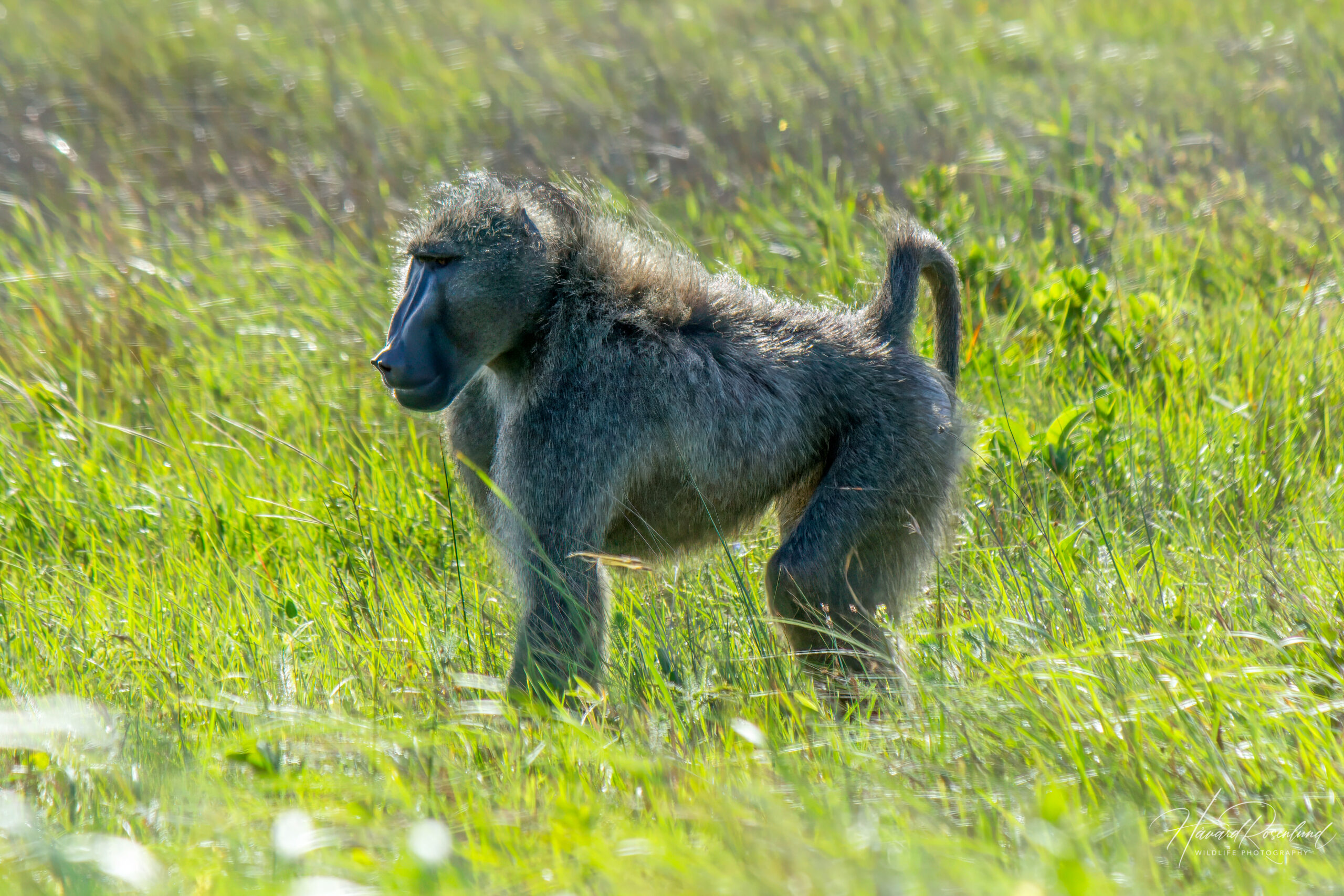
Chacma Baboon
Papio ursinus
At a glance
Habitat
- Savanna, woodland, semi-desert, mountains and coastal fynbos
Diet
- Omnivore: mainly fruit, seeds, roots, bulbs and grasses, plus animal food
Activity
- Diurnal; sleeps in trees or on cliffs
Size
- Length: 51–100 cm Weight: 12–40 kg
Range
- Southern Africa south of the Zambezi
Description
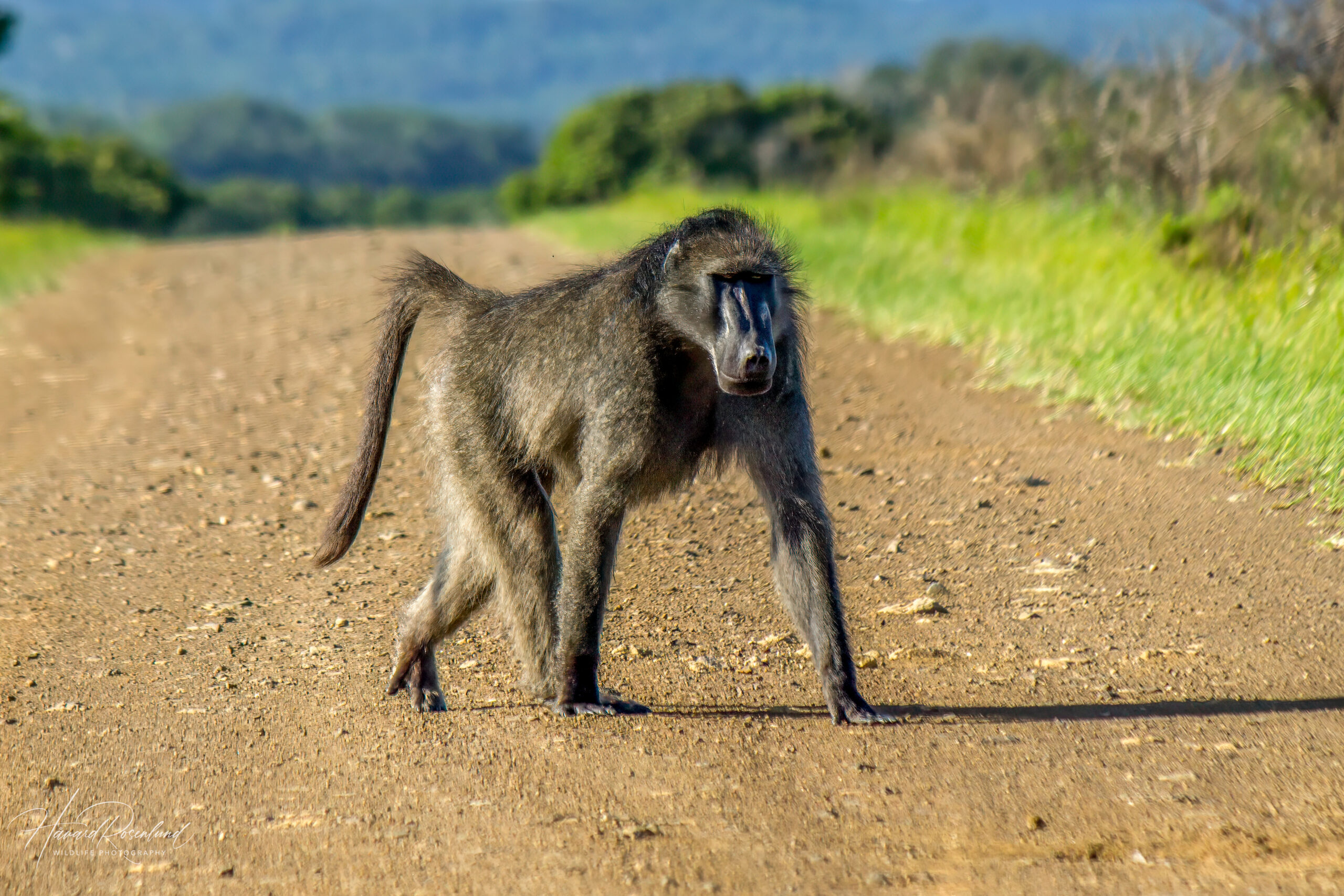
The chacma baboon, or Cape baboon (Papio ursinus), is the largest baboon by average body size and one of the largest monkeys in the world. Adult males generally measure about 68–100 cm in head-and-body length and weigh 25–40 kg, while females are about 51–62 cm and 12–20 kg. The coarse coat varies from grey-brown to almost black, and adult males have a long, downward-sloping muzzle and powerful canine teeth.
Unlike the olive baboon (Papio anubis), a mature chacma male does not normally develop a large contrasting shoulder mantle.
Taxonomy
Three named geographical forms are widely used in traditional treatments: Papio ursinus ursinus across much of South Africa, P. u. griseipes farther northeast and P. u. ruacana in the arid northwest around Namibia and southern Angola. Their boundaries are not sharp, and current Mammal Diversity Database treatment retains them within the single species Papio ursinus.
Habitat
Chacma baboons live in an unusually broad range of habitats, from savanna woodland and semi-desert to montane grasslands in the Drakensberg, coastal forest, fynbos and dry shrublands dominated by succulents. They need access to water and a secure sleeping site such as a cliff, cave, rocky outcrop or tall tree.
Diet
Chacma baboons are opportunistic omnivores, although plant food dominates most diets. Fruit, seeds, bulbs, roots, shoots, grasses and flowers are supplemented with insects, eggs and small vertebrates. Coastal troops also forage for mussels, limpets and crabs.
The exact diet changes strongly with season and locality. This flexibility is one reason chacma baboons can occupy environments ranging from dry semi-desert to wet coastal forest.
Behaviour
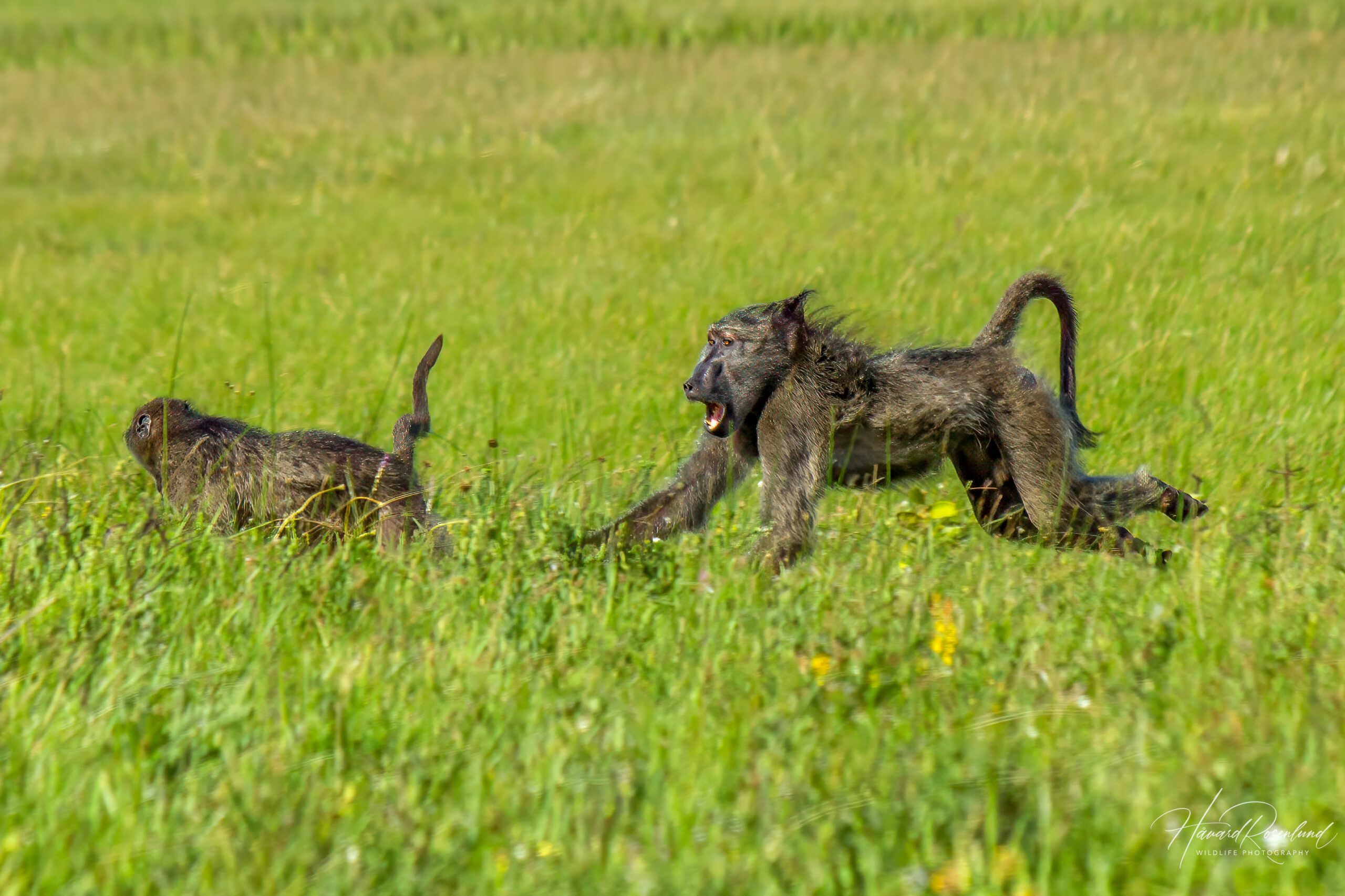
Chacma baboons are diurnal and spend much of the day travelling and feeding on the ground. A troop may move several kilometres as seasonal foods change before gathering around dusk at familiar sleeping cliffs, caves, rocky outcrops or tall trees.
Young baboons gradually learn local travel routes, safe resting places and food choices by following and watching experienced troop members, linking individual experience closely to group life.
Social behaviour
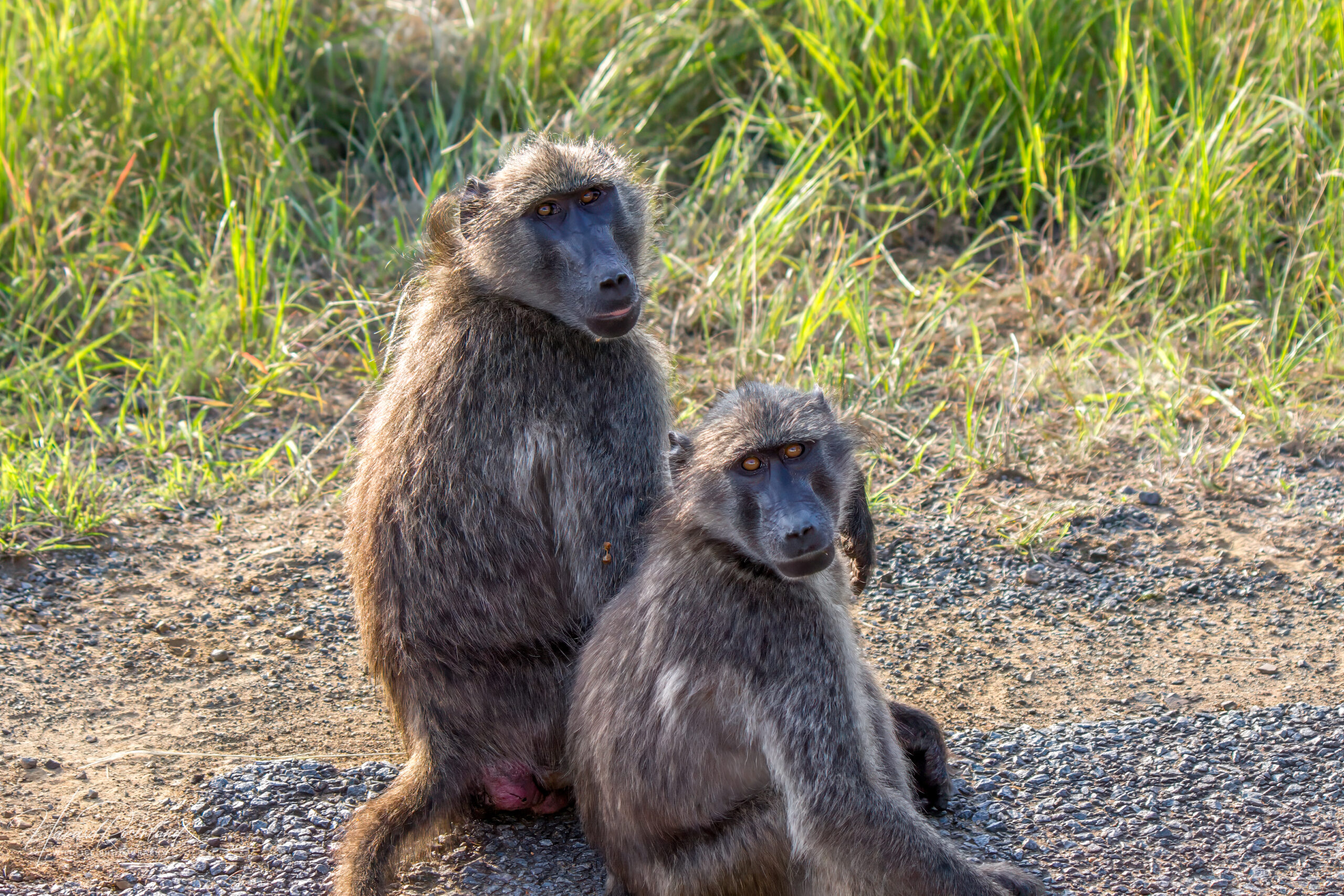
Most chacma baboons live in troops containing several adult males and females, ranging from a handful of animals to well over 100. Both sexes form clear dominance hierarchies. Females usually remain in the troop in which they were born and form stable family lines of mothers, daughters and sisters, with rank strongly influenced by the mother’s position. Males normally leave as they approach adulthood and may move between troops several times.
Troop life depends on much more than dominance. Baboons communicate through various calls and other sounds, as well as facial expressions, posture and touch. Grooming removes debris and parasites but also repairs relationships and strengthens alliances. Long-term research has shown that females with strong social bonds raise young with better survival prospects, independent of rank.
A particularly well-studied relationship is the close association between a mother with a dependent young and an adult male. The pair may travel and groom together, and the male can provide protection when a new male enters the troop. When a new dominant male takes over, the risk of infanticide can rise—the killing of very young offspring by a male—and females with a close male associate show a smaller stress response. The male associate is often, but not always, the young animal’s father, while females also maintain important bonds with other females.
Predation
Leopards (Panthera pardus) are generally regarded as the most important natural predators of baboons across Africa. Chacma baboons are dangerous prey and normally make up only a small part of a leopard’s diet, but predation can become much more important locally. In one Waterberg study, baboons accounted for 18.7% of the prey eaten by three female leopards when measured by weight, and most of the baboons killed were adults.
Group vigilance, the formidable defence of adult males and rapid escape reduce the risk. Familiar cliffs, caves, rocky outcrops and tall trees also provide important night-time refuges, although leopards can still hunt around sleeping sites. The risk from predators is therefore closely linked to group living, vigilance and repeated use of secure sleeping sites.
Reproduction
Reproduction can occur throughout the year. As ovulation approaches, the female develops a conspicuous sexual swelling and may spend shorter periods in close association with one or more males. Male rank and alliances influence access to females, but females also affect which males they approach and remain close to.
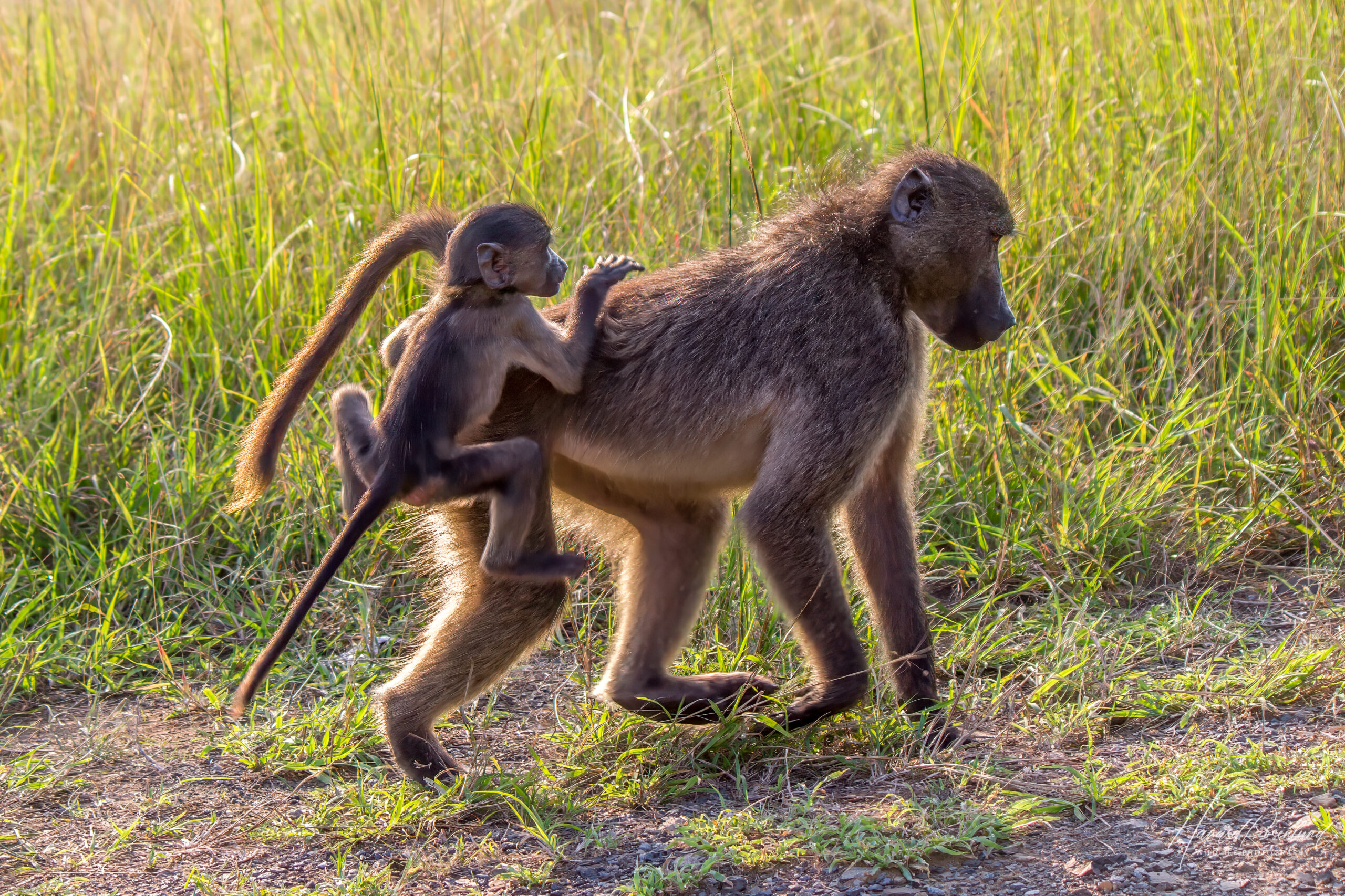
Gestation lasts about six months and normally results in one young. Newborns have a black coat and are carried against the mother’s belly before later riding on her back. As they grow, youngsters explore, play and learn feeding skills while remaining dependent on the mother and the wider troop for protection.
Females may begin reproducing at around three to four years of age, while males mature later and still need the size and social position required to compete effectively with adults. The time between births is commonly about 18–24 months, but it varies with food availability, whether the previous young survives and the mother’s condition.
Cultural significance
Chacma baboons have a deep cultural history in southern Africa. They appear in South African rock art, and the recorded traditions of the |Xam San describe baboons as unusually human-like animals that could speak, sing and show emotions. In some stories they belonged to an earlier time when animals were regarded as people.
Baboons were also associated with protective medicine. |Xam traditions described them as carrying a powerful medicinal root, and related beliefs later appeared across several southern African communities. The species therefore occupied an unusual position between animal, person and protective symbol rather than being viewed simply as wildlife.
Relationship with humans
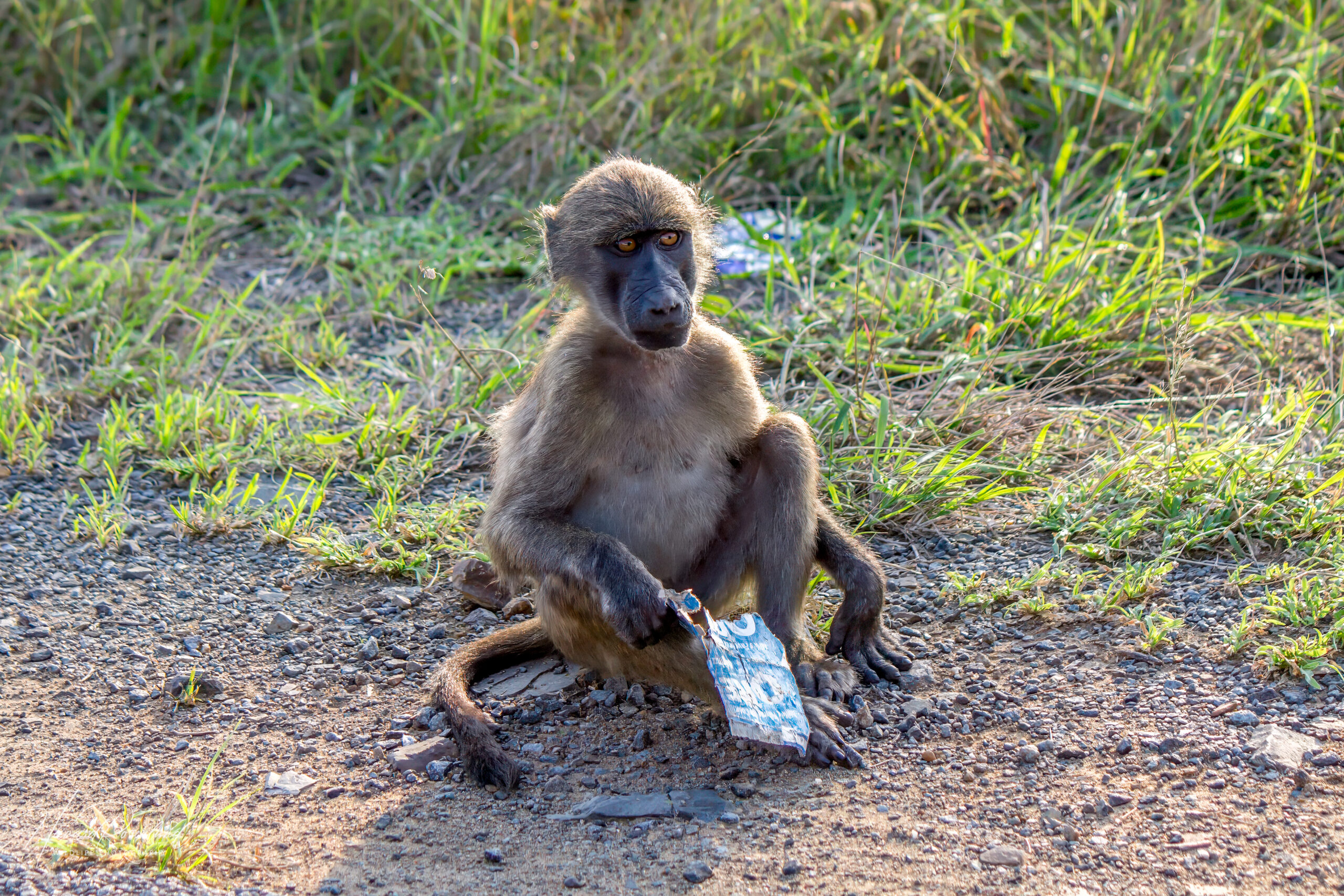
Chacma baboons have a long and often difficult relationship with people. Around farms, towns and tourist areas, unsecured rubbish, cultivated food, kitchens and deliberate feeding can reward bold behaviour and repeatedly draw troops into human-dominated areas. Persecution, road traffic, snares and loss of natural foraging habitat can then add further mortality.
Chacma baboons do not normally attack people, but an adult male is a powerful animal with razor-sharp canine teeth up to about five centimetres long. The risk increases especially when deliberate feeding, unsecured waste or other easily accessible human food has taught baboons to associate people with food and to intimidate them into surrendering it. If a baboon feels threatened, is cornered or is challenged over food, it can bite and inflict deep, potentially life-threatening injuries. Children are especially vulnerable. People should therefore never approach a baboon closely, block its escape route or try to take food back by force.
The Cape Peninsula is an especially well-known example. Much of the low-lying land preferred for foraging has been transformed into residential, commercial and agricultural landscapes, while natural habitat and secure cliff roosts remain immediately beside them. This creates a landscape in which human food can be unusually rewarding even though entering urban areas carries substantial risk.
The Cape Peninsula Baboon Strategic Management Plan covers 2023–2034. A detailed Action Plan adopted in November 2025 includes area-specific fencing, improved waste management, ranger support and sanctuary options for animals that cannot safely remain free-ranging. On 25 February 2026, the Western Cape High Court dismissed an application seeking to halt key parts of the plan, allowing implementation to continue. Keeping food and waste inaccessible, never deliberately feeding baboons and giving animals space to move away remain important ways of reducing conflict.
Status
The chacma baboon is listed as Least Concern on the IUCN Red List. It remains widespread across southern Africa and occupies many protected and modified landscapes.
That global category does not mean every local population is secure. Habitat transformation, hunting, persecution and conflict with people can reduce numbers or isolate troops in particular areas, but there is currently no range-wide decline severe enough to place the species in a threatened category.
Image gallery
Loading map and observations…
Have you seen this species?
Independent species archive
Did you find this species page useful?
Wildlife Vagabond is independently built and maintained. Voluntary support helps cover hosting, maps, data storage and continued improvements to the species archive.
Support Wildlife VagabondSpecies content will remain freely available.
References
Information about the species’ global distribution and status is based primarily on global Red List data. See the references below for details.
- Beehner, J. C., Bergman, T. J., Cheney, D. L., Seyfarth, R. M., & Whitten, P. L. (2005). The effect of new alpha males on female stress in free-ranging baboons. Animal Behaviour, 69(5), 1211–1221. https://doi.org/10.1016/j.anbehav.2004.08.014
- CapeNature. (2025). Final Cape Peninsula baboon action plan. https://www.capenature.co.za/news/2025/final-action-plan-for-baboons-includes-a-sanctuary-fencing-waste-strategy
- CapeNature. (2026). Joint statement on continued implementation of the Cape Peninsula baboon Action Plan. https://www.capenature.co.za/news/2026/joint-statement-final-action-plan-for-baboons-includes-a-sanctuary-fencing-waste-strategy-wildlife-by-law-and-by-law-enforcement
- CapeNature. (n.d.). Cape Peninsula Baboon Strategic Management Plan 2023–2034. https://www.capenature.co.za/resources/cape-peninsula-baboon-strategic-management-plan-2023-24-to-2033-34
- Hollmann. (2022). Baboons. In Customs and Beliefs of the |Xam. https://www.cambridge.org/core/books/customs-and-beliefs-of-the-xam/baboons/53C7CB3EC1025AD031C8D8280AF8F106
- International Union for Conservation of Nature. (n.d.). Papio ursinus (Chacma Baboon). The IUCN Red List of Threatened Species. https://www.iucnredlist.org/species/16022/168568698
- Jooste, E., Pitman, R., van Hoven, W., & Swanepoel, L. (2013). Unusually High Predation on Chacma Baboons (Papio ursinus) by Female Leopards (Panthera pardus) in the Waterberg Mountains, South Africa. Folia Primatologica, 83(3-6), 353-360. https://doi.org/10.1159/000339644
- Mammal Diversity Database. (2026). Papio ursinus: current taxonomy and nomenclature. American Society of Mammalogists. https://www.mammaldiversity.org/taxon/1000633/
- Palombit, R., Cheney, D., & Seyfarth, R. (2001). Female–female competition for male ‘friends’ in wild chacma baboons (Papio cynocephalus ursinus). Animal Behaviour, 61(6), 1159-1171. https://doi.org/10.1006/anbe.2000.1690
- Primates in South African Rock Art. (n.d.). World Archaeoprimatology. https://www.cambridge.org/core/product/identifier/9781108766500%23CN-BP-13/type/BOOK_PART
- Silk, J. B., Beehner, J. C., Bergman, T. J., Crockford, C., Engh, A. L., Moscovice, L. R., Wittig, R. M., Seyfarth, R. M., & Cheney, D. L. (2009). The benefits of social capital: close social bonds among female baboons enhance offspring survival. Proceedings. Biological sciences, 276(1670), 3099-104. https://doi.org/10.1098/rspb.2009.0681
- South African National Biodiversity Institute. (n.d.). Chacma Baboon: ecology, distribution and behaviour. https://www.sanbi.org/animal-of-the-week/chacma-baboon/