
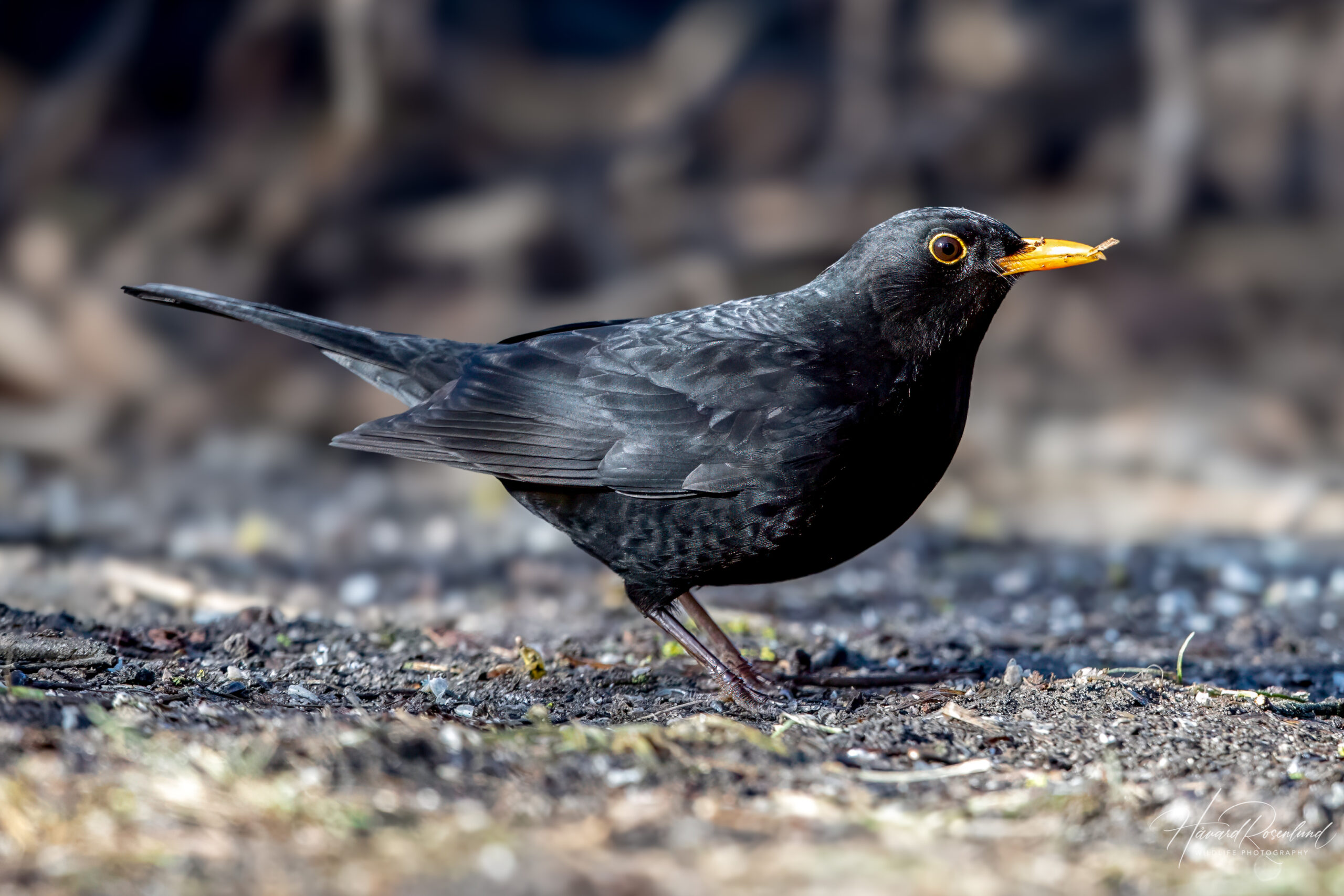
Eurasian Blackbird
Turdus merula
At a glance
Habitat
- Woodland, scrub, hedges, parks, gardens and other green spaces
Diet
- Earthworms, insects and other invertebrates; fruit and berries especially in autumn and winter
Activity
- Diurnal; song and activity often peak around dawn and dusk
Size
- Length: 23–29 cm Weight: 102 g
Range
- Europe, western and central Asia and North Africa
Description
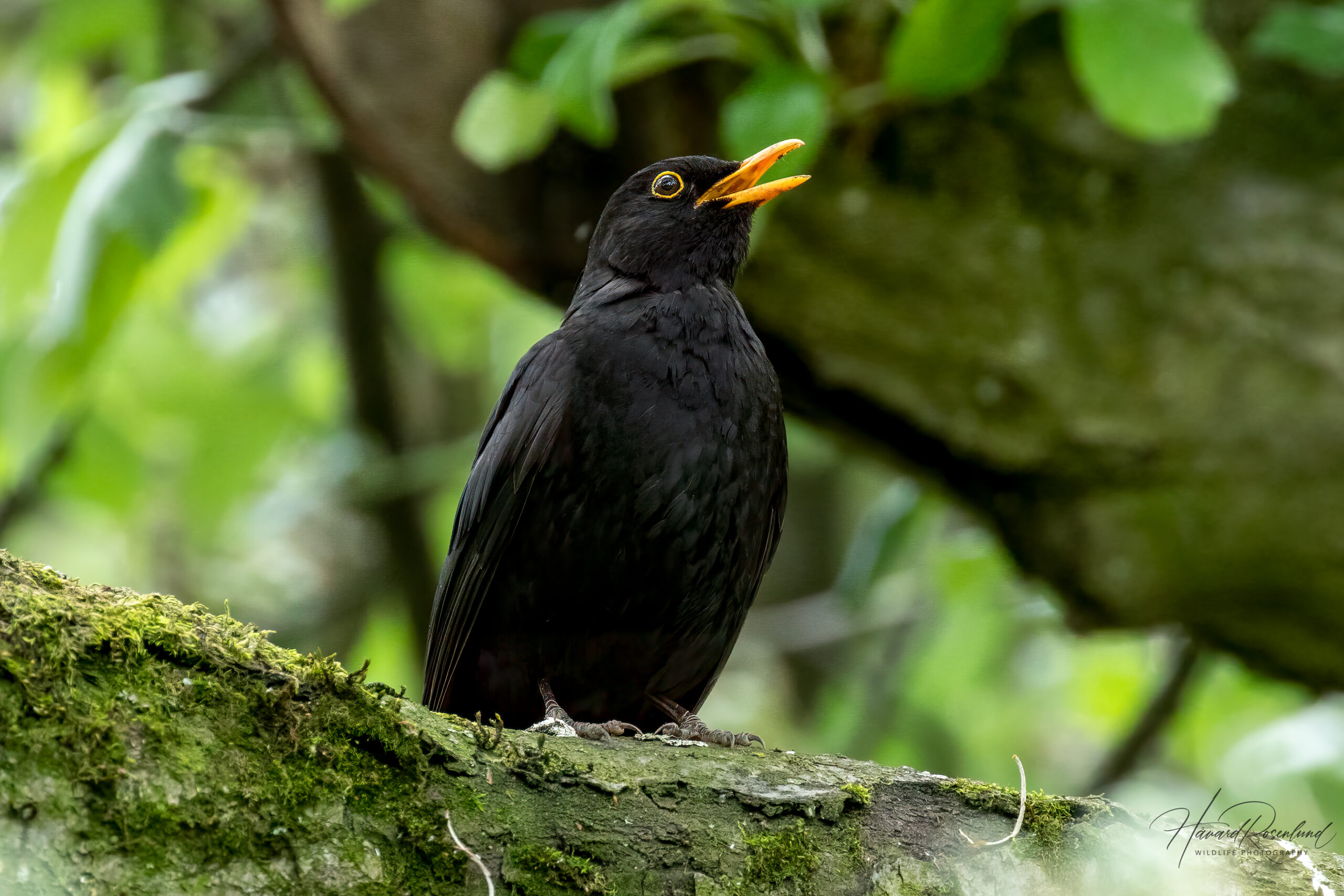
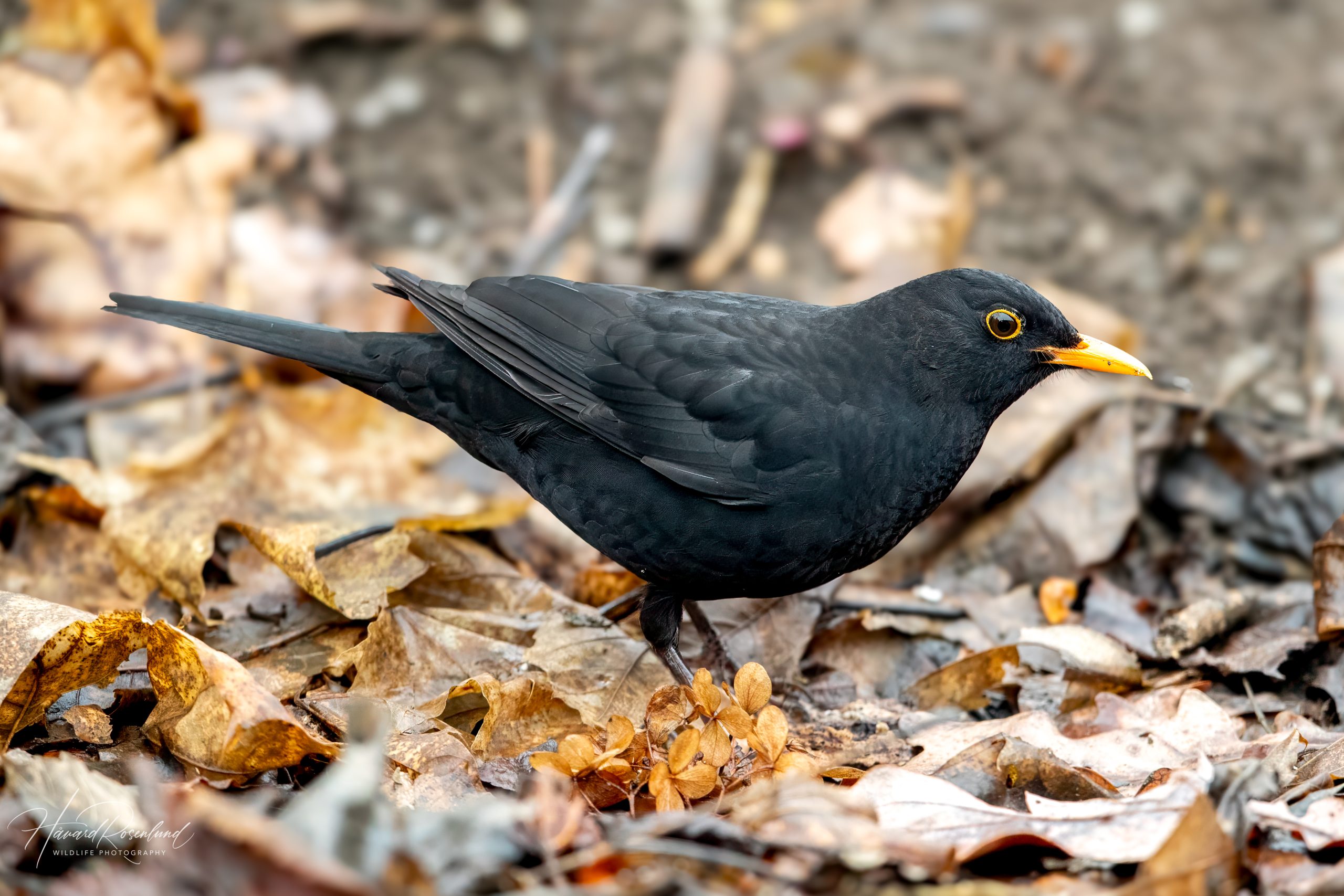
The Eurasian blackbird (Turdus merula) is a familiar medium-sized thrush native to Europe, parts of western and central Asia and North Africa. Adults are about 23–29 cm long, have a wingspan of roughly 34–38.5 cm and average around 102 g. The sexes are strikingly different: adult males are almost entirely black with a yellow-orange bill and eye-ring, whereas females are brown, often with mottling on the throat and breast. Juveniles are browner and more heavily spotted.
The male’s rich, fluting song, usually delivered from an exposed perch around dawn and dusk, is one of the characteristic sounds of European gardens and woodland. The species has also adapted extremely well to towns and suburbs, where its familiar song and ground-foraging behaviour make it one of the most conspicuous thrushes.
Habitat
Blackbirds occupy woodland with a well-developed understorey, scrub, hedges, parks, gardens and other green spaces. Dense low vegetation provides cover and nest sites, while nearby open soil, lawns and leaf litter give access to food.
The species has become particularly successful in urban and suburban areas. Parks and gardens often provide the same combination of dense cover and open feeding ground found at woodland edges, and urban birds can adjust where and when they feed in response to human disturbance rather than abandoning otherwise suitable habitat.
Diet
Earthworms, insects, spiders and other invertebrates form much of the diet during spring and summer, while fruit and berries become increasingly important from late summer through winter. Seeds and other plant material are also taken.
Blackbirds forage mostly on or close to the ground. They run and pause across lawns or leaf litter, turn leaves aside with the bill and probe soft soil for hidden prey. This flexible switch between animal prey and seasonal fruit helps the species thrive in a wide range of both natural and human-modified habitats.
Behaviour
Blackbirds are strongly territorial during breeding. Males advertise territories with song from prominent perches and may chase rivals vigorously, while pairs remain closely tied to a relatively small nesting area. Outside breeding, territoriality weakens and birds can tolerate one another more readily where food is abundant.
Urban blackbirds are also highly flexible in how they respond to people. A study of three urban parks in Madrid found that birds disturbed by pedestrians were more vigilant, spent less time feeding and stayed closer to protective cover. A long-term study published in 2026, based on repeated measurements of the same urban blackbirds across years, also found strong individual differences in escape distance, which varied with age and sex. Adult males generally allowed a closer approach than females.
Migration
Migration varies markedly across the range. Many blackbirds in western and southern Europe are resident, while birds from colder northern and eastern regions are more likely to move south or west for winter. Northern European birds commonly winter in western Europe, so winter populations in milder regions can contain both local residents and migrants that have arrived from farther north.
Partial migration also occurs within single populations. A seven-year study using marking and tracking in southern Germany found that migratory blackbirds had a roughly 16% higher probability of surviving the winter than resident birds in that population. This shows that leaving the breeding area can bring a measurable benefit even though migration itself is costly.
Breeding
The female builds a substantial cup nest from grasses, roots and other plant material, usually reinforced with mud and placed in a shrub, hedge, tree, climbing plant or sheltered structure. A typical clutch contains 3–4 eggs.
The female incubates the eggs for 12–14 days, while both parents feed the chicks. Young usually leave the nest after about 14–16 days but remain dependent for a short period afterwards. Blackbirds can breed several times in one season where conditions are favourable, and two or three broods are common.
Introduced populations
Blackbirds were introduced to Australia and New Zealand during the 19th century and are now firmly established in both regions. In New Zealand, the species is widespread across the main islands and occurs in habitats ranging from gardens and farmland to native forest. In Australia, it is concentrated mainly in the southeast and Tasmania, but has also spread into bushland.
Its ecological effects are mixed. Blackbirds eat large quantities of fruit and can disperse the seeds of introduced weeds, helping some invasive plants spread into natural vegetation. At the same time, they also disperse seeds of some native fleshy-fruited plants and consume snails, slugs, insects and other invertebrates. In New Zealand, despite the species being extremely widespread, no clear negative impact on native bird species has been demonstrated. In Australia, blackbirds are often regarded as pests in gardens and orchards and can disturb ground vegetation while foraging.
Status
The Eurasian blackbird is classified as least concern on the IUCN Red List. It has a very large range and remains one of Europe’s most familiar birds.
Population trends differ regionally. The species has benefited greatly from gardens and urban green spaces in many areas, while habitat change and severe weather can cause local declines. Disease can also have a substantial regional impact: the mosquito-borne Usutu virus has reduced blackbird survival and contributed to recent declines in parts of southeast England.
Image gallery
Loading map and observations…
Have you seen this species?
Independent species archive
Did you find this species page useful?
Wildlife Vagabond is independently built and maintained. Voluntary support helps cover hosting, maps, data storage and continued improvements to the species archive.
Support Wildlife VagabondSpecies content will remain freely available.
References
Information about the species’ global distribution and status is based primarily on global Red List data. See the references below for details.
- BirdLife Australia. (n.d.). Common Blackbird. https://birdlife.org.au/bird-profiles/common-blackbird/
- BirdLife International. (n.d.). Eurasian Blackbird species factsheet. https://datazone.birdlife.org/species/factsheet/eurasian-blackbird-turdus-merula
- British Trust for Ornithology. (n.d.). Blackbird. https://www.bto.org/learn/about-birds/birdfacts/blackbird
- Fernández-Juricic, E., & Tellería, J. (2000). Effects of human disturbance on spatial and temporal feeding patterns of Blackbird Turdus merula in urban parks in Madrid, Spain. Bird Study, 47(1), 13-21. https://doi.org/10.1080/00063650009461156
- International Union for Conservation of Nature. (n.d.). Eurasian Blackbird. The IUCN Red List of Threatened Species. https://www.iucnredlist.org/species/103888106/87871094
- Lawson, B., Robinson, R. A., Briscoe, A. G., Cunningham, A. A., Fooks, A. R., Heaver, J. P., Hernández-Triana, L. M., John, S. K., Johnson, N., Johnston, C., Lean, F. Z. X., Macgregor, S. K., Masters, N. J., McCracken, F., McElhinney, L. M., Medlock, J. M., Pearce-Kelly, P., Seilern-Moy, K., Spiro, S., … Folly, A. J. (2022). Combining host and vector data informs emergence and potential impact of an Usutu virus outbreak in UK wild birds. Scientific Reports, 12(1), 10298. https://doi.org/10.1038/s41598-022-13258-2
- New Zealand Birds Online. (n.d.). Eurasian blackbird. https://www.nzbirdsonline.org.nz/species/eurasian-blackbird
- Snow, D. W. (1956). Territory in the blackbird <i>Turdus merula</i>. Ibis, 98(3), 438-447. https://doi.org/10.1111/j.1474-919X.1956.tb01428.x
- Wysocki, D., Modelska, Z., Opolska, M., & Minias, P. (2026). Age, sex and individual identity are associated with the escape behaviour of Common Blackbirds (Turdus merula) in a European city. Ibis, 168(2), 701-710. https://doi.org/10.1111/ibi.70029
- Zúñiga, D., Gager, Y., Kokko, H., Fudickar, A. M., Schmidt, A., Naef-Daenzer, B., Wikelski, M., & Partecke, J. (2017). Migration confers winter survival benefits in a partially migratory songbird. eLife, 6, e28123. https://doi.org/10.7554/eLife.28123