
Hamerkop
Scopus umbretta
At a glance
Habitat
- Rivers, streams, marshes, lake shores, floodplains, irrigated land and other shallow wetlands
Diet
- Frogs and tadpoles, fish, aquatic invertebrates and occasional small vertebrates
Activity
- Diurnal
Size
- Length: 50–56 cm Weight: about 400–470 g
Range
- Sub-Saharan Africa, Madagascar and a small area of southwestern Arabia
Description
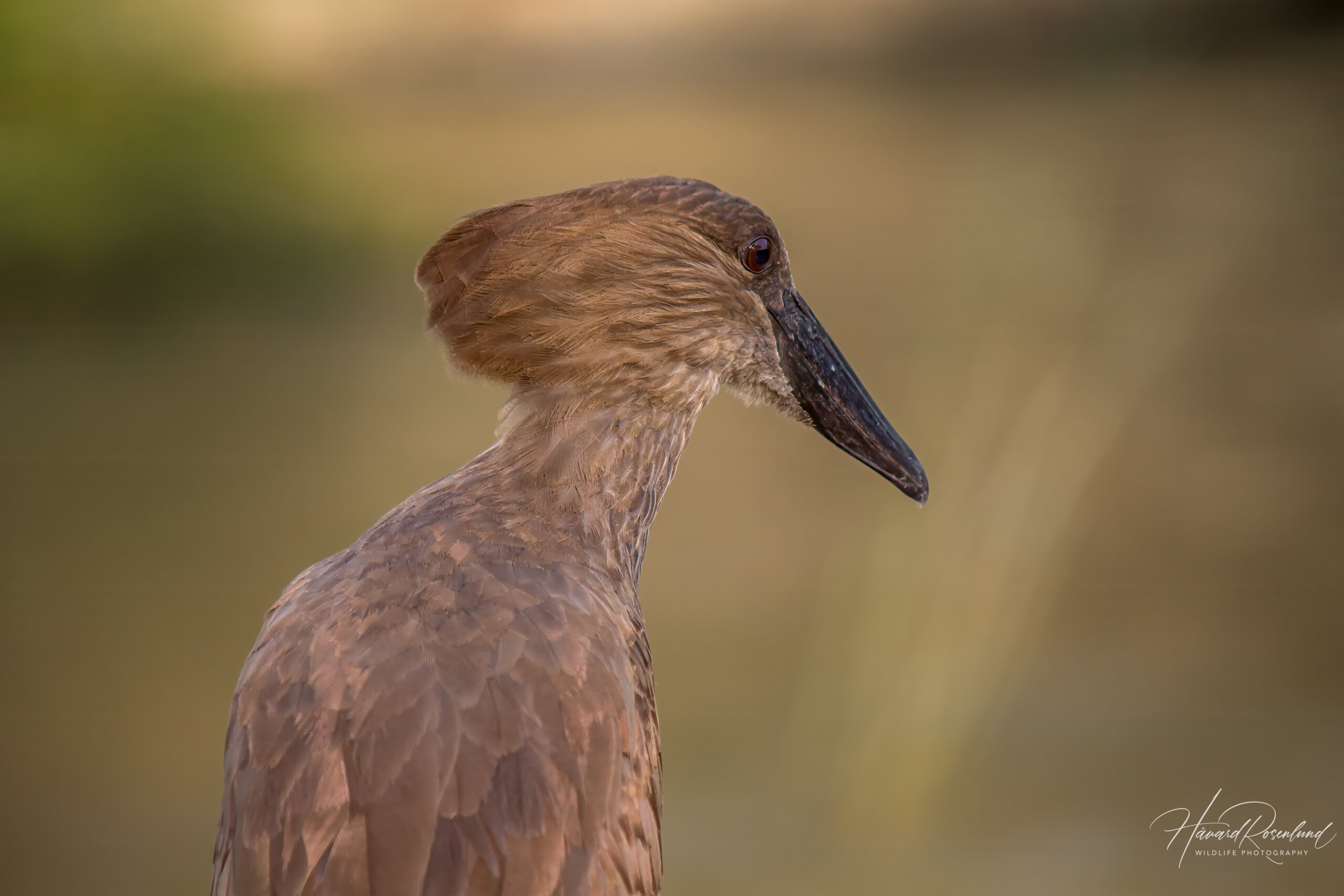
The hamerkop (Scopus umbretta) is a distinctive medium-sized waterbird and the only living member of the family Scopidae. It measures about 50–56 cm and weighs roughly 400–470 g. The name comes from the hammer-like outline formed by the long bill and backward-pointing crest.
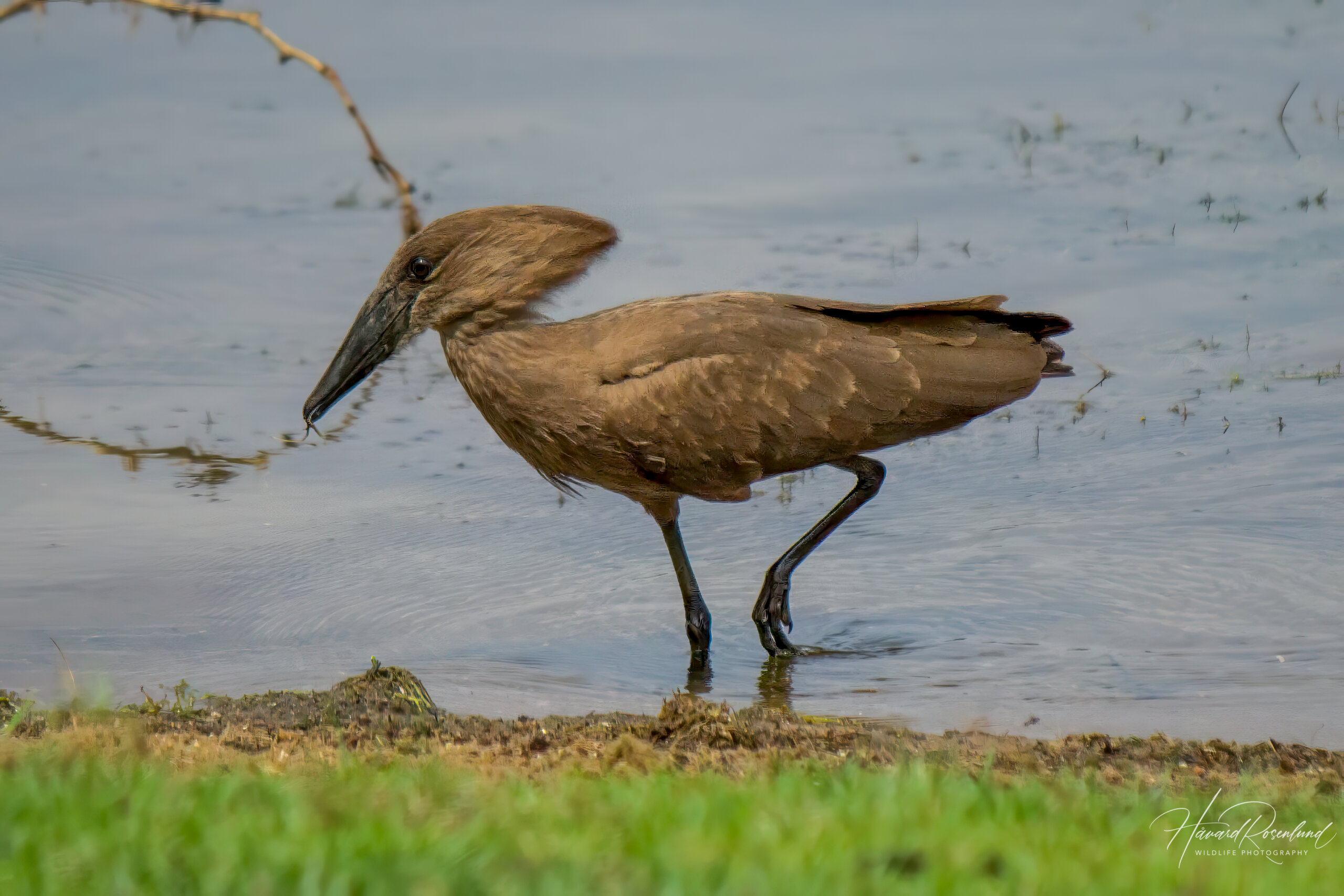
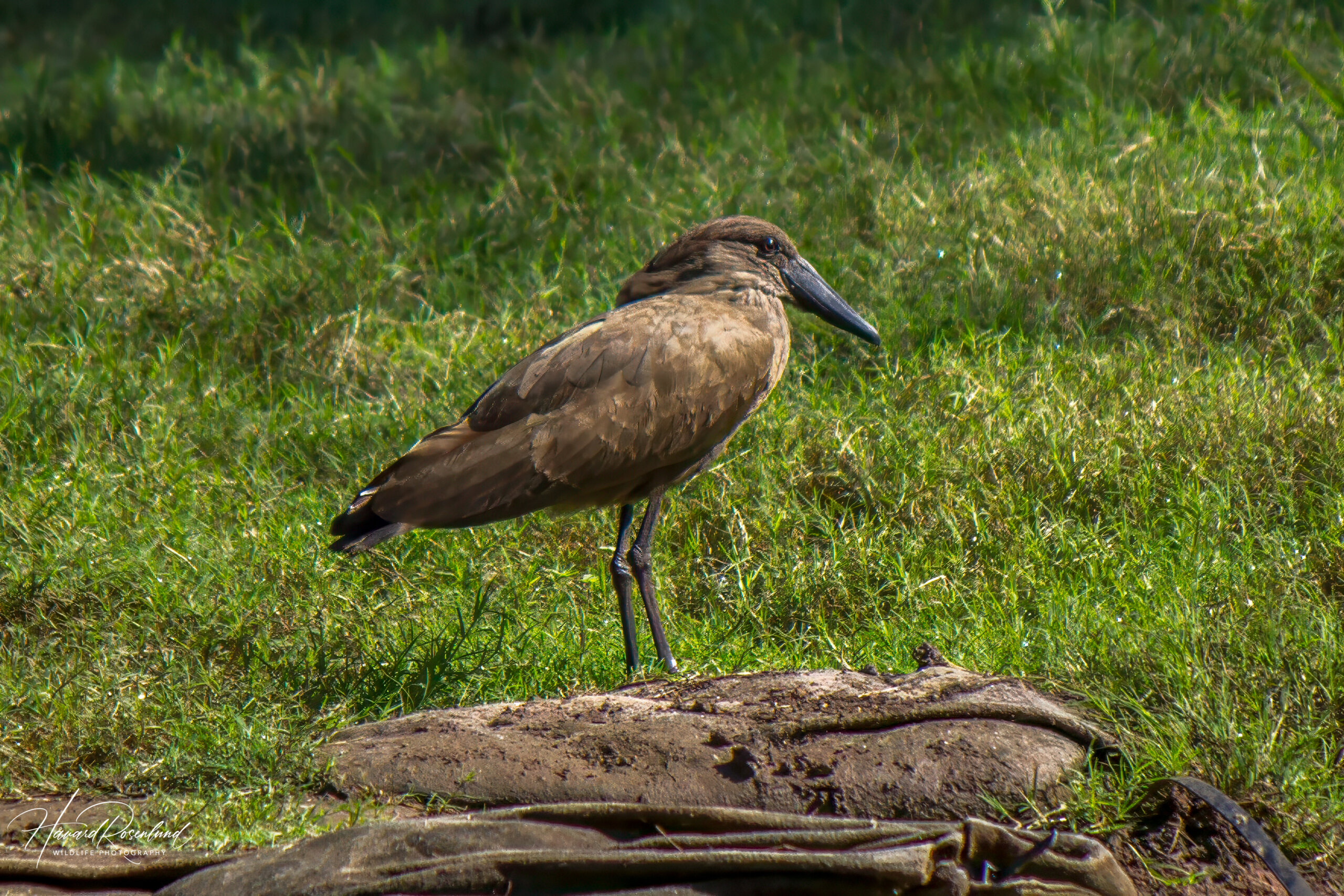
The plumage is uniformly umber-brown, with black legs and a long dark bill. In flapping flight the neck is partly retracted, while it may be extended during gliding or soaring. Genetic evidence places the hamerkop in the same major waterbird lineage as pelicans and shoebills.
Habitat
Hamerkops live close to water and use rivers, streams, marshes, lake margins, floodplains, dams, irrigation channels and even small roadside pools. They occur in landscapes ranging from savanna and farmland to woodland and forest wherever shallow feeding water is available.
Diet
Frogs and tadpoles are important prey, supplemented by fish, aquatic insects, crustaceans, worms and occasional small mammals or reptiles.
Foraging
Hamerkops usually feed alone or in pairs in shallow water. They walk slowly while watching for movement, probe mud and vegetation and may stir prey from cover with the feet or partly opened wings. They may also hunt from the backs of hippos or follow cattle, buffalo or banded mongooses to take small animals flushed by the movement of the larger animals.
They can exploit very small or temporary pools as well as larger wetlands, which helps them persist in agricultural and other human-modified landscapes where suitable shallow water remains.
Behaviour
Hamerkops are diurnal and are often seen alone or as a pair, although several birds may gather at rich feeding sites or around nests. Home ranges can overlap substantially and the species is generally less strongly territorial than many other large waterbirds.
Pairs and other interacting birds use calls, raised crests, wing-fluttering and circling movements. Birds may also mount one another outside mating contexts, and some briefly stand on top of one another. The function is uncertain and may vary with social context, so it should not be interpreted simply as dominance behaviour.
Breeding
The hamerkop is famous for building one of the most extraordinary nests of any bird. Both members of a pair construct the huge enclosed structure from sticks, reeds, grass and mud. A completed nest can be around 1.5 m across, approach 2 m in depth and weigh many tens of kilograms. A side tunnel leads to an internal chamber protected by thick walls.
Construction can continue through much of the year. A study published in 1987 in central Mali found that each pair built about 2.9–4.5 nests annually, with some used for breeding, others for roosting and older structures repaired and reused. Pairs may therefore invest in several large structures within the same home range.
Breeding timing varies with rainfall and water conditions and can occur during much of the year. Clutches usually contain about three to seven eggs, although the Mali study recorded four to eight. Both parents incubate for approximately 26–30 days and feed the chicks.
The enclosed chamber allows adults to leave the young unattended for periods while both forage. Chicks fledge at roughly 44–50 days and may continue using the nest as a roost after they can fly.
Nest reuse
Hamerkop nests remain ecologically valuable even when the builders are not breeding in them. A 2023 review documented at least 20 bird species using hamerkop nests for breeding across 18 African countries. Six species were recorded taking over nests from hamerkop pairs, nine nested inside the chamber and eight nested on top of the structure.
The barn owl (Tyto alba) was the most frequently reported avian occupant, while reptiles and small mammals also use the cavities. By creating large, durable structures that persist after the original builders leave, hamerkops provide nesting and shelter opportunities for many other animals.
Cultural significance
The hamerkop's enormous nests and unusual behaviour have given the species a distinctive place in several African traditions. In Zulu tradition, destroying a hamerkop nest has been associated with the danger of one's home catching fire, while Kalahari San traditions have linked robbing the nest with the risk of being struck by lightning.
Such beliefs vary among peoples and should not be treated as one shared African tradition, but they show that the bird and its monumental nests have long been regarded with considerable respect.
Status
The hamerkop is classified globally as least concern on the IUCN Red List. It has a vast range and uses some artificial water bodies, but no current global population estimate is available.
The 2025 regional assessment for South Africa, Lesotho and Eswatini classified the species as near threatened. It estimated fewer than 10,000 mature individuals in the region and considered the population to be declining. Degradation of rivers and wetlands, altered water flow, pollution, removal of large nesting trees and disturbance can reduce local populations.
Image gallery
Loading map and observations…
National Red List status
| Country | Status | Assessment | Source |
|---|---|---|---|
| South Africa | NTNear Threatened | Regional Red Data Book of Birds of South Africa, Lesotho and Eswatini 2025 | BirdLife South Africa – Regional Red Data Book 2025 |
Have you seen this species?
Independent species archive
Did you find this species page useful?
Wildlife Vagabond is independently built and maintained. Voluntary support helps cover hosting, maps, data storage and continued improvements to the species archive.
Support Wildlife VagabondSpecies content will remain freely available.
References
Information about the species’ global distribution and status is based primarily on global Red List data. See the references below for details.
- Biodiversity and Development Institute. (n.d.). Hamerkop Scopus umbretta species account. https://thebdi.org/2022/05/20/hamerkop-scopus-umbretta/
- BirdLife International. (n.d.). Hamerkop Scopus umbretta species factsheet. https://datazone.birdlife.org/species/factsheet/hamerkop-scopus-umbretta
- BirdLife South Africa. (2025). Hamerkop regional Red List assessment. https://www.birdlife.org.za/red-list/hamerkop/
- Gula, J., & Downs, C. T. (2023). Second-hand housing: a review of avian species using Hamerkop nests for breeding. African Zoology, 58(1), 1-5. https://doi.org/10.1080/15627020.2023.2188905
- International Union for Conservation of Nature. (n.d.). Scopus umbretta (Hamerkop). The IUCN Red List of Threatened Species. https://www.iucnredlist.org/species/22697356/93610351
- Kahl, M. P. (1967). Observations on the behaviour of the Hamerkop Scopus umbretta in Uganda. Ibis, 109(1), 25–32. https://doi.org/10.1111/j.1474-919X.1967.tb00004.x
- South African National Biodiversity Institute. (n.d.). Hamerkop: natural history, behaviour and cultural beliefs. https://www.sanbi.org/animal-of-the-week/hamerkop/
- Wilson, R. T., & Wilson, M. P. (1986). Nest building by the hamerkop <i>Scopus umbretta</i>. Ostrich, 57(4), 224-232. https://doi.org/10.1080/00306525.1986.9633660
- Wilson, R. T., Wilson, M. P., & Durkin, J. W. (1987). Aspects of the reproductive ecology of the Hamerkop Scopus umbretta in central Mali. Ibis, 129(2), 382-388. https://doi.org/10.1111/j.1474-919X.1987.tb03182.x