
Black Rhinoceros
Diceros bicornis
At a glance
Habitat
- Scrub, savanna, woodland and desert margins
Diet
- Browser: leaves, shoots, twigs and fruit
Activity
- Flexible; often crepuscular or nocturnal in hot conditions
Size
- Length: 2.8–3.8 m Weight: 800–1,400 kg
Range
- Fragmented populations in eastern and southern Africa
Description
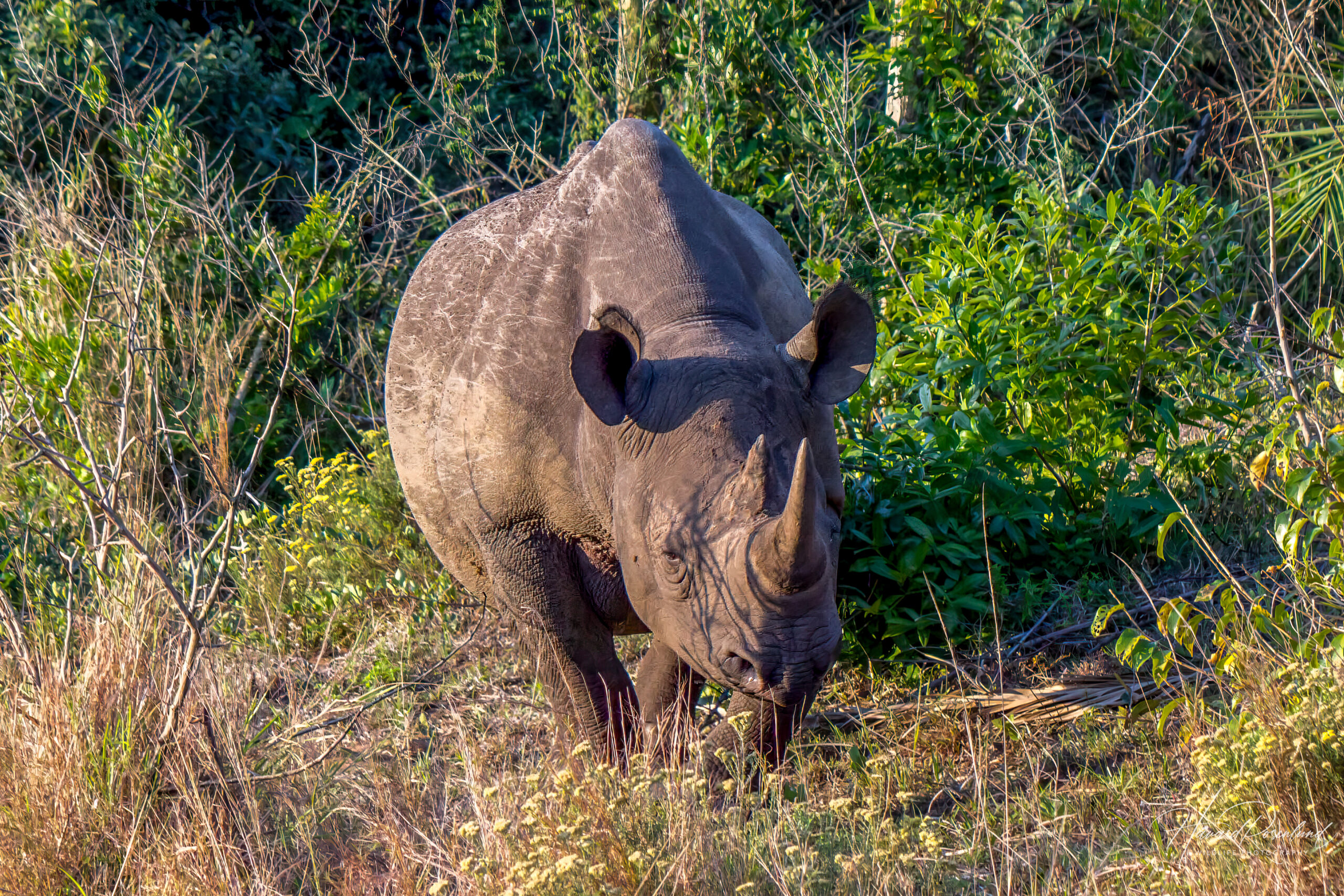
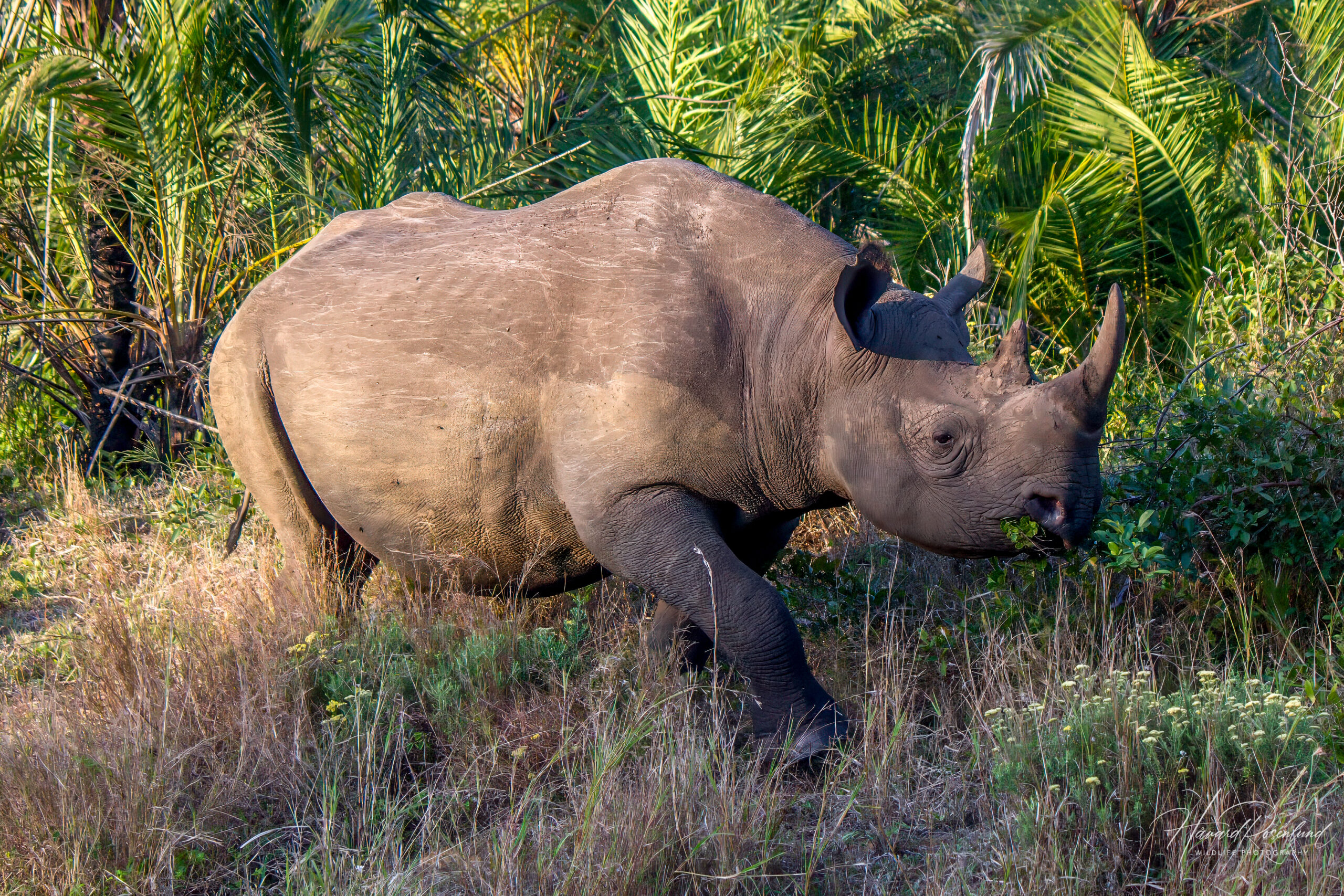
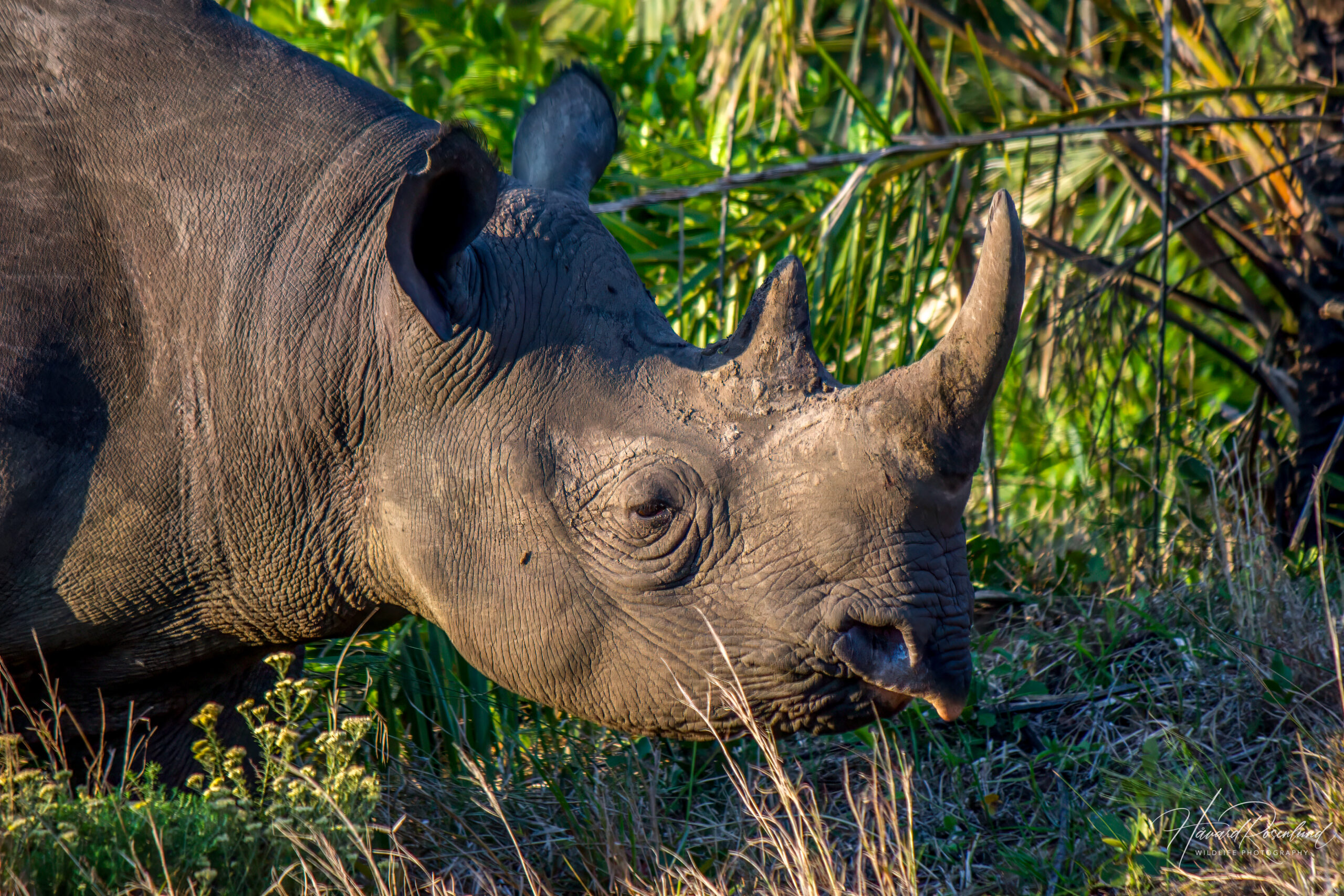
The black rhinoceros (Diceros bicornis), or hook-lipped rhinoceros, is the smaller of Africa’s two living rhino species. Both black and white rhinos are normally grey; the black rhino is better recognised by its pointed, grasping upper lip.
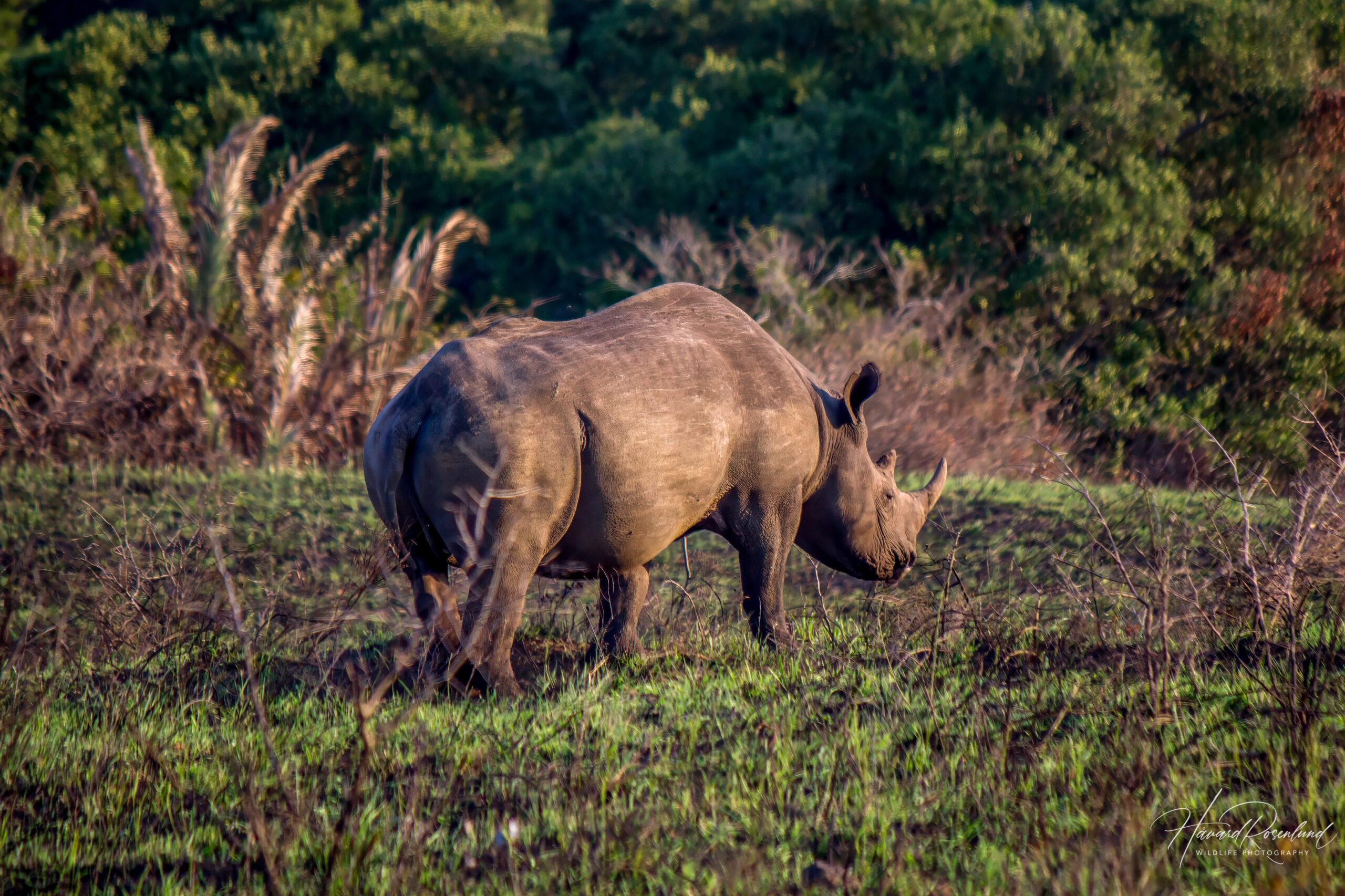
Compared with the white rhinoceros, the black rhinoceros has a shorter, more compact build, a smaller head, a more arched back profile and a much less pronounced neck hump. It also carries its head higher because it browses leaves and twigs from bushes and trees rather than grazing with its head close to the ground. Together, these traits give it a more upright appearance, and the silhouette is often easier to recognise at a distance than the shape of the lip.
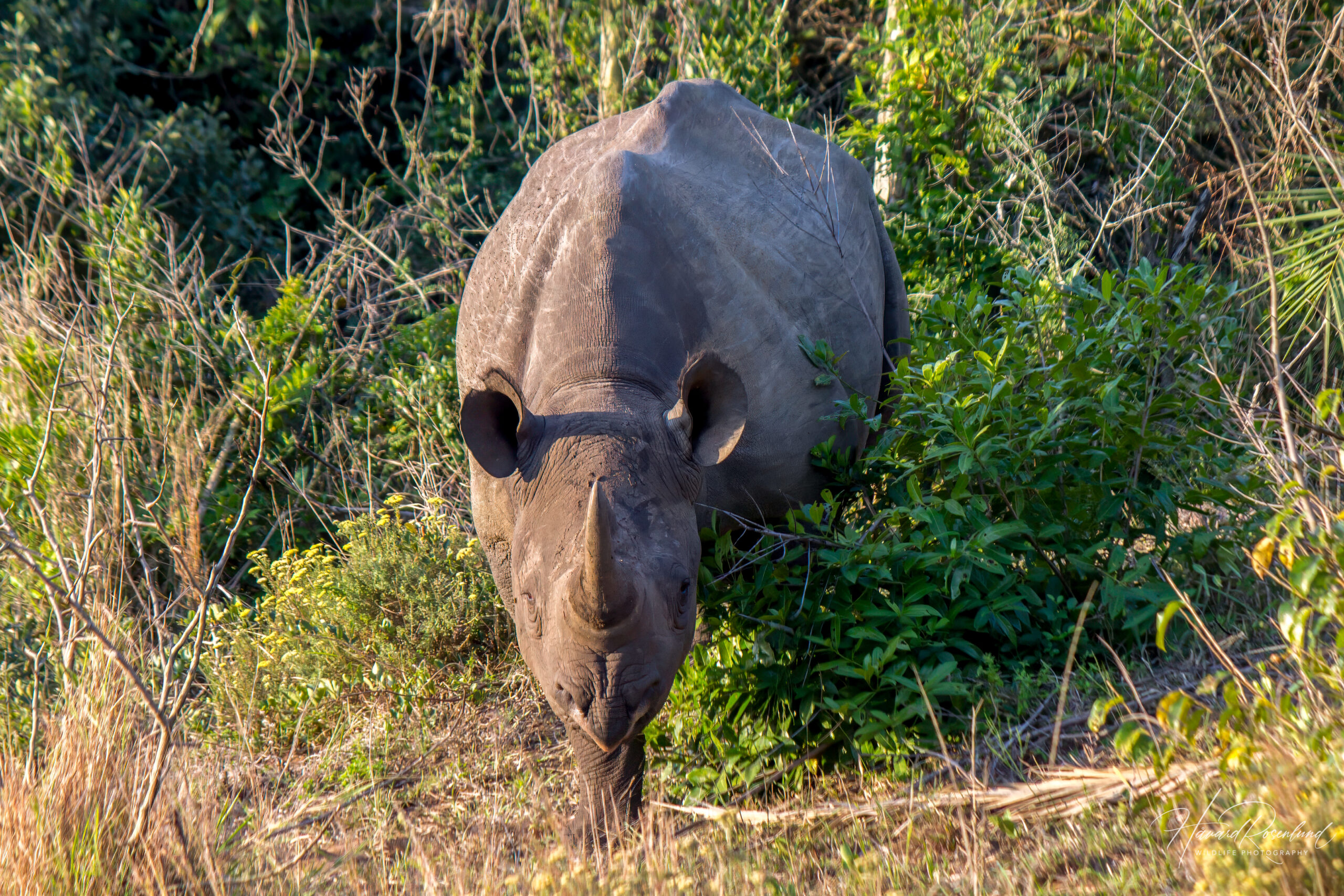
Adults stand about 132–180 cm at the shoulder, reach roughly 2.8–3.8 m in length and usually weigh 800–1,400 kg. Both sexes normally have two horns made mainly of keratin. The front horn is much larger, usually around 50 cm long, but can reach about 1.3 m in exceptional animals. The rear horn can reach about 55 cm. Shape also varies: males tend to have thicker horns, while females often carry longer and slimmer ones. The horns grow throughout life and are continually reshaped by wear, scraping and fighting.
Taxonomy
The black rhinoceros is the only living species in Diceros. Three subspecies survive: south-central D. b. minor (about 2,720 animals at the end of 2024), south-western D. b. bicornis (about 2,597) and eastern D. b. michaeli (about 1,471).
The names reflect the geographic centres of the subspecies. The south-central black rhinoceros has its largest populations in north-eastern South Africa and Zimbabwe, with smaller populations extending north through countries including Zambia, Malawi and Tanzania and reintroduced populations elsewhere in southern Africa. The south-western black rhinoceros belongs to the arid far south-west of the continent and is found mainly in Namibia and western parts of South Africa. The eastern black rhinoceros has its principal stronghold in Kenya, with a smaller population in northern Tanzania; some animals have also been moved to reserves outside the original range.
The western black rhinoceros (D. b. longipes) was declared extinct in 2011. The marked regional differences among the surviving populations make genetic compatibility an important consideration when animals are translocated.
Habitat
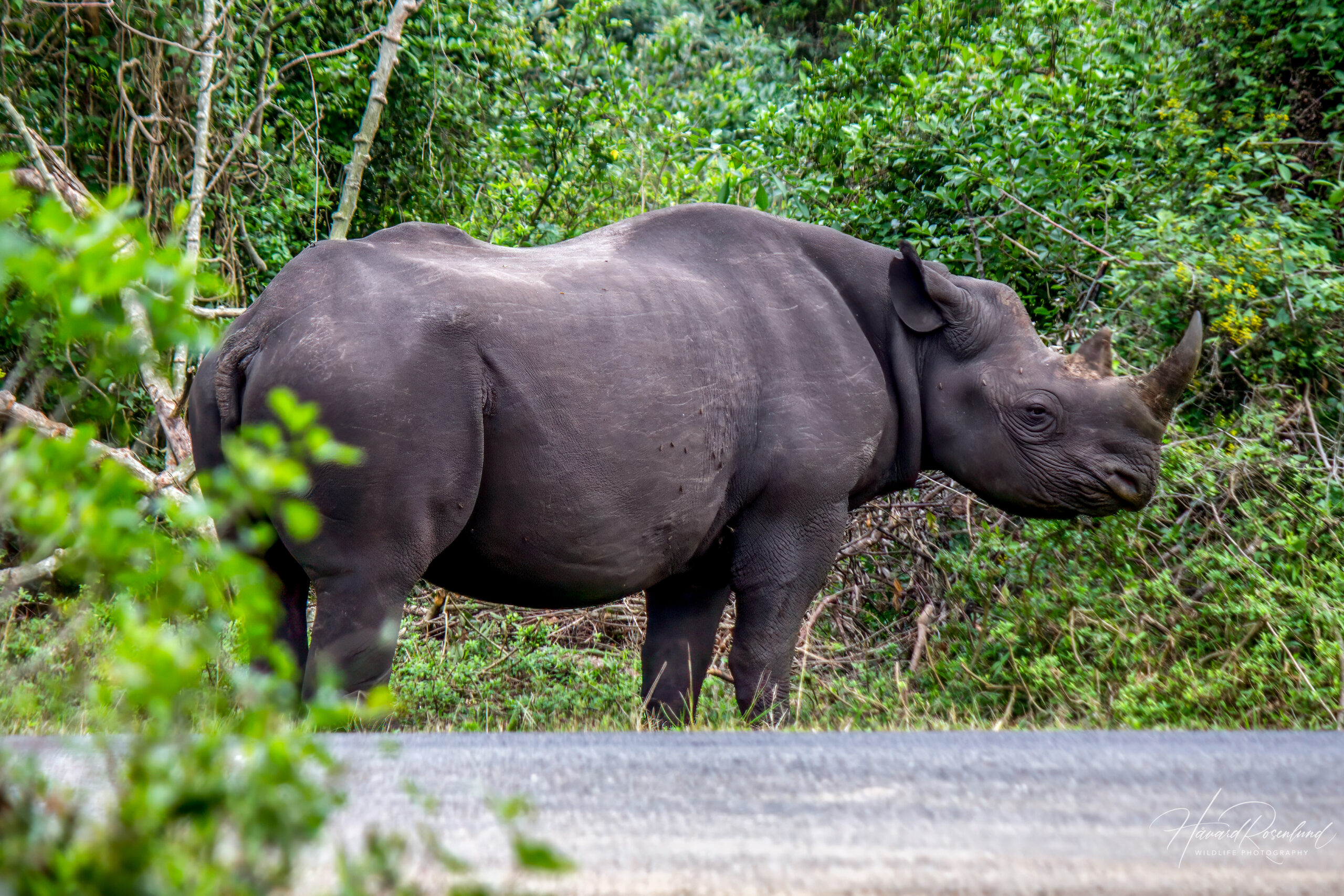
Black rhinos live in thorn scrub, bushland, savanna, open woodland and desert margins. Across much of this broad habitat range they favour dense scrub and thicket, especially where shrubs and low trees provide both browse and cover. This contrasts clearly with the grazing white rhinoceros (Ceratotherium simum), which is much more often found in open grassland. Habitat use nevertheless changes with rainfall, water and food availability, and south-western populations can also live in very open, arid country.
Habitat choice is also an important reason black rhinos are often harder to see than white rhinos. Even an animal weighing more than a tonne can disappear surprisingly completely into dense thorn scrub. In hot weather they often rest in shade during the middle of the day and become more active in the evening, at night and early in the morning.
Diet
Black rhinos are specialised browsers. Their flexible upper lip pulls leaves, shoots, twigs and fruit from shrubs and trees, while the thick skin helps them move through thorny vegetation.
Unlike the grazing white rhinoceros (Ceratotherium simum), they are built for picking food from woody plants. Heavy browsing can gradually change the shape and density of vegetation.
Seed dispersal
Fruit also makes black rhinos important seed carriers. A 2025 experiment with camel thorn (Vachellia erioloba) found that seeds recovered from rhino dung germinated better overall than untreated seeds.
Rhinos repeatedly use communal dung middens, concentrating seeds and nutrients at particular sites and linking their movements with plant regeneration.
Behaviour
Black rhinos have poor eyesight but excellent hearing and smell. Their ears turn independently towards sounds, and they regularly use well-worn paths, mud wallows and rubbing sites.
Black rhinos are shy and difficult to approach, but are also known for a nervous temperament and a very short fuse. They are far more likely to charge than white rhinos, and if surprised at close range, especially in thick vegetation, an animal may rush at whatever it perceives as a threat. Poor eyesight means it may not identify the disturbance before reacting. A surprised black rhino is therefore among the most dangerous large mammals to encounter on foot in the African bush.
Social behaviour
Adults often spend time alone, except for mothers with calves, but the species is not strictly solitary. Females can form multi-year associations with other females, and temporary gatherings occur around food, water and other important sites.
Scent is central to communication. Rhinos use shared dung middens and urine marking and investigate scent traces left by other individuals. This helps them keep track of neighbours and allows males to detect when a female is ready to mate.
Home ranges
Black rhino home ranges vary greatly between habitats, although the figures also depend on how the areas are calculated. In a standardised study in Hluhluwe-iMfolozi Park, the average was between about 10 and 20 km² depending on the method used. Estimates of up to 3,000 km² have been published from arid Namibia, but differences in data and methodology mean that the extremes cannot be compared directly.
The broad pattern is nevertheless that animals need more space where food and water are more widely scattered. Male and female ranges can overlap substantially, so a home range is not the same as an exclusive territory. This is important for management because fenced reserves must contain enough food, water and space for several individuals with overlapping ranges.
Predation
Adult black rhinos have few natural predators, but calves can be killed by both lions (Panthera leo) and spotted hyenas (Crocuta crocuta). Lion attacks on older juveniles have also been documented, including in Etosha, although such events are unusual.
Young calves stay close to their mothers, who may place themselves between the calf and an attacker and use their horns in defence. Predation is usually far less important than poaching, but can matter locally in very small populations.
Reproduction
After detecting an oestrous female through her scent marks, a male may follow her for several days or weeks. Rival males may fight for access, and the pair may mate repeatedly before separating.
Pregnancy lasts about 15–16 months and normally produces one calf. The calf remains with its mother for two to three years and often becomes independent when she is preparing for another calf.
Females usually mature at about five to seven years and males at seven to eight. Slow reproduction means populations cannot quickly replace losses. Black rhinos may live for roughly 35–50 years.
Cultural significance
Rhinos have long carried symbolic meaning in southern Africa. Research drawing on archaeology, oral traditions and historical sources found that farming communities used the black rhino’s more solitary and forceful character as a model of chiefly power and leadership, alongside the contrasting social and territorial qualities associated with the white rhinoceros (Ceratotherium simum).
Rhinos more generally appear in chiefly praise poetry, initiation traditions, rainmaking practices and symbols of authority. The famous gold rhinoceros from Mapungubwe is one of the best-known archaeological examples, although it cannot be confidently assigned to one living rhino species. Rhino horn also acquired cultural value far beyond Africa: it was historically used in traditional medicine and carved objects in parts of East Asia and for jambiya dagger handles in Yemen.
Status
The black rhinoceros is Critically Endangered on the IUCN Red List. An estimated 100,000 animals remained in 1960, but the population fell to roughly 2,300 by the mid-1990s.
Protection and careful population management have since produced a slow recovery. The latest continent-wide estimate is 6,788 animals at the end of 2024, 5.2% more than in 2023, but the species remains far below its former abundance.
Threats
Poaching for rhino horn remains the most immediate threat. Rhino horn is mainly keratin and has no proven medicinal benefit, but illegal demand continues. Habitat loss and small, isolated populations add further pressure.
South Africa recorded 352 rhinos poached in 2025, 16% fewer than the 420 recorded in 2024. The figures include both African rhino species, not black rhinos alone, but show that poaching remains a major problem.
Conservation
Recovery has depended on intensive protection, monitoring and translocations to establish or strengthen breeding populations. The Black Rhino Range Expansion Project is one example of creating additional secure populations and giving growing groups more space.
Dehorning is also used as a preventive measure in vulnerable populations, but it cannot replace guarding and other protection. A study of 368 black rhinos in ten South African reserves found that dehorned animals used home ranges that were 45.5% smaller on average and were 37% less likely to engage in social encounters. The study found no increase in natural mortality, but shows that an anti-poaching measure can also alter the species’ natural behaviour.
South Africa published a revised Black and White Rhino Biodiversity Management Plan in April 2026, bringing both species into one national framework for protection, population growth, habitat and cooperation between government, private reserves and other range states.
Long-term recovery also depends on populations being large and connected enough to maintain strong reproduction and retain genetic diversity.
Conservation organizations

Image gallery
Loading map and observations…
National Red List status
| Country | Status | Assessment | Source |
|---|---|---|---|
| South Africa | CRCritically Endangered | Red List of South African Species 2016 | SANBI – Red List of South African Species |
Have you seen this species?
Independent species archive
Did you find this species page useful?
Wildlife Vagabond is independently built and maintained. Voluntary support helps cover hosting, maps, data storage and continued improvements to the species archive.
Support Wildlife VagabondSpecies content will remain freely available.
References
- Boeyens & Van der Ryst. (2014). The cultural and symbolic significance of the African rhinoceros. Southern African Humanities, 26, 21–55. https://www.sahumanities.org/index.php/sah/article/view/394
- Brain, C., Forge, O., & Erb, P. (1999). Lion predation on black rhinoceros (Diceros bicornis) in Etosha National Park. African Journal of Ecology, 37(1), 107-109. https://doi.org/10.1046/j.1365-2028.1999.00137.x
- Duthé, V., Odendaal, K., Van der Westhuizen, R., Church, B., Naylor, S., Boshoff, S., Venter, M., Prinsloo, M., Ngwenya, P., Hanekom, C., Kelly, C. P., Walker, T. W. N., Rasmann, S., & Defossez, E. (2023). Reductions in home-range size and social interactions among dehorned black rhinoceroses (Diceros bicornis). Proceedings of the National Academy of Sciences, 120(25), e2301727120. https://doi.org/10.1073/pnas.2301727120
- Goddard, J. (1966). Mating and courtship of the black rhinoceros. African Journal of Ecology, 4(1), 69-75. https://doi.org/10.1111/j.1365-2028.1966.tb00883.x
- Hitchins, P. M., & Anderson, J. L. (1983). Reproduction, population characteristics and management of the black rhinoceros <i>Diceros bicornis minor</i> in the Hluhluwe/Corridor/Umfolozi Game Reserve complex. South African Journal of Wildlife Research, 13(3), 78–85. https://rhinoresourcecenter.com/wp-content/uploads/2006/12/1183010221.pdf
- International Rhino Foundation. (n.d.). State of the Rhino 2025. https://rhinos.org/about-rhinos/state-of-the-rhino/
- International Union for Conservation of Nature. (2025). African rhino numbers and poaching trends. The IUCN Red List of Threatened Species. https://iucn.org/press-release/202508/poaching-african-rhinos-down-drought-and-other-threats-drive-losses-globally
- International Union for Conservation of Nature. (n.d.). Diceros bicornis (Black Rhinoceros). The IUCN Red List of Threatened Species. https://www.iucnredlist.org/species/6557/16980917
- International Union for Conservation of Nature. (n.d.). IUCN SSC African Rhino Specialist Group Report 2024–2025. The IUCN Red List of Threatened Species. https://iucn.org/sites/default/files/2025-09/2024-2025-iucn-ssc-african-rhino-sg-report_publication.pdf
- Jones, O. E., Beckett, H., Abraham, A. J., Makunga, N. P., & Midgley, G. F. (2025). Endozoochory by Black Rhinoceroses Enhances Germination of a Key Arid Savanna Tree Species. Ecology and Evolution, 15(9), e71951. https://doi.org/10.1002/ece3.71951
- Mammal Diversity Database. (n.d.). Diceros bicornis (Black Rhinoceros). American Society of Mammalogists. https://www.mammaldiversity.org/taxon/1006113/
- Plotz, R. D., Grecian, W. J., Kerley, G. I., & Linklater, W. L. (2016). Standardising Home Range Studies for Improved Management of the Critically Endangered Black Rhinoceros. PLOS ONE, 11(3), e0150571. https://doi.org/10.1371/journal.pone.0150571
- Rhino Resource Center. (n.d.). Rhino temperament and defensive charges. https://rhinoresourcecenter.com/facts/are-rhinos-aggressive/
- Save the Rhino International. (n.d.). Black rhino physical characteristics. https://www.savetherhino.org/rhino-info/rhino-species/black-rhinos/
- Save the Rhino International. (n.d.). Historical demand for rhino horn in Asia and Yemen. https://www.savetherhino.org/thorny-issues/tackling-the-demand-for-rhino-horn/
- Save the Rhino International. (n.d.). Rhino population figures. https://www.savetherhino.org/rhino-info/population-figures/
- South African Department of Forestry, Fisheries and the Environment. (2026). Black and White Rhino Biodiversity Management Plan. https://www.dffe.gov.za/node/5371
- South African Department of Forestry, Fisheries and the Environment. (2026). Rhino poaching statistics for 2025. https://www.dffe.gov.za/mediarelease/aucamp_16%25decline_antipoaching
- WWF. (n.d.). Black rhinoceros subspecies and geographic ranges. https://wwfeu.awsassets.panda.org/downloads/ecop13blackrhinofactsheet.pdf