
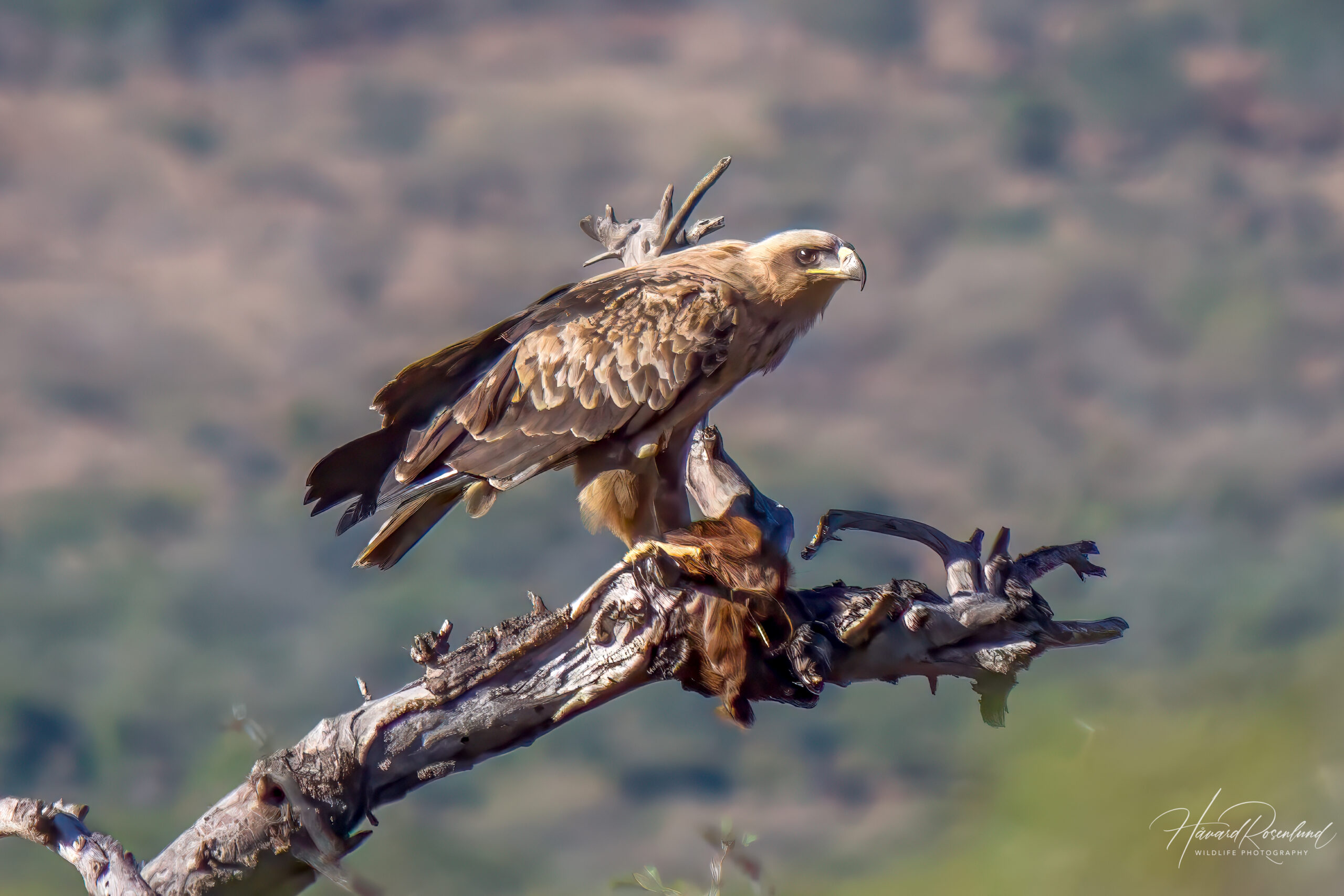
Tawny Eagle
Aquila rapax
At a glance
Habitat
- Open savanna, thornveld, grassland and semi-desert; avoids dense forest
Diet
- Carrion, small mammals, birds, reptiles, amphibians and large invertebrates
Activity
- Diurnal
Size
- Length: 65–77 cm Weight: 1.6–2.4 kg
Range
- Sub-Saharan Africa and parts of North Africa, Arabia and South Asia
Description
The tawny eagle (Aquila rapax) is a large, powerfully built eagle of open country. Adults are about 65–77 cm long and typically weigh around 1.6–2.4 kg, with females generally larger than males. Plumage is exceptionally variable, ranging from pale sandy or buff birds to rich tawny-brown and dark brown individuals. The bill is heavy, the wings broad, and the legs are feathered down to the toes, as in other booted eagles.
Large brown eagles can be difficult to identify. The steppe eagle (Aquila nipalensis) is usually larger and heavier-looking and has a longer gape extending to or beyond the rear of the eye. The smaller Wahlberg's eagle (Hieraaetus wahlbergi) is more slender and has rounded rather than vertically elongated nostrils. Plumage colour alone is unreliable, so structure, gape length, nostril shape, age and several plumage features should be considered together.
Tawny and steppe eagles were formerly treated together by some authorities, but differences in morphology, immature plumage and genetics support their recognition as separate species. Three subspecies of tawny eagle are generally recognised across Africa, Arabia and South Asia.
Habitat
Tawny eagles favour lightly wooded savanna, thornveld, grassland and semi-desert and generally avoid dense forest and high mountains. Open ground provides good opportunities to find food, while scattered trees and artificial structures provide nest sites and tall trees, cliffs and other high points are used as perches.
In southern Africa the species is now much more common inside protected areas than outside them. A smaller population also persists in the largely treeless Karoo, where electricity pylons have created nesting opportunities in landscapes that otherwise offer few natural supports for the large nests.
Diet
Tawny eagles have an exceptionally broad diet. They take small and medium-sized mammals, birds, reptiles, amphibians and large invertebrates, while carrion can form an important part of the food supply. What is eaten varies strongly with local abundance and temporary opportunities.
Hunting & scavenging
Tawny eagles combine active hunting with scavenging and food piracy. They search from perches and while soaring, descend on live prey when opportunities arise and readily investigate carcasses. Kleptoparasitism—stealing food caught or discovered by another animal—is also characteristic, with tawny eagles sometimes displacing smaller raptors or using the activity of other scavengers to locate food.
Home ranges
Breeding tawny eagles form territorial pairs, but the amount of space they use varies greatly with habitat, food availability and whether birds are resident or migratory. In the South African Karoo, breeding pairs are concentrated more closely in areas with abundant prey than in apparently suitable open country with fewer prey.
Seasonal ranges can be much larger in migratory populations. One tawny eagle tracked between Kazakhstan and western India used about 3,700 km² on its summering grounds and 4,800 km² in its wintering area in Rajasthan. These values come from a single bird and are not species averages, but they illustrate how dramatically space use can differ from the territories of established breeding pairs.
Breeding
Tawny eagles form long-term territorial pairs. During courtship, pairs may circle together and perform shallow undulating flights above the breeding area. Breeding timing varies geographically; in southern Africa much breeding takes place during the austral winter. The nest is a large stick platform placed in a tree or, increasingly in some areas, on an electricity pylon and is often lined with fresh green leaves. Pairs may reuse and enlarge a nest over successive seasons.
Clutches contain one to three eggs, most often one or two. Incubation lasts roughly six weeks and is mainly carried out by the female, while the male supplies much of the food early in the nesting cycle. Young remain in the nest for around 10–12 weeks and continue to depend on their parents after fledging. With a generation length of more than a decade and relatively few young, populations are poorly able to replace sustained mortality among adults.
Status
The tawny eagle is globally classified as vulnerable on the IUCN Red List. The global population has been estimated at roughly 100,000–499,999 mature individuals and is declining.
The situation is more severe in South Africa, Lesotho and Eswatini. BirdLife South Africa's 2025 regional Red Data Book classifies the species as endangered and estimates about 500–800 mature individuals. A continent-wide analysis published in 2024 also found very steep declines among African savanna raptors, with losses generally more severe outside protected areas.
Threats
Poisoning is one of the most serious direct threats. Because tawny eagles readily scavenge, they can be killed by poisoned carcasses intended for mammalian predators or by poisoning associated with poaching. Persecution based on perceived threats to livestock and poultry also causes mortality.
Habitat transformation, loss of prey, woody encroachment into open savannas and disturbance at nests further reduce habitat quality. Infrastructure creates additional risks through electrocution, collisions with vehicles while feeding on roadkill and collisions at wind-energy facilities. Many of these pressures are stronger outside protected areas, helping explain the species' growing dependence on reserves.
Conservation
Tawny eagle conservation depends especially on reducing preventable adult mortality while keeping extensive open savanna landscapes functional. Work in southern Africa includes poisoning awareness among landowners and livestock farmers, raptor monitoring and efforts to make human-modified landscapes safer for large birds of prey.
Stronger control of poisoning, bird-safe power infrastructure, adequate buffer zones around important nests and protected areas, and careful siting of wind-energy developments can reduce mortality. Protected areas remain crucial refuges, but tawny eagles range widely and regularly cross reserve boundaries, so surrounding landscapes also need to be safer.
Conservation organizations

Image gallery
Loading map and observations…
National Red List status
| Country | Status | Assessment | Source |
|---|---|---|---|
| South Africa | ENEndangered | Regional Red Data Book of Birds of South Africa, Lesotho and Eswatini 2025 | BirdLife South Africa – Regional Red Data Book 2025 |
Have you seen this species?
Independent species archive
Did you find this species page useful?
Wildlife Vagabond is independently built and maintained. Voluntary support helps cover hosting, maps, data storage and continued improvements to the species archive.
Support Wildlife VagabondSpecies content will remain freely available.
References
Information about the species’ global distribution and status is based primarily on global Red List data. See the references below for details.
- BirdLife International. (n.d.). Tawny Eagle species factsheet. https://datazone.birdlife.org/species/factsheet/tawny-eagle-aquila-rapax
- BirdLife South Africa. (2025). Tawny Eagle regional Red List assessment. https://www.birdlife.org.za/red-list/tawny-eagle/
- Brown, C. (1991). Declining martial Polemaetus bellicosus and tawny Aquila rapax eagle populations and causes of mortality on farmlands in central Namibia. Biological Conservation, 56(1), 49-62. https://doi.org/10.1016/0006-3207(91)90088-Q
- International Union for Conservation of Nature. (n.d.). Tawny Eagle. The IUCN Red List of Threatened Species. https://www.iucnredlist.org/species/22696033/203852137
- Osborne, T. O. (1982). Observations on the tawny eagle in southern Zambia. Ostrich, 53(2), 107-111. https://doi.org/10.1080/00306525.1982.9634734
- Shaw, P., Ogada, D., Dunn, L., Buij, R., Amar, A., Garbett, R., Herremans, M., Virani, M. Z., Kendall, C. J., Croes, B. M., Odino, M., Kapila, S., Wairasho, P., Rutz, C., Botha, A., Gallo-Orsi, U., Murn, C., Maude, G., & Thomsett, S. (2024). African savanna raptors show evidence of widespread population collapse and a growing dependence on protected areas. Nature Ecology & Evolution, 8(1), 45-56. https://doi.org/10.1038/s41559-023-02236-0
- The Peregrine Fund. (n.d.). Tawny Eagle. https://peregrinefund.org/explore-raptors-species/eagles/tawny-eagle