
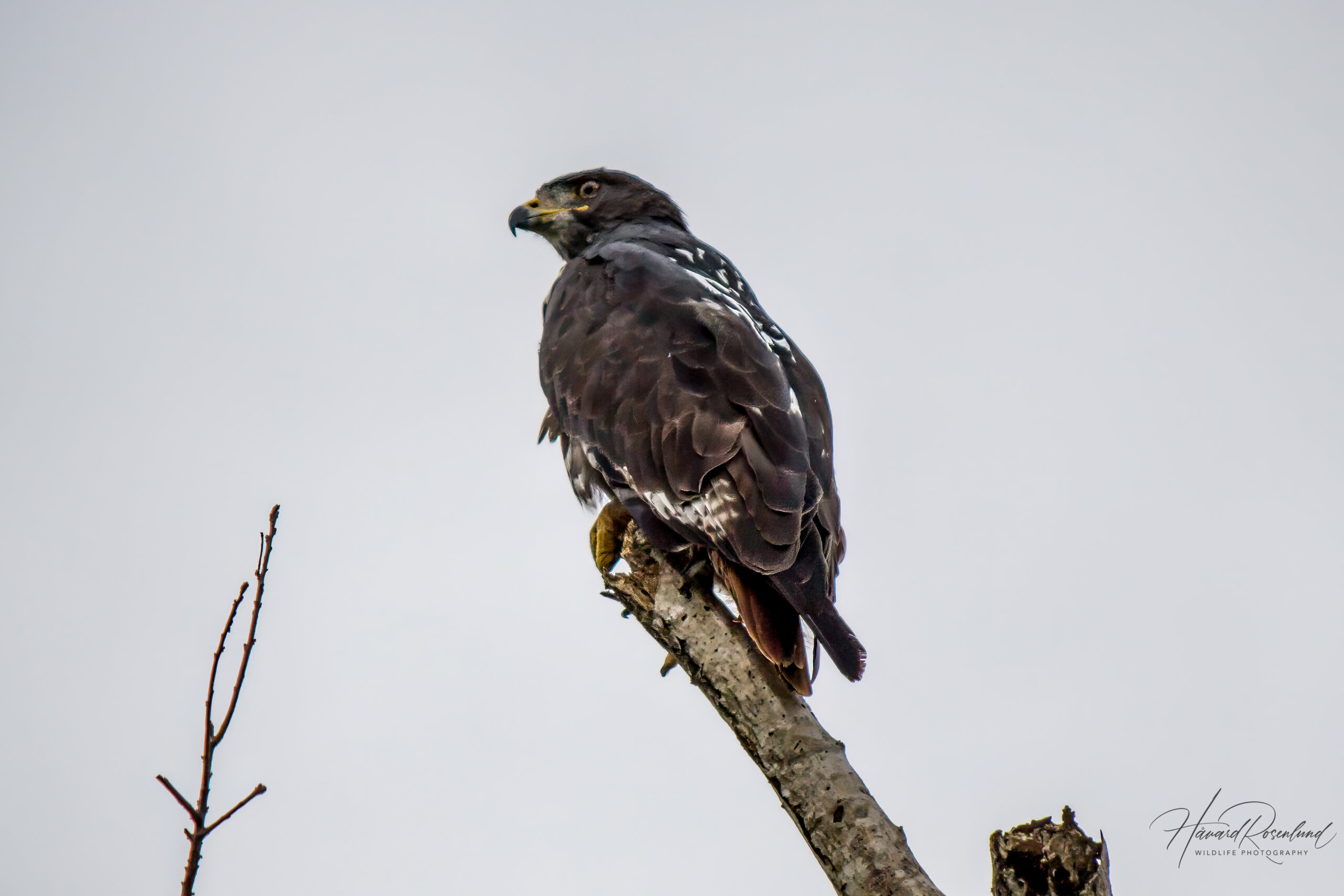
Jackal Buzzard
Buteo rufofuscus
At a glance
Habitat
- Mountains, cliffs, rocky hills, grassland, shrubland and other open country
Diet
- Mainly small mammals; also reptiles, birds, invertebrates and carrion
Activity
- Diurnal; resident and territorial year-round
Size
- Length: About 50 cm Weight: Males about 990 g; females about 1.3 kg
Range
- Southern Africa
Description
The jackal buzzard (Buteo rufofuscus) is endemic to southern Africa and one of the region's most distinctive large buzzards. Adults are about 50 cm long; males average around 990 g and females about 1.3 kg. The classic adult plumage has dark slate-grey to blackish upperparts, a rich rufous breast and tail and strongly contrasting black-and-white underwings.
The sharp, barking call has often been compared with the voice of the black-backed jackal and gave the species its English name. Juveniles are much browner and lack the clean adult pattern, making them potentially difficult to separate from other Buteo buzzards.
Jackal buzzards show pronounced colour polymorphism, meaning that the same species occurs in several markedly different plumage forms. Adult breast colour ranges from rich rufous through pale buff or almost white to very dark birds, and the amount of black, white and rufous below varies greatly between individuals.
The variation is especially important when identifying juveniles, which can resemble wintering steppe buzzards. Structure, tail and wing pattern, behaviour and—when heard—the characteristic call can therefore be more useful than relying on a single plumage feature.
Habitat
Jackal buzzards occur in a wide variety of southern African landscapes, from mountains, cliffs and steep slopes to open grassland, Karoo shrubland, farmland and roadsides. They are especially associated with open hunting country combined with high perches or cliffs and occur from near sea level to high mountain plateaus.
Diet
Small mammals, particularly rodents, make up much of the diet, supplemented by reptiles, birds, large invertebrates and carrion. The balance between food types changes with habitat, season and local availability.
Hunting
Birds hunt from poles, rocks and other lookout points or while soaring before dropping steeply onto prey on the ground. They can also pursue birds in flight.
In windy conditions they can hover almost motionless on rising air along slopes for extended periods before moving on or descending towards potential prey below. This use of uplift is especially useful in mountainous country.
Behaviour
Jackal buzzards are most often encountered alone or in pairs. They are resident and territorial throughout the year and are not known to undertake regular seasonal migrations, although immature birds disperse and food shortages can trigger more nomadic movements between areas with better feeding conditions.
Adults often spend long periods soaring over valleys and along mountainsides, and conspicuous calling and flight help advertise occupied territories.
Breeding
Jackal buzzards usually breed as monogamous pairs. In the Lesotho highlands, polyandry also occurs, meaning one female may breed with two males that both contribute to nest building, food provision and defence. This is a local feature and is not known as the normal mating system elsewhere in the range.
Both adults build or repair a large stick nest on a cliff ledge or in a sturdy tree and line it with softer material and fresh vegetation. The clutch usually contains two eggs, although one or three can occur. Incubation lasts around 39–40 days and is performed mainly by the female while the male provides food.
The eggs hatch asynchronously, meaning they do not hatch at the same time, often two to three days apart. This quickly creates a marked size difference between siblings. The older nestling can attack and outcompete the younger one, which often dies before the nestling period is over. As a result, only one young commonly fledges even from a two-egg clutch.
The female remains close to the nest early in the nestling period, while both adults contribute food as the surviving young grows. Fledging occurs after roughly seven to eight weeks, and parental care continues for several more weeks.
Relationship with humans
Jackal buzzards use human-modified open landscapes readily. Farmland, grazing land and road verges can provide abundant food, while fences, utility poles and other structures offer elevated hunting perches. Roadside carrion provides an additional opportunistic food source.
Wind-energy facilities can also create collision risk for raptors using the airspace around turbines. Jackal buzzards are therefore among the species monitored closely in South African wind-energy management, and knowledge of home ranges and flight behaviour is used to reduce risk when facilities are planned and operated.
Status
The jackal buzzard is classified as Least Concern on the IUCN Red List; the global assessment was updated in 2024. The species remains common across much of its southern African range.
BirdLife South Africa's 2025 regional assessment also retained the species as Least Concern and describes the population as broadly stable. Wind energy, power infrastructure and local persecution can create risks in some areas, but the species is not considered threatened regionally or globally.
Image gallery
Loading map and observations…
Have you seen this species?
Independent species archive
Did you find this species page useful?
Wildlife Vagabond is independently built and maintained. Voluntary support helps cover hosting, maps, data storage and continued improvements to the species archive.
Support Wildlife VagabondSpecies content will remain freely available.
References
Information about the species’ global distribution and status is based primarily on global Red List data. See the references below for details.
- Bam, S., Hart, L., & Willows-Munro, S. (2019). Mc1r genotype and plumage colouration in highly polymorphic jackal buzzards, Buteo rufofuscus. African Zoology, 54(4), 239-242. https://doi.org/10.1080/15627020.2019.1658539
- Biodiversity Explorer. (n.d.). Buteo rufofuscus: breeding biology and diet, based on Roberts – Birds of Southern Africa VII. Iziko Museums of South Africa. https://www.biodiversityexplorer.info/birds/accipitridae/buteo_rufofuscus.htm
- BirdLife International. (n.d.). Jackal Buzzard Buteo rufofuscus species factsheet. https://datazone.birdlife.org/species/factsheet/jackal-buzzard-buteo-rufofuscus
- BirdLife South Africa. (2025). Regional Endemics and Near Endemics listed as Least Concern: Jackal Buzzard. https://www.birdlife.org.za/red-data-book/least-concern-endemics/
- FitzPatrick Institute of African Ornithology. (n.d.). Impacts of power infrastructure: Jackal Buzzard research. https://science.uct.ac.za/fitzpatrick/research-maintaining-biodiversity-species-level-conservation/impacts-power-infrastructure
- International Union for Conservation of Nature. (2024). Buteo rufofuscus (Jackal Buzzard), global Red List. The IUCN Red List of Threatened Species. https://www.iucnredlist.org/species/22695987/263633918
- Nkomo, M. N., Murgatroyd, M., Ralston-Paton, S., & Amar, A. (2024). Using stakeholder knowledge to co-produce research priorities for a raptor species vulnerable to impacts of wind energy facilities. Ostrich, 95(3), 200-212. https://doi.org/10.2989/00306525.2024.2387723