
Southern Banded Snake-Eagle
Circaetus fasciolatus
At a glance
Habitat
- Coastal forest, sand forest, riverine forest, forest edges, marshes and floodplains
Diet
- Mainly snakes and lizards; also frogs, rodents, arthropods and occasional birds
Activity
- Diurnal; secretive perch-hunter within and along forest edges
Size
- Length: 55–60 cm Weight: 1.0–1.2 kg
Range
- Fragmented eastern African coastal distribution from southern Somalia to northeastern South Africa
Description
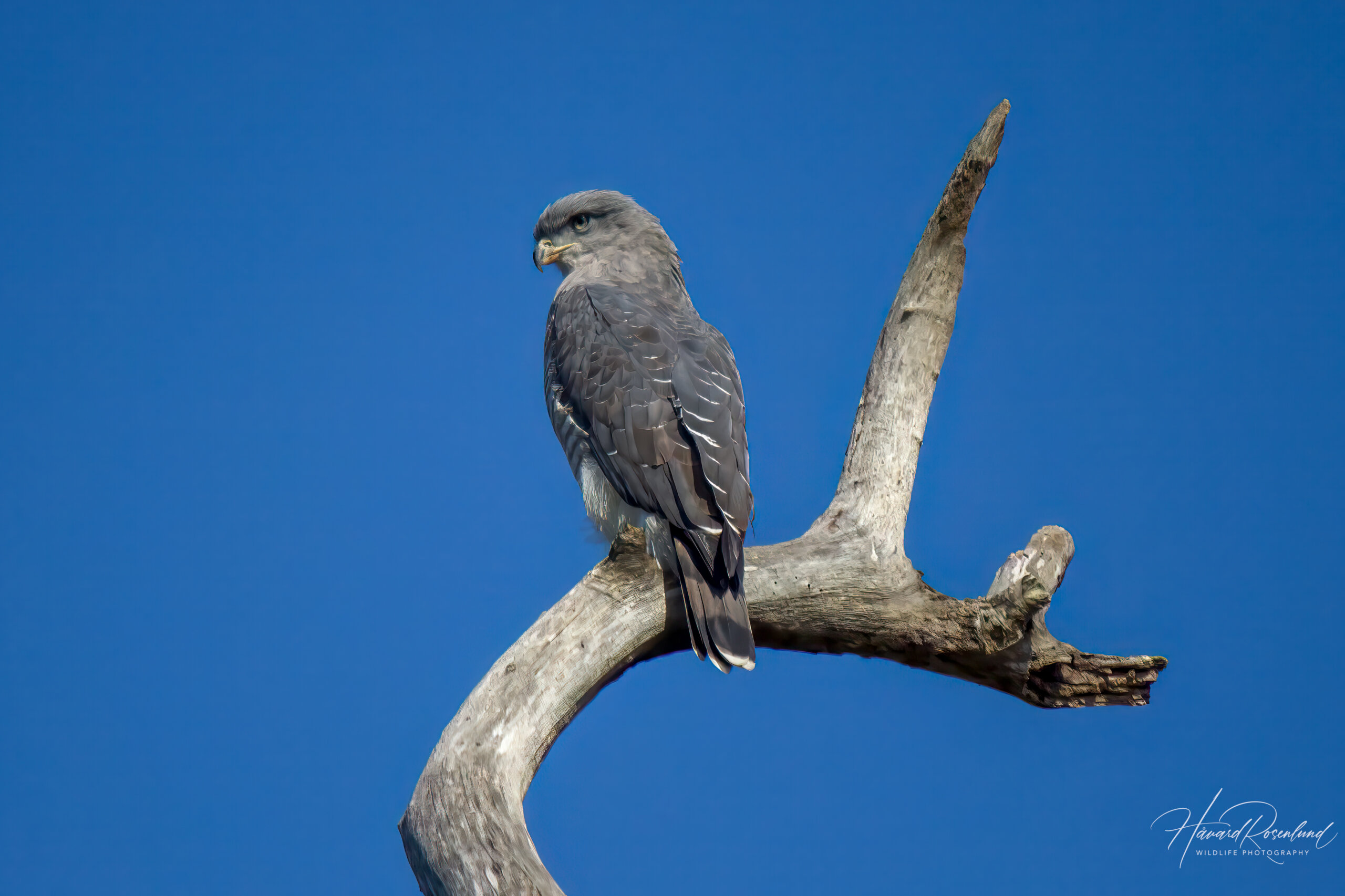
The southern banded snake-eagle (Circaetus fasciolatus) is a relatively small, compact snake-eagle of the eastern side of sub-Saharan Africa. Adults are about 55–60 cm long and weigh roughly 1.0–1.2 kg. The head and chest are grey-brown, the upperparts darker, and the white belly and underwings are heavily barred. Pale yellow eyes, yellow legs and a banded tail with a pale tip complete the distinctive appearance.
Juveniles are browner and less cleanly patterned than adults. The species is much more closely associated with dense forest than most other African snake-eagles, which helps explain why it can be surprisingly difficult to see even where it occurs.
Habitat
Southern banded snake-eagles are strongly associated with lowland coastal forest, sand forest, riverine forest and forest edges. They also hunt in adjoining clearings, coastal grasslands, marshes and floodplains, so the most useful landscapes contain a mosaic of dense cover and open hunting areas.
In South Africa the species is concentrated in the coastal lowlands of northern KwaZulu-Natal, with iSimangaliso Wetland Park forming the core of the regional range. Around 60% of the current regional range lies within protected areas, but the South African population is extremely small and isolated from the nearest populations farther north.
Diet
Snakes and lizards are the principal prey, reflecting the reptile specialisation typical of snake-eagles. Frogs and other amphibians, rodents, large arthropods and occasional birds are also recorded.
The diet is therefore broader than the name snake-eagle suggests, but reptiles remain the ecological core of its feeding niche.
Hunting
The southern banded snake-eagle is primarily a perch-hunter. It waits quietly on a concealed or semi-open branch, scans the ground and surrounding vegetation, then drops rapidly onto detected prey. Forest edges and openings are particularly useful because they combine elevated cover with clearer access to reptiles and other ground prey.
This differs from the extensive soaring searches often associated with larger snake-eagles of open savanna. The species can remain almost invisible inside coastal forest while repeatedly using productive perches along clearings, marshes and floodplains.
Behaviour
The species is secretive and usually solitary outside the breeding season. Adults may spend long periods perched quietly below or near the canopy, and even occupied territories can be difficult to detect without hearing the birds or watching known perches.
Two neighbouring territories tracked in South Africa each covered less than about 2 km². Movement and dispersal remain poorly understood, especially in immature birds.
Breeding
Pairs are monogamous and territorial. Both adults build an open stick platform, usually about 50–70 cm wide and placed in the main fork of a tree, well concealed by foliage or climbing plants. The nest is lined with fresh green leaves. One egg is normally laid.
The female performs most of the incubation while the male supplies food and may take short incubation shifts. Incubation lasts about 49–51 days. Both adults feed the chick after hatching, but during the first few days the male does most of the hunting while the female remains at the nest and tends the young. Breeding success and dispersal after fledging are still poorly known.
Status
Globally, the southern banded snake-eagle is classified as Near Threatened on the IUCN Red List. The global population is estimated at only about 670–2,000 mature individuals and is considered to be decreasing.
In South Africa the situation is much more severe. The species is Critically Endangered, with only about 40–50 mature individuals estimated to remain. The figure is very uncertain, but the evidence still points to a tiny regional population in decline.
Threats
Historical decline in South Africa is closely linked to loss and fragmentation of coastal forest through forestry, agriculture and development. More than 80% of the Indian Ocean Coastal Belt Forest has already been lost, and continued degradation can remove not only nesting forest but also the forest-edge mosaics needed for hunting.
Electrical infrastructure creates an additional regional danger. Southern banded snake-eagles use pylons and other structures as hunting perches, and several electrocutions have been recorded at pole-mounted transformer boxes. Climate-driven changes to the remaining coastal forest are another longer-term concern for such a small and isolated population.
Conservation
BirdLife South Africa uses tracking and repeated field surveys to improve knowledge of the species' distribution, movements and population trend in South Africa. Better population data are especially valuable because the current estimate remains very uncertain.
Work with Eskom has also targeted electrocution risk in northern KwaZulu-Natal. Sixty-two high-risk pole-mounted transformer bays within the species' core range were identified for mitigation, leading to insulation and other modifications of dangerous structures. Protecting and reconnecting coastal forest remains equally important for the long-term survival of the regional population.
Conservation organizations
Image gallery
Loading map and observations…
National Red List status
| Country | Status | Assessment | Source |
|---|---|---|---|
| South Africa | CRCritically Endangered | Regional Red Data Book of Birds of South Africa, Lesotho and Eswatini 2025 | BirdLife South Africa – Regional Red Data Book 2025 |
Have you seen this species?
Independent species archive
Did you find this species page useful?
Wildlife Vagabond is independently built and maintained. Voluntary support helps cover hosting, maps, data storage and continued improvements to the species archive.
Support Wildlife VagabondSpecies content will remain freely available.
References
Information about the species’ global distribution and status is based primarily on global Red List data. See the references below for details.
- BirdLife International. (n.d.). Southern Banded Snake-Eagle species factsheet. https://datazone.birdlife.org/species/factsheet/southern-banded-snake-eagle-circaetus-fasciolatus
- BirdLife South Africa. (n.d.). Southern Banded Snake Eagle, 2025 Red Data Book. https://www.birdlife.org.za/red-list/southern-banded-snake-eagle/
- BirdLife South Africa. (n.d.). Southern Banded Snake Eagle conservation project. https://www.birdlife.org.za/what-we-do/species-conservation/what-we-do/southern-banded-snake-eagle/
- International Union for Conservation of Nature. (n.d.). Southern Banded Snake-Eagle. The IUCN Red List of Threatened Species. https://www.iucnredlist.org/species/22695277/200956033
- South African National Biodiversity Institute. (n.d.). SANBI – Southern Banded Snake Eagle regional species assessment. https://speciesstatus.sanbi.org/assessment/last-assessment/3022/