
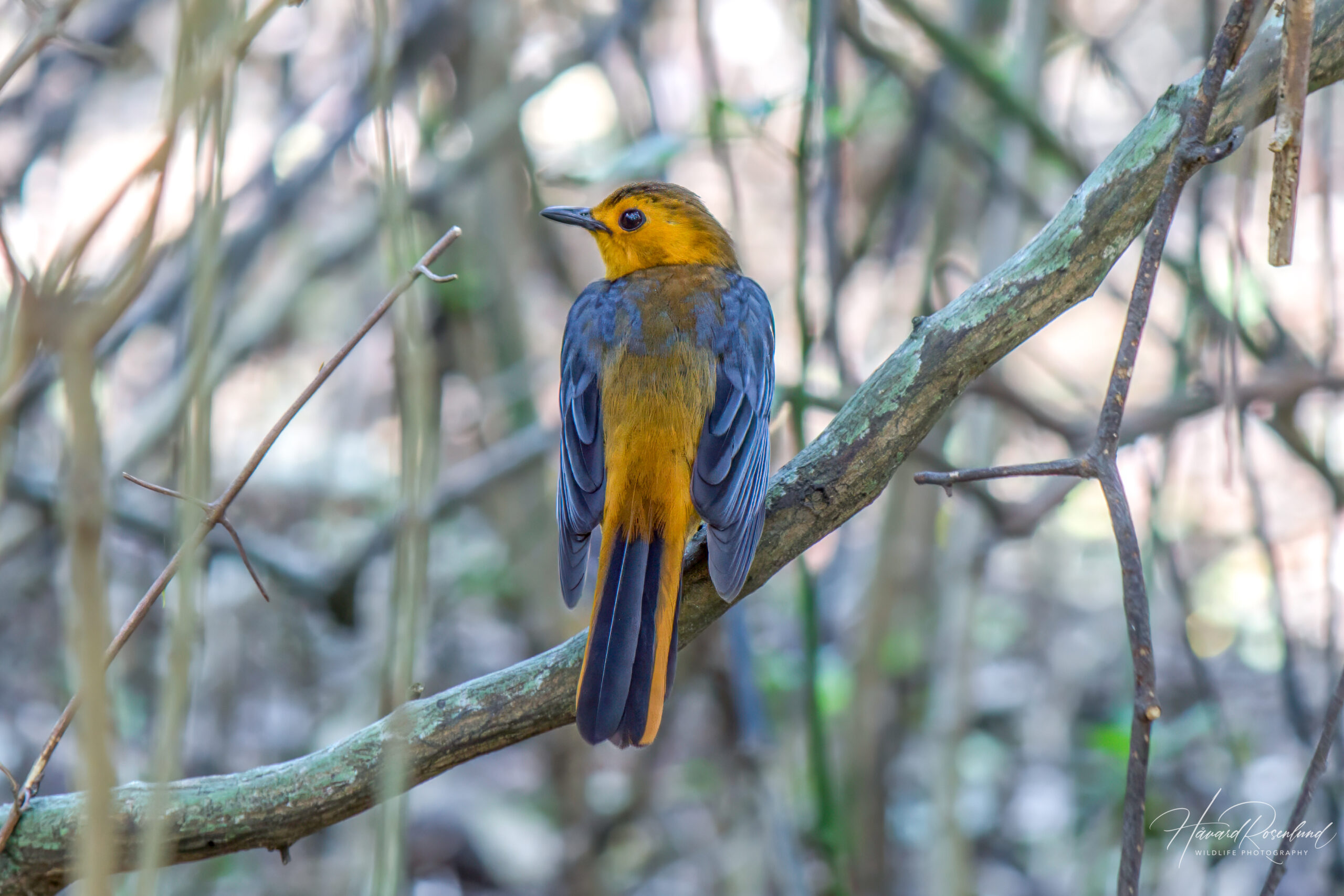
Red-capped Robin-Chat
Cossypha natalensis
At a glance
Habitat
- Forest understorey, dense woodland, thickets and well-vegetated gardens
Diet
- Mostly insects and other invertebrates; also fruit
Activity
- Diurnal
Size
- Length: 16–17 cm Weight: 24–40 g
Range
- Patchily across sub-Saharan Africa, from West and East Africa south to eastern South Africa
Description
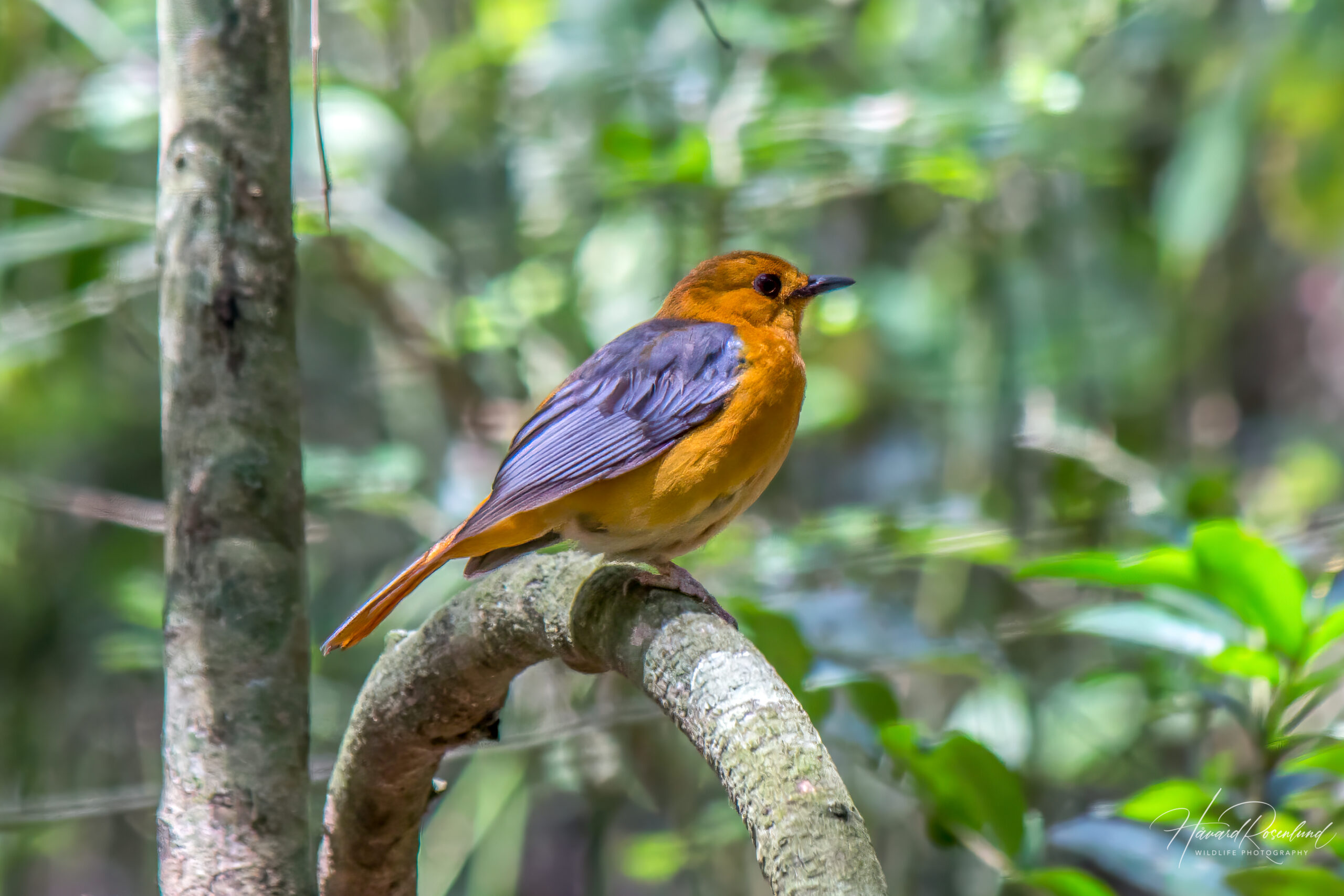
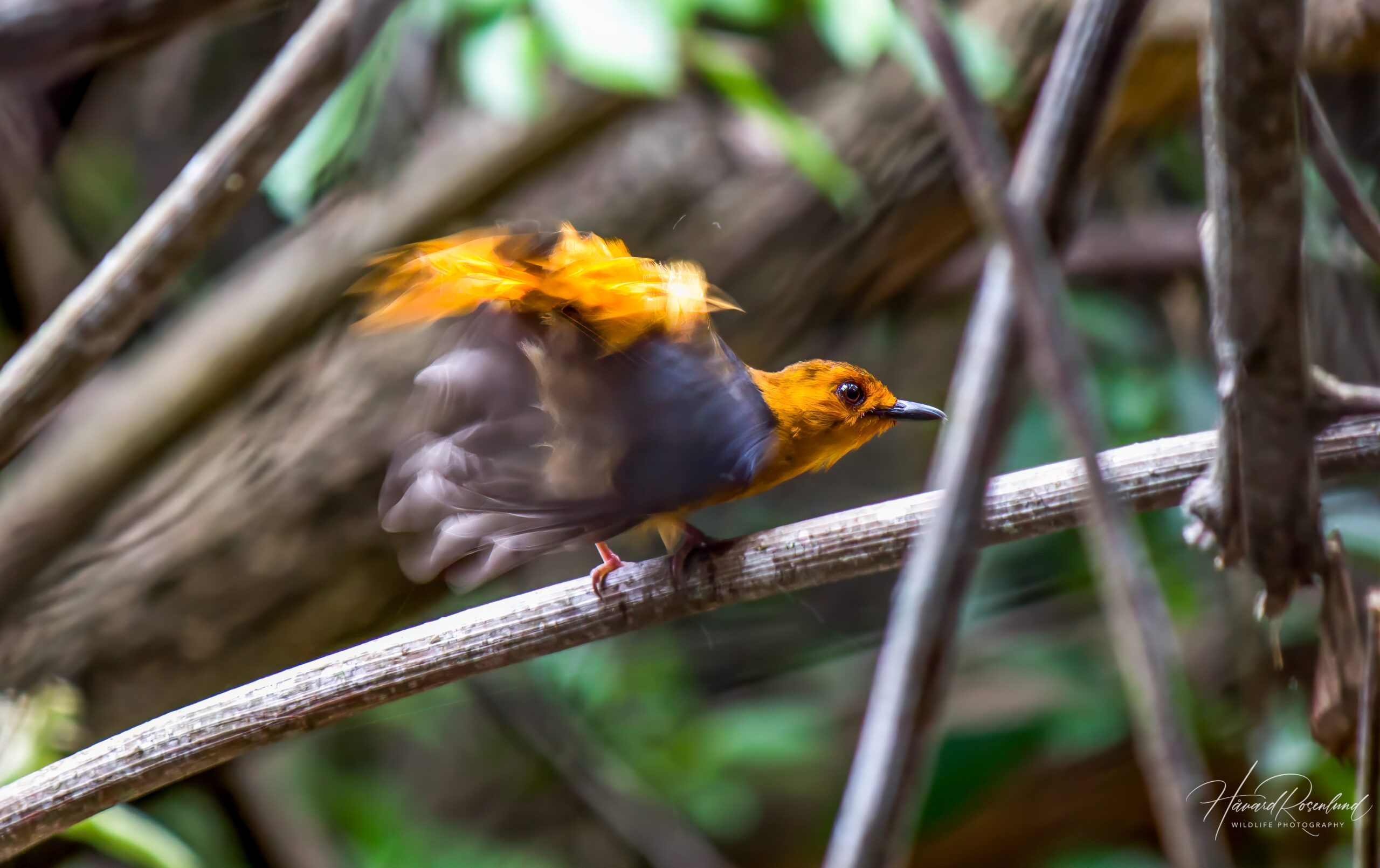
The red-capped robin-chat (Cossypha natalensis) is a medium-sized African forest songbird, about 16–17 cm long and weighing roughly 24–40 g. The crown, face and underparts are warm rufous-orange, contrasting with blue-grey to brownish upperparts. The tail is especially distinctive: the central feathers are dark while the outer feathers are rich rufous, and the bird often flicks or raises it while moving through cover.
In South Africa it overlaps locally with the closely related chorister robin-chat (Cossypha dichroa). Birds with intermediate plumage have been documented in several contact zones, and genetic work supports hybridisation and backcrossing between the two species. They nevertheless remain distinct species across most of their shared range.
Habitat
Red-capped robin-chats favour dense, shaded vegetation, including forest understorey, woodland, thickets, riverine growth and well-vegetated gardens. They usually remain low in the vegetation and often feed on or close to the ground.
The species occurs patchily across sub-Saharan Africa, from parts of West and East Africa south to eastern South Africa. Dense leaf litter and tangled vegetation provide both feeding opportunities and cover, allowing the brightly coloured bird to remain surprisingly difficult to see.
Diet
Insects and other invertebrates form most of the diet, including beetles, caterpillars, spiders and a variety of other small animals found among leaf litter and low vegetation.
Fruit and berries are also taken, giving the species more dietary flexibility than a strict insectivore.
Red-capped robin-chats typically hop through dense cover, turn leaves and inspect the ground and low branches while searching for food. Most foraging therefore takes place close to the ground within leaf litter and tangled understorey rather than in open air.
Behaviour
Vocal mimicry is one of the most characteristic features of the red-capped robin-chat. Its own song is rich and melodious, but individuals also incorporate calls and songs of other birds into their repertoire. Research has shown that the species copied differ between populations and largely reflect the local bird community rather than a fixed set of preferred models. A bird's song can therefore carry an audible imprint of the bird community around it.
The species also has a much simpler two-part contact call. This is useful where it overlaps with the chorister robin-chat: although their songs can sound similar, ordinary calls remain distinctly different. Outside periods of conspicuous singing, red-capped robin-chats are often secretive and move quietly through dense cover, frequently flicking the contrasting tail.
Migration
Movement patterns vary across the large African range. Some populations are resident, while others make seasonal movements within the continent. In parts of East Africa birds appear and disappear predictably with the seasons, yet the exact routes and destinations remain incompletely known.
The species therefore has no single migration pattern across its range. In several regions it is still unclear where seasonally absent birds spend the non-breeding period.
Breeding
In southern Africa, egg-laying occurs mainly from September to January and peaks around November. The pair builds an open cup nest in a sheltered site, often in a hollow stump, cavity, bank or protected crevice among dense vegetation. Dead leaves, roots, twigs and dry grass are commonly incorporated into the nest.
Clutches contain two to four eggs. The female incubates for about 14–15 days, while both parents feed the chicks after hatching. The young usually leave the nest after only about 11–12 days, occasionally later, but remain dependent on their parents for food and protection for roughly another six weeks.
Status
The red-capped robin-chat is classified as least concern on the IUCN Red List. It remains widespread across suitable forest and woodland habitats in sub-Saharan Africa.
The species also tolerates some modified habitats, including wooded gardens, provided that sufficient dense vegetation and ground cover remain. No major range-wide threat is currently known.
Image gallery
Loading map and observations…
Have you seen this species?
Independent species archive
Did you find this species page useful?
Wildlife Vagabond is independently built and maintained. Voluntary support helps cover hosting, maps, data storage and continued improvements to the species archive.
Support Wildlife VagabondSpecies content will remain freely available.
References
Information about the species’ global distribution and status is based primarily on global Red List data. See the references below for details.
- Avibase. (n.d.). AviList 2025 / Avibase – Red-capped Robin-Chat (Cossypha natalensis). https://avibase.bsc-eoc.org/species.jsp?avibaseid=3846F8A8B94E134B&lang=EN
- Biodiversity Explorer. (n.d.). Red-capped Robin-Chat. Iziko Museums of South Africa. https://www.biodiversityexplorer.info/birds/muscicapidae/cossypha_natalensis.htm
- BirdLife International. (n.d.). Red-capped Robin-Chat species factsheet. https://datazone.birdlife.org/species/factsheet/red-capped-robin-chat-cossypha-natalensis
- Davies, G. B., Symes, C. T., Boon, R. G., & Campbell, H. A. (2011). Inferred hybridisation, sympatry and movements of Chorister Robin-Chat Cossypha dichroa and Red-capped Robin-Chat C. natalensis. Ostrich, 82(3), 231-241. https://doi.org/10.2989/00306525.2011.607860
- Ferguson, J. W. H., van Zyl, A., & Delport, K. (2002). Vocal mimicry in African Cossypha robin chats. Journal für Ornithologie, 143(3), 319-330. https://doi.org/10.1046/j.1439-0361.2002.02012.x
- International Union for Conservation of Nature. (n.d.). Red-capped Robin-Chat. The IUCN Red List of Threatened Species. https://www.iucnredlist.org/species/22709828/94224513
- Nussbaumer, R., Kirao, L., Liechti, F., & Jackson, C. (2022). Using ringing data to inform geolocator deployment: a case study of the Red-capped Robin-chat Cossypha natalensis in East Africa. Journal of Field Ornithology, 93(2), art8. https://doi.org/10.5751/JFO-00113-930208