
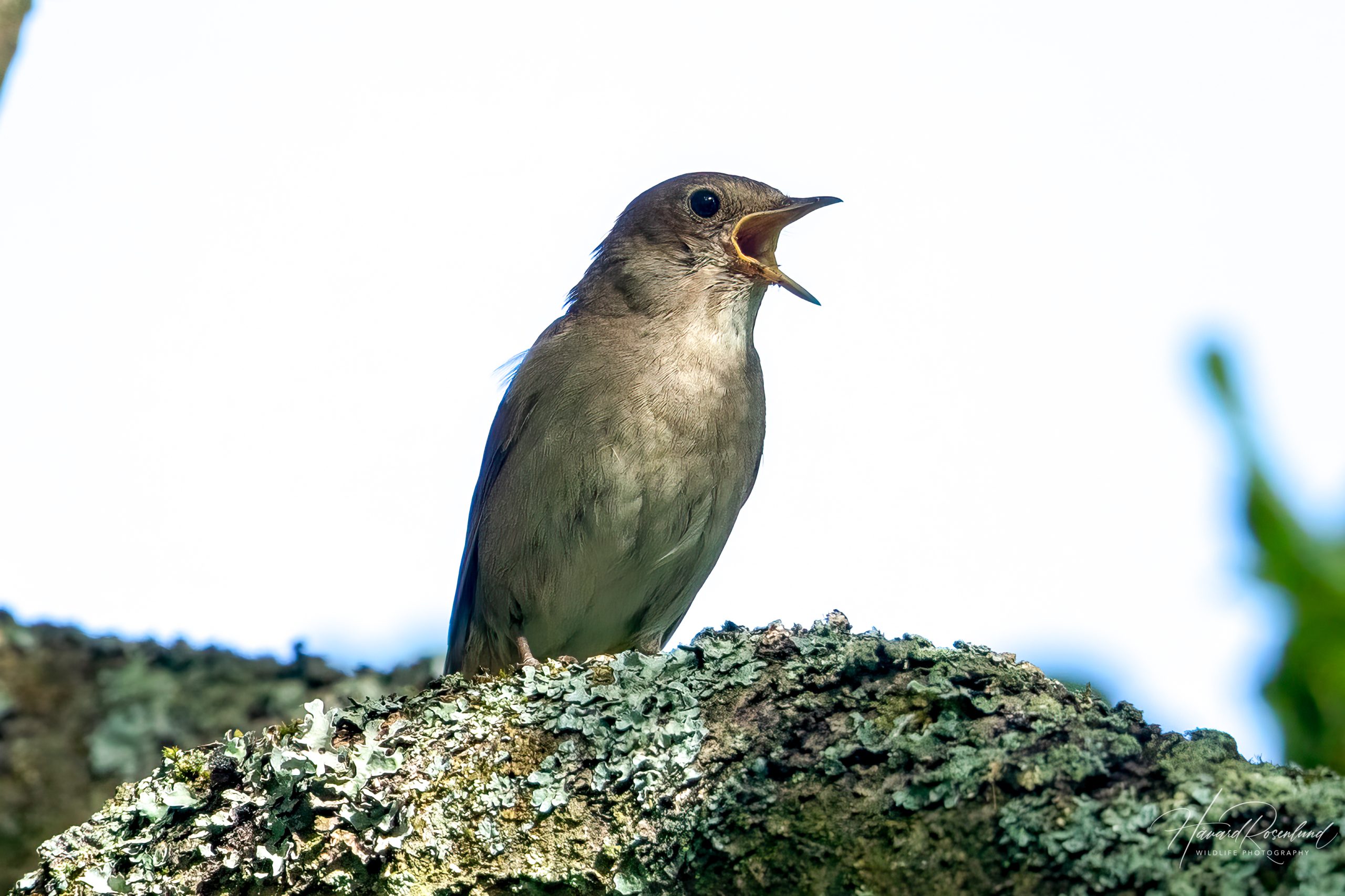
Thrush Nightingale
Luscinia luscinia
At a glance
Habitat
- Dense damp scrub, deciduous thickets, woodland edge and river or wetland margins with rich undergrowth
Diet
- Mostly insects, spiders, worms and other invertebrates; berries and fruit increase before migration
Activity
- Mostly day-active; males also sing at night and migration is nocturnal
Size
- Length: 15–16.5 cm Weight: 20–30 g
Range
- Breeds from northern and eastern Europe into western Asia; winters in eastern and southern sub-Saharan Africa
Description
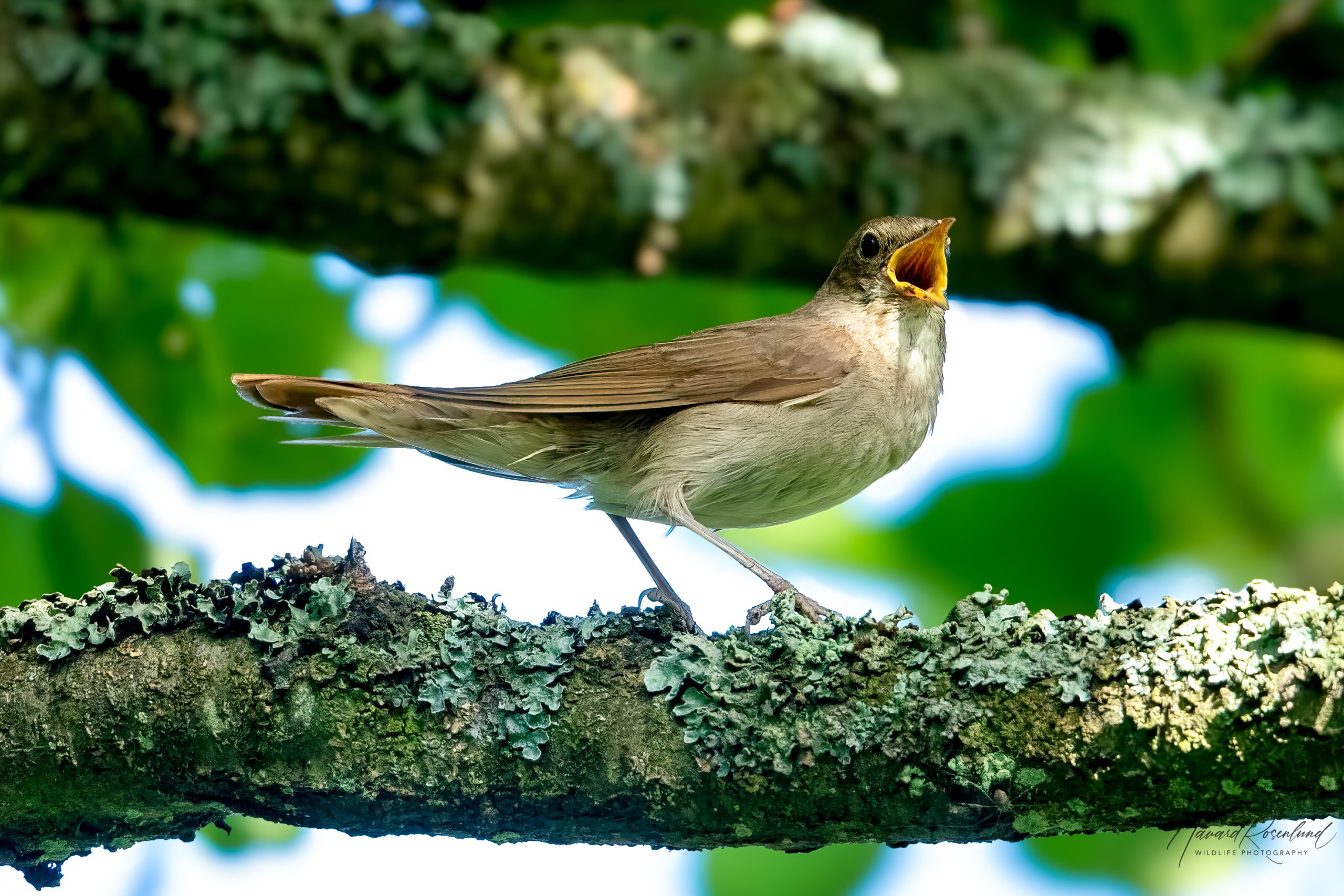
The thrush nightingale (Luscinia luscinia) is a medium-sized, plain brown songbird whose voice is far more conspicuous than its plumage. Adults are about 15–16.5 cm long, with dark grey-brown upperparts, a duller pale underside and a tail that is only weakly rufous. Males and females look very similar.
The closely related common nightingale (Luscinia megarhynchos) is warmer and more reddish-brown, especially on the tail, while thrush nightingales tend to look greyer and heavier. The two species meet and sometimes hybridise across a broad zone in central and eastern Europe. A genome-wide study published in 2023 of more than 300 birds from the contact zone found that only 6.5% were hybrids, showing strong but incomplete reproductive isolation between the species.
Habitat
Thrush nightingales breed in dense, low vegetation with moist ground and abundant cover. Favoured sites include deciduous thickets, willow and alder scrub, river margins, woodland edge, overgrown clearings, wet meadows and other habitats where tangled shrubs and herbs meet more open feeding ground.
The species is often associated with water but does not require standing water itself. What matters most is a cool, productive ground layer with leaf litter and dense vegetation for concealment. In northern Europe this combination is common along rivers, wetlands and fertile woodland margins.
Diet
The diet consists mainly of invertebrates living on the ground and in low vegetation, including beetles, ants, flies, caterpillars, spiders and worms. Birds forage mostly on or close to the ground, hopping through leaf litter and dense vegetation and picking prey from leaves, stems and the ground.
Berries and other fruit become more important in late summer and during migration, providing concentrated energy while birds build fat reserves.
Behaviour
Males are famous for a loud, rich and rhythmically varied song delivered from dense cover. Singing occurs by day and through the night during the breeding season, especially before pairing. Compared with the common nightingale, the song is generally deeper, more forceful and contains more buzzing and repeated elements.
A playback study published in 1998 showed that territorial males recognised familiar neighbours and reacted more strongly when a neighbour's song was played from an unexpected side of the territory. Local song traditions can also change considerably over time: a study published in 2025 from the Kursk region of Russia found that the population's repertoire of song types changed completely over several decades, while the average size of each male's repertoire remained remarkably stable.
Territoriality is not limited entirely to the breeding grounds. A study published in 2023 found that only a fraction of males defended territories in the East African non-breeding season, while others remained non-territorial. The social organisation of the same migratory population can therefore change markedly through the annual cycle.
Migration
The thrush nightingale is a long-distance nocturnal migrant between Eurasia and Africa. A geolocator study published in 2012 followed two Swedish birds and revealed an unusually complex non-breeding cycle. After crossing the Sahara, both remained for six to seven weeks in the Sahel region of Sudan, then moved to northern Kenya for about a month before continuing to final wintering areas in southern Africa.
These successive movements closely followed seasonal rainfall, suggesting that the birds track areas with abundant insects rather than settling in one winter area for the entire season. They return north in spring through eastern Africa and the Middle East, completing an annual cycle that links breeding habitat in Europe with several different African regions.
Breeding
The nest is built close to the ground in very dense vegetation, often among shrubs, herbs or tangled stems. It is a cup of leaves, grasses and other plant material with a finer inner lining. Four to six eggs are usual.
The female performs most or all of the incubation, which lasts roughly two weeks. Both parents feed the chicks after hatching. Young leave the nest after around 10–12 days while still dependent on the adults and remain concealed in surrounding vegetation as they continue to be fed and develop flight skills.
Status
The thrush nightingale is classified as least concern on the IUCN Red List and remains widespread from northern and eastern Europe into western Asia. Regional trends nevertheless differ, with long-term declines documented in parts of Europe.
Loss of dense wet scrub, drainage, woodland simplification and changes in traditional land use can reduce breeding habitat locally. Conditions during migration and in Africa may be equally important: for northern populations, survival depends on a chain of Sahel, East African and southern African habitats used at different stages of the non-breeding season.
Image gallery
Loading map and observations…
Have you seen this species?
Independent species archive
Did you find this species page useful?
Wildlife Vagabond is independently built and maintained. Voluntary support helps cover hosting, maps, data storage and continued improvements to the species archive.
Support Wildlife VagabondSpecies content will remain freely available.
References
Information about the species’ global distribution and status is based primarily on global Red List data. See the references below for details.
- BirdLife International. (n.d.). Thrush Nightingale species factsheet. https://datazone.birdlife.org/species/factsheet/thrush-nightingale-luscinia-luscinia
- Brumm, H., de Framond, L., & Goymann, W. (2023). Territorial behaviour of thrush nightingales outside the breeding season. Proceedings of the Royal Society B: Biological Sciences, 290(2005), 20230496. https://doi.org/10.1098/rspb.2023.0496
- International Union for Conservation of Nature. (n.d.). Thrush Nightingale. The IUCN Red List of Threatened Species. https://www.iucnredlist.org/species/22709691/87882842
- Ivanitskii, V., Bezrukova, J., Grebenkova, A., Mikhylova, M., Opaev, A., Vlasov, A., & Marova, I. (2025). Long-term variability in the song of the thrush nightingale (Luscinia luscinia) and its relations to the territorial behavior of males. Behavioural Processes, 230, 105228. https://doi.org/10.1016/j.beproc.2025.105228
- Naguib, M., & Todt, D. (1998). Recognition of Neighbors' Song in a Species with Large and Complex Song Repertoires: The Thrush Nightingale. Journal of Avian Biology, 29(2), 155. https://doi.org/10.2307/3677193
- Sottas, C., Reif, J., Piálek, L., Poignet, M., Kverek, P., Dolata, P. T., & Reifová, R. (2023). Patterns of hybridization in a secondary contact zone between two passerine species, the common nightingale Luscinia megarhynchos and the thrush nightingale Luscinia luscinia. Journal of Avian Biology, 2023(3-4), e03061. https://doi.org/10.1111/jav.03061
- Stach, R., Jakobsson, S., Kullberg, C., & Fransson, T. (2012). Geolocators reveal three consecutive wintering areas in the thrush nightingale. Animal Migration, 1(1), 1-7. https://doi.org/10.2478/ami-2012-0001