
White-browed Scrub-Robin
Cercotrichas leucophrys
At a glance
Habitat
- Savanna, scrub, dry open woodland and bushy grassland
Diet
- Mostly insects and other invertebrates; also some fruit and nectar
Activity
- Diurnal
Size
- Length: 14–16 cm Weight: 13–20 g
Range
- Much of eastern, central and southern Africa outside dense rainforest and extreme desert
Description
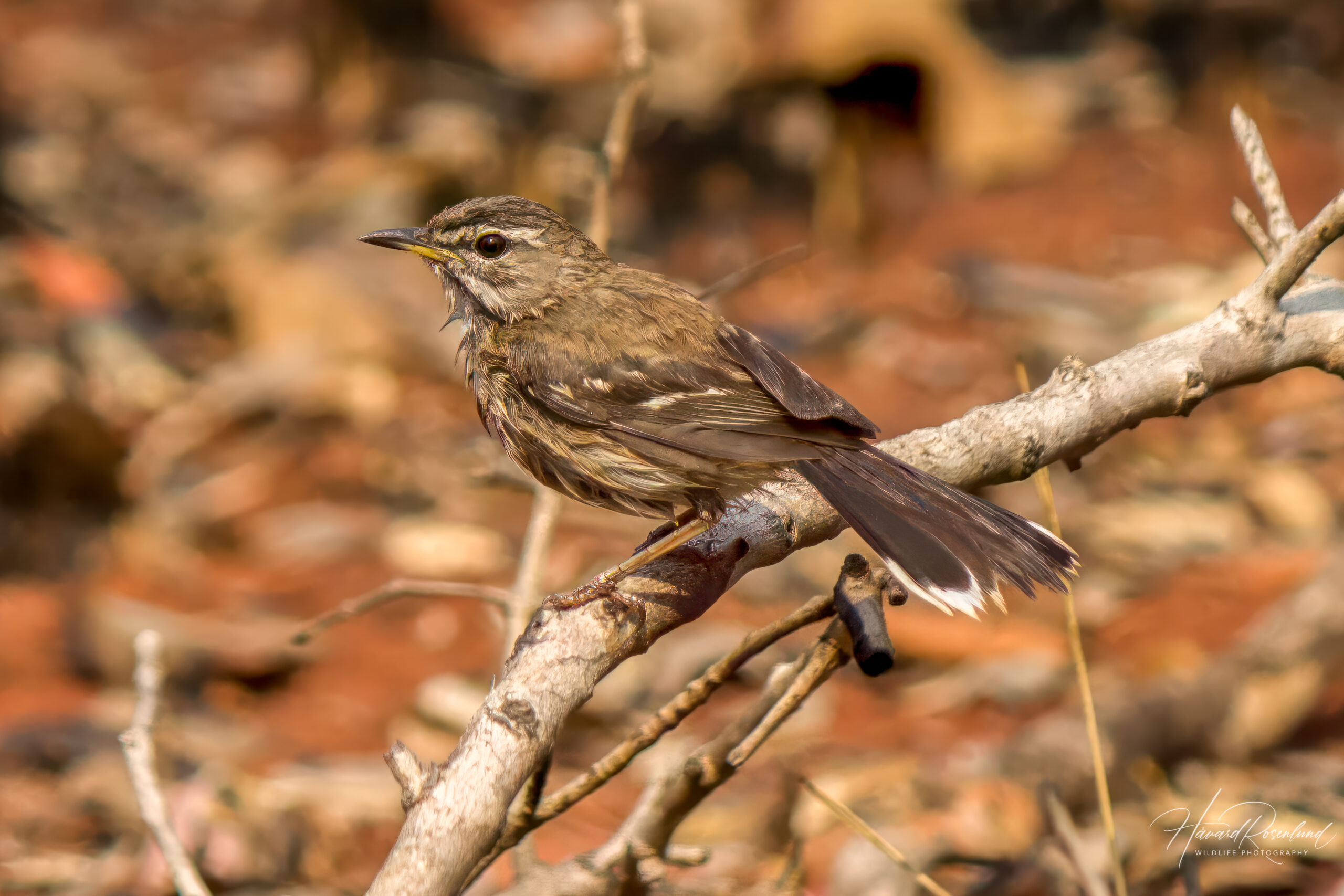
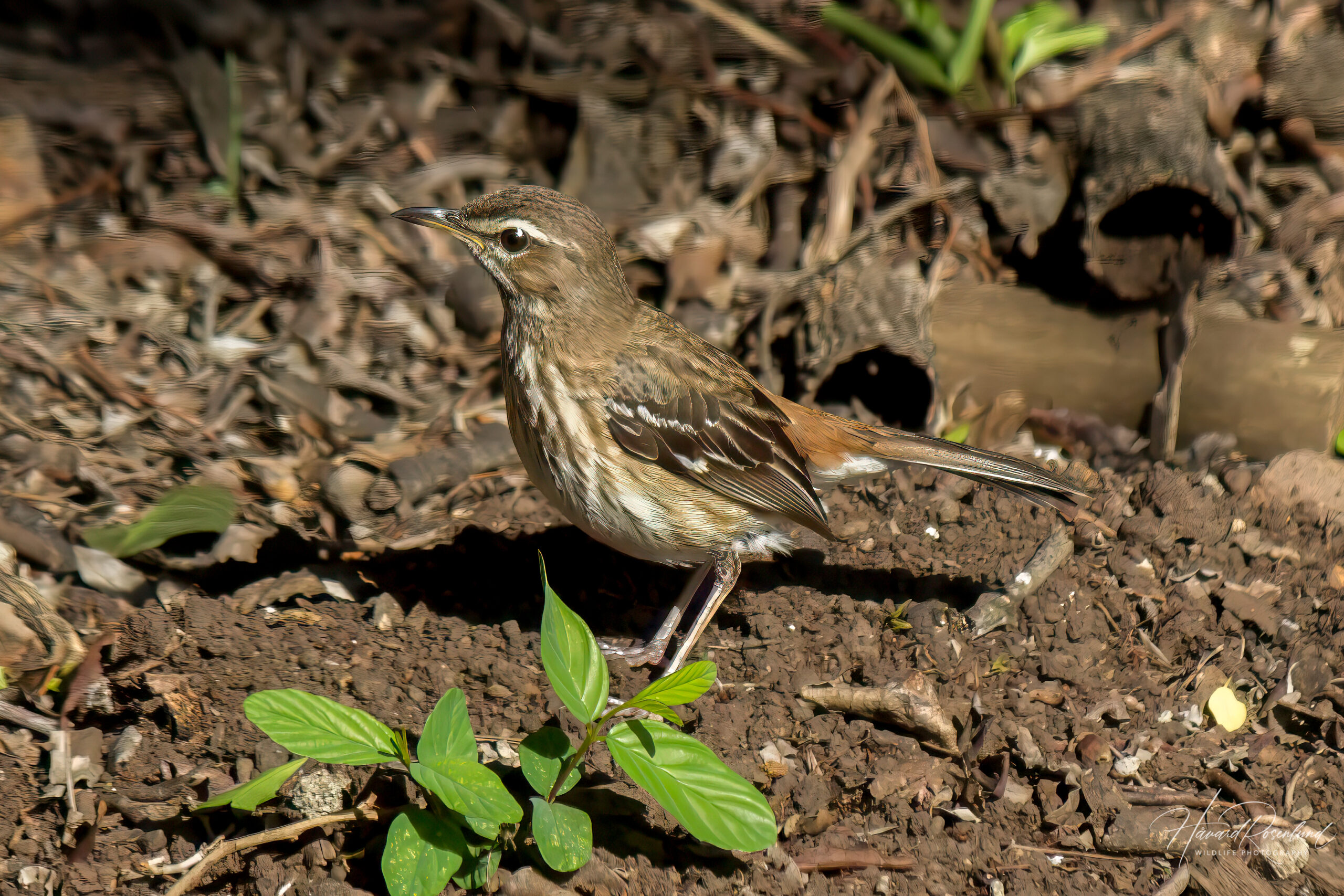
The white-browed scrub-robin (Cercotrichas leucophrys) is a small ground-foraging songbird distributed across much of sub-Saharan Africa. Adults are about 14–16 cm long and weigh roughly 13–20 g. The southern nominate form has a warm brown back, rufous rump, pale streaked underparts, a bold white eyebrow and a dark tail tipped and edged with white.
Plumage varies considerably across the range. Northern and northeastern populations can show more rufous upperparts, stronger white wing markings and different tail patterns than birds in southern Africa. The sexes are alike, while juveniles are more scaly and mottled.
Habitat
White-browed scrub-robins are birds of open, bushy country rather than closed forest. They use acacia and other savannas, scrub, dry open woodland, mopane, thickets and bushy grassland, and can also persist in well-vegetated gardens.
Completely open ground is generally avoided unless bushes or thickets provide nearby cover. Dense low vegetation is important both as refuge and as a base from which the birds move onto more open ground to feed.
Diet
The diet consists mainly of insects and other invertebrates. Termites and ants are important prey, together with moths, caterpillars, bugs, crickets, grasshoppers, spiders, centipedes and other small animals. Fruit and nectar are taken occasionally, including aloe nectar in winter.
White-browed scrub-robins forage mainly on the ground, hopping through leaf litter and flicking leaves and debris aside to expose hidden prey. They may also investigate herbivore dung for insects. Feeding usually takes place close to low, dense cover, allowing the bird to retreat quickly into scrub when disturbed.
Behaviour
The species is usually encountered singly or as a territorial pair and is often much easier to hear than to see because it spends long periods inside thorny or dense cover. Males sing through much of the year, producing a strong, melodious sequence of repeated phrases that varies geographically between populations.
When disturbed, birds often run rapidly into cover or move low through vegetation rather than immediately flying far. Most populations are resident, although some local and seasonal movements occur near the southern edge of the range.
Breeding
Breeding timing varies greatly across Africa. In South Africa egg laying is concentrated mainly from September to February, with a peak from October to December, whereas populations farther north breed at different times according to local rainfall.
Courtship can make the normally secretive male more conspicuous. He may lower the wings and raise and fan the tail while displaying near the female. The female builds the deep cup-shaped nest alone, usually low in a grass tuft, shrub, aloe or other dense cover, often less than two metres above ground.
Clutches normally contain two to four eggs. The female incubates alone for about 12–14 days, while both parents feed the chicks, largely with insects. Young leave the nest after roughly 11–12 days and remain dependent on the adults for at least another couple of weeks.
Nest predation can be high, and pairs may make repeated attempts. The species is also recorded as a host of several African brood parasites, including red-chested cuckoo (Cuculus solitarius), Klaas's cuckoo (Chrysococcyx klaas) and diederik cuckoo (Chrysococcyx caprius).
Status
The white-browed scrub-robin is classified as least concern on the IUCN Red List. It is widespread and generally common across much of its African range.
Its broad habitat tolerance, including the ability to use dry savanna, scrub and moderately modified landscapes, means that no major range-wide threat is currently recognised. Local populations can nevertheless decline where bush and thicket cover is extensively cleared.
Image gallery
Loading map and observations…
Have you seen this species?
Independent species archive
Did you find this species page useful?
Wildlife Vagabond is independently built and maintained. Voluntary support helps cover hosting, maps, data storage and continued improvements to the species archive.
Support Wildlife VagabondSpecies content will remain freely available.
References
Information about the species’ global distribution and status is based primarily on global Red List data. See the references below for details.
- Avibase. (n.d.). White-browed Scrub-Robin (Cercotrichas leucophrys). https://avibase.bsc-eoc.org/species.jsp?avibaseid=14766EC7A847441B
- Biodiversity Explorer. (n.d.). White-browed Scrub-robin (Cercotrichas leucophrys). Iziko Museums of South Africa. https://www.biodiversityexplorer.info/birds/muscicapidae/cercotrichas_leucophrys.htm
- BirdLife International. (n.d.). White-browed Scrub-robin species factsheet. https://datazone.birdlife.org/species/factsheet/white-browed-scrub-robin-cercotrichas-leucophrys
- International Union for Conservation of Nature. (n.d.). White-browed Scrub-Robin. The IUCN Red List of Threatened Species. https://www.iucnredlist.org/species/22709927/94228013
- Oiseaux.net. (n.d.). White-browed Scrub Robin. https://www.oiseaux.net/birds/white-browed.scrub.robin.html