
Fieldfare
Turdus pilaris
At a glance
Habitat
- Open woodland, forest edges, farmland, parks, orchards and other landscapes with trees beside open feeding ground
Diet
- Earthworms and other invertebrates in spring and summer; berries and fruit become important in autumn and winter
Activity
- Diurnal
Size
- Length: 25 cm Weight: 80–130 g
Range
- Breeds across northern and central Eurasia; many populations winter farther south and west
Description
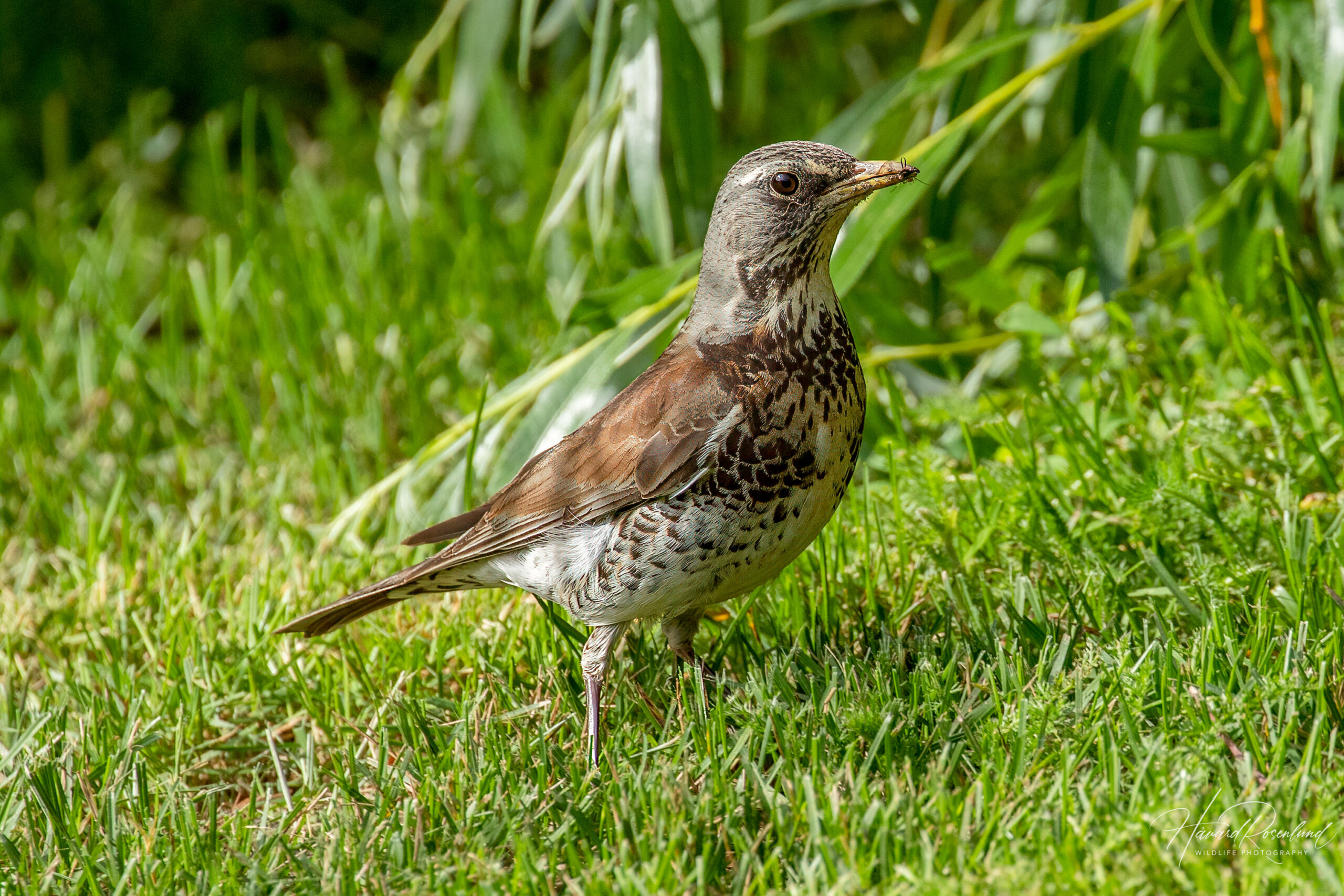
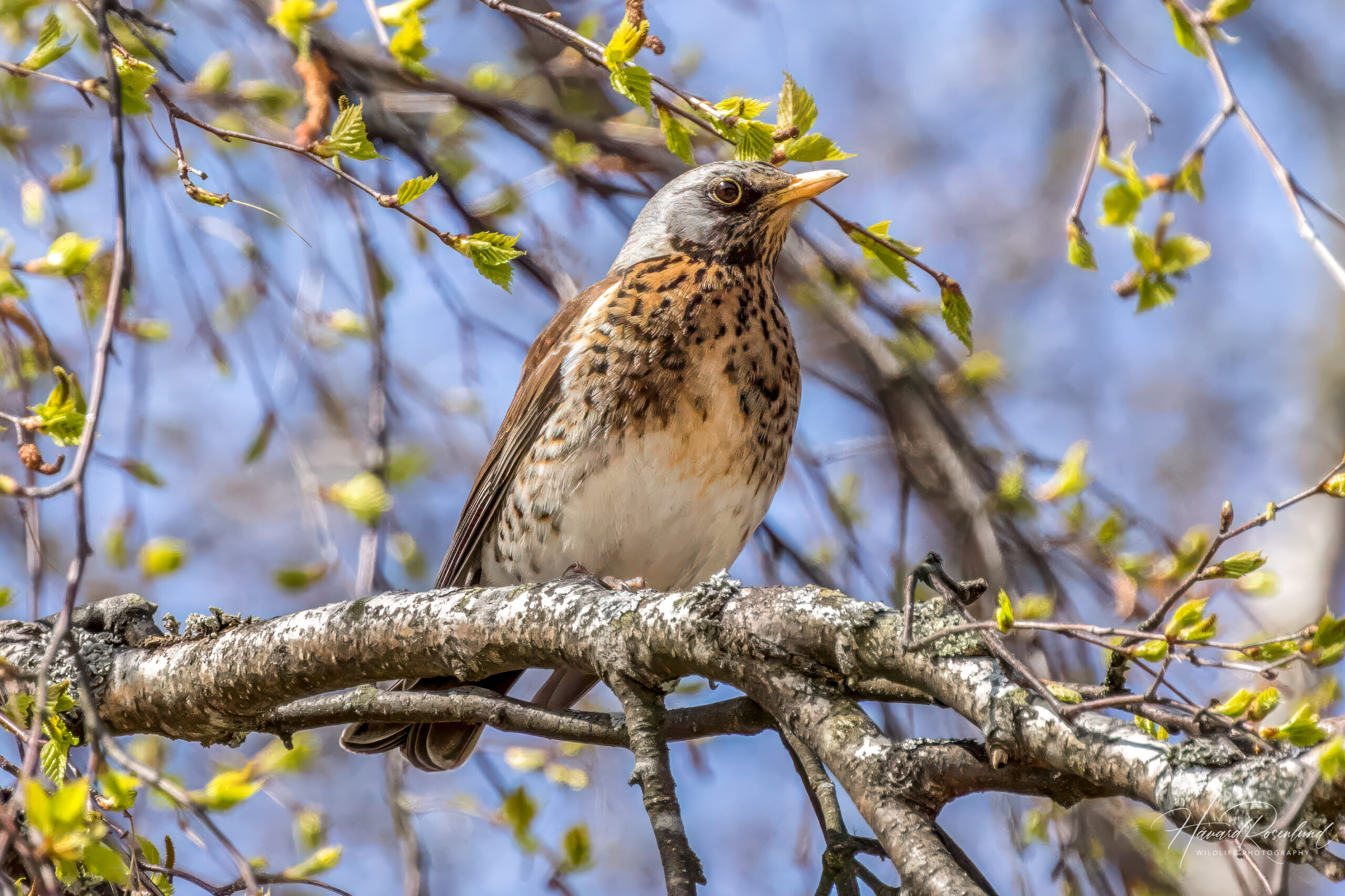
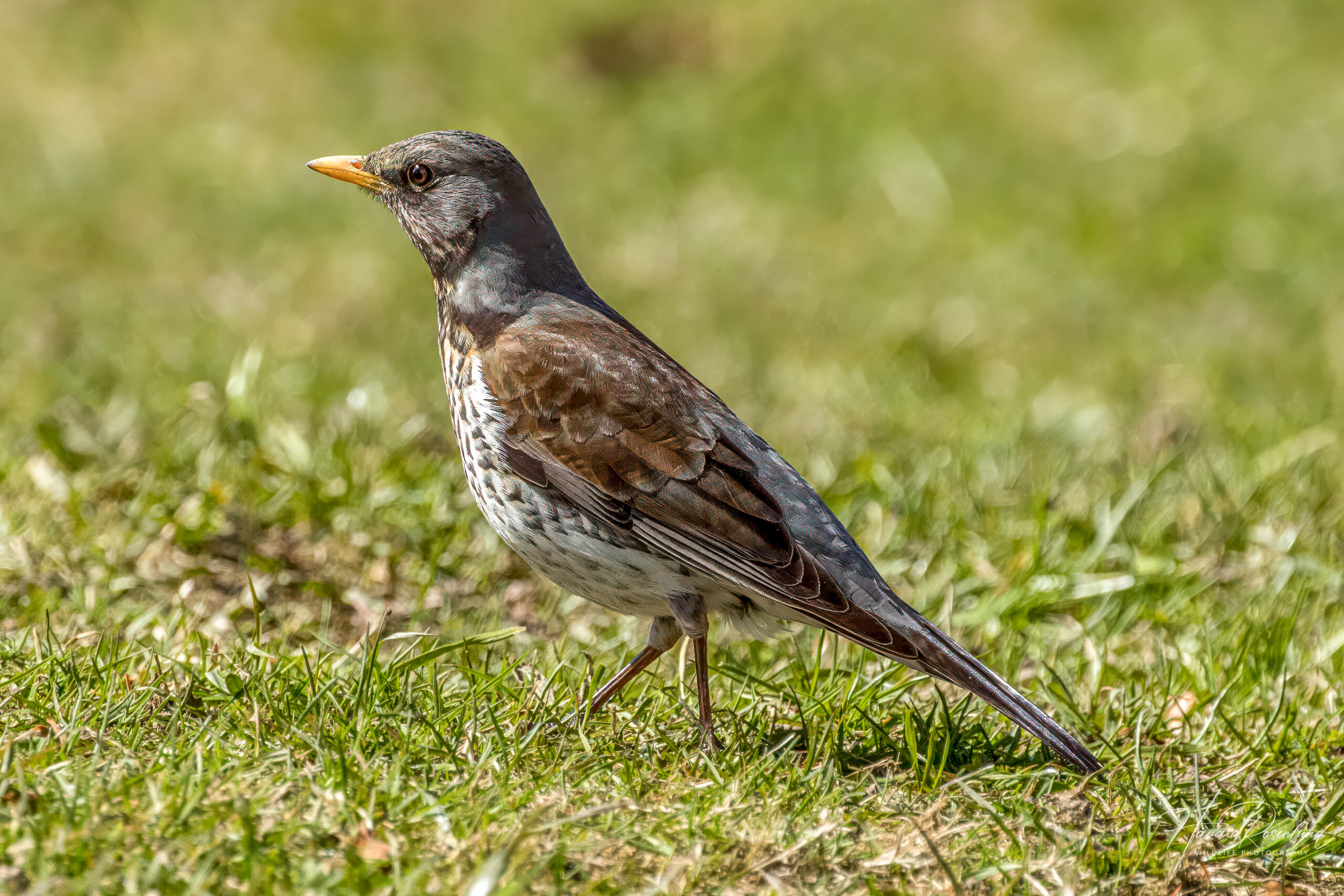
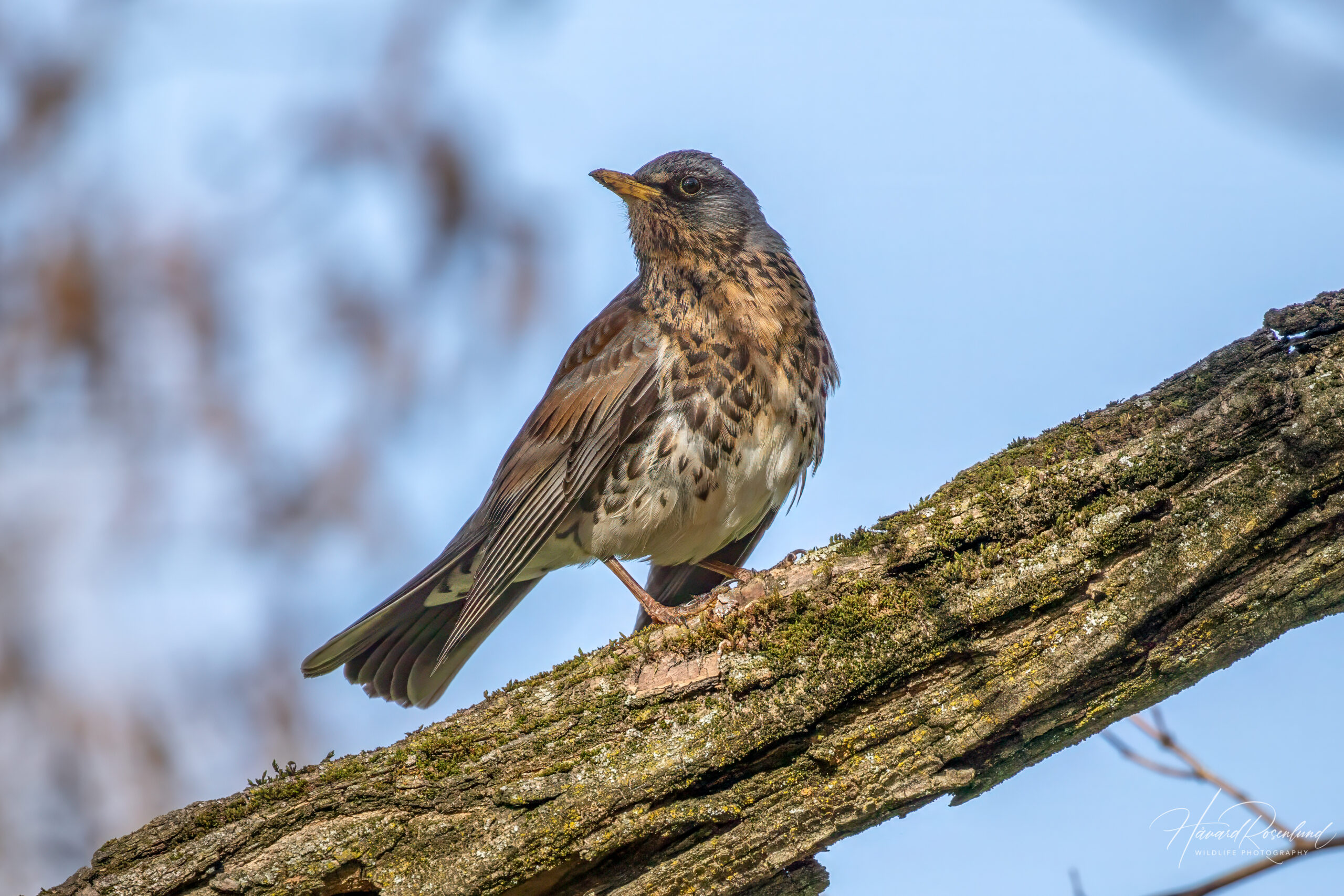
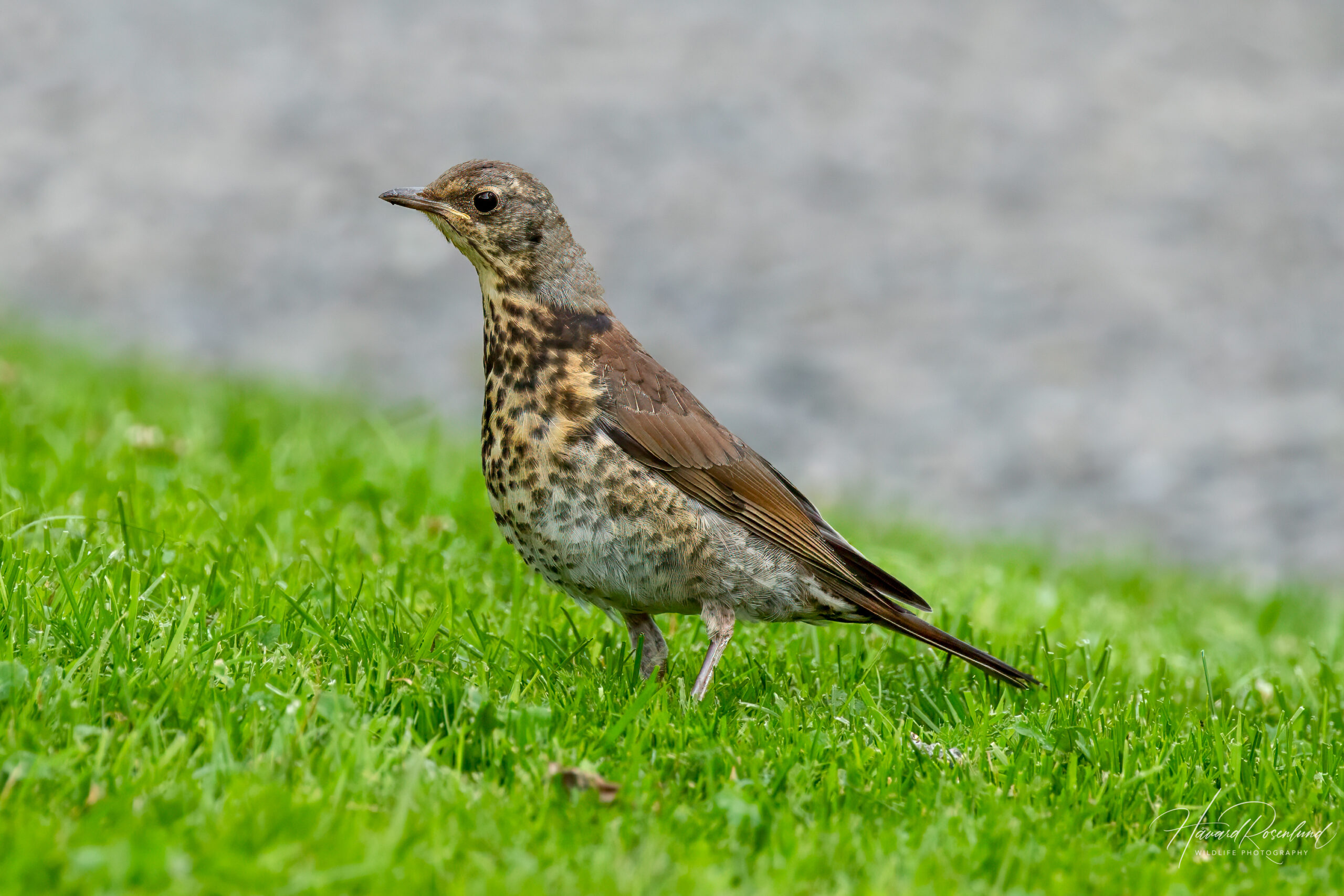
The fieldfare (Turdus pilaris) is a large, boldly patterned thrush, about 25 cm long, typically 80–130 g in weight and with a wingspan of 39–42 cm. Adults have an ash-grey head and rump, chestnut-brown back, dark tail and a yellowish breast marked with dark arrowhead-shaped spots. The contrasting grey and brown upperparts make the species distinctive both perched and in flight.
Fieldfares are often more conspicuous by behaviour than by song. Their common call is a loud, dry chattering note, and outside the breeding season they frequently move in noisy flocks, often alongside redwings (Turdus iliacus) and other thrushes.
Habitat
Fieldfares favour landscapes that combine open feeding ground with trees or shrubs for shelter and nesting. Woodland edges, farmland, orchards, parks, river valleys and mountain birch country can all support breeding birds.
The species can breed from lowland agricultural areas to open northern woodland and subalpine habitats. What matters most is the close combination of suitable nest sites and short or open vegetation where birds can search efficiently for ground-dwelling prey.
Diet
During spring and summer fieldfares feed heavily on earthworms and other soil invertebrates, running or hopping across short grass before stopping to probe or pull prey from the ground. Insects, larvae and other small animals are also important, particularly when chicks are being fed.
In autumn and winter the diet shifts strongly towards berries and fruit. Rowan, hawthorn, apples and other rich fruit crops can attract large flocks, and the availability of these foods often determines where the birds remain and when they move on.
Migration
The fieldfare is a partial migrant whose movements vary considerably between regions and years. Birds breeding in northern and eastern parts of the range generally move south or west for winter, while some populations farther south remain closer to their breeding areas.
Winter distribution can change quickly with weather and food supply. Large flocks may concentrate wherever berries and fallen fruit are abundant, then move on once a food source is exhausted or severe cold and snow make feeding difficult. This makes winter movements more flexible than a simple fixed journey between two sites.
Breeding
Nests are usually built in trees, but fieldfares also use shrubs, ledges and structures where trees are scarce. The cup is made from grass, twigs and other plant material, reinforced with mud and lined more softly. Pairs may nest alone, but loose colonies are common where suitable sites are concentrated.
Field studies published in 1980 showed that colonial nesting can reduce nest predation by allowing neighbouring fieldfares to cooperate in driving away avian predators. Adults may mob crows, raptors and other intruders, repeatedly diving at them and sometimes deliberately bombarding them with droppings. Foul plumage can interfere with the flight and insulation of avian predators, making repeated attacks by several fieldfares an effective deterrent. The defence can also be directed at people approaching the nest.
A 15-year study published in 1995 showed that this defence is not equally effective against every predator. Protection is strongest against conspicuous aerial predators, whereas mammalian predators can still exploit concentrations of nests. Colonial breeding therefore brings both the benefit of cooperative defence and the risk of placing many nests in one area.
A clutch usually contains about five or six eggs. The female incubates for around 11–14 days, and the young normally leave the nest after another 12–16 days. Both parents feed the chicks, and pairs in favourable southern parts of the breeding range may raise a second brood.
Status
The fieldfare is classified as least concern on the IUCN Red List. It remains widespread and numerous across northern Eurasia.
Across Europe, breeding numbers were almost unchanged over the long term, but fell by about 22% between 2015 and 2024. Large year-to-year movements driven by weather and fruit crops can still make local numbers fluctuate much more sharply than the wider population.
Image gallery
Loading map and observations…
Have you seen this species?
Independent species archive
Did you find this species page useful?
Wildlife Vagabond is independently built and maintained. Voluntary support helps cover hosting, maps, data storage and continued improvements to the species archive.
Support Wildlife VagabondSpecies content will remain freely available.
References
Information about the species’ global distribution and status is based primarily on global Red List data. See the references below for details.
- BirdLife International. (n.d.). Fieldfare species factsheet. https://datazone.birdlife.org/species/factsheet/fieldfare-turdus-pilaris
- British Trust for Ornithology. (n.d.). Fieldfare. https://www.bto.org/learn/about-birds/birdfacts/fieldfare
- Hogstad, O. (1995). Do avian and mammalian nest predators select for different nest dispersion patterns of Fieldfares Turdus pilaris? A 15-year study. Ibis, 137(4), 484–489. https://doi.org/10.1111/j.1474-919X.1995.tb03257.x
- Hogstad, O. (2005). Sex‐differences in nest defence in Fieldfares Turdus pilaris in relation to their size and physical condition. Ibis, 147(2), 375-380. https://doi.org/10.1111/j.1474-919X.2005.00416.x
- International Union for Conservation of Nature. (n.d.). Fieldfare. The IUCN Red List of Threatened Species. https://www.iucnredlist.org/species/22708816/87874379
- PECBMS – Species trends. (n.d.). Turdus pilaris. https://pecbms.info/trends-and-indicators/species-trends/
- Royal Society for the Protection of Birds. (n.d.). Fieldfare. https://www.rspb.org.uk/birds-and-wildlife/fieldfare
- Wiklund, C. G., & Andersson, M. (1980). Nest predation selects for colonial breeding among fieldfares <i>Turdus pilaris</i>. Ibis, 122(3), 363-366. https://doi.org/10.1111/j.1474-919X.1980.tb00891.x