
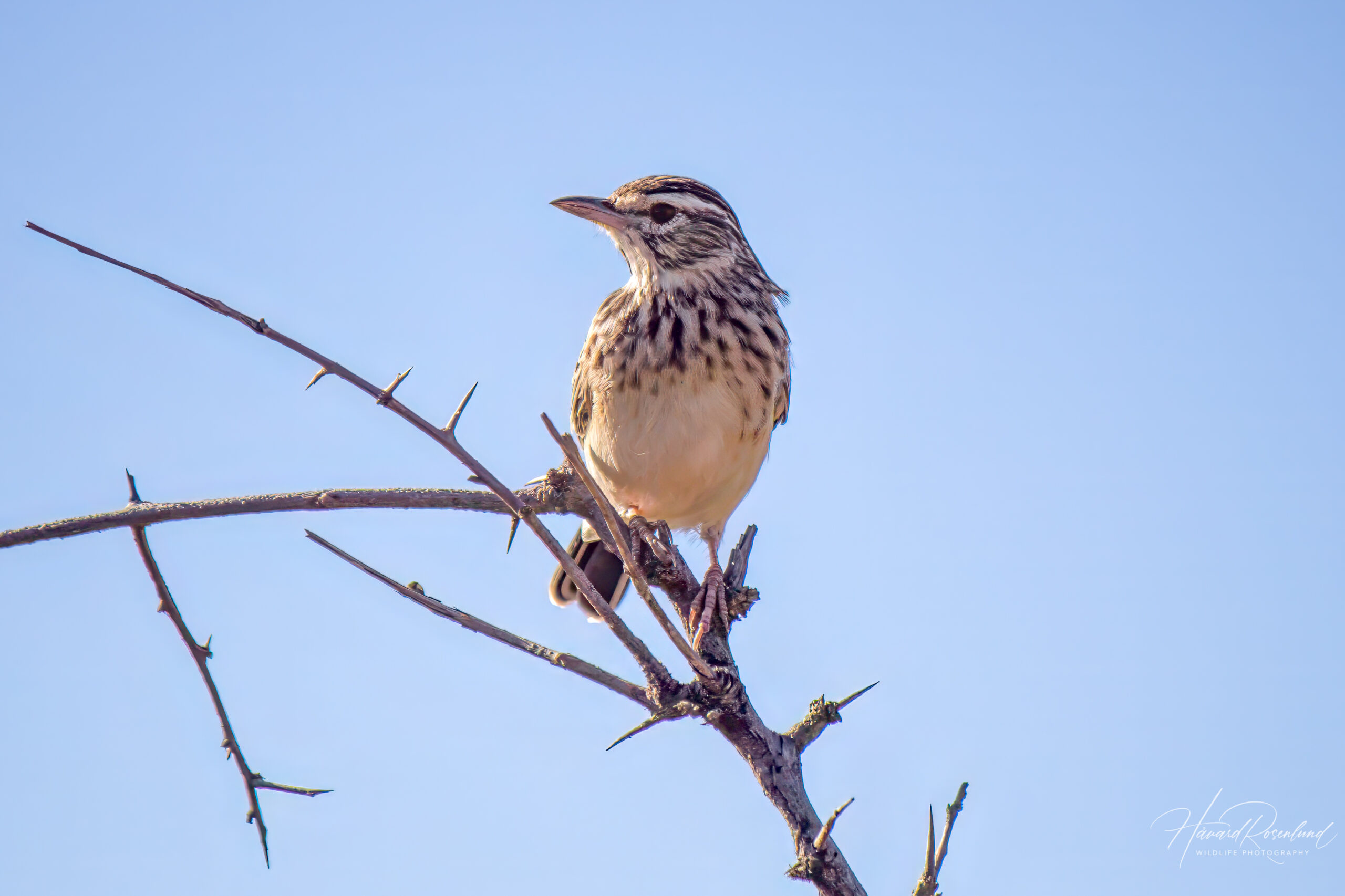
Sabota Lark
Calendulauda sabota
At a glance
Habitat
- Dry savanna, thornveld, shrubland, open woodland and rocky slopes
Diet
- Insects and other small invertebrates, plus seeds and other plant material
Activity
- Diurnal
Size
- Length: 14–15 cm Weight: about 25 g
Range
- Southern Africa, from Angola and Namibia east to Zimbabwe and Mozambique and south into South Africa
Description
The sabota lark (Calendulauda sabota) is a medium-sized, strongly ground-dwelling lark of southern Africa. Adults are about 14–15 cm long and weigh around 25 g. Plumage varies geographically but is generally cryptic brown, grey-brown or sandy, with a conspicuous pale eyebrow, streaked upperparts and a streaked breast above a paler belly. Bill size and shape also vary considerably between populations.
The similar fawn-coloured lark (Calendulauda africanoides) overlaps in parts of southern Africa. Sabota larks are generally more strongly streaked above and below and show a more distinct facial pattern, including malar and moustachial markings, whereas fawn-coloured larks tend to have a plainer face and often show more rufous in the wing.
Taxonomy
The sabota lark is geographically variable and has traditionally been divided into several subspecies. Much of this variation falls into two broad forms centred on bill structure: a slender-billed group and a thick-billed group. Birds from parts of southern Angola and north-western Namibia show intermediate combinations of characters rather than a completely sharp division.
These populations continue to be treated as a single species, Calendulauda sabota. The strong geographic variation is nevertheless biologically meaningful and explains why birds from different parts of southern Africa can differ noticeably in bill dimensions, size and overall appearance.
Habitat
Sabota larks occupy dry savanna, thornveld, open woodland, shrubland, semi-arid grassland and rocky slopes. They are especially associated with open ground beneath scattered woody vegetation rather than dense grass or closed forest.
The species also uses grazed and otherwise modified landscapes where suitable patches of bare or sparsely vegetated ground remain. Different populations occur across a broad climatic range, from relatively dry western savannas to somewhat moister woodland in the east.
Diet
The diet includes insects and other small invertebrates together with seeds and other plant material, with the balance changing according to season and local availability.
Food is taken almost entirely on the ground. Sabota larks walk or run between patches of bare soil and low vegetation, pecking and probing at the surface for prey and seeds as they move. This flexible ground-foraging strategy helps the species remain resident through pronounced seasonal changes in rainfall and food supply.
Song
Male sabota larks sing conspicuously from the tops of bushes, trees and other elevated perches and may also sing during display flights. The repertoire is unusually varied, with long phrases, marked differences among individuals and frequent imitation of other bird species.
Song varies extensively both within and among vegetation types rather than following one fixed stereotyped form. Voice is therefore extremely useful for detecting the otherwise cryptically coloured birds, while singing males can sound quite different from place to place.
Breeding
Breeding is closely linked to rainfall and peaks during the wet season. The female alone constructs the ground nest, often placing it beside a grass tuft or small shrub. Nest structure varies greatly: some nests have a partial dome and a small apron of plant material in front of the entrance, while others are much simpler.
Clutches average about 2.5 eggs. The female incubates alone for roughly 12 days, and nestlings remain in the nest for about another 12 days. Both parents supply food, and both sexes may also brood the young, an unusual pattern among closely related larks. A study published in 2019 of a South African population found that about one third of breeding attempts succeeded, with predation the main cause of nest failure, so replacement clutches were common.
Status
The sabota lark is classified as least concern on the IUCN Red List. It has one of the broadest distributions of the southern African larks and remains common across much of its range.
Its ability to use several open and semi-arid habitat types makes it less restricted than many regional lark species. Local populations still depend on suitable ground structure and scattered woody vegetation, however, and can be affected where land use produces either dense uniform cover or extensive loss of natural vegetation.
Image gallery
Loading map and observations…
Have you seen this species?
Independent species archive
Did you find this species page useful?
Wildlife Vagabond is independently built and maintained. Voluntary support helps cover hosting, maps, data storage and continued improvements to the species archive.
Support Wildlife VagabondSpecies content will remain freely available.
References
Information about the species’ global distribution and status is based primarily on global Red List data. See the references below for details.
- BirdLife International. (n.d.). Sabota Lark species factsheet. https://datazone.birdlife.org/species/factsheet/sabota-lark-calendulauda-sabota
- Engelbrecht, G. D., & Mashao, M. L. (2019). Nesting ecology and parental care of the Sabota Lark (Calendulauda sabota) in a savanna landscape in South Africa. The Wilson Journal of Ornithology, 131(2), 272-284. https://doi.org/10.1676/18-125
- International Union for Conservation of Nature. (n.d.). Sabota Lark. The IUCN Red List of Threatened Species. https://www.iucnredlist.org/species/22717127/94521681
- Marr, S. M., Mashao, M. L., & Engelbrecht, G. D. (2017). Morphological variation in the Sabota Lark Calendulauda sabota in southern Africa. Ostrich, 88(1), 67-71. https://doi.org/10.2989/00306525.2016.1216016
- Mashao, M., Engelbrecht, D., & de Swardt, D. H. (2015). Desktop ecology: Sabota Lark Calendulauda sabota. Biodiversity Observations, 6, 84–91. https://doi.org/10.15641/bo.283
- Store norske leksikon. (n.d.). Sabotalerke. https://snl.no/sabotalerke