
Garden Warbler
Sylvia borin
At a glance
Habitat
- Dense scrub, woodland understorey, young woodland and well-vegetated edges
Diet
- Mainly insects and other invertebrates in the breeding season; increasingly fruit and berries during migration
Activity
- Diurnal; much migration occurs at night
Size
- Length: 13–15 cm Weight: 17 g
Range
- Breeds across much of Europe and western Asia; winters south of the Sahara in Africa
Description
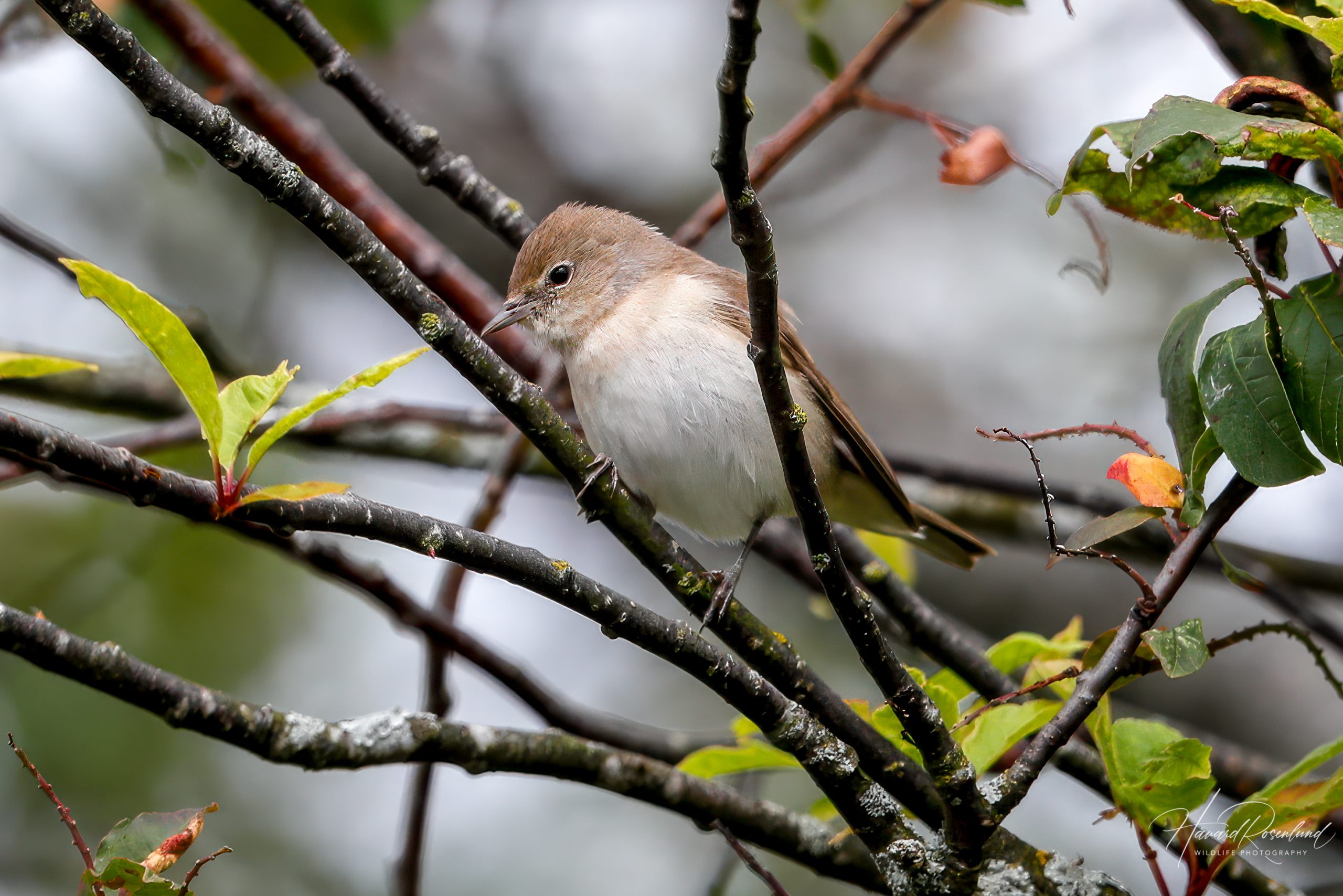
The garden warbler (Sylvia borin) is a medium-sized, remarkably plain warbler of dense vegetation across Europe and western Asia. Adults are about 13–15 cm long, have a wingspan of around 20–24.5 cm and weigh around 17 g. The plumage is almost featureless grey-brown to olive-brown above and pale below, with no obvious wing bars, eye stripe or cap. This lack of strong markings is itself one of the best visual clues.
The species is often confused with female or juvenile Eurasian blackcaps (Sylvia atricapilla), but garden warblers lack the contrasting crown. Their strongest identification feature is often the song: a long, rich stream of fluting and chattering phrases. It resembles blackcap song, but is generally more continuous and less neatly divided into a clear final flourish.
Habitat
Garden warblers breed in dense, leafy vegetation rather than open forest. Typical habitats include deciduous and mixed woodland with a rich understorey, young regenerating woodland, scrub, overgrown clearings, woodland edges, riverine thickets, hedges and other places with tall herbs and bushes. Despite the English name, gardens are not especially important unless they provide this dense structure.
The species is particularly associated with a layered mix of shrubs and low trees. This provides concealed song posts, nest sites and a large surface area for insect foraging. On migration and in Africa, garden warblers likewise favour wooded or scrubby habitats where both insects and fruit are abundant.
Diet
During the breeding season garden warblers feed mainly on insects and other small invertebrates, including beetles, caterpillars, flies, bugs, spiders and other arthropods gleaned from leaves and twigs. They move methodically through shrubs and low tree canopies while picking prey from vegetation. The chicks are fed predominantly animal prey because of their high protein demands.
Fruit becomes increasingly important after breeding and during migration. Berries and other soft fruits allow birds to gain fat rapidly before long flights across the Mediterranean and Sahara. A feeding experiment published in 1987 found that low dietary levels of both protein and fat could reduce body mass, but birds partly compensated by increasing food intake and altering how efficiently nutrients were used. Daily net fat intake was substantially higher than protein intake both when the birds maintained body mass and when they rebuilt it.
Behaviour
Garden warblers spend much of their time inside dense foliage, moving quietly through shrubs and low branches and often remaining hidden even when they are singing nearby. The combination of plain plumage and a secretive way of life makes the species easy to overlook where it is common.
Breeding males establish territories and sing persistently from concealed perches. A study from Wytham Wood in England published in 1981 found strong territorial competition with Eurasian blackcaps. Blackcaps were consistently more aggressive and could exclude garden warblers from otherwise suitable habitat; when established blackcaps were removed, garden warblers quickly settled and bred in parts of the vacated area. Garden warblers that had already established territories defended them against both their own species and blackcaps.
Migration
The garden warbler is a long-distance migrant. European and western Asian breeders leave from late summer and cross the Mediterranean and Sahara to spend the non-breeding season in sub-Saharan Africa. Much of the migratory flight takes place at night, while daytime is used for feeding and rebuilding fat reserves. Outside breeding the species is less territorial and may concentrate loosely where fruit is abundant, although it does not usually form tight flocks.
A study published in 2005 using data from Nigeria and The Gambia found that birds often arrived south of the Sahara with relatively small fat reserves, refuelled in West African savannas and continued south in November–December. Before the spring crossing of the Sahara many built reserves equivalent to around half of lean body mass, while about one in ten carried enough fuel for total body mass to be close to double the lean mass. A 2011 study from Obudu in southeastern Nigeria showed that not all birds necessarily continued far south: lower fuel loads and moulting individuals suggested that some may remain in the area through winter.
Breeding
Male song also helps attract a female after the birds return from Africa in spring. Garden warblers build a light cup nest low in dense shrubs, brambles, tall herbs or other thick vegetation. A typical clutch contains four to five eggs. Both adults incubate and feed the chicks. Incubation usually lasts about 10–12 days, and the chicks leave the nest after roughly 11–12 days. Young remain dependent on the parents for a period after fledging. The species normally raises one brood but can occasionally raise two. Dense vegetation around the nest is important both for concealment and for providing nearby insect prey.
Status
The garden warbler is classified as least concern on the IUCN Red List. It remains widespread across Europe and western Asia, and long-term monitoring in Britain shows a broadly stable population through 2024. Because it depends on dense scrub and young woodland, local abundance can change rapidly when woodland matures, scrub is removed or regeneration is prevented.
As a trans-Saharan migrant, the species also depends on habitats far beyond the breeding grounds. Loss or degradation of stopover and non-breeding habitat in Africa can affect body condition and survival even when breeding habitat remains suitable. The annual cycle therefore depends on suitable habitat in both the breeding range and Africa.
Image gallery
Loading map and observations…
Have you seen this species?
Independent species archive
Did you find this species page useful?
Wildlife Vagabond is independently built and maintained. Voluntary support helps cover hosting, maps, data storage and continued improvements to the species archive.
Support Wildlife VagabondSpecies content will remain freely available.
References
Information about the species’ global distribution and status is based primarily on global Red List data. See the references below for details.
- Bairlein, F. (1987). Nutritional requirements for maintenance of body weight and fat deposition in the long-distance migratory garden warbler, Sylvia borin (Boddaert). Comparative Biochemistry and Physiology Part A: Physiology, 86(2), 337-347. https://doi.org/10.1016/0300-9629(87)90340-9
- BirdLife International. (n.d.). Garden Warbler species factsheet. https://datazone.birdlife.org/species/factsheet/garden-warbler-sylvia-borin
- British Trust for Ornithology. (n.d.). BirdFacts – Garden Warbler. https://www.bto.org/learn/about-birds/birdfacts/garden-warbler
- Garcia. (1981). An experimental and observational study of interspecific territoriality between the blackcap Sylvia atricapilla and the garden warbler Sylvia borin. University of Oxford DPhil thesis. https://ora.ox.ac.uk/objects/uuid:b2cdc8f8-6786-48be-a25c-c6ddcf4a913b
- International Union for Conservation of Nature. (n.d.). Garden Warbler. The IUCN Red List of Threatened Species. https://www.iucnredlist.org/species/22716906/111812037
- Iwajomo, S. B., Ottosson, U., Barshep, Y., Helseth, A., Hulme, M. F., Stevens, M., & Waldenström, J. (2011). The stopover behaviour of the Garden Warbler Sylvia borin in Obudu, southeast Nigeria. Ornis Svecica, 21(1), 29-36. https://doi.org/10.34080/os.v21.22608
- Ottosson, U., Waldenström, J., Hjort, C., & McGregor, R. (2005). Garden Warbler Sylvia borin migration in sub‐Saharan West Africa: phenology and body mass changes. Ibis, 147(4), 750-757. https://doi.org/10.1111/j.1474-919X.2005.00460.x
- Royal Society for the Protection of Birds. (n.d.). Garden Warbler. https://www.rspb.org.uk/birds-and-wildlife/garden-warbler