
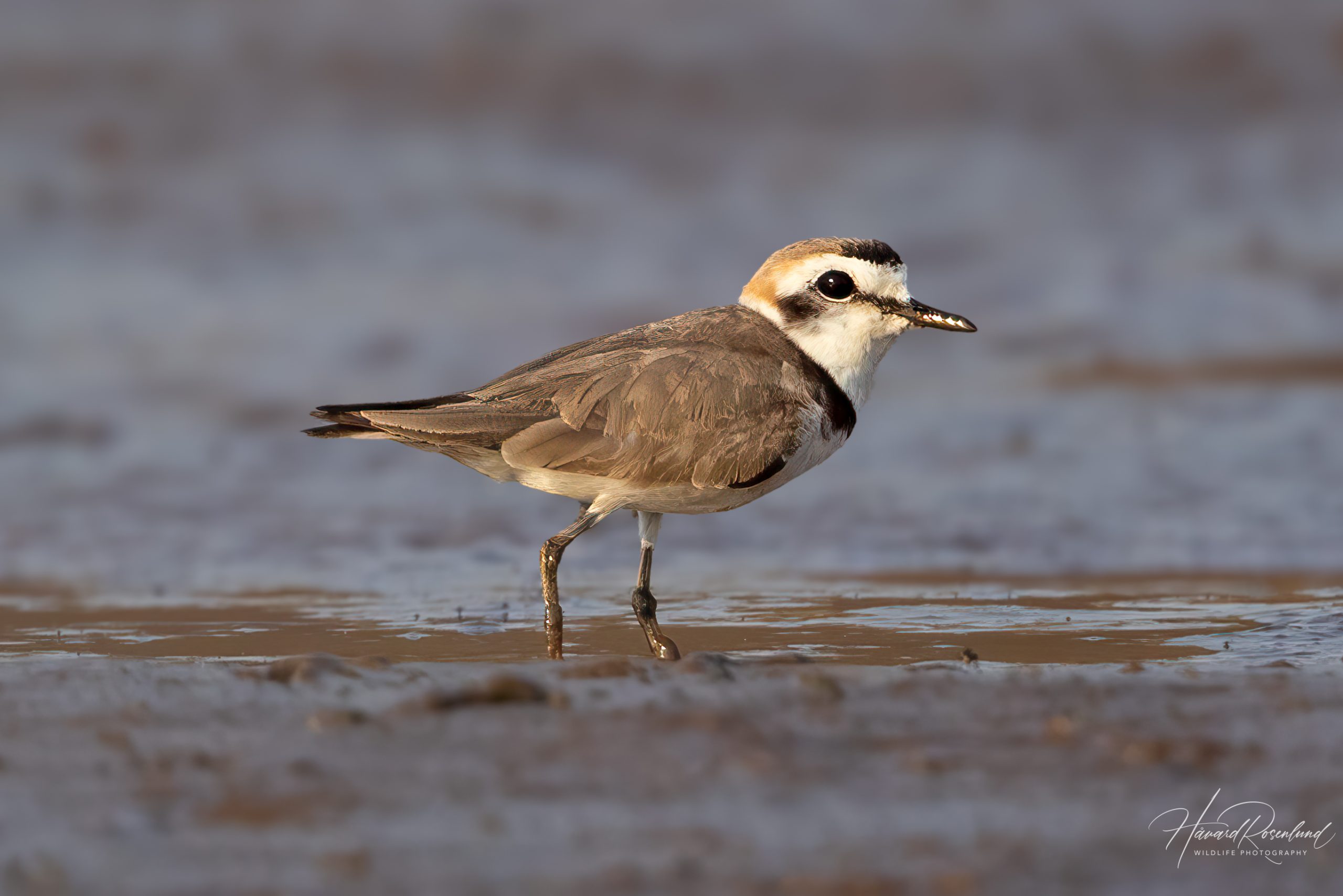
Kentish Plover
Anarhynchus alexandrinus
At a glance
Habitat
- Sandy and gravelly coasts, saltmarshes, mudflats, saltpans and sparsely vegetated inland wetlands
Diet
- Small insects, crustaceans, worms, molluscs and other invertebrates
Activity
- Diurnal; feeding often extends into twilight
Size
- Length: 15–17 cm; wingspan 42–45 cm Weight: about 39–48 g
Range
- Europe and North Africa east across western, central and South Asia; resident and migratory populations
Description
The Kentish plover (Anarhynchus alexandrinus) is a small shorebird about 15–17 cm long, with a wingspan of roughly 42–45 cm and a mass of around 39–48 g. It has pale sandy-brown upperparts, white underparts, a short black bill and dark legs. Breeding males usually show a rufous crown, black forehead markings and dark patches at the sides of the breast, while females and non-breeding birds are softer brown and less strongly patterned.
White-faced plover (Anarhynchus dealbatus) is very similar but typically has a whiter face, weaker dark markings around the eye and paler legs. The two are most difficult to separate outside breeding plumage and in areas of East Asia where their ranges approach one another.
Taxonomy
The Kentish plover once formed part of a much broader species complex. Snowy plover (Anarhynchus nivosus) of the Americas and white-faced plover (A. dealbatus) of East Asia are now recognised as separate species, leaving A. alexandrinus with a mainly Eurasian and North African distribution.
Early genetic studies found little separation between Kentish and white-faced plovers despite strong plumage differences. A genome-wide study published in 2019 instead found two well-defined genetic clusters, limited hybridisation and a narrow contact zone, supporting recognition of white-faced plover as a separate species. Modern plover phylogenies also place Kentish plover in Anarhynchus rather than the traditional genus Charadrius.
Habitat
Kentish plovers favour open, sparsely vegetated ground near shallow water. Typical habitats include sandy and gravelly beaches, saltmarshes, tidal flats, saltpans, saline lakes, reservoir margins and dry flats around inland wetlands.
Low vegetation and exposed substrate make it easier to detect predators and move chicks, but also leave nests vulnerable to disturbance. The species can use artificial saltpans and other modified wetlands when suitable open ground is retained.
Diet
Small invertebrates dominate the diet, including insects, crustaceans, marine worms, molluscs and other prey taken from wet mud, sand and shallow water. Birds use the typical plover strategy of running several steps, stopping abruptly and picking visible prey from the surface.
Feeding continues through much of the day and may extend into twilight, especially on tidal coasts where access to feeding ground follows the tide rather than a fixed daily schedule.
Behaviour
Kentish plovers are usually seen alone, in pairs or in small groups during breeding, while larger loose flocks form at feeding and roosting sites outside the breeding season. They rely heavily on camouflage and often crouch or move quietly away before taking flight when disturbed.
Outside the immediate nesting context they can be mobile across open shorelines, shifting between feeding and resting patches as tides, water levels and disturbance change. Birds at communal resting sites may remain inconspicuous until the whole group suddenly takes flight.
Migration
Movement varies greatly across the range. Many populations in warm coastal regions are resident or make short local movements, while birds breeding in Europe and Central Asia migrate south to North and sub-Saharan Africa, the Middle East and South Asia.
India holds both resident birds and winter visitors. Migrants depend on many coastal and inland wetlands for feeding and resting between breeding and wintering areas.
Breeding
Breeding timing varies geographically and often extends from spring into summer. The nest is a shallow scrape on bare sand, gravel or salt-encrusted ground, sometimes lined with small stones, shells or plant fragments. Clutches usually contain three eggs, although two or four occur. Both parents share incubation, which commonly lasts about 25–28 days, and chicks become capable of flight at around 30 days.
Breeding adults defend the area around nests and chicks and use distraction displays to draw potential predators away. The chicks hatch covered in down, leave the nest soon afterwards and find much of their own food while the adults guard and warm them.
Parental care is unusually flexible. In many populations one adult, often the female, leaves the brood before the young can fly, while the male continues caring for the chicks; the departing bird may then breed again with a new mate. A study published in 2000 in southern Spain found that female brood desertion was not caused by poorer body condition or higher energetic costs of incubation. Its timing instead corresponded more closely to how much parental care the chicks still required.
Status
The Kentish plover is classified as least concern on the IUCN Red List. It remains widespread across Europe, North Africa and much of Asia, while many local populations are affected by loss and disturbance of open shoreline and wetland habitat.
State of India’s Birds 2025 classifies the species as High Priority nationally. The updated estimates show a long-term decline of about 68.8% and a current annual decline of about 4.4%; both are classified as Rapid Decline.
Coastal development, recreation, vehicles, dogs, altered water levels and loss of sparsely vegetated nesting ground can all reduce breeding success. A study published in 2024 projected an average loss of more than 22% of suitable nesting habitat by 2040 along the studied central Adriatic coast as the shoreline changes under human and climatic pressures.
Image gallery
Loading map and observations…
Have you seen this species?
Independent species archive
Did you find this species page useful?
Wildlife Vagabond is independently built and maintained. Voluntary support helps cover hosting, maps, data storage and continued improvements to the species archive.
Support Wildlife VagabondSpecies content will remain freely available.
References
Information about the species’ global distribution and status is based primarily on global Red List data. See the references below for details.
- Amat, J. A., Visser, G. H., Pérez–Hurtado, A., & Arroyo, G. M. (2000). Brood desertion by female shorebirds: a test of the differential parental capacity hypothesis on Kentish plovers. Proceedings of the Royal Society of London. Series B: Biological Sciences, 267(1458), 2171-2176. https://doi.org/10.1098/rspb.2000.1265
- AviList. (n.d.). v2025 – Global avian checklist. https://www.avilist.org/
- BirdLife International. (n.d.). Kentish Plover species factsheet. https://datazone.birdlife.org/species/factsheet/kentish-plover-charadrius-alexandrinus
- Bouakkaz, A., Belhassini, K., Bensouilah, T., Bensouilah, M. A., & Houhamdi, M. (2017). Breeding behaviour of the Kentish plover (Charadrius alexandrinus) in a salt marsh from the Eastern High Plateaux, northeast Algeria. Journal of King Saud University - Science, 29(3), 291-301. https://doi.org/10.1016/j.jksus.2016.05.006
- Fraga & Amat. (1996). Breeding biology of a Kentish Plover population in an inland saline lake. Ardeola, 43, 69–85. https://www.ardeola.org/en/volumes/431/articles/69-85/
- International Ornithologists’ Union. (n.d.). IOC World Bird List – plover taxonomy and White-faced Plover split. https://www.worldbirdnames.org/new/updates/species-updates/
- International Union for Conservation of Nature. (n.d.). Kentish Plover. The IUCN Red List of Threatened Species. https://www.iucnredlist.org/species/22727487/155485165
- Sadanandan, K. R., Küpper, C., Low, G. W., Yao, C.-T., Li, Y., Xu, T., Rheindt, F. E., & Wu, S. (2019). Population divergence and gene flow in two East Asian shorebirds on the verge of speciation. Scientific Reports, 9(1), 8546. https://doi.org/10.1038/s41598-019-44996-5
- State of India's Birds. (2025). State of India’s Birds (2025 update) – Kentish Plover. https://stateofindiasbirds.in/species/kenplo1/
- Villalobos Perna, P., Finizio, M., Carranza, M. L., Innangi, M., Bongiovanni, S. B., Andino, N., & Di Febbraro, M. (2024). Anthropogenic and climate change-driven coastline dynamics will erode future nesting habitats of the kentish plover on the central adriatic coast. Scientific Reports, 14(1), 23306. https://doi.org/10.1038/s41598-024-74726-5