
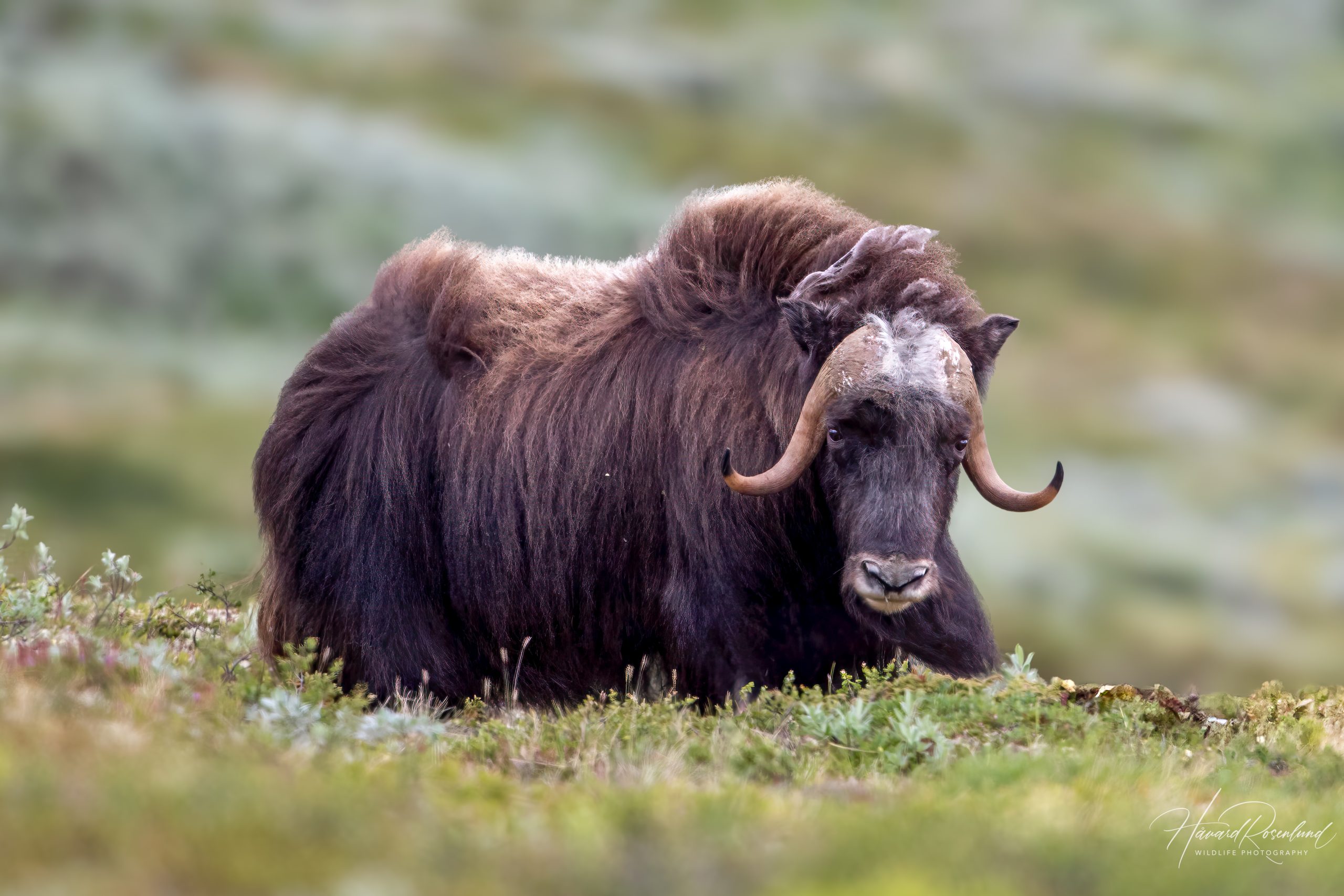
Muskox
Ovibos moschatus
At a glance
Habitat
- Arctic tundra, polar desert and open valleys with sedges, grasses and dwarf shrubs; introduced populations also occur in some subarctic mountain areas
Diet
- Mainly sedges and grasses, with willow and other shrubs especially important seasonally; lichens and other tundra plants are also taken
Activity
- Active throughout the day, alternating feeding and resting; movements are strongly shaped by season, snow and forage
Size
- Length: ~190–250 cm body length; ~120–152 cm shoulder height Weight: Females ~180–275 kg; males commonly ~250–400 kg
Range
- Native to Arctic Canada and Greenland; introduced or reintroduced populations occur in Alaska, Russia, Norway and some other regions
Description
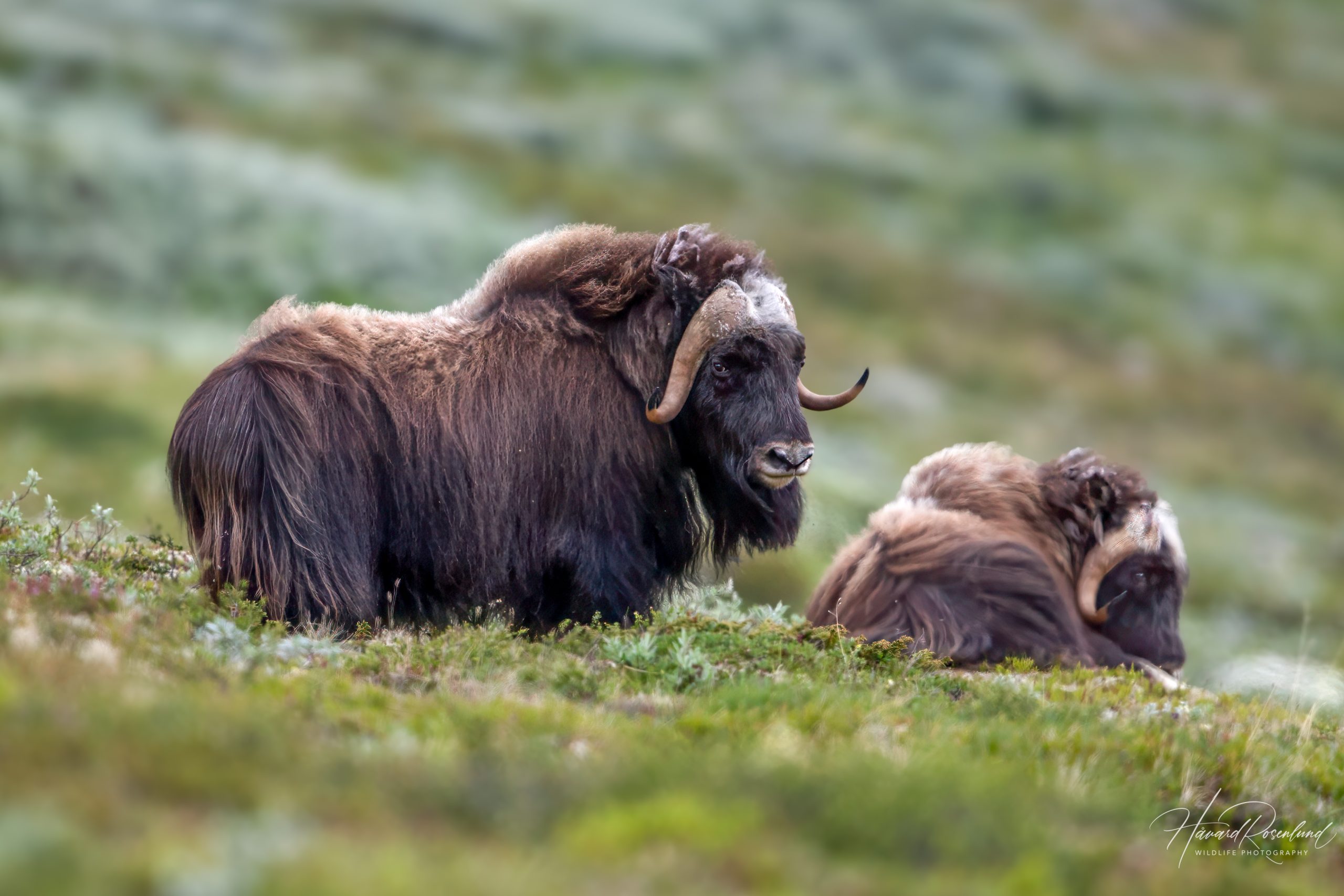
The muskox (Ovibos moschatus) is a large, powerfully built Arctic herbivore with a long shaggy coat, short legs and heavy horns. Despite its ox-like appearance, it belongs to the same branch of the bovid family as sheep and goats. Adults stand roughly 1.2–1.5 m at the shoulder. Males are much heavier than females and commonly weigh around 250–400 kg, while females are often around 180–275 kg.
Both sexes carry horns. In mature bulls the horn bases become extremely thick and meet across much of the forehead, forming a solid protective boss before curving downward and then upward. Females have narrower horn bases. The long outer hair can hang almost to the ground and hides much of the compact body beneath it.
Cold adaptations
The coat has two very different layers. Long coarse guard hairs protect the body from wind and precipitation, while underneath lies an exceptionally fine and dense wool called qiviut. This underwool traps a thick layer of insulating air and is shed when temperatures rise. The large compact body and relatively short legs also reduce the amount of heat lost to the surroundings.
Newborn calves show how far these adaptations go. Experimental work found that calves only hours to days old could maintain body temperature at around −30 °C under calm conditions. They combine excellent fur insulation with very high heat production, including heat generated by brown fat. The same physiology that makes muskoxen exceptional cold specialists also leaves them poorly suited to prolonged heat.
Muskoxen can also conserve heat through peripheral heterothermy, allowing outer parts of the body to remain cooler than the core. Winter measurements from cows and calves have shown that this temperature pattern, together with the exceptionally insulating coat, keeps heat loss low even in severe cold.
Habitat
Native muskoxen live in Arctic tundra, polar desert, river valleys and other treeless landscapes in Greenland and northern Canada. They favour areas where wind, topography or relatively shallow snow allows access to vegetation through winter. Introduced or reintroduced populations occupy comparable open environments in Alaska, Russia and Norway.
Winter conditions can be more important than low temperature itself. Hard ice layers formed by thawing and refreezing or rain falling onto snow can lock vegetation beneath an impenetrable crust. Such events can suddenly make otherwise suitable feeding areas unusable and have caused major mortality in some Arctic populations.
Diet
Muskoxen are grazing ruminants whose diet is dominated by sedges and grasses across much of the Arctic range. Willows and other dwarf shrubs become especially important in some seasons and regions, while herbs, lichens, mosses and other tundra plants are also eaten.
Food quality changes dramatically through the year. Summer brings a short period of abundant, nutritious vegetation during which animals feed heavily and rebuild body reserves. Winter forage is sparse and fibrous. Muskoxen reduce their food intake and have a large digestive system that can process coarse plant material slowly and efficiently rather than trying to compensate for poor food by simply eating much more. They use the front hooves to dig through snow for vegetation and can also use the head to break through harder snow crusts.
Behaviour
Muskoxen alternate repeatedly between feeding, moving, resting and ruminating rather than following one simple day–night activity pattern. Year-round tracking in north-east Greenland showed clear activity cycles during the dark winter, with bouts of foraging and rest recurring throughout the 24-hour period. The pattern was less rigid during the continuous light of summer.
Social behaviour
Muskoxen are strongly social and live in herds whose size and composition change through the year. Many herds contain around 10–20 animals, although summer groups can be smaller and winter herds much larger. Adult bulls may be solitary or form male groups outside the breeding season. Staying together also provides benefits beyond feeding and reproduction, particularly when animals need to protect calves.
Communication includes both sound and body language. Calves bleat, while adults may grunt, snort and roar. Stomping, chasing and head movements are also used as dominance signals between adults, especially around the rut.
Predation
Wolves (Canis lupus) are the main natural predator across much of the muskox's range and can have a substantial influence on some High Arctic populations. Calves are especially vulnerable, but studies on Ellesmere Island show that wolves also kill adult muskoxen regularly, despite their formidable size and horns.
Muskoxen respond with one of the most distinctive group defences among large herbivores. Adults may form a line or tight circle facing outward with their horns while calves remain behind or inside the group. Mature bulls often place themselves between the threat and the rest of the herd, and an intact group can be extremely difficult for wolves to attack. Animals that become isolated are much more vulnerable.
Reproduction
The rut takes place in late summer and early autumn. Mature bulls compete for access to females through displays, roaring and head-on charges in which the thick horn bosses absorb powerful impacts. Dominant bulls may hold groups of several females during the breeding period, while younger and subordinate males are often kept at a distance.
After a gestation of about eight months, females usually give birth to a single calf in April or May, shortly before the rapid spring growth of tundra vegetation. Twins are rare. Calves weigh roughly 8–11 kg at birth and can stand and follow their mothers very quickly. Milk remains important through their first growing season and often longer, even though young begin nibbling vegetation within weeks.
Reproductive success depends strongly on the female's condition. In difficult years some females may skip breeding rather than invest in a calf they cannot support.
Longevity differs between the sexes. Females often live around 15–18 years, while adult males commonly live about 10–12 years; some muskoxen have survived beyond 20 years.
Introduction to Norway
Muskoxen lived naturally in Scandinavia tens of thousands of years ago, but the animals on Dovrefjell today descend from modern introductions and are therefore regarded as a non-native population. An early attempt involving animals brought from Greenland in 1931–32, followed by two more animals in 1938, failed. Between 1947 and 1953, 27 calves and yearlings were brought from Greenland to Dovrefjell. Probably only about ten were still alive in 1953, and these formed the foundation of the present population.
Norway's 2023 Alien Species List classifies the muskox as potentially high risk (PH). The population has a high potential to spread if it is not controlled, but no major ecological effect on native species or habitat types is known. The Dovrefjell population is kept within a defined core area, and animals that establish themselves outside it are normally removed.
The January 2026 winter count recorded at least 220 animals, including 32 calves, all within the core area. The target is a maximum of 200 animals in winter, so removals may be needed when the population exceeds this level.
Dovrefjell lies near the warm edge of conditions this Arctic specialist tolerates well. Severe pneumonia outbreaks in 2006 and 2012 caused mortality of roughly 25–30% of the population. Research linked the outbreaks to respiratory infections, and the 2006 event coincided with exceptionally warm and humid weather. The population may also be exposed to pathogens from domestic sheep grazing in the same mountain areas.
Tourism centred on the muskoxen can increase disturbance to wild reindeer (Rangifer tarandus). Visitors are advised to keep at least 200 m away from muskoxen for safety and to avoid unnecessary disturbance.
Status
The muskox is classified as least concern on the IUCN Red List. A circumpolar review published in 2020 estimated roughly 170,000 muskoxen worldwide, but also showed that populations differ greatly in their trajectories and that several have experienced substantial declines.
Climate change can affect muskoxen through several pathways rather than simply by making the Arctic warmer. Ice layers can block winter forage, warmer summers can increase heat stress and insect harassment, and changing conditions can alter parasites and infectious disease. Hunting, habitat change and low genetic diversity add further pressure in some populations. Regional populations can therefore be vulnerable even though the species is globally classified as least concern.
Image gallery
Loading map and observations…
Have you seen this species?
Independent species archive
Did you find this species page useful?
Wildlife Vagabond is independently built and maintained. Voluntary support helps cover hosting, maps, data storage and continued improvements to the species archive.
Support Wildlife VagabondSpecies content will remain freely available.
References
Information about the species’ global distribution and status is based primarily on global Red List data. See the references below for details.
- Anderson, M. L., Cluff, H. D., Mech, L. D., & MacNulty, D. R. (2025). Wolf density and predation patterns in the Canadian High Arctic. The Journal of Wildlife Management, 89(1), e22671. https://doi.org/10.1002/jwmg.22671
- Animal Diversity Web. (n.d.). Ovibos moschatus. https://animaldiversity.org/accounts/Ovibos_moschatus/
- Artsdatabanken. (n.d.). Muskox, Alien Species List 2023. https://lister.artsdatabanken.no/fremmedartslista/2023/1478
- Blix, A., Grav, H., Markussen, K., & White, R. (1984). Modes of thermal protection in newborn muskoxen (Ovibos moschatus). Acta Physiologica Scandinavica, 122(4), 443-453. https://doi.org/10.1111/j.1748-1716.1984.tb07532.x
- Cuyler, C., Rowell, J., Adamczewski, J., Anderson, M., Blake, J., Bretten, T., Brodeur, V., Campbell, M., Checkley, S. L., Cluff, H. D., Côté, S. D., Davison, T., Dumond, M., Ford, B., Gruzdev, A., Gunn, A., Jones, P., Kutz, S., Leclerc, L.-M., … Ytrehus, B. (2020). Muskox status, recent variation, and uncertain future. Ambio, 49(3), 805-819. https://doi.org/10.1007/s13280-019-01205-x
- Handeland, K., Tengs, T., Kokotovic, B., Vikøren, T., Ayling, R. D., Bergsjø, B., Sigurðardóttir, Ó. G., & Bretten, T. (2014). Mycoplasma ovipneumoniae - A Primary Cause of Severe Pneumonia Epizootics in the Norwegian Muskox (Ovibos moschatus) Population. PLoS ONE, 9(9), e106116. https://doi.org/10.1371/journal.pone.0106116
- International Union for Conservation of Nature. (n.d.). Muskox. The IUCN Red List of Threatened Species. https://www.iucnredlist.org/species/29684/22149286
- Mammal Diversity Database. (n.d.). Ovibos moschatus. American Society of Mammalogists. https://www.mammaldiversity.org/taxon/1006202/
- Mech, L. D. (2010). Proportion of Calves and Adult Muskoxen, <em>Ovibos moschatus</em> Killed by Gray Wolves, <em>Canis lupus</em>, in July on Ellesmere Island. The Canadian Field-Naturalist, 124(3), 258. https://doi.org/10.22621/cfn.v124i3.1083
- Munn, A. J., & Barboza, P. S. (2008). Could a big gut be too costly for muskoxen (Ovibos moschatus) in their first winter? Zoology, 111(5), 350-362. https://doi.org/10.1016/j.zool.2007.10.004
- Munn, A. J., Barboza, P. S., & Dehn, J. (2009). Sensible Heat Loss from Muskoxen (Ovibos moschatus) Feeding in Winter: Small Calves Are Not at a Thermal Disadvantage Compared with Adult Cows. Physiological and Biochemical Zoology, 82(5), 455-467. https://doi.org/10.1086/605400
- National Park Service. (n.d.). Muskox, Bering Land Bridge National Preserve. https://www.nps.gov/bela/learn/nature/muskox.htm
- National Park Service. (n.d.). Muskox circle defense. https://www.nps.gov/gaar/learn/nature/muskox-circle-defense.htm
- Norwegian Environment Agency. (n.d.). Miljødirektoratet – Moskus. https://www.miljodirektoratet.no/ansvarsomrader/arter-naturtyper/fremmede-arter/moskus/
- Statsforvalteren i Trøndelag. (n.d.). Muskox in Norway is introduced. https://www.statsforvalteren.no/nn/Trondelag/Miljo-og-klima/Naturmangfald/Moskus/Undersider-moskus/Om-moskus/
- Statsforvalteren i Trøndelag. (n.d.). Stabil bestand med moskus på Dovre, winter count 2026. https://www.statsforvalteren.no/nb/Trondelag/Miljo-og-klima/Naturmangfold/stabil-bestand-med-moskus-pa-dovre/
- University of Alaska Fairbanks – Large Animal Research Station. (n.d.). Muskox. https://www.uaf.edu/lars/animals/muskox.php
- van Beest, F. M., Beumer, L. T., Chimienti, M., Desforges, J.-P., Huffeldt, N. P., Pedersen, S. H., & Schmidt, N. M. (2020). Environmental conditions alter behavioural organization and rhythmicity of a large Arctic ruminant across the annual cycle. Royal Society Open Science, 7(10), 201614. https://doi.org/10.1098/rsos.201614
- Ytrehus, B., Bretten, T., Bergsjø, B., & Isaksen, K. (2008). Fatal Pneumonia Epizootic in Musk Ox (Ovibos moschatus) in a Period of Extraordinary Weather Conditions. EcoHealth, 5(2), 213-223. https://doi.org/10.1007/s10393-008-0166-0