
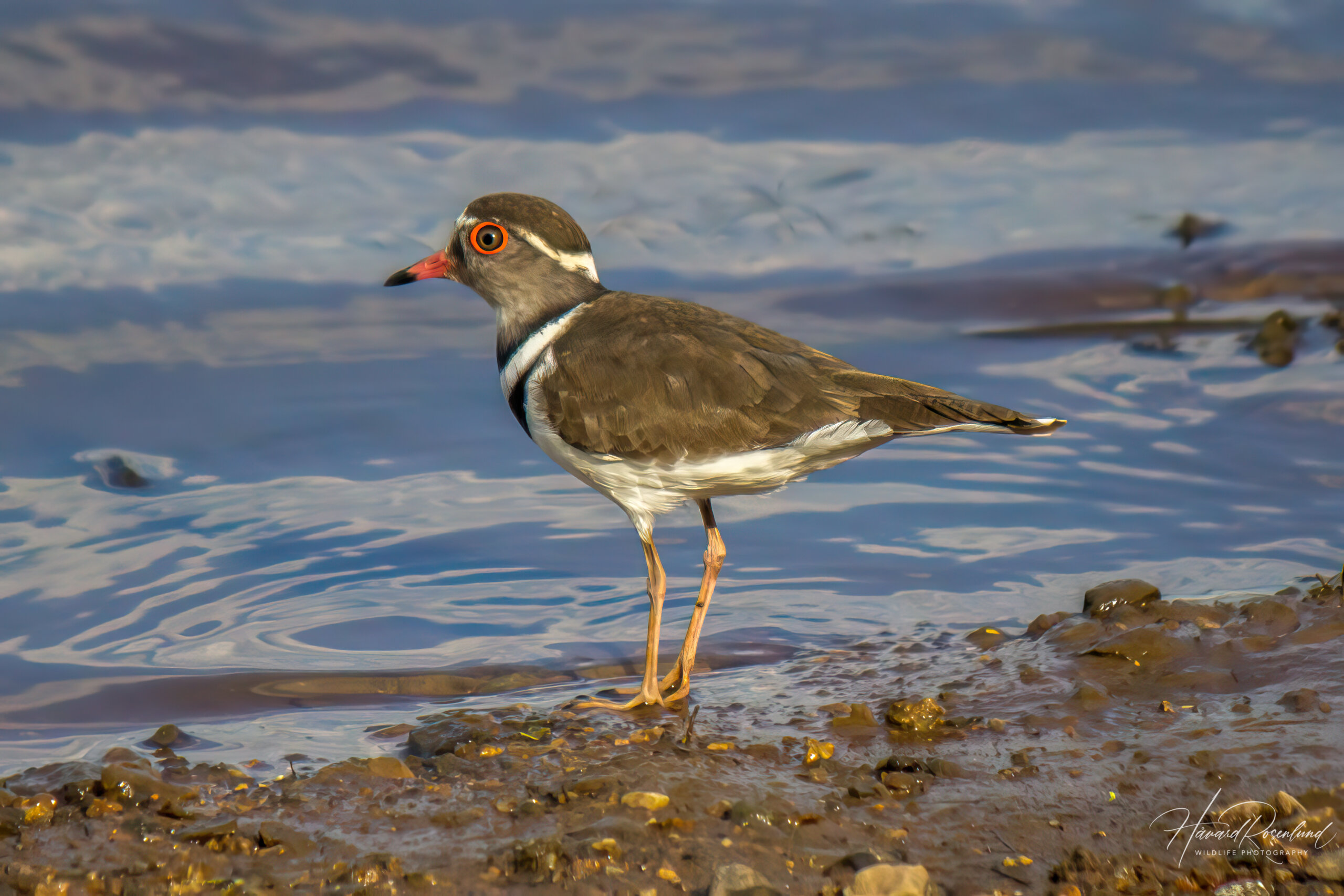
Three-banded Plover
Thinornis tricollaris
At a glance
Habitat
- Firm muddy, sandy or gravel edges of inland freshwater
Diet
- Insects and other small aquatic and terrestrial invertebrates
Activity
- Diurnal; feeds with a characteristic run-stop-pick pattern along shorelines
Size
- Length: 17–18 cm Weight: 25–32 g
Range
- Widespread across eastern, central and southern Africa
Description
The three-banded plover (Thinornis tricollaris) is a small African plover, about 17–18 cm long and weighing roughly 25–32 g. Adults are readily recognised by the three contrasting breast bands—black, white and black—together with a white forehead and eyebrow, a red bill tipped black and a bright red-orange eye-ring. The upperparts are brown and the underparts white.
Males and females look alike. Juveniles are duller, with less sharply defined markings, but retain the same basic pattern. The combination of two dark breast bands and the red eye-ring makes adults especially distinctive among small African plovers.
Taxonomy
AviList v2025b places the three-banded plover in the genus Thinornis as Thinornis tricollaris. BirdLife International and BirdLife South Africa still use Charadrius tricollaris, so both scientific names remain in current use.
The Madagascar population is also treated differently. AviList includes bifrontatus as the subspecies Thinornis tricollaris bifrontatus, whereas BirdLife International treats the Madagascar form as a separate species.
Habitat
Three-banded plovers are primarily birds of inland freshwater. They occur along rivers, streams, pools, farm dams, sewage works, seasonal pans and the margins of lakes and wetlands, favouring firm mud, sand or gravel with good visibility.
They adapt readily to artificial waterbodies and disturbed shorelines. Estuaries and lagoons are used occasionally, but open beaches are unusual habitat.
Diet
Insects and their larvae form much of the diet, together with small crustaceans, molluscs, worms and other terrestrial and aquatic invertebrates.
The birds feed with the familiar plover pattern of short runs separated by abrupt stops, picking small prey from exposed mud, sand, gravel or the immediate water's edge. This simple surface-feeding method allows them to exploit newly exposed margins as water levels change.
Behaviour
The species is essentially non-migratory, but local and seasonal movements occur as rainfall and changing water levels create or remove suitable freshwater habitat. Birds are most often seen alone or in pairs while feeding. Small groups of around ten are also regular, and loose flocks of roughly 40 birds have been recorded where conditions are particularly favourable.
Outside breeding territories, birds may gather more freely, and larger numbers can sometimes rest together at productive wetlands.
Breeding
Three-banded plovers form monogamous pairs and are strongly territorial around the nest. Breeding can occur opportunistically throughout the year when conditions are favourable, although timing varies with rainfall and region. The nest is a shallow scrape on firm sand, dry mud or gravel close to water.
A clutch contains one to three eggs, most often two. Both adults incubate, and incubation lasts about 26–28 days. The chicks are precocial: they hatch covered in down and already well developed, leave the nest early and find their own food while the parents continue to brood and guard them. They may make their first short flights at around 21–22 days and fly strongly about 9–10 days later.
The species can raise more than one brood in a season, and some pairs raise three. A new clutch may even be started before the young from the previous brood are fully fledged. This flexible breeding strategy allows pairs to exploit temporary periods of suitable water and food conditions.
Status
The three-banded plover is globally classified as Least Concern on the IUCN Red List. The global population is estimated at about 46,700–93,300 mature individuals, while the population in South Africa, Lesotho and Eswatini is considered to exceed 25,000 mature birds.
The population trend in southern Africa is uncertain. Long-term waterbird counts suggest a possible decline of about 53% over three generations, whereas bird-atlas data indicate a much more stable distribution, with only about a 1% decline over the same period. Despite these contrasting signals, the species remains regionally classified as Least Concern, although the overall trend appears to be downward.
No single threat is known to dominate, but degradation and loss of freshwater habitats, pollution and repeated disturbance of exposed shorelines can reduce local feeding and nesting habitat. The species' ability to use dams and other artificial waterbodies provides some flexibility.
Image gallery
Loading map and observations…
Have you seen this species?
Independent species archive
Did you find this species page useful?
Wildlife Vagabond is independently built and maintained. Voluntary support helps cover hosting, maps, data storage and continued improvements to the species archive.
Support Wildlife VagabondSpecies content will remain freely available.
References
Information about the species’ global distribution and status is based primarily on global Red List data. See the references below for details.
- AviList. (n.d.). Global avian taxonomy, v2025. https://www.avilist.org/
- Biodiversity and Development Institute. (2023). Three-banded Plover species account. https://thebdi.org/2023/11/14/three-banded-plover-charadrius-tricollaris/
- BirdLife International. (n.d.). Three-banded Plover species factsheet. https://datazone.birdlife.org/species/factsheet/three-banded-plover-charadrius-tricollaris
- BirdLife South Africa. (n.d.). Three-banded Plover, 2025 Red Data Book. https://www.birdlife.org.za/red-list/three-banded-plover/
- del Hoyo, J., Wiersma, P., Kirwan, G. M., Collar, N., Christie, D., & Boesman, P. F. D. (2023). Three-banded Plover (Charadrius tricollaris). Birds of the World. https://doi.org/10.2173/bow.thbplo1.01.1
- International Union for Conservation of Nature. (n.d.). Three-banded Plover (2024). The IUCN Red List of Threatened Species. https://www.iucnredlist.org/species/22727471/264970343