
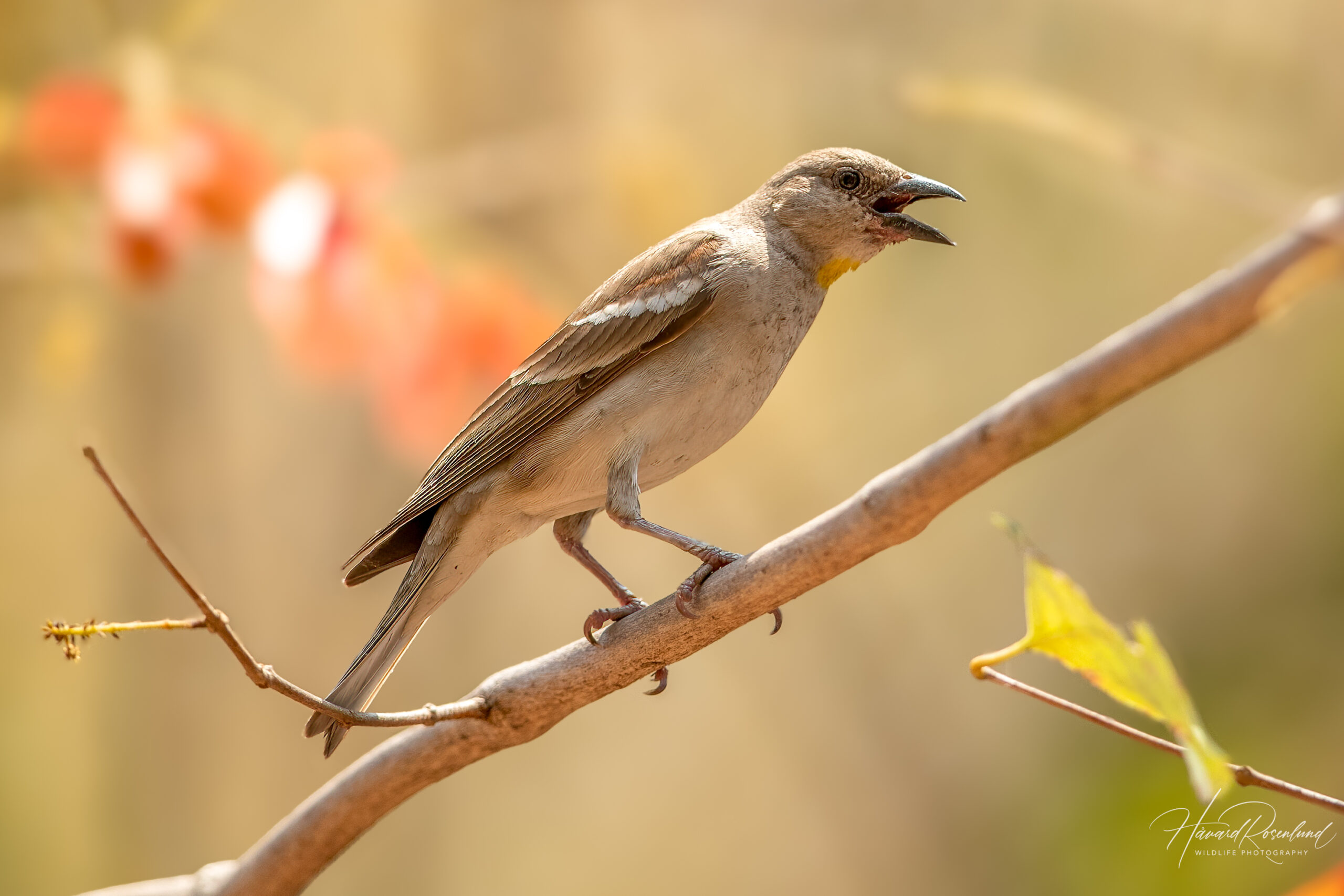
Yellow-throated Sparrow
Gymnoris xanthocollis
At a glance
Habitat
- Dry open woodland, scrub, orchards, farmland and lightly wooded settlements
Diet
- Seeds and grain, supplemented by insects and other small invertebrates
Activity
- Diurnal
Size
- Length: 12.5–14 cm Weight: 14–20 g
Range
- Indian subcontinent and parts of western Asia, from southeastern Iran and Afghanistan east across India to Bangladesh
Description
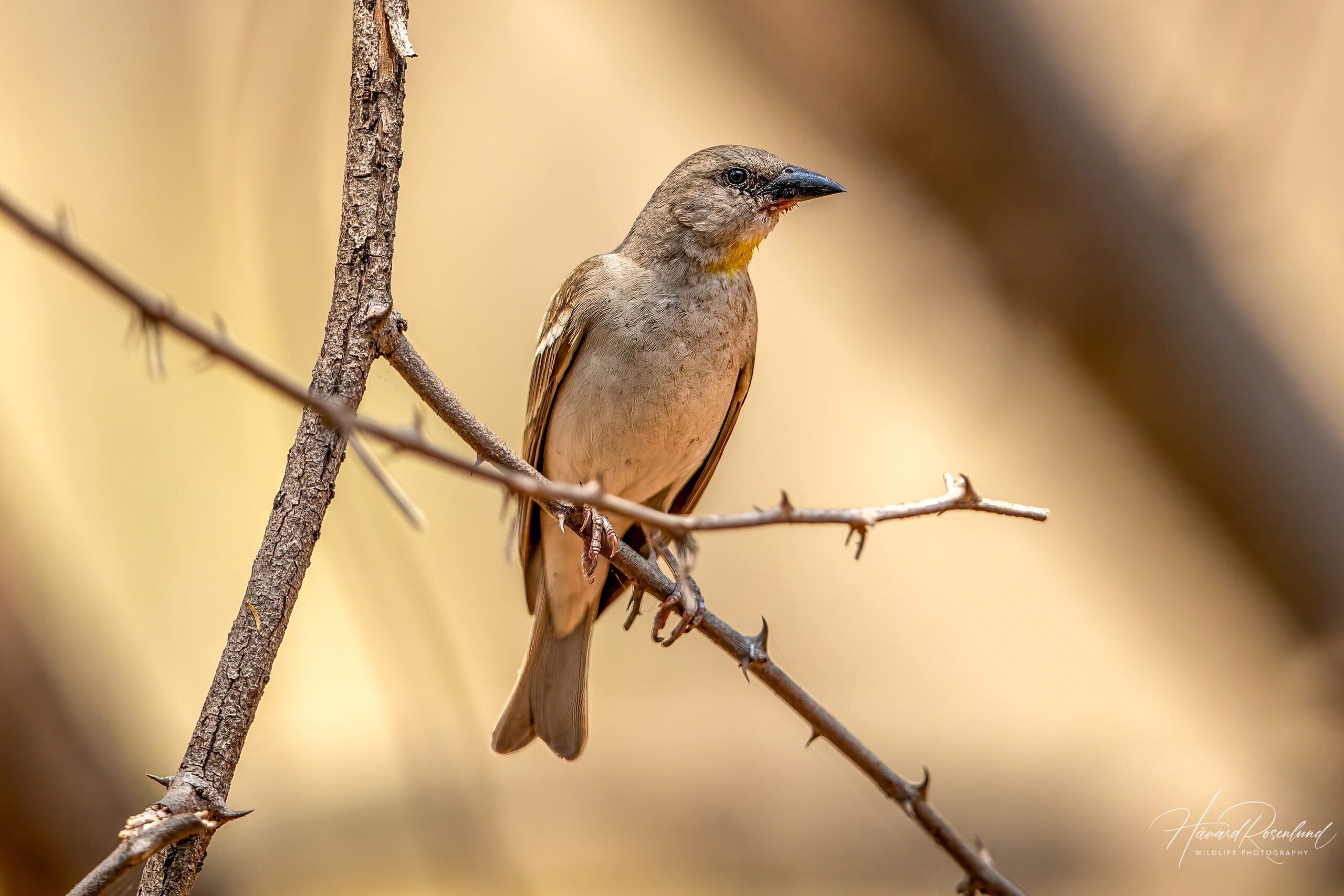
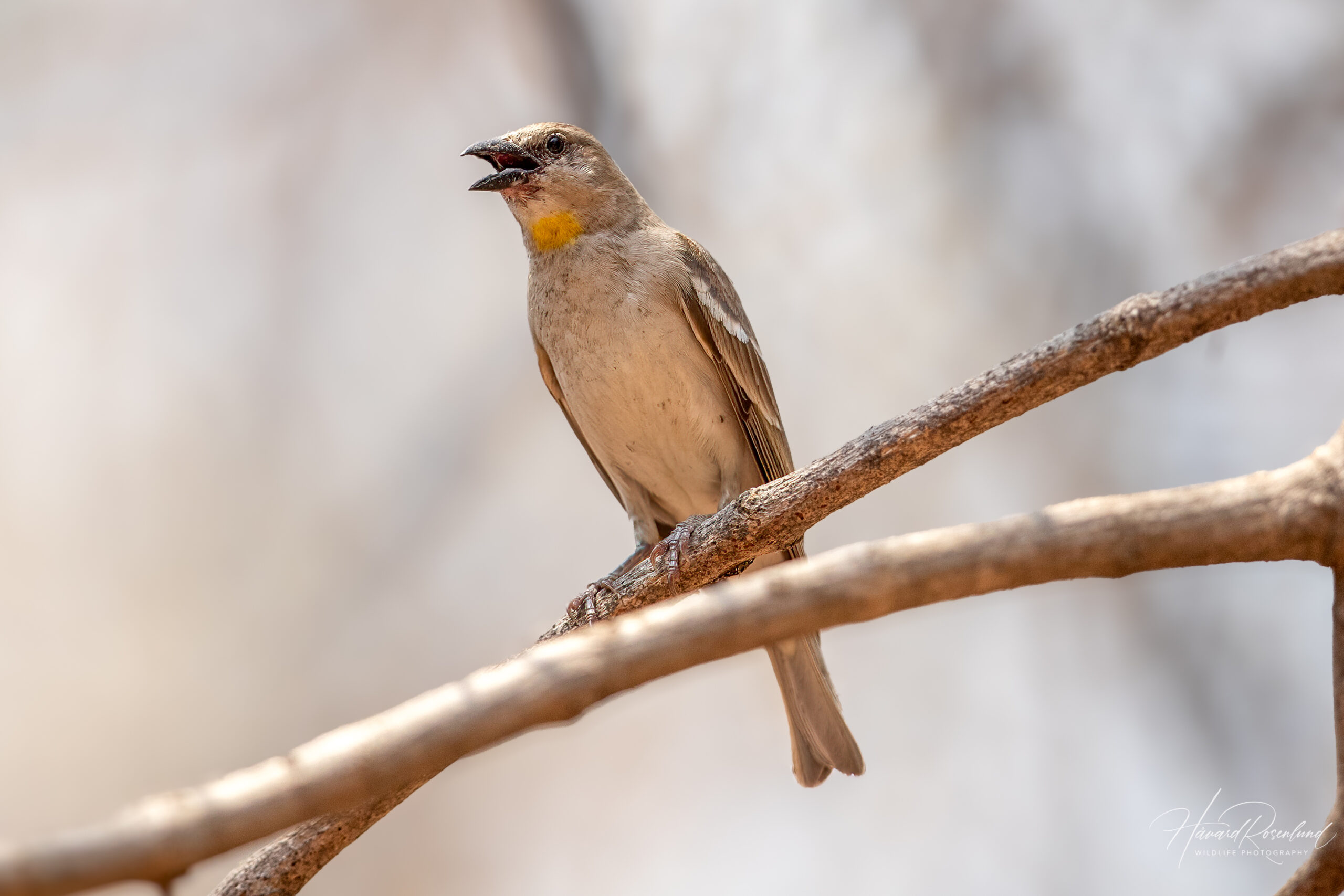
The yellow-throated sparrow (Gymnoris xanthocollis), also widely known in India as the chestnut-shouldered petronia, is a small sparrow of the Indian subcontinent and parts of western Asia. Adults are about 12.5–14 cm long and weigh roughly 14–20 g. The plumage is understated, with grey-brown upperparts, pale underparts, two pale wingbars and a chestnut shoulder patch. Adult males show the small yellow throat patch most clearly, especially in fresh plumage or when singing, while it can be difficult to see at other times.
The thick conical bill reflects the seed-rich diet. Gymnoris xanthocollis is the only member of its predominantly African genus occurring naturally in Asia.
Habitat
Yellow-throated sparrows favour dry open woodland, scrub, orchards, wooded farmland and lightly built-up landscapes with scattered mature trees. They are less strongly tied to dense human settlement than house sparrows and are especially characteristic of dry woodland mosaics.
In India the species is strongly associated with forest and plantations rather than behaving as a habitat generalist. Mature trees are important not only as feeding and resting sites but also because the species depends on existing cavities for breeding.
Diet
Seeds and grain form much of the diet, while insects and other small invertebrates become particularly important during breeding when adults are provisioning growing chicks. Birds feed both on the ground and in trees and may gather loosely around abundant seasonal food resources.
Breeding
Yellow-throated sparrows are secondary cavity nesters. They commonly use natural tree holes and abandoned cavities excavated by woodpeckers or barbets and will also occupy holes in walls, buildings and other structures. In 2013, a pair in India was recorded using an old Eastern red-rumped swallow (Cecropis daurica) nest, illustrating how flexible nest-site choice can be when a sheltered cavity is available.
The nest chamber is filled with grass, feathers and other soft material. Clutches usually contain about three to four eggs. The female incubates, with hatching after about 12–14 days. Breeding timing varies across the range and is influenced by seasonal conditions. Experiments on Indian birds showed that increasing day length stimulates reproductive development. This fits the broad pattern of breeding beginning before or around the summer monsoon in much of India rather than being restricted to the wettest months.
Status
The yellow-throated sparrow is classified as least concern on the IUCN Red List. It remains widespread across a very large South Asian range.
Indian monitoring data published in 2025 give a long-term national estimate of about −22%, although the long-term trend remains inconclusive. The recent annual estimate is close to zero at about −0.1% and is classified as stable. The species remains in the low conservation-priority category in India.
Image gallery
Loading map and observations…
Have you seen this species?
Independent species archive
Did you find this species page useful?
Wildlife Vagabond is independently built and maintained. Voluntary support helps cover hosting, maps, data storage and continued improvements to the species archive.
Support Wildlife VagabondSpecies content will remain freely available.
References
Information about the species’ global distribution and status is based primarily on global Red List data. See the references below for details.
- BirdLife International. (n.d.). Yellow-throated Sparrow species factsheet. https://datazone.birdlife.org/species/factsheet/yellow-throated-sparrow-gymnoris-xanthocollis
- International Union for Conservation of Nature. (n.d.). Yellow-throated Sparrow. The IUCN Red List of Threatened Species. https://www.iucnredlist.org/species/22718294/155508722
- Oiseaux.net. (n.d.). Yellow-throated Sparrow. https://www.oiseaux.net/en/oiseaux/yellow-throated.sparrow.html
- Sharma, S. K., & Koli, V. K. (2013). Use of Red-rumped Swallow Cecropis daurica nest by Yellow-throated Sparrow Gymnoris xanthocollis. Journal of the Bombay Natural History Society, 110(3), 226. https://www.bnhsjournal.in/index.php/bnhs/article/view/94040
- State of India's Birds. (2025). 2025 – Yellow-throated Sparrow. https://stateofindiasbirds.in/species/chspet1/
- Tewary, P. D., & Dixit, A. S. (1986). Photoperiodic regulation of reproduction in subtropical female Yellow-throated Sparrows (<i>Gymnorhis xanthocollis</i>). The Condor, 88(1), 70–73. https://doi.org/10.2307/1367755