
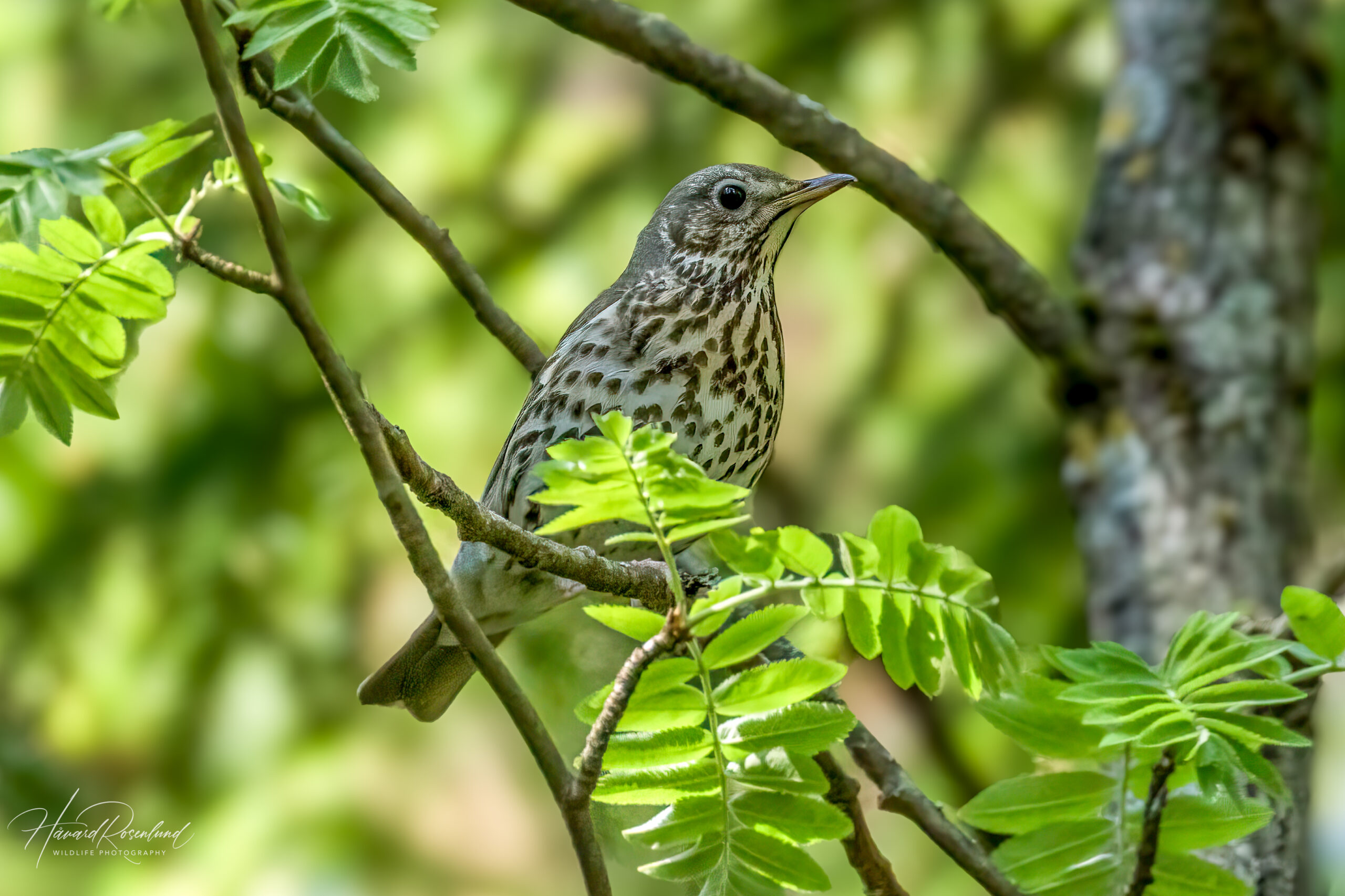
Song Thrush
Turdus philomelos
At a glance
Habitat
- Woodland, forest edges, parks and gardens with dense cover and moist, open feeding ground
Diet
- Earthworms, snails and other invertebrates; berries and fruit become more important outside breeding
Activity
- Diurnal, with much singing around dawn and dusk
Size
- Length: about 23 cm Weight: about 75 g
Range
- Breeds across most of Europe and western Asia; northern populations winter in western and southern Europe and North Africa
Description
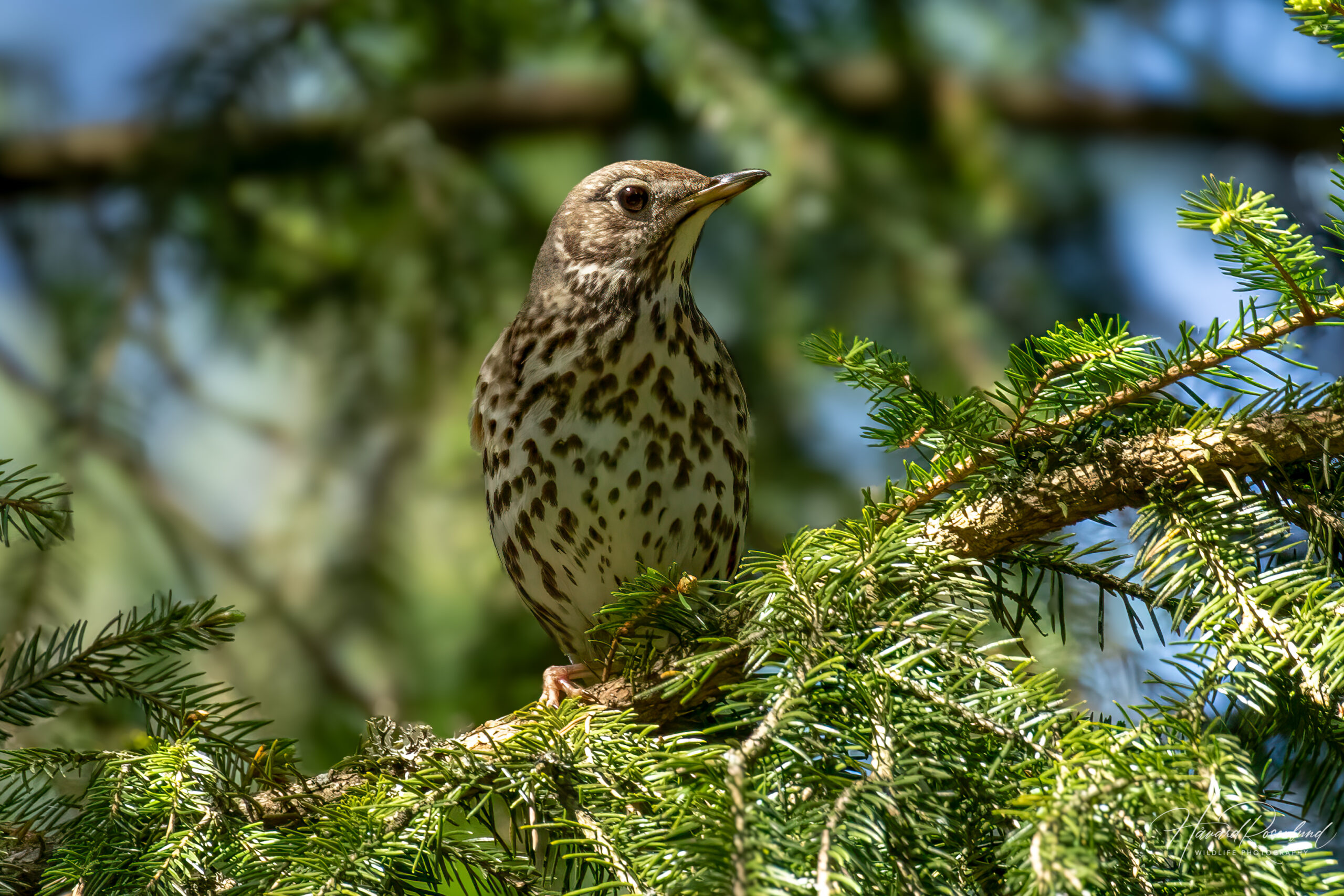
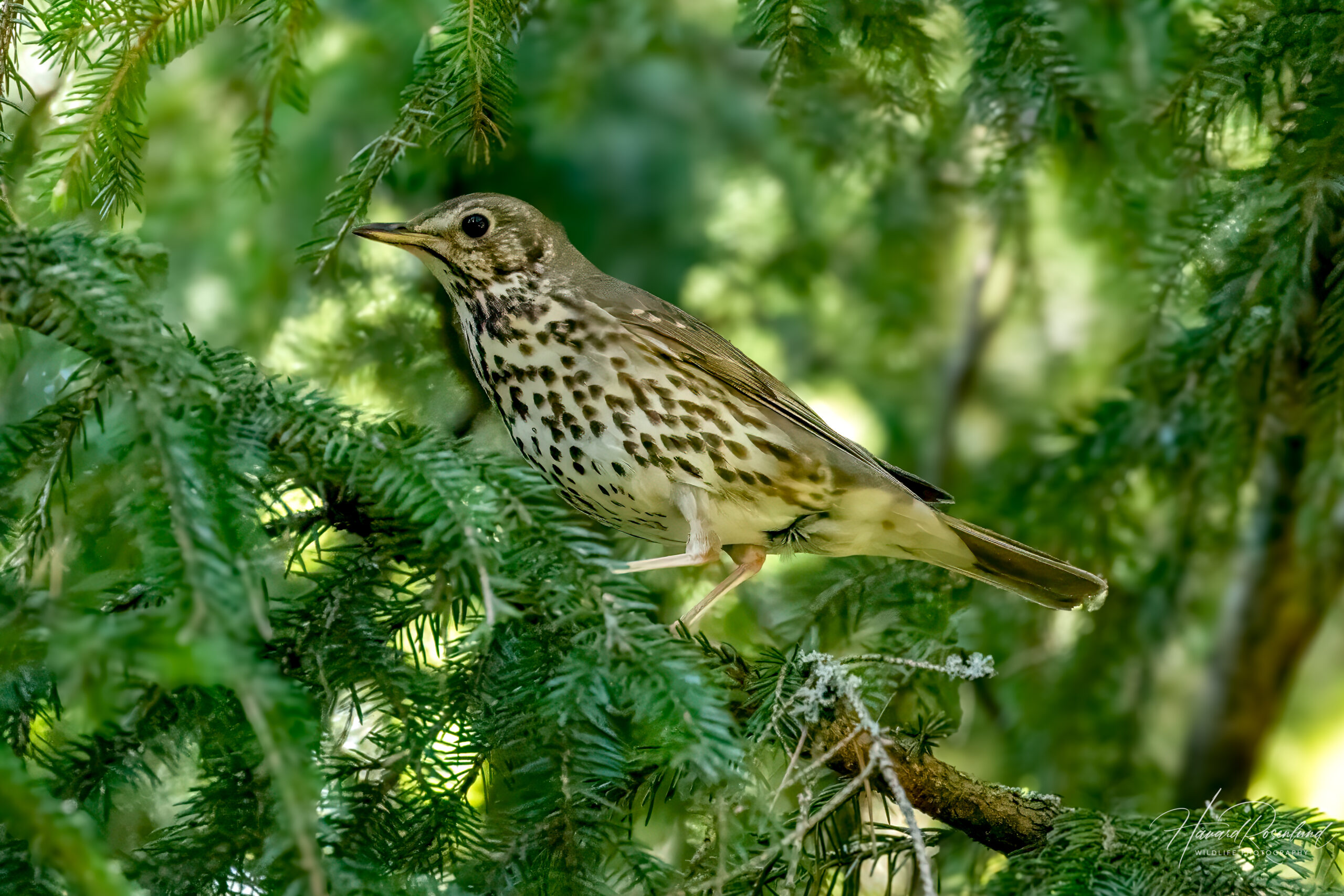
The song thrush (Turdus philomelos) is a medium-sized thrush breeding across most of Europe and western Asia. The species was introduced to New Zealand in the nineteenth century and is now widely established there. Adults are about 23 cm long and weigh around 75 g. The upperparts are warm brown and the underparts pale cream, marked with neat dark arrowhead-shaped spots across the breast and flanks. Males and females look alike.
The superficially similar mistle thrush (Turdus viscivorus) is noticeably larger and greyer, with rounder spots and a more upright, powerful appearance. The song thrush is smaller, warmer brown and more densely marked below.
Habitat
Song thrushes are primarily woodland birds but also breed in forest edges, scrub, parks and mature gardens. Suitable territories combine dense woody vegetation for nesting and shelter with nearby moist, relatively open ground where soil invertebrates remain accessible.
Studies in British farmland show why this combination matters. Birds preferentially foraged along scrub, woodland edges, wet ditches and bare garden soil, while earthworm availability fell sharply as surface soils dried. In intensively farmed arable landscapes with little woodland or permanent grassland, poorer feeding conditions were associated with fewer nesting attempts.
Diet
Earthworms, snails, insects and other invertebrates dominate the diet during spring and summer, while berries and other fruit become increasingly important later in the year.
The species is especially well known for opening larger snails by carrying them to a favoured stone or other hard surface and repeatedly striking the shell against it. These snail “anvils” may be reused and can accumulate conspicuous piles of broken shells.
Vocalisations
The song is one of the species' best field characters. A male delivers a large repertoire of short phrases from a prominent perch, characteristically repeating an individual phrase several times before switching to a new one. This repeated phrasing makes the song highly recognisable even when the bird itself is hidden.
Song structure also varies with habitat. A 2019 comparison of urban and forest males found that urban birds had larger syllable repertoires, repeated syllable sequences more often and used higher-frequency whistle syllables. These differences may reflect urban acoustic conditions, although population density and other habitat effects may also contribute.
Migration
Migration varies strongly across the range. Populations in northern and eastern Europe are largely migratory, while many birds in milder western areas are resident or move only short distances. Northern breeders travel south and west in autumn to winter across western and southern Europe, the Mediterranean region and North Africa.
Ringing data show considerable fidelity to both breeding and wintering regions, although individual movements vary. Scandinavian birds form an important part of the autumn passage through western Europe, and many continue toward the Iberian Peninsula and north-west Africa before returning north in spring.
Breeding
The female builds a substantial cup nest in a tree, shrub, hedge or other dense vegetation. The outer nest is made from grass, leaves and plant material, while the inner bowl is characteristically strengthened and smoothed with mud and decaying wood fibres rather than lined with soft material.
A typical clutch contains four blue eggs with dark spots. The female incubates for about 14 days, and both parents feed the chicks after hatching. Young normally leave the nest after about 14–15 days. Two or three broods are typical where the season is long enough, with exceptional pairs making a fourth attempt.
Status
The song thrush is classified as least concern on the IUCN Red List and remains widespread across a very large Eurasian range.
British monitoring shows that the breeding population remains about 45% below its 1967 level in 2024, despite partial recovery after the steep declines of the 1970s and 1980s. Lower survival after fledging and through the first winter, together with loss of damp, invertebrate-rich feeding habitat in intensively managed landscapes, appear to have contributed to the decline.
Image gallery
Loading map and observations…
Have you seen this species?
Independent species archive
Did you find this species page useful?
Wildlife Vagabond is independently built and maintained. Voluntary support helps cover hosting, maps, data storage and continued improvements to the species archive.
Support Wildlife VagabondSpecies content will remain freely available.
References
- BirdLife International. (n.d.). Song Thrush species factsheet. https://datazone.birdlife.org/species/factsheet/song-thrush-turdus-philomelos
- British Trust for Ornithology. (n.d.). Song Thrush. https://www.bto.org/learn/about-birds/birdfacts/song-thrush
- Deoniziak, K., & Osiejuk, T. S. (2019). Habitat-related differences in song structure and complexity in a songbird with a large repertoire. BMC Ecology, 19(1), 40. https://doi.org/10.1186/s12898-019-0255-7
- International Union for Conservation of Nature. (n.d.). Song Thrush. The IUCN Red List of Threatened Species. https://www.iucnredlist.org/species/22708822/132076619
- Milwright, R. D. P. (2006). Post‐breeding dispersal, breeding site fidelity and migration/wintering areas of migratory populations of Song Thrush Turdus philomelos in the Western Palearctic. Ringing & Migration, 23(1), 21-32. https://doi.org/10.1080/03078698.2006.9674340
- Peach, W. J., Denny, M., Cotton, P. A., Hill, I. F., Gruar, D., Barritt, D., Impey, A., & Mallord, J. (2004). Habitat selection by song thrushes in stable and declining farmland populations. Journal of Applied Ecology, 41(2), 275-293. https://doi.org/10.1111/j.0021-8901.2004.00892.x