
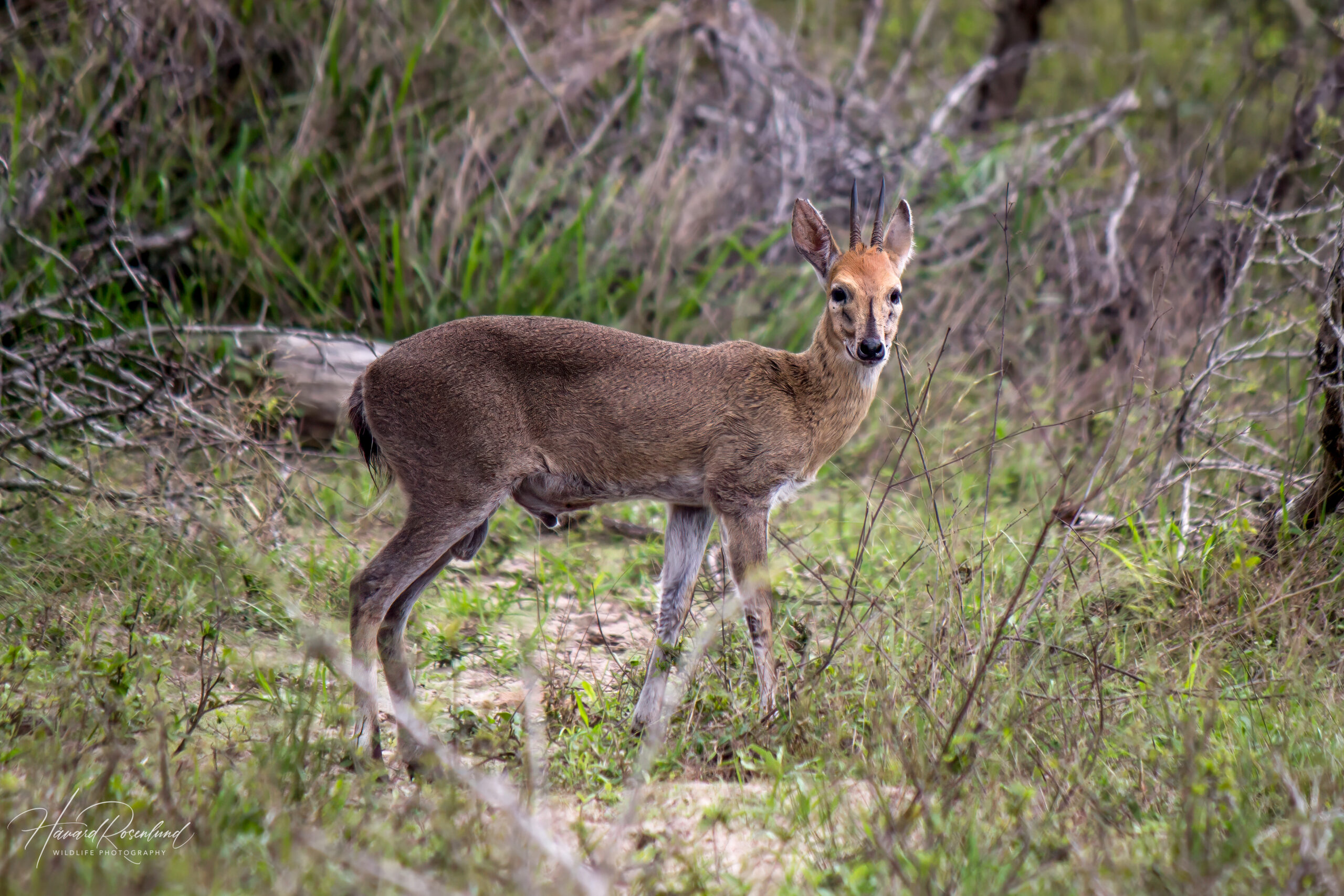
Common Duiker
Sylvicapra grimmia
At a glance
Habitat
- Savanna, woodland edge, shrubland, farmland margins and hilly country with cover
Diet
- Leaves, shoots, fruit, seeds, fungi and occasional animal prey
Activity
- Mostly crepuscular and nocturnal
Size
- Length: 70–115 cm (head–body) Weight: about 10–26 kg
Range
- Most of sub-Saharan Africa outside closed central rainforest, the Horn and true desert
Description
The common duiker, grey duiker or bush duiker (Sylvicapra grimmia) is a small and highly adaptable African antelope. The name “duiker” comes from Afrikaans for “diver”, referring to the animal’s habit of plunging into dense cover when alarmed.
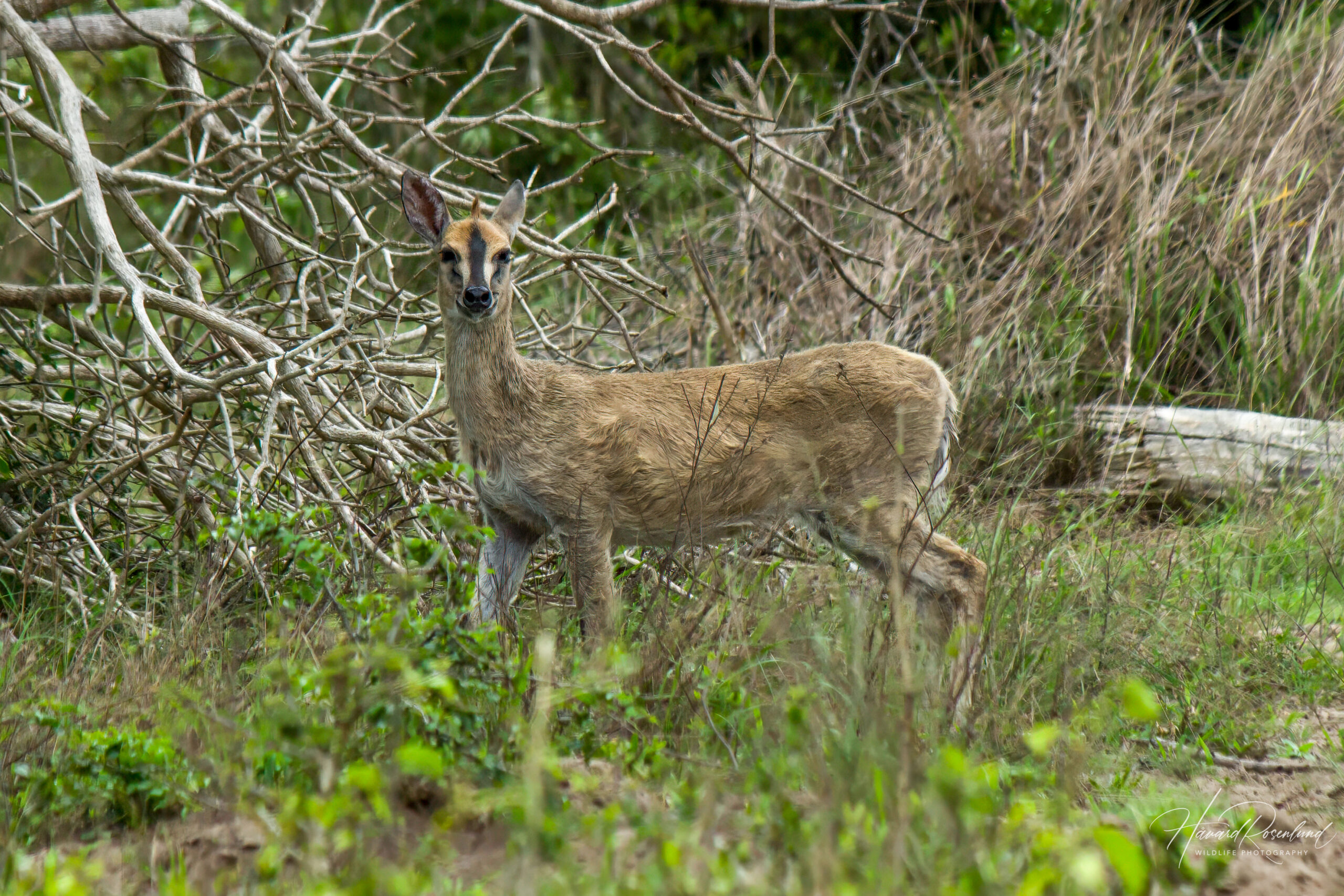
Colour varies greatly across its wide range, from reddish or sandy brown to grey. Both sexes have a dark facial stripe and a black forehead tuft, but normally only males carry short, straight horns. Females tend to be larger. Head-and-body length is about 70–115 cm, shoulder height roughly 39–68 cm and weight around 10–26 kg.
Taxonomy
The common duiker is the only living species in the genus Sylvicapra. Numerous regional forms and subspecies have been named historically because colour, size and horn development vary so much across Africa, but modern mammal databases retain them within a single widespread species rather than treating the regional forms as separate species.
Habitat
Common duikers occupy savanna, woodland edge, shrubland, farmland margins and hilly country wherever enough vegetation remains for concealment. They generally avoid closed central African rainforest, treeless open grassland and true desert, although they may follow vegetated watercourses into arid country.
The species tolerates substantial habitat disturbance and can persist in agricultural and settled landscapes if patches of cover remain. This flexibility helps explain its exceptionally wide distribution across sub-Saharan Africa.
Diet
The common duiker has an unusually broad diet for an antelope. It eats leaves, shoots, seeds, fruit, pods, flowers, roots, bark and fungi and may follow monkeys to pick up fruit and leaves dropped from the canopy.
It also feeds on animal matter when opportunities arise. Recorded foods include insects, frogs, reptiles, eggs, nestling and ground-dwelling birds, small mammals and carrion. This does not make the species primarily carnivorous, but it is a striking example of how flexible its feeding behaviour can be.
Behaviour
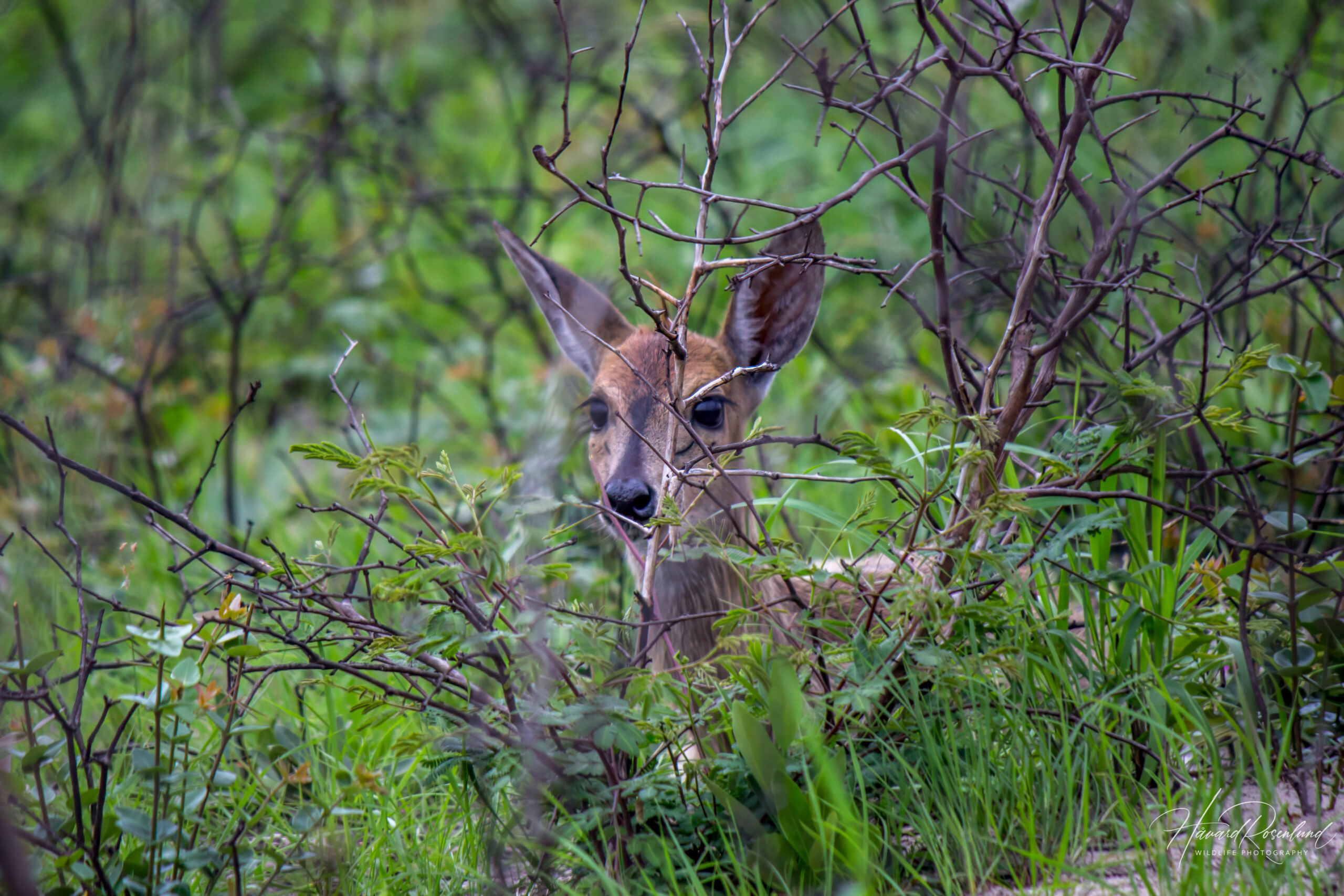
Common duikers are most active around dawn, dusk and at night and often become more nocturnal where human disturbance is high. When alarmed they typically freeze briefly or sprint towards dense vegetation, using quick changes of direction and cover rather than prolonged running in the open.
Scent marking is important. Preorbital glands beside the eyes and scent associated with the hooves are used on vegetation and along frequently used paths, helping neighbouring duikers communicate without frequent direct encounters.
Social behaviour
Common duikers are usually solitary, but males and females may occupy overlapping territories and form relatively stable pairs. Individuals of the same sex are less tolerant of one another, especially where space and food are limited.
Because the species spends much of its time alone and hidden in cover, social relationships are less obvious than in herd-living antelopes. Much communication takes place through scent rather than direct interaction.
Predation
Common duikers are taken by a wide range of predators, including leopards (Panthera pardus), jackals, caracals (Caracal caracal), large eagles and pythons. As noted earlier, their main defence is to remain hidden and, when danger is detected, make a quick dash into dense vegetation.
If cornered, adults can strike with sharp hooves and males may also use their horns. Distress calls can attract nearby duikers, and a threatened lamb may call to its mother.
Reproduction
Breeding can occur throughout the year. Gestation lasts roughly 186–216 days, after which the female usually gives birth to a single well-developed lamb.
The lamb remains concealed for much of its first weeks while the mother returns to nurse it. Young can run within about a day of birth and mature quickly. Sexual maturity can be reached at around 8–9 months of age, although the timing of first actual breeding varies between populations and local conditions.
Cultural significance
The common duiker has cultural significance in several southern African traditions. Among some Sotho-speaking groups, duiker totems form part of clan identity and oral tradition. The Baphuthi and related groups are among communities historically associated with a duiker totem, showing how a small and familiar antelope can become woven into ideas about ancestry and social identity.
Recent documentation of Khwe traditional knowledge in Namibia also describes the common duiker as an animal associated with omens. Repeatedly missing one during a hunt or encountering it in particular circumstances could be interpreted as a warning of danger or death, and a captured animal might sometimes be released to avert misfortune. These beliefs are local traditions rather than meanings shared across the species’ entire range.
Relationship with humans
Common duikers are widely hunted for meat and hides and are among the small antelopes most capable of living close to farms and settlements. Their ability to use disturbed vegetation means they may remain common even where larger antelopes disappear.
This tolerance has limits. Heavy hunting combined with loss of cover can reduce local populations, while roads, dogs and habitat simplification add pressure in densely settled landscapes.
Status
The common duiker is listed as Least Concern on the IUCN Red List. The global assessment published in 2016 describes it as one of Africa’s most widespread and adaptable antelopes.
The overall population trend is considered decreasing, mainly because of hunting and local habitat loss, but large populations remain across much of sub-Saharan Africa. Its broad diet, tolerance of disturbed habitat and ability to use dense cover make it more resilient than many more specialised antelopes.
Image gallery
Loading map and observations…
Have you seen this species?
Independent species archive
Did you find this species page useful?
Wildlife Vagabond is independently built and maintained. Voluntary support helps cover hosting, maps, data storage and continued improvements to the species archive.
Support Wildlife VagabondSpecies content will remain freely available.
References
- Animal Diversity Web. (n.d.). Sylvicapra grimmia. https://animaldiversity.org/accounts/Sylvicapra_grimmia/
- Birss, C., Relton, C., & Selier, J. (2016). A conservation assessment of <i>Sylvicapra grimmia</i>. South African National Biodiversity Institute and Endangered Wildlife Trust. https://ewt.org/wp-content/uploads/2022/11/28.-Common-Duiker-Sylvicapra-grimmia_LC.pdf
- International Union for Conservation of Nature. (2016). Sylvicapra grimmia. The IUCN Red List of Threatened Species. https://www.iucnredlist.org/species/21203/50194717
- Mammal Diversity Database. (n.d.). Sylvicapra grimmia. American Society of Mammalogists. https://www.mammaldiversity.org/taxon/1006232/
- Namibia Nature Foundation. (2026). National Outlook on Indigenous and Local Knowledge of Biodiversity. https://nnf.org.na/wp-content/uploads/2026/03/National-Outlook-on-ILK-of-Biodiversity.pdf
- National Museum South Africa. (2026). Totems and their cultural significance in South Africa. https://nationalmuseumpublications.co.za/totems-and-their-cultural-significance-in-south-africa/
- South African National Biodiversity Institute. (n.d.). Sylvicapra grimmia species assessment. https://speciesstatus.sanbi.org/assessment/last-assessment/2230/