
Green Sandpiper
Tringa ochropus
At a glance
Habitat
- Wooded freshwater margins, forest pools, bogs, streams and quiet river edges; more open wetlands outside breeding
Diet
- Aquatic and terrestrial insects, spiders, worms, crustaceans and other small wetland prey
Activity
- Diurnal and crepuscular; may also feed at night
Size
- Length: 21–24 cm Weight: about 85 g
Range
- Breeds across boreal Europe and Asia; winters from western and southern Europe through Africa and southern Asia
Description
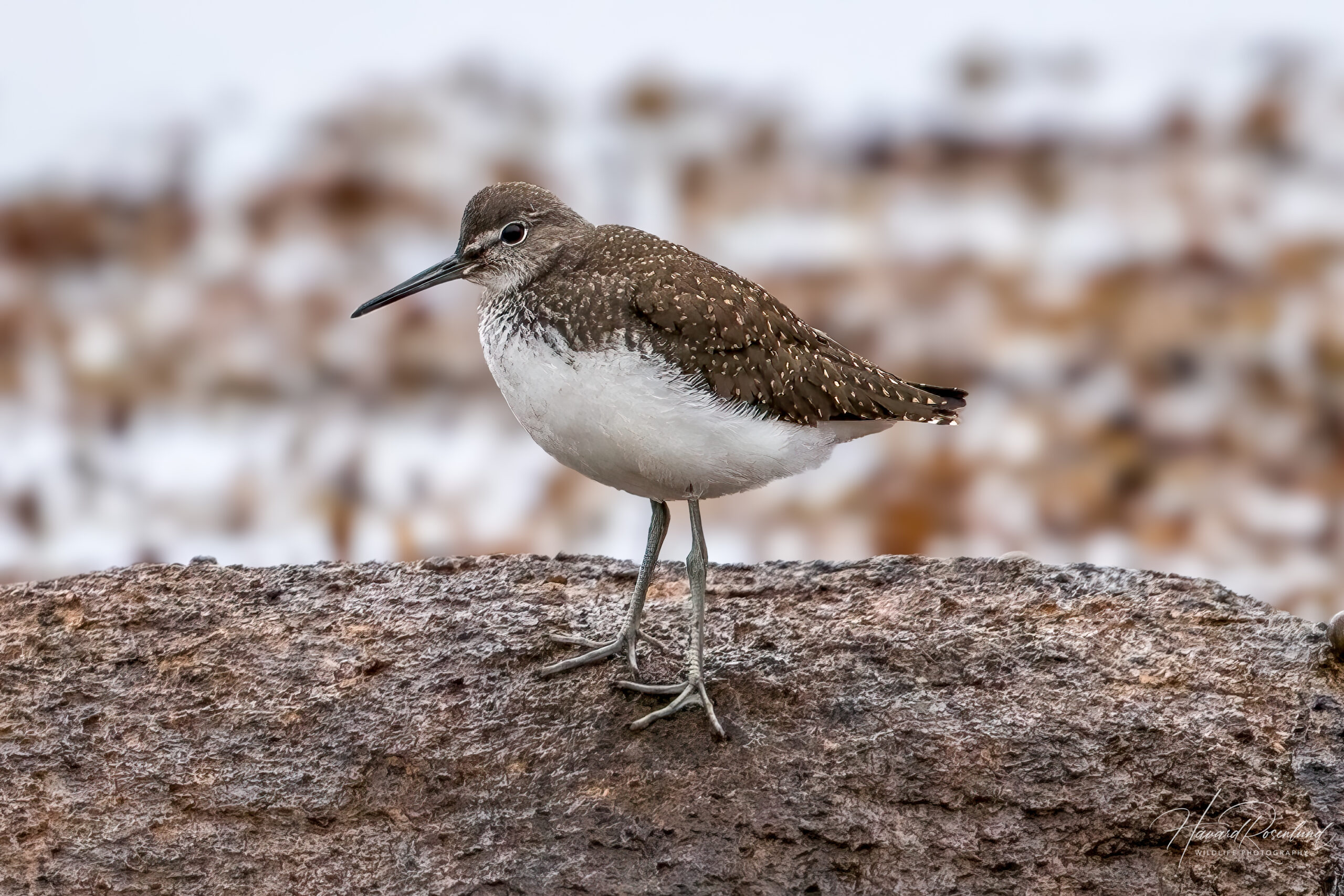
The green sandpiper (Tringa ochropus) is a medium-sized freshwater wader that breeds across the boreal forest zone of Europe and Asia. Adults are about 21–24 cm long, have a wingspan of around 59 cm and average roughly 85 g. The upperparts are very dark brown with fine pale spotting, contrasting sharply with the white underparts. In flight, the brilliant white rump and dark wings and tail create a particularly distinctive pattern.
It can be confused with the wood sandpiper (Tringa glareola), but the green sandpiper is darker and heavier-looking, with a less obvious eyebrow and a more contrasting white rump. When disturbed it often rises steeply from the water's edge with a clear repeated whistle, briefly exposing the striking rump pattern.
Habitat
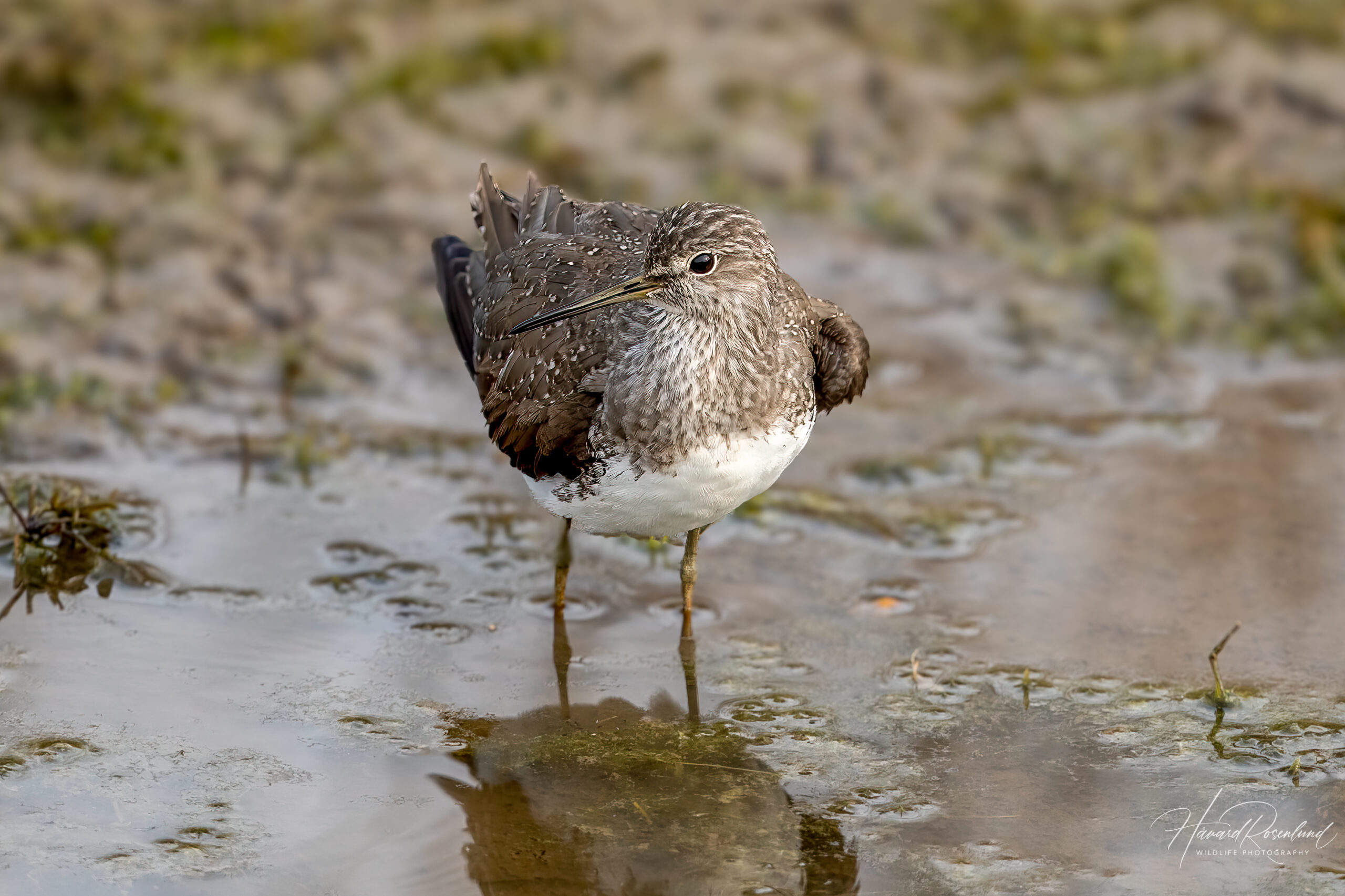
During breeding, green sandpipers are closely associated with wet boreal woodland, using forest pools, bogs, quiet streams, ditches and slow-moving rivers with trees nearby. This close link between woodland and freshwater is unusual among many familiar waders.
Outside the breeding season they use a wider range of freshwater habitats, from small muddy ponds and drainage channels to reservoirs, marshes and river margins. Individuals often tolerate surprisingly small or disturbed wetlands as long as shallow feeding edges remain available.
Diet
Green sandpipers feed mainly on insects and their larvae, spiders, worms, small crustaceans and other aquatic or terrestrial invertebrates, with small fish taken occasionally. Food is picked from the surface or obtained by probing and pecking in shallow water and soft mud.
Behaviour
Productive feeding patches are often used by single birds, and the species is commonly encountered alone rather than in large flocks. This solitary feeding style is especially typical along small streams, pools and muddy edges.
Migration
Green sandpipers are migratory across most of the range. Southward migration begins remarkably early: females can leave the breeding grounds as early as June, followed by males and then juveniles through July and August. Spring migration takes place mainly from March to May. Wintering areas extend from western and southern Europe through much of Africa, the Middle East and southern Asia.
A tracking study published in 2024 of green sandpipers wintering in Hertfordshire, southern England, found breeding areas in Fennoscandia, from southern Norway through Sweden to Finland. The birds completed their spring migration in a median of just two days, covering a mean distance of 1,463 km. Females remained on the breeding grounds for only 42 days, compared with 60 days for males.
Breeding
The green sandpiper has one of the most unusual nesting habits among waders. Instead of making the typical ground scrape, it commonly lays its eggs above ground in an abandoned nest built by another bird, especially a thrush, in a tree or shrub.
Four eggs are typical. Incubation lasts about 20–23 days and is carried out mainly by the female, with occasional participation by the male. The chicks are precocial, meaning they hatch well developed and leave the nest soon afterwards, sometimes dropping from considerable height to the ground. They find their own food but are guided and guarded by the parents as they grow, becoming capable of flight after about 27–29 days.
Status
The green sandpiper is classified as least concern on the IUCN Red List. It remains widespread across northern Eurasia, and there is no evidence of a strong range-wide decline.
Regional patterns vary, but conservation of small wetlands, quiet streams and wooded river systems remains important because the species depends on a close combination of freshwater feeding habitat and suitable nesting woodland.
Image gallery
Loading map and observations…
Have you seen this species?
Independent species archive
Did you find this species page useful?
Wildlife Vagabond is independently built and maintained. Voluntary support helps cover hosting, maps, data storage and continued improvements to the species archive.
Support Wildlife VagabondSpecies content will remain freely available.
References
Information about the species’ global distribution and status is based primarily on global Red List data. See the references below for details.
- BirdLife International. (n.d.). Green Sandpiper species factsheet. https://datazone.birdlife.org/species/factsheet/green-sandpiper-tringa-ochropus
- British Trust for Ornithology. (n.d.). Green Sandpiper BirdFacts. https://www.bto.org/learn/about-birds/birdfacts/green-sandpiper
- International Union for Conservation of Nature. (n.d.). Green Sandpiper. The IUCN Red List of Threatened Species. https://www.iucnredlist.org/species/22693243/86680632
- Smith, K. W., Trevis, B. E., & Reed, M. (2024). Migration patterns and breeding areas of Green Sandpipers Tringa ochropus wintering in southern Britain. Bird Study, 71(1), 32-39. https://doi.org/10.1080/00063657.2023.2298662
- Summers, R. D., Summers, R. W., Taylor, S., Etheridge, B., Dugan, D., & Christian, N. (2026). Status and habitat associations of breeding Green Sandpipers in the Highlands – the role of wetland management. British Birds, 119(1), 9–21. https://britishbirds.co.uk/journal/article/status-and-habitat-associations-breeding-green-sandpipers-highlands-role-wetland