
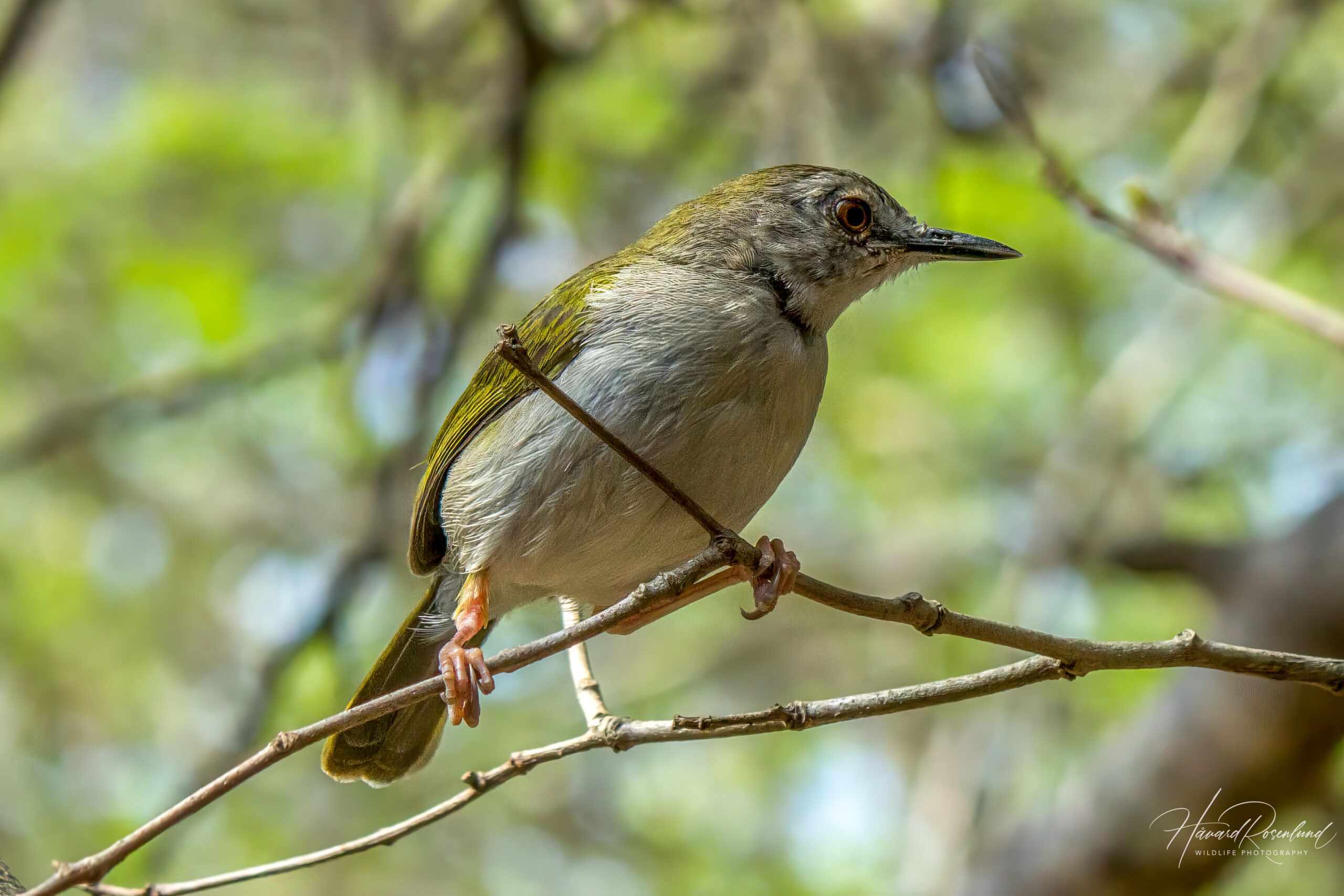
Green-backed Camaroptera
Camaroptera brachyura
At a glance
Habitat
- Dense undergrowth, forest edge, riverine scrub, moist woodland, gardens and parks
Diet
- Insects, spiders and other small invertebrates
Activity
- Diurnal
Size
- Length: 10–12 cm Weight: about 10 g
Range
- Green-backed forms occur mainly in southeastern Africa; broader treatments extend across much of sub-Saharan Africa
Description
The green-backed camaroptera (Camaroptera brachyura), also called the bleating camaroptera, is a small and often secretive member of the cisticola family. It measures about 10–12 cm and weighs around 10 g.
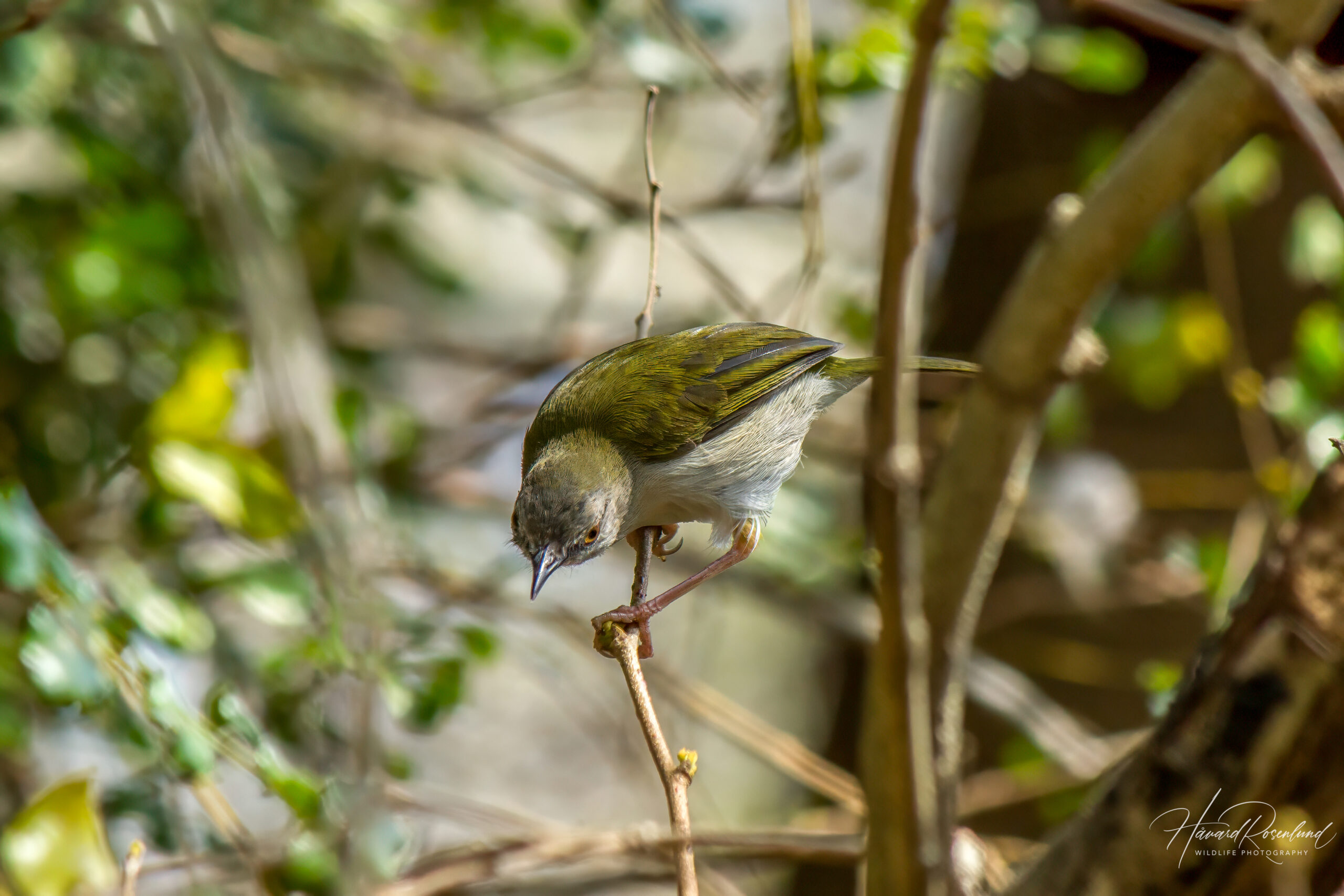
Adults have a grey head, pale grey or whitish underparts, olive-green wings and a green or olive back and tail. The short tail is often cocked, and the rounded wings give the bird a compact appearance. Males and females look alike. Juveniles are duller and may show a yellowish wash below.
Taxonomy
Current AviList treatment includes the green-backed and grey-backed forms within a single species, Camaroptera brachyura. The southeastern African birds covered on this page belong to the green-backed brachyura group, while the grey-backed brevicaudata group occurs farther north and west.
Habitat
Green-backed camaropteras remain close to dense cover, including moist woodland, riverine scrub, forest edge, coastal bush, gardens and parks. They usually stay within a few metres of the ground and can be common even where the tangled vegetation makes them difficult to see.
Diet
Insects, spiders and other small invertebrates dominate the diet.
The birds move actively through low foliage and tangled branches, gleaning prey from leaves, bark and twigs. They may also take small animals disturbed by people or larger mammals moving through the vegetation.
Behaviour
Green-backed camaropteras are usually encountered alone or in pairs and are strongly territorial during breeding. They move rapidly through dense vegetation and often reveal their presence by sound long before they are seen.
The loud, nasal call is one of the species’ most conspicuous field characters and inspired the alternative English name “bleating camaroptera”. Breeding pairs call persistently to mark and defend their territory.
Breeding
Both adults help build the distinctive nest. Leaves are drawn together and fastened with spider silk and plant fibres around a compact ball of grass and finer material. The nest is usually placed from ground level to about 2 m high in grass, a shrub or a sapling, although sites up to about 6 m are occasionally used.
In southern Africa, egg-laying occurs mainly from September to February, with a peak from October to December. The clutch generally contains two to four eggs. Both parents incubate for about 14–15 days and feed the chicks, which remain in the nest for a similar period before fledging.
Green-backed camaroptera nests are a confirmed host of the African emerald cuckoo (Chrysococcyx cupreus) in southern Africa.
Status
The current BirdLife/IUCN assessment, published in 2024, classifies Camaroptera brachyura as least concern on the IUCN Red List. The species has a very large range and is common in many suitable habitats.
No global population estimate is available. Removal of dense undergrowth and local habitat degradation can reduce populations, but no major range-wide decline has been identified.
Image gallery
Loading map and observations…
Have you seen this species?
Independent species archive
Did you find this species page useful?
Wildlife Vagabond is independently built and maintained. Voluntary support helps cover hosting, maps, data storage and continued improvements to the species archive.
Support Wildlife VagabondSpecies content will remain freely available.
References
- AviList. (2026). The Global Avian Checklist, v2025b. https://www.avilist.org/checklist/v2025b/
- Biodiversity Explorer. (n.d.). Camaroptera brachyura: habitat, feeding and breeding in southern Africa. Iziko Museums of South Africa. https://www.biodiversityexplorer.info/birds/cisticolidae/camaroptera_brachyura.htm
- BirdLife International. (n.d.). Green-backed Camaroptera Camaroptera brachyura species factsheet. https://datazone.birdlife.org/species/factsheet/green-backed-camaroptera-camaroptera-brachyura
- International Union for Conservation of Nature. (2024). Camaroptera brachyura. The IUCN Red List of Threatened Species. https://www.iucnredlist.org/species/103774592/263893395
- Store norske leksikon. (n.d.). Villnissanger Camaroptera brachyura: name, measurements and ecology. https://snl.no/villnissanger