
Coyote
Canis latrans
At a glance
Habitat
- Prairie, desert, forest, wetland, mountains, farmland and urban areas
Diet
- Opportunistic omnivore; mainly small and medium-sized animals
Activity
- Active by day and night; often more nocturnal near people
Size
- Length: 75–100 cm (head–body) Weight: 7–21 kg
Range
- North America through Central America to eastern Panama
Description
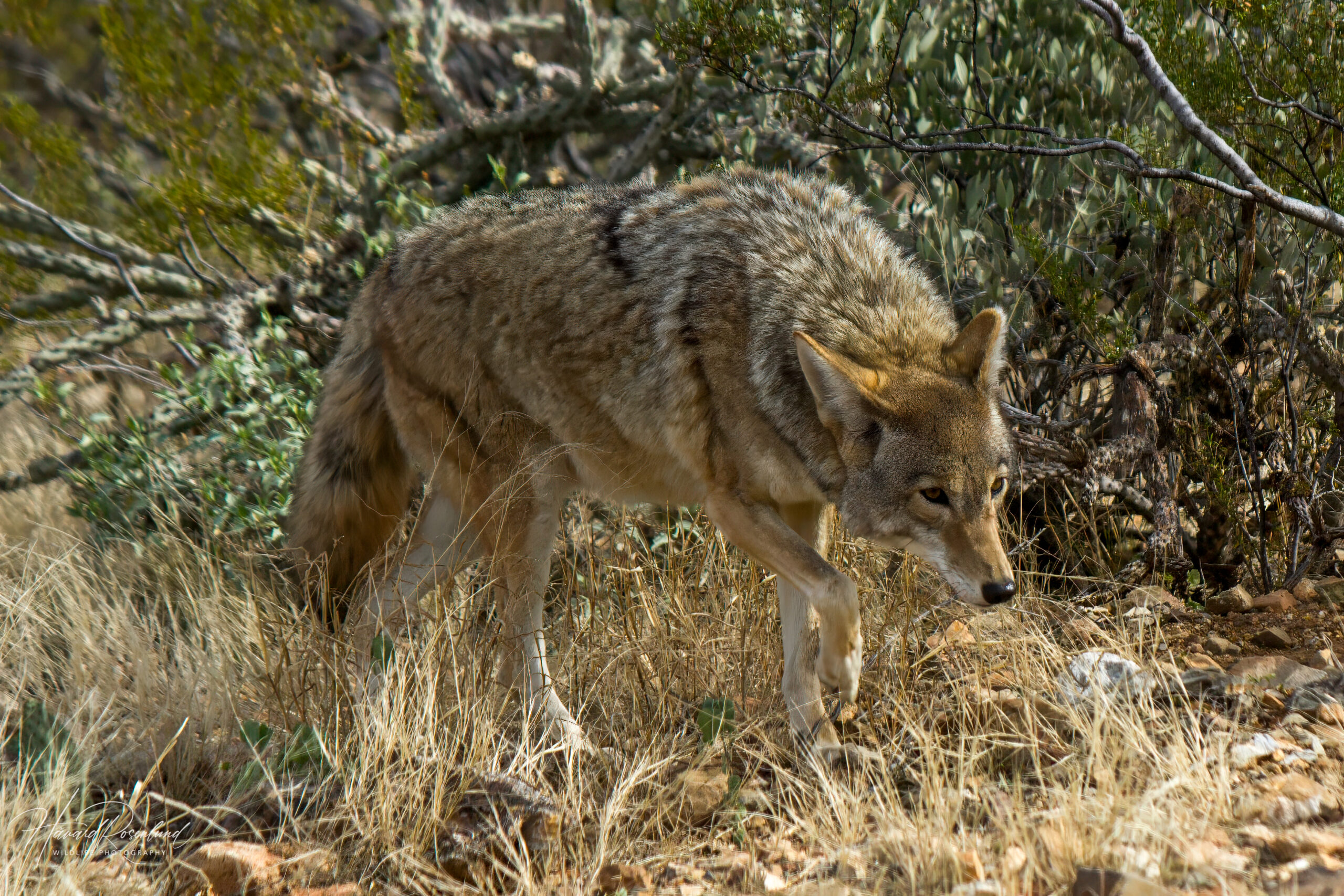
The coyote (Canis latrans) is a medium-sized North American canid and a smaller relative of the grey wolf (Canis lupus). Adults measure roughly 75–100 cm from head to body, stand about 53–61 cm at the shoulder and usually weigh 7–21 kg. Males average larger than females, and northern animals tend to be heavier than coyotes from warm, arid regions.
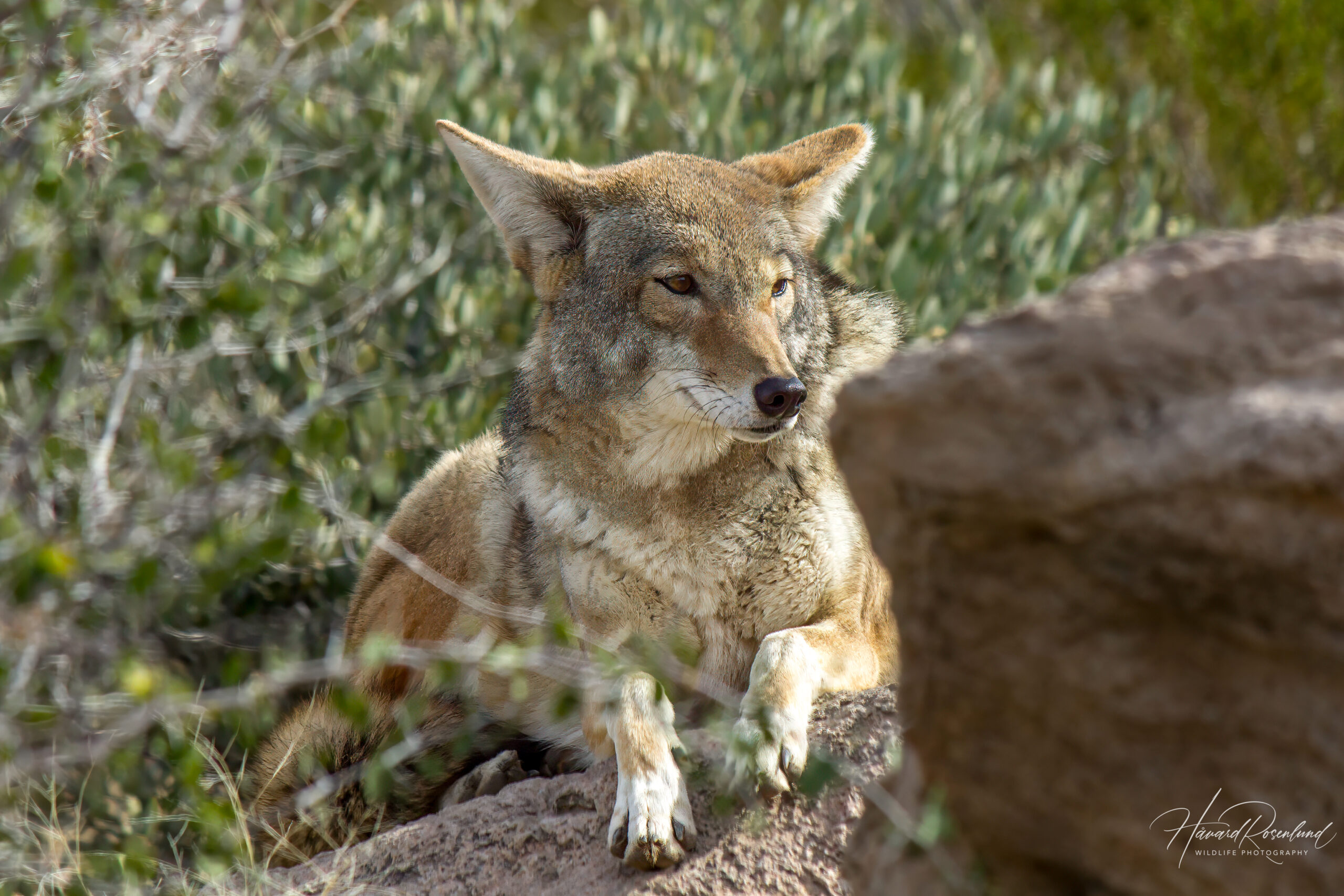
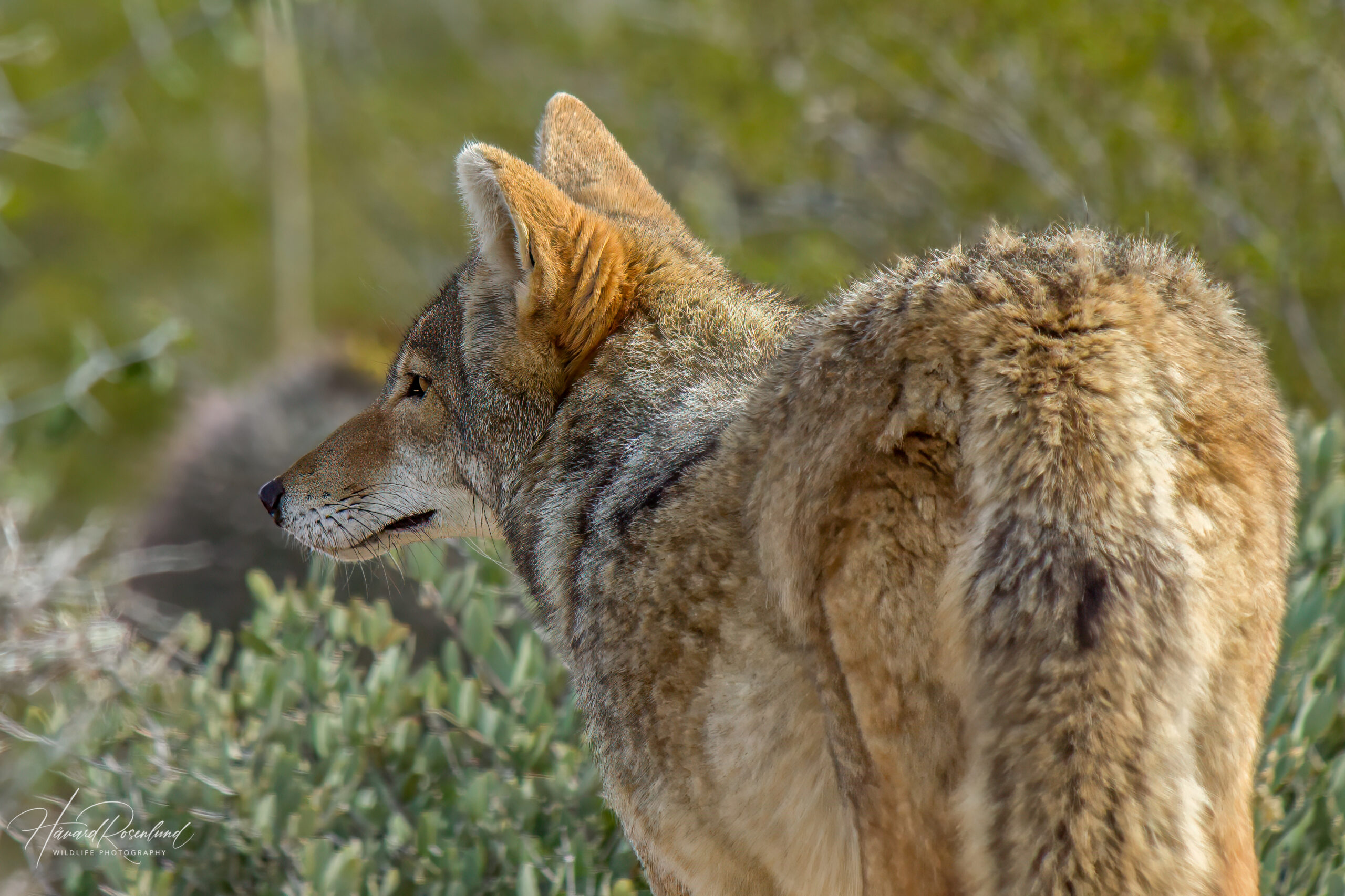
The coat varies from grey-brown to reddish brown and may include black shading. Many animals have reddish legs and ears, a narrow muzzle and large pointed ears. Coyotes are more lightly built than grey wolves, with proportionally longer ears and a narrower face.
Taxonomy
The coyote remains a distinct species, Canis latrans, but its evolutionary history includes gene flow with other members of the genus Canis. As coyotes expanded eastward across North America, some populations interbred with grey wolves (Canis lupus) and domestic dogs.
Many eastern coyotes therefore carry varying amounts of wolf and dog ancestry. This admixture can influence body size and other traits, but it does not make the eastern coyote a separate formal “coywolf” species. The term is sometimes used informally, while taxonomic authorities continue to treat these animals as coyotes with mixed ancestry.
Habitat
Coyotes use almost every major habitat across their range, including prairie, desert, forest, wetland, mountains and tropical landscapes. They are especially successful in fragmented and human-modified environments and have adapted to farmland, suburbs and large cities.
The species can persist wherever sufficient food, cover and denning sites remain. This ecological flexibility has allowed coyotes to occupy environments ranging from arid southwestern deserts to boreal forest and densely populated metropolitan areas.
Diet
Coyotes are opportunistic omnivores. Rabbits, hares, rodents and other small mammals are important in many regions, while birds, reptiles, amphibians, insects, fruit, carrion, livestock and young ungulates are taken according to season and availability.
Diet changes greatly among habitats. Urban coyotes may also exploit fallen fruit, refuse or pet food when these are accessible, while animals in more natural landscapes depend more heavily on wild prey and carrion.
Hunting
Most small prey is caught by a single coyote using stalking, short chases or sudden pounces. Pairs or family groups can cooperate when pursuing larger prey or defending a carcass, allowing them to tackle animals that would be difficult for one coyote to subdue alone.
Coyotes also sometimes hunt in close association with American badgers (Taxidea taxus). The two predators use complementary strategies: coyotes are effective at pursuing prey above ground, while badgers can dig rapidly into burrows. A study published in 1992 found that coyotes hunting with badgers could capture ground squirrels more efficiently than coyotes hunting alone. There are also observations of such partners resting together and engaging in calm social contact between hunting bouts.
Behaviour
Coyotes communicate with scent marking, body language and a wide repertoire of barks, yips and howls. Vocal exchanges help mark territories and maintain contact between separated family members.
They can be active at any time of day, but behaviour changes strongly around people. Coyotes living in relatively undisturbed landscapes may be active by day, whereas animals in towns, suburbs and heavily used recreational areas often shift activity towards night, dawn and dusk.
Social behaviour
Coyotes have a flexible social system. Resident animals often form a long-term pair with offspring from the current or previous year, creating a family group that shares a territory. Young dispersers and non-territorial animals may instead travel alone over large areas.
Group size changes with food and season. Larger temporary groups can form around abundant food or during hunts for larger prey, but coyotes do not normally live in large, stable packs comparable with those of grey wolves.
Home ranges
Space use differs sharply between resident and transient coyotes. Resident pairs and family groups maintain relatively stable territories that often cover from a few to several tens of square kilometres, depending on food availability, habitat and population density. A study published in 2015 in eastern North Carolina found stable home ranges of up to about 47 km² in resident animals, while transients used shifting areas larger than roughly 65 km².
Transient coyotes can move far beyond the scale of an ordinary family territory while searching for vacant space or a mate. Dispersal movements of more than 200 km and use areas covering several hundred square kilometres have been recorded in such animals. The contrast between territorial residents and wide-ranging transients is therefore a central part of coyote space use.
Interspecific competition
Where the two species coexist, grey wolves (Canis lupus) are the clearly dominant competitor. Wolves can kill coyotes, displace them from food and constrain how they use otherwise overlapping landscapes. A study published in 2007 in the Greater Yellowstone Ecosystem found a strong negative relationship between wolf and coyote density, showing that direct competition with wolves can limit local coyote populations.
Coyotes can nevertheless coexist with wolves through considerable flexibility in diet and behaviour. They may alter space use, activity timing and access to carrion rather than avoiding wolf territories completely. The historical removal of wolves from large parts of North America therefore eliminated an important ecological constraint and contributed to conditions that favoured coyote expansion.
Reproduction
Coyotes usually form long-term pair bonds. Mating takes place in winter, and the pair establishes a territory and prepares a den in an enlarged burrow, rocky crevice, hollow log or dense cover. Older offspring may remain with the pair and help guard or feed the pups.
After a gestation of about 60–63 days, the female gives birth in spring. Litter size varies with food availability and population density but averages around five or six pups. The pups open their eyes after roughly ten days, emerge during their first month and gradually accompany the adults while learning to forage and hunt.
Cultural significance
Coyote is an important figure in the oral traditions of many Indigenous peoples of North America, but the meaning is not the same across cultures. In different traditions Coyote can appear as a trickster, teacher, transformer, creator or comic figure whose actions explain features of the landscape, human behaviour or the consequences of poor choices.
For example, Nimiipuu (Nez Perce) Coyote stories connect specific landscapes with language, history and cultural teaching, while Cherokee storytellers preserve their own distinct Coyote narratives. The long cultural history of Coyote therefore reflects many living traditions rather than one universal North American story.
Relationship with humans
Before European colonisation, coyotes were concentrated mainly in open and arid western North America. Forest clearance, agriculture, transport corridors and the removal of larger predators helped them expand eastward, northward and southward. They now occupy almost all of North America and have extended into Central America as far as eastern Panama.
The same adaptability creates frequent contact with people. Conflicts arise around livestock, poultry, pets and food attractants in towns and cities. Deliberate feeding and unsecured rubbish, pet food or fallen fruit can cause animals to lose their natural wariness.
Coexistence is most effective when people remove attractants, supervise pets, secure small livestock and maintain distance from wild coyotes. Broad lethal control can reduce numbers locally, but populations often recover through immigration and increased reproduction, making prevention of specific conflicts more useful than attempting to eliminate coyotes from large landscapes.
Status
The coyote is classified as least concern in the current IUCN assessment, published in 2018. The species is abundant, its population trend is increasing and its geographic range continues to expand.
Local mortality comes from persecution, hunting, trapping, vehicles and conflict control, but none of these pressures threatens the species globally. In many regions the more important management question is how to reduce conflict while allowing this highly adaptable predator to remain part of the ecosystem.
Image gallery
Loading map and observations…
Have you seen this species?
Independent species archive
Did you find this species page useful?
Wildlife Vagabond is independently built and maintained. Voluntary support helps cover hosting, maps, data storage and continued improvements to the species archive.
Support Wildlife VagabondSpecies content will remain freely available.
References
- Animal Diversity Web. (n.d.). Canis latrans: morphology, ecology, social behaviour and reproduction. https://animaldiversity.org/accounts/Canis_latrans/
- Berger, K. M., & Gese, E. M. (2007). Does interference competition with wolves limit the distribution and abundance of coyotes? Journal of Animal Ecology, 76(6), 1075-1085. https://doi.org/10.1111/j.1365-2656.2007.01287.x
- Hinton, J. W., van Manen, F. T., & Chamberlain, M. J. (2015). Space Use and Habitat Selection by Resident and Transient Coyotes (Canis latrans). PLOS ONE, 10(7), e0132203. https://doi.org/10.1371/journal.pone.0132203
- Hody, J. W., & Kays, R. (2018). Mapping the expansion of coyotes (Canis latrans) across North and Central America. ZooKeys, 759, 81-97. https://doi.org/10.3897/zookeys.759.15149
- International Union for Conservation of Nature. (2018). Canis latrans. The IUCN Red List of Threatened Species. https://www.iucnredlist.org/species/3745/163508579
- IUCN SSC Canid Specialist Group. (n.d.). Coyote Canis latrans: range, population, ecology and threats. https://www.canids.org/species/view/prekja587951
- Minta, S. C., Minta, K. A., & Lott, D. F. (1992). Hunting Associations between Badgers (Taxidea taxus) and Coyotes (Canis latrans). Journal of Mammalogy, 73(4), 814-820. https://doi.org/10.2307/1382201
- Monzón, J., Kays, R., & Dykhuizen, D. E. (2014). Assessment of coyote–wolf–dog admixture using ancestry-informative diagnostic SNPs. Molecular Ecology, 23(1), 182–197. https://doi.org/10.1111/mec.12570
- National Park Service. (n.d.). . Coexisting with Coyotes: behaviour and reducing urban conflict. https://www.nps.gov/samo/learn/nature/coyotes.htm
- National Park Service. (n.d.). . Coyote's Fishnet Legend — Nimiipuu cultural landscape and storytelling. https://www.nps.gov/nepe/learn/historyculture/coyotes-fishnet-history.htm
- National Park Service. (n.d.). . Coyote — ecology and cultural representations. https://www.nps.gov/whsa/learn/nature/coyote.htm
- Project Coyote. (n.d.). Coyote profile and coexistence resources. https://projectcoyote.org/carnivores/coyote/
- Smithsonian Institution. (n.d.). Smithsonian National Museum of the American Indian. Art of Storytelling: Robert Lewis (Cherokee Nation). https://americanindian.si.edu/collections-search/object/yt_1c5RqUsT4KQ