
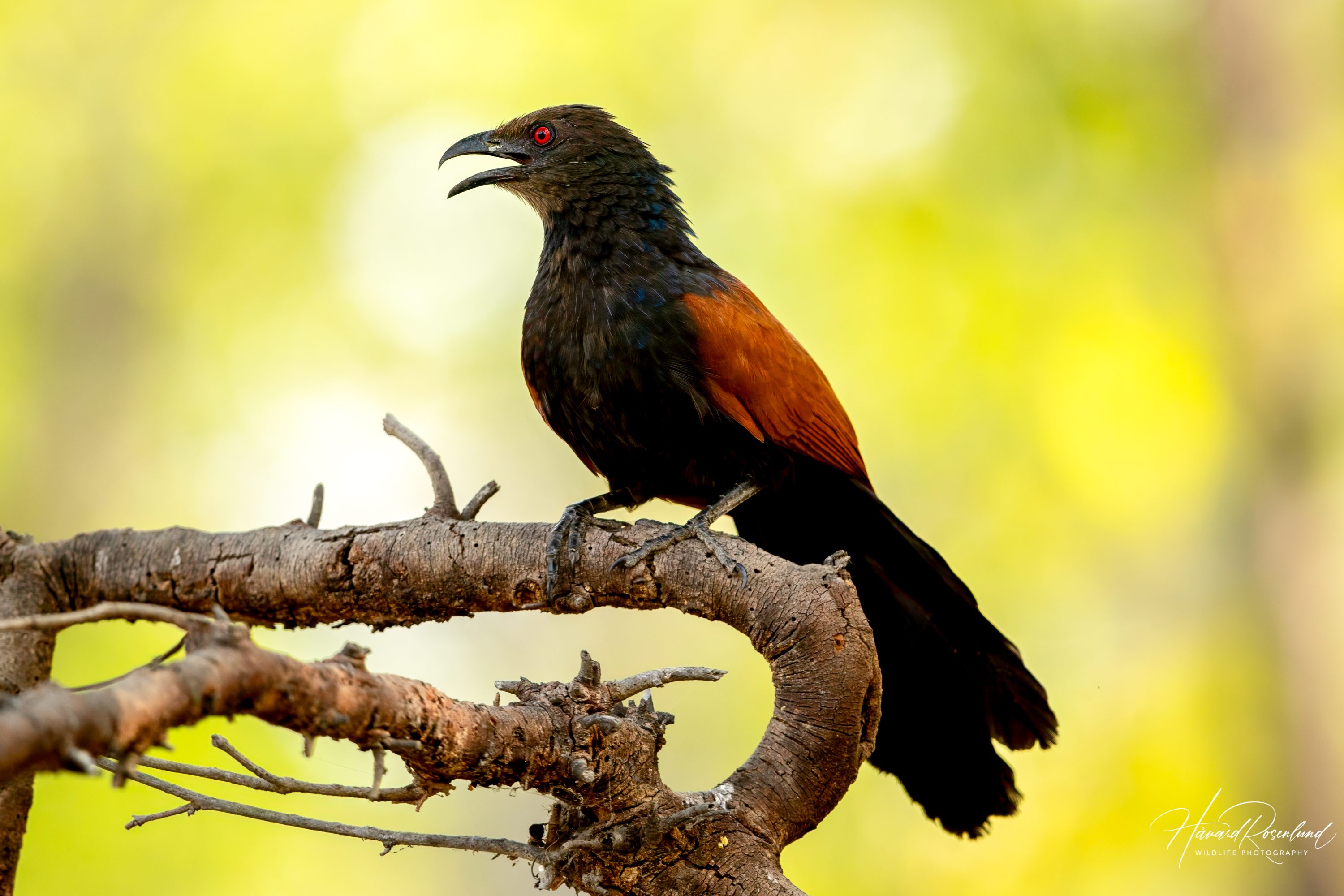
Greater Coucal
Centropus sinensis
At a glance
Habitat
- Dense scrub, tall grass, woodland edge, reedbeds, mangroves, farmland, plantations and gardens
Diet
- Large insects and other invertebrates, snails, reptiles, amphibians, small mammals, eggs and nestlings, plus fruit and seeds
Activity
- Diurnal; often most active in the warmer morning and late afternoon
Size
- Length: 48–55 cm Weight: 235–330 g
Range
- Indian subcontinent east through southern China and Southeast Asia to parts of Indonesia
Description
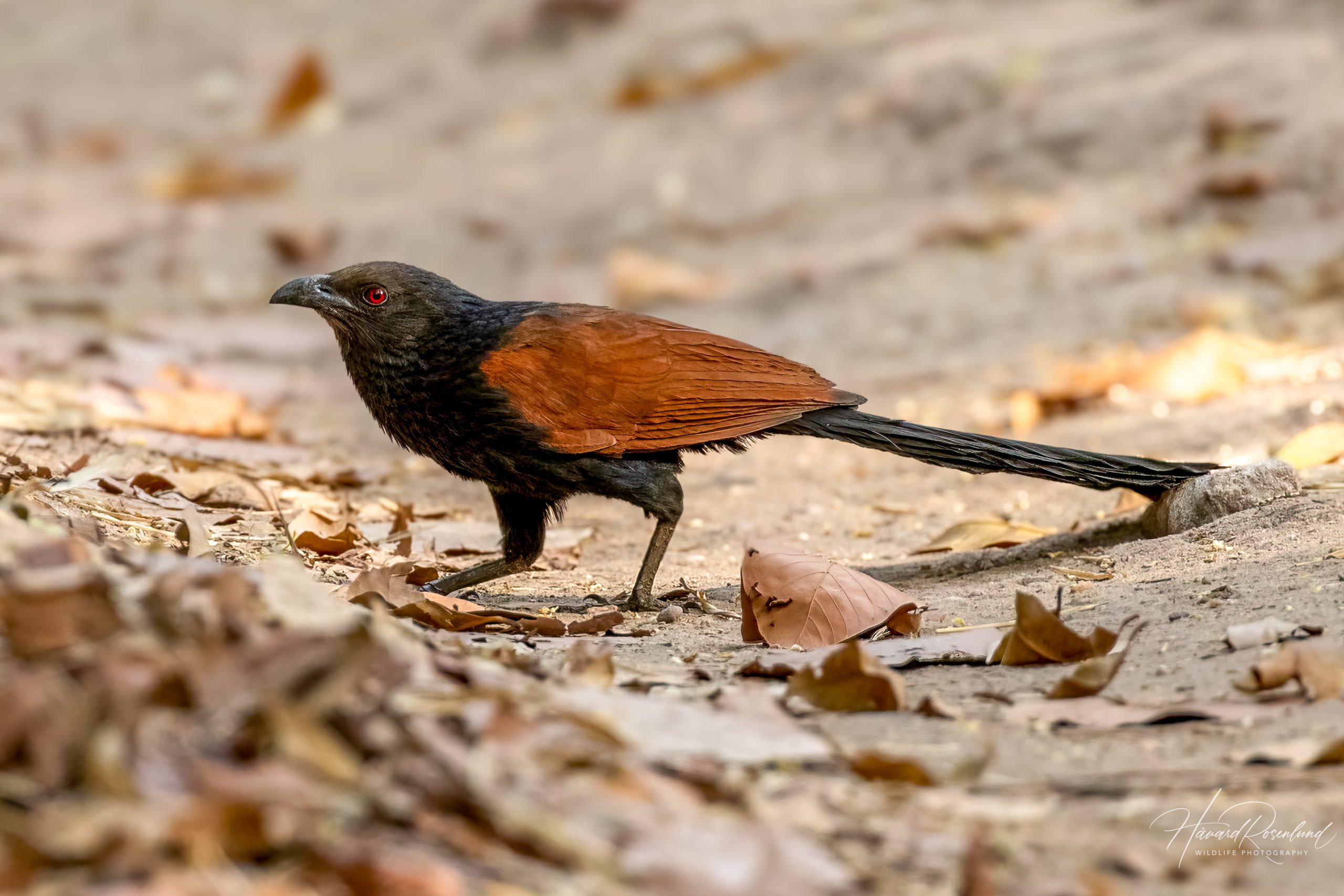
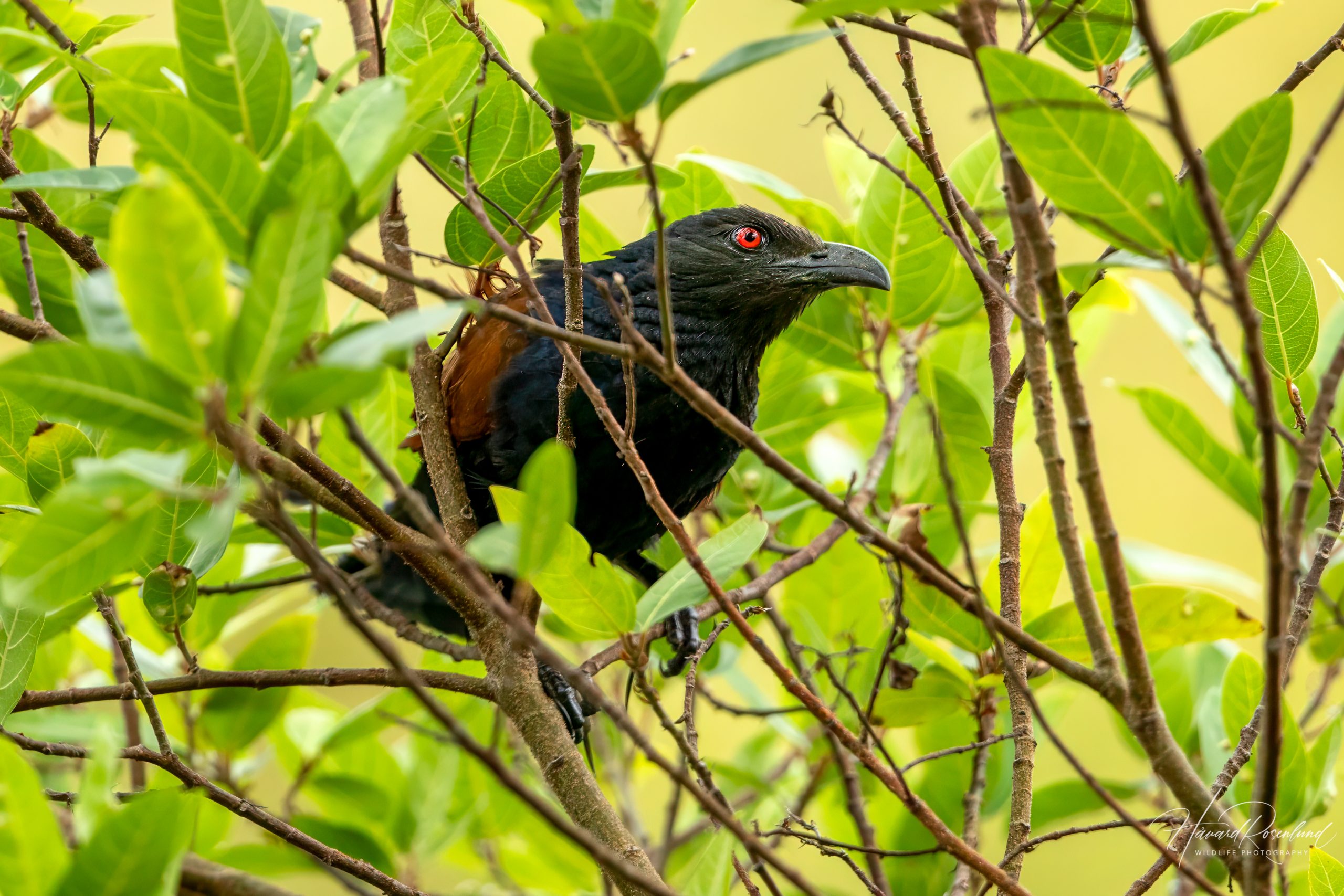
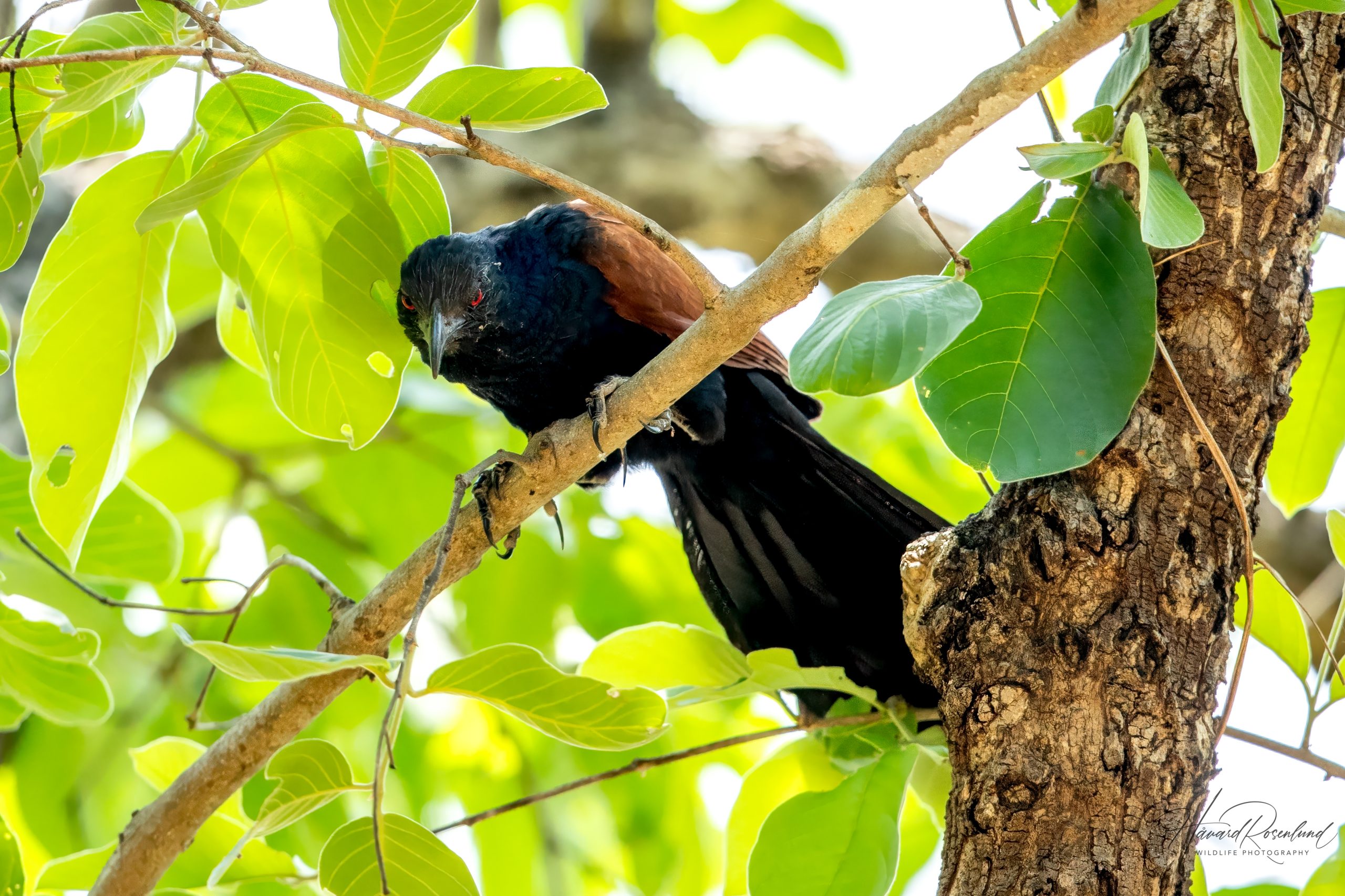
The greater coucal (Centropus sinensis) is a large, long-tailed member of the cuckoo family found across South and Southeast Asia. Adults are roughly 48–55 cm long, with a glossy black-purple head and body, rich chestnut wings, a long dark green-black tail and striking deep red eyes. The heavy bill and strong legs suit a bird that spends much of its time moving through dense vegetation and on the ground rather than flying long distances.
The lesser coucal (Centropus bengalensis) is smaller and more lightly built, with a shorter tail and bill and different plumage details, including dark rather than red eyes in adults. Greater coucals also differ from the brood-parasitic cuckoos familiar in Europe: they construct their own nests, incubate their own eggs and raise their chicks.
Habitat
Greater coucals occupy a broad range of habitats with dense low cover, including scrub, tall grass, reedbeds, bamboo, mangroves, woodland edges, secondary forest and wetland margins. They also use rice fields, plantations, orchards, gardens and other human-modified landscapes where patches of thick vegetation remain.
In India, the species is resident and a pronounced habitat generalist with a very large range. Dense cover is particularly important for concealment, nesting and movement, while open patches and ground beneath vegetation provide many feeding opportunities.
Diet
The greater coucal is an opportunistic omnivore with a strongly animal-based diet. Large insects, caterpillars, spiders, scorpions, snails and other invertebrates are taken alongside lizards, snakes, frogs, small mammals, bird eggs and nestlings. Fruit and seeds are also eaten when available.
A 1993 study of the southern Indian form at Point Calimere documented a broad and flexible diet, while other observations from Tamil Nadu include predation on snakes and heavy use of snails. Plant food can also become important locally: a 1989 study of Indian oil-palm plantations recorded greater coucals feeding on the fleshy parts of ripe oil-palm fruits. The species can therefore shift among food sources according to local and seasonal availability.
Behaviour
Greater coucals are usually seen alone or in pairs and are resident across most of their range. They move with a deliberate, almost pheasant-like gait on the ground and climb through tangled shrubs and branches with strong legs. Flight is generally reserved for short movements between patches of cover and consists of heavy wingbeats followed by gliding.
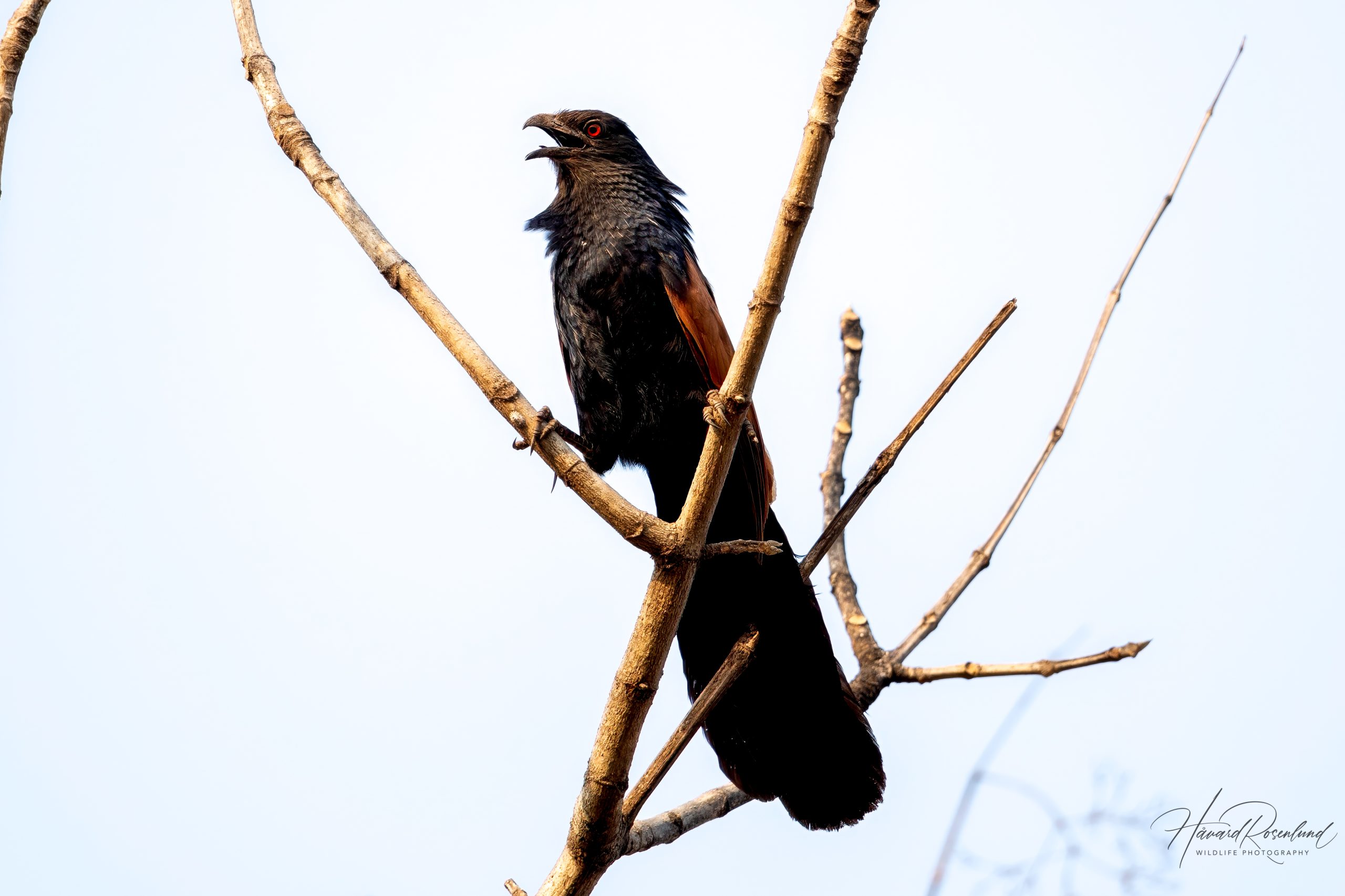
The deep, resonant series of coop-coop-coop notes is one of the species’ most recognisable features and can carry far through dense vegetation. Pairs may call in duet. Coucals also regularly sun themselves from exposed perches, spreading the wings and body feathers, especially during the morning.
Breeding pairs are territorial. A study published in 1997 of the southern Indian population at Point Calimere found defended territories ranging from 0.9 to 7.2 hectares, with a mean of about 3.8 hectares. Territory size therefore varied greatly even within this one local population.
Breeding
Greater coucals are not brood parasites. Pairs build a substantial domed or globular nest of twigs, leaves, roots and other plant material, with a side entrance, hidden within dense shrubs, creepers, bamboo or leafy trees. Breeding timing varies markedly across the range and often follows seasonal rainfall.
The 1997 Point Calimere study found that both sexes participated in nest building and parental care. Clutches there ranged from one to four eggs, averaging 2.6, incubation lasted 15–16 days and chicks fledged after 18–22 days. Because breeding conditions vary widely across the species’ range, exact clutch size and timing can differ elsewhere.
Status
The greater coucal is classified as least concern on the IUCN Red List and remains widespread across South and Southeast Asia. India’s 2025 national update estimates its range at about 2.43 million km².
The updated Indian data remain strongly positive: the long-term trend is estimated at about a 98% increase, while the recent annual trend remains a rapid increase at about 4.8% per year. The species uses scrub, farmland, plantations and tree-rich settlements as well as more natural habitats. Local loss of dense vegetation can still remove breeding and feeding habitat, but there is currently no evidence of a broad national decline in India.
Image gallery
Loading map and observations…
Have you seen this species?
Independent species archive
Did you find this species page useful?
Wildlife Vagabond is independently built and maintained. Voluntary support helps cover hosting, maps, data storage and continued improvements to the species archive.
Support Wildlife VagabondSpecies content will remain freely available.
References
Information about the species’ global distribution and status is based primarily on global Red List data. See the references below for details.
- BirdLife International. (n.d.). Greater Coucal species factsheet. https://datazone.birdlife.org/species/factsheet/greater-coucal-centropus-sinensis
- Dhileepan, K. (1989). Investigations on avian pests of oil palm,Elaeis guineensisJacq. in India†. Tropical Pest Management, 35(3), 273-277. https://doi.org/10.1080/09670878909371379
- International Union for Conservation of Nature. (n.d.). Greater Coucal. The IUCN Red List of Threatened Species. https://www.iucnredlist.org/species/22684229/93020052
- Natarajan. (1993). Food and feeding habits of the Southern Crow-Pheasant Centropus sinensis parroti at Point Calimere, Tamil Nadu. Journal of the Bombay Natural History Society, 90, 11–16. https://eol.org/pages/1047956/articles
- Natarajan. (1997). Breeding biology of the Southern Crow-Pheasant Centropus sinensis parroti at Point Calimere, Tamil Nadu. Journal of the Bombay Natural History Society, 94, 56–64. https://www.biodiversitylibrary.org/part/156247
- State of India's Birds. (n.d.). State of India’s Birds – Greater Coucal. https://stateofindiasbirds.in/species/grecou1/