
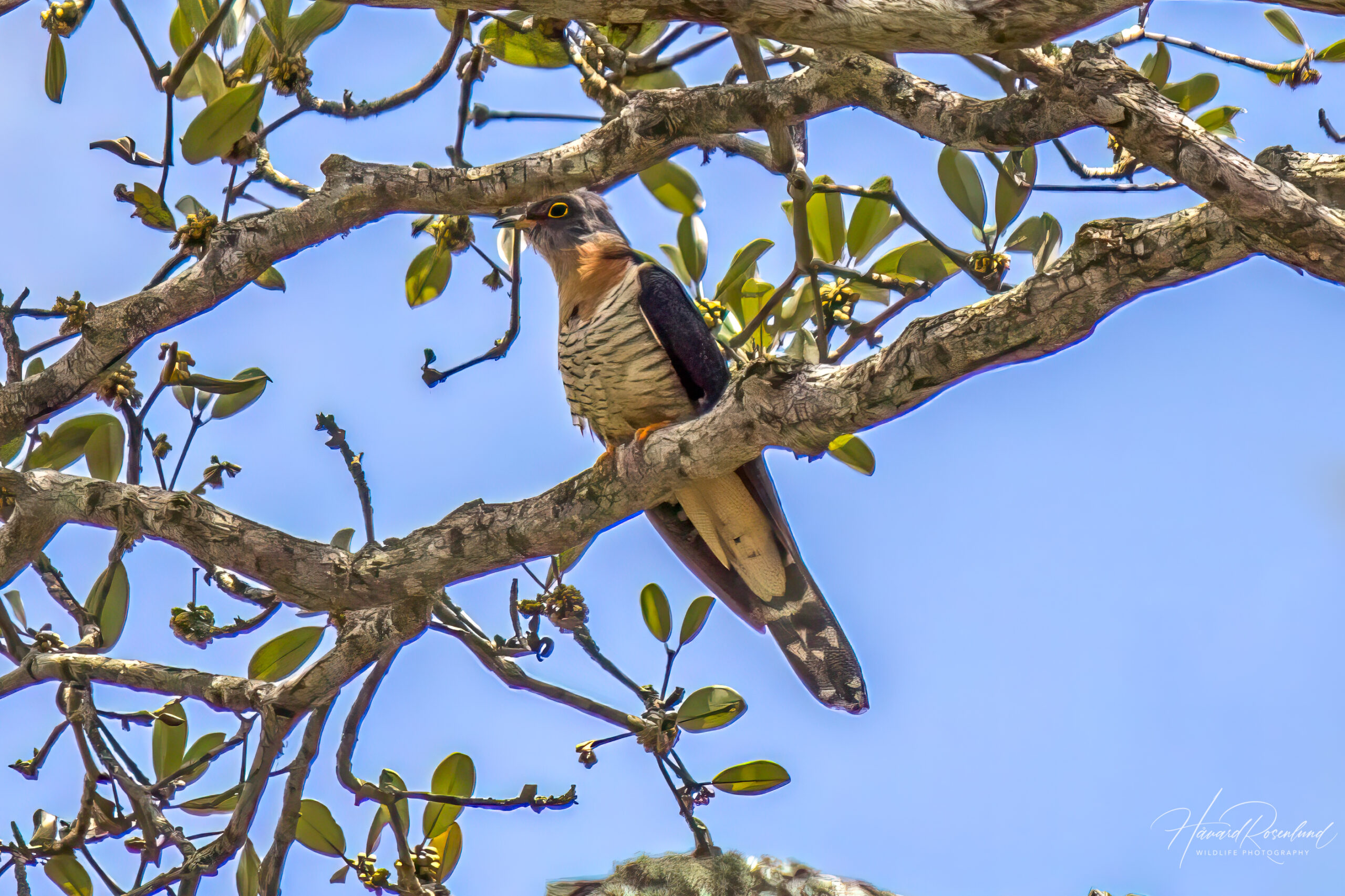
Red-chested Cuckoo
Cuculus solitarius
At a glance
Habitat
- Forest, woodland, wooded savanna, plantations and dense thickets
Diet
- Mainly invertebrates, especially caterpillars; also other arthropods
Activity
- Diurnal, but males may call well into the night
Size
- Length: 28–30 cm Weight: about 73 g
Range
- Sub-Saharan Africa; an intra-African migrant with seasonal movements
Description
The red-chested cuckoo (Cuculus solitarius) is a medium-sized African cuckoo, about 28–30 cm long and weighing around 73 g. Adults have a dark slate-grey head and upperparts, a conspicuous rufous-red breast and boldly barred lower underparts. The long tail and pointed wings give the bird the characteristic shape of a typical Cuculus cuckoo.
The species is widespread across sub-Saharan Africa and is most often encountered in wooded habitats. Despite its striking breast colour, it can be surprisingly difficult to see when sitting quietly inside foliage.
Habitat
Red-chested cuckoos use a broad range of wooded habitats, including forest, woodland, wooded savanna, plantations and dense thickets. They are most common where foliage provides good cover and where suitable host species breed.
Habitat use shifts with migration and rainfall. In southern Africa the species becomes much more conspicuous during the warm rainy season, when both insect prey and breeding hosts are abundant.
Diet
The diet is dominated by invertebrates, especially caterpillars, including hairy species that many other birds avoid. Beetles, grasshoppers, termite alates, spiders, centipedes, millipedes, snails and slugs are also taken, together with occasional small frogs and lizards. Berries have been recorded as a minor plant component.
Birds usually forage alone, moving methodically through foliage and branches and picking prey from vegetation. This largely concealed feeding style contributes to the contrast between how often the species is heard and how rarely it is seen well.
Behaviour
Red-chested cuckoos are usually solitary and can remain inconspicuous outside the breeding season. Males become much more obvious after arrival in breeding areas because of their loud, far-carrying song, which may continue for long periods during both day and night.
In southern Africa the three-note song is traditionally rendered as “piet-my-vrou” in Afrikaans, roughly “Piet, my wife”. The phrase has also inspired a popular joke that the male keeps calling because he never manages to find a mate. The call is strongly associated with the onset of the summer rains and is so characteristic that many people know the bird by sound long before seeing it.
The video below shows a male calling at Tembe Elephant Park on 1 November 2013.
Migration
The species is an intra-African migrant, although movement patterns vary across its enormous range. In southern Africa it is best known as a summer breeding visitor, arriving around the onset of the rainy season and later moving north again during the non-breeding period. Populations closer to the tropics may be resident or make shorter seasonal movements.
The close timing between arrival, intense calling and seasonal rainfall explains why the species is widely regarded as a “rain bird” in parts of southern and eastern Africa.
Breeding
Red-chested cuckoos are obligate brood parasites, meaning they never build a nest or raise their own young. Instead, the female lays in the nests of other birds and leaves all incubation and chick care to the host. A southern African study documented parasitism of 18 host species. Cape robin-chat was the most frequently recorded host in the material, while 12.5% of the bearded scrub-robin nests examined were parasitised.
Several distinct cuckoo egg types occur. Some closely resemble the eggs of particular hosts, while others are poorer matches, showing that the system is less uniformly specialised than in some better-known cuckoos. Host species also differ greatly in how readily they recognise and reject foreign eggs.
After hatching, the cuckoo chick begins ejecting host eggs or young at about two days old and is then raised alone by the foster parents. It remains in the nest for about 17–21 days and becomes fully independent roughly 20–25 days after leaving it. Removing the host brood eliminates competition for food and gives the growing cuckoo the full parental effort of its hosts.
Status
The red-chested cuckoo is classified as least concern on the IUCN Red List. It remains widespread across sub-Saharan Africa, and the global population trend is regarded as stable.
Local numbers depend on suitable wooded habitat, abundant insect prey and healthy populations of host species, but no major range-wide threat is currently recognised.
Image gallery
Loading map and observations…
Have you seen this species?
Independent species archive
Did you find this species page useful?
Wildlife Vagabond is independently built and maintained. Voluntary support helps cover hosting, maps, data storage and continued improvements to the species archive.
Support Wildlife VagabondSpecies content will remain freely available.
References
Information about the species’ global distribution and status is based primarily on global Red List data. See the references below for details.
- Biodiversity Explorer. (n.d.). Cuculus solitarius, based on Roberts Birds of Southern Africa. Iziko Museums of South Africa. https://www.biodiversityexplorer.info/birds/cuculidae/cuculus_solitarius.htm
- BirdLife International. (n.d.). Red-chested Cuckoo species factsheet. https://datazone.birdlife.org/species/factsheet/red-chested-cuckoo-cuculus-solitarius
- Convention on Migratory Species. (n.d.). African-Eurasian Migratory Landbirds Action Plan – species status and population trend. https://www.migrantlandbirds.org/files/documents/general/CMS%20LAP%20Annex%203%20Species%20List%20-%20EN.pdf
- Honza, M., Kuiper, S. M., & Cherry, M. I. (2005). Behaviour of African turdid hosts towards experimental parasitism with artificial red‐chested cuckoo Cuculus solitarius eggs. Journal of Avian Biology, 36(6), 517-522. https://doi.org/10.1111/j.0908-8857.2005.03358.x
- International Union for Conservation of Nature. (n.d.). Red-chested Cuckoo (Cuculus solitarius). The IUCN Red List of Threatened Species. https://www.iucnredlist.org/species/22683862/93004360
- Kuiper, S. M., & Cherry, M. I. (2002). Brood parasitism and egg matching in the Red‐chested Cuckoo Cuculus solitarius in southern Africa. Ibis, 144(4), 632-639. https://doi.org/10.1046/j.1474-919X.2002.00097.x