
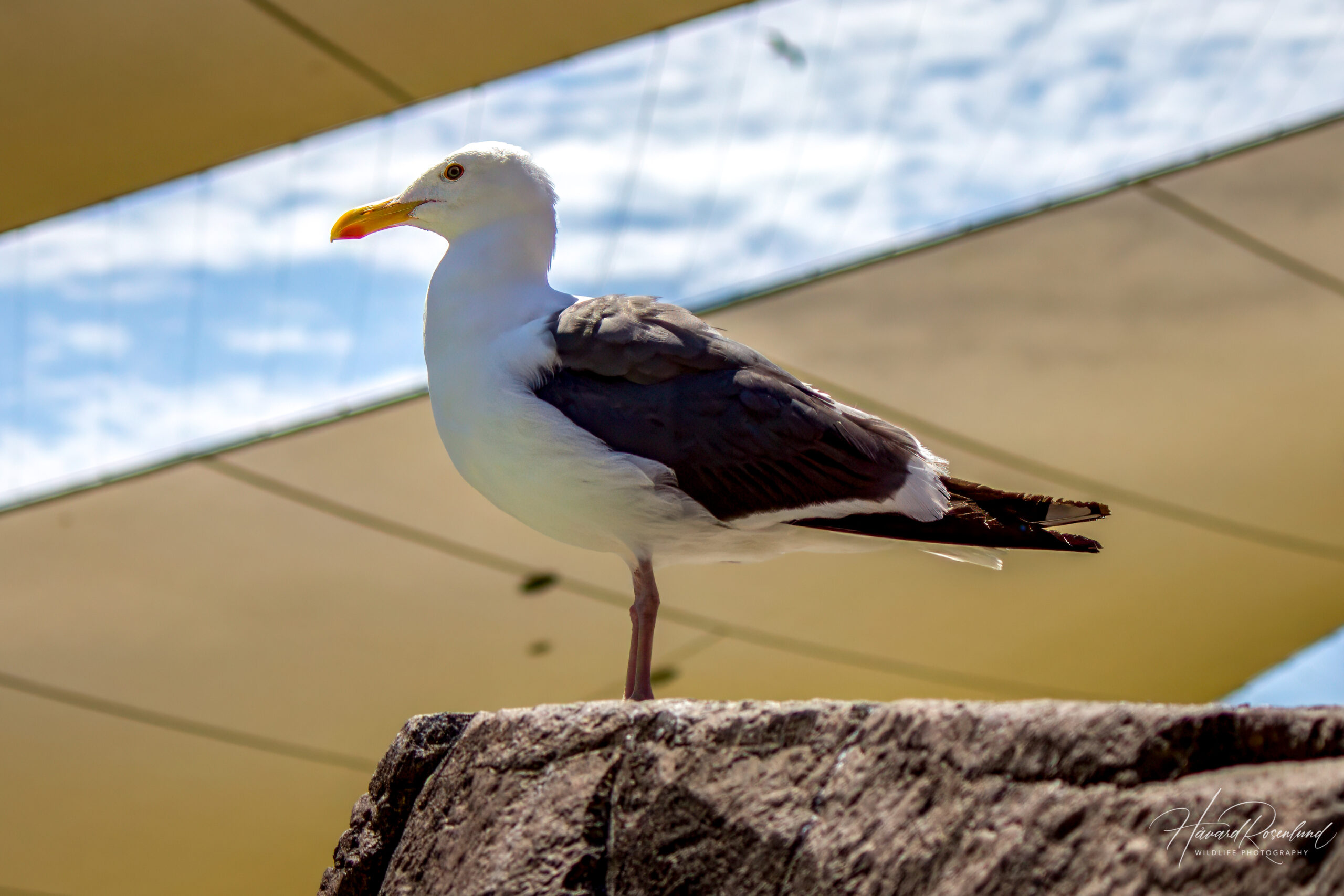
Western Gull
Larus occidentalis
At a glance
Habitat
- Pacific coasts, rocky islands, beaches, harbors, kelp beds and other coastal habitats
Diet
- Highly opportunistic; fish, marine invertebrates, birds, eggs, carrion and human food
Activity
- Diurnal
Size
- Length: 56–66 cm Weight: 800–1,250 g
Range
- Pacific coast of North America, from Baja California north to Washington and southwestern British Columbia
Description
The western gull (Larus occidentalis) is a large, heavy-bodied gull of the Pacific coast of North America. Adults are 56–66 cm long and weigh about 800–1,250 g, with a thick neck, large head and powerful yellow bill marked by a red spot near the tip. The head and underparts are white, the legs are pale pink and the back and upperwings are dark grey to nearly black.
It is one of the characteristic large gulls of the Pacific coast and is generally darker above than the closely related glaucous-winged gull (Larus glaucescens).
Taxonomy
Two subspecies are currently recognised. The northern L. o. occidentalis, breeding from central California northward, has a somewhat paler grey back and typically darker eyes, while the southern L. o. wymani, from central California into Baja California, is darker-backed and usually pale-eyed.
Western gulls also form an extensive hybrid zone with glaucous-winged gulls along the Pacific Northwest coast. Hybrids often show intermediate back and wingtip colours and can be more common than either parental species in parts of Washington. The hybrid zone has persisted for many generations without the two species simply merging into a single population.
Habitat
Western gulls are strongly coastal. They breed on offshore islands, rocky headlands, abandoned piers and other maritime sites that offer protection from terrestrial predators and heavy disturbance.
Outside the nesting area they use rocky and sandy shores, harbours, kelp beds and nearshore waters and also forage farther offshore when marine prey is concentrated.
Diet
The diet is extremely broad. Fish and marine invertebrates are important, including squid, crabs, sea urchins and molluscs, but western gulls also take carrion, eggs, nestlings and occasionally adult seabirds.
The balance between natural prey and scavenged food varies greatly by place and season. Despite their reputation as garbage feeders, natural marine prey can form a large part of the diet.
Foraging
Western gulls are highly flexible in how they obtain food. They walk and swim through intertidal habitat, dip for fish, steal prey from other birds and follow fishing vessels or marine mammals when these concentrate food near the surface.
Hard-shelled prey such as clams, oysters and crabs may be carried into the air and dropped onto rocks or pavement to break the shell. This behavioural flexibility allows the species to exploit rapidly changing coastal food sources.
Breeding
Western gulls often form long-term pair bonds and return to the same breeding areas year after year. Both birds scrape out potential nest sites on the ground, usually beside a rock, shrub, log or other windbreak, and line the chosen site with grass, seaweed, feathers and other available material.
Clutches contain one to three eggs. Both parents incubate for about 25–29 days, although females may spend somewhat more time on the eggs. Newly hatched young are mobile within about a day and leave the nest cup while remaining inside the parents' territory. They begin flying at roughly six to seven weeks and remain dependent on their parents for some time afterwards. Territorial conflicts can be intense, with calls, threat postures, pecking and wing blows used against neighbouring gulls and other intruders.
Relationship with humans
Western gulls readily exploit food concentrated by people and are common around fishing ports, fish-processing facilities, restaurants, picnic areas and some landfills. They may also follow fishing boats for discarded catch.
This adaptability brings the species into frequent contact with people, but human food is not always the dominant resource. Landfill use increases when natural food is scarce, while periods with abundant marine prey draw more of the birds' feeding activity back toward the coast and sea.
Status
The western gull is classified as least concern on the IUCN Red List, but numbers have declined substantially over the long term in North America even though the species remains locally common along much of the Pacific coast.
Changes in marine food availability, contaminants, strong ocean-warming events, oil spills and disturbance at colonies can all affect local populations.
Image gallery
Loading map and observations…
Have you seen this species?
Independent species archive
Did you find this species page useful?
Wildlife Vagabond is independently built and maintained. Voluntary support helps cover hosting, maps, data storage and continued improvements to the species archive.
Support Wildlife VagabondSpecies content will remain freely available.
References
Information about the species’ global distribution and status is based primarily on global Red List data. See the references below for details.
- BirdLife International. (n.d.). Western Gull species factsheet. https://datazone.birdlife.org/species/factsheet/western-gull-larus-occidentalis
- Cornell Lab of Ornithology. (n.d.). Western Gull Life History and conservation status. https://www.allaboutbirds.org/guide/Western_Gull/lifehistory
- Cornell Lab of Ornithology. (n.d.). Western Gull Overview. https://www.allaboutbirds.org/guide/Western_Gull/overview
- Geng, X., Summers, J., & Chen, N. (2024). Ecological niche contributes to the persistence of the western × glaucous‐winged gull hybrid zone. Ecology and Evolution, 14(7), e11678. https://doi.org/10.1002/ece3.11678
- International Union for Conservation of Nature. (n.d.). Western Gull. The IUCN Red List of Threatened Species. https://www.iucnredlist.org/species/22694337/132543621