
Black-bellied Tern
Sterna acuticauda
At a glance
Habitat
- Large inland rivers, lakes and reservoirs with open sandbars, sandy islands and shallow feeding water
Diet
- Small fish, crustaceans, aquatic insects, frogs and other small aquatic prey
Activity
- Diurnal
Size
- Length: 32–35 cm; wingspan about 60–70 cm Weight: about 160 g
Range
- Now concentrated in the Indian subcontinent, with small remnant populations farther east; formerly more widespread in Southeast Asia
Description
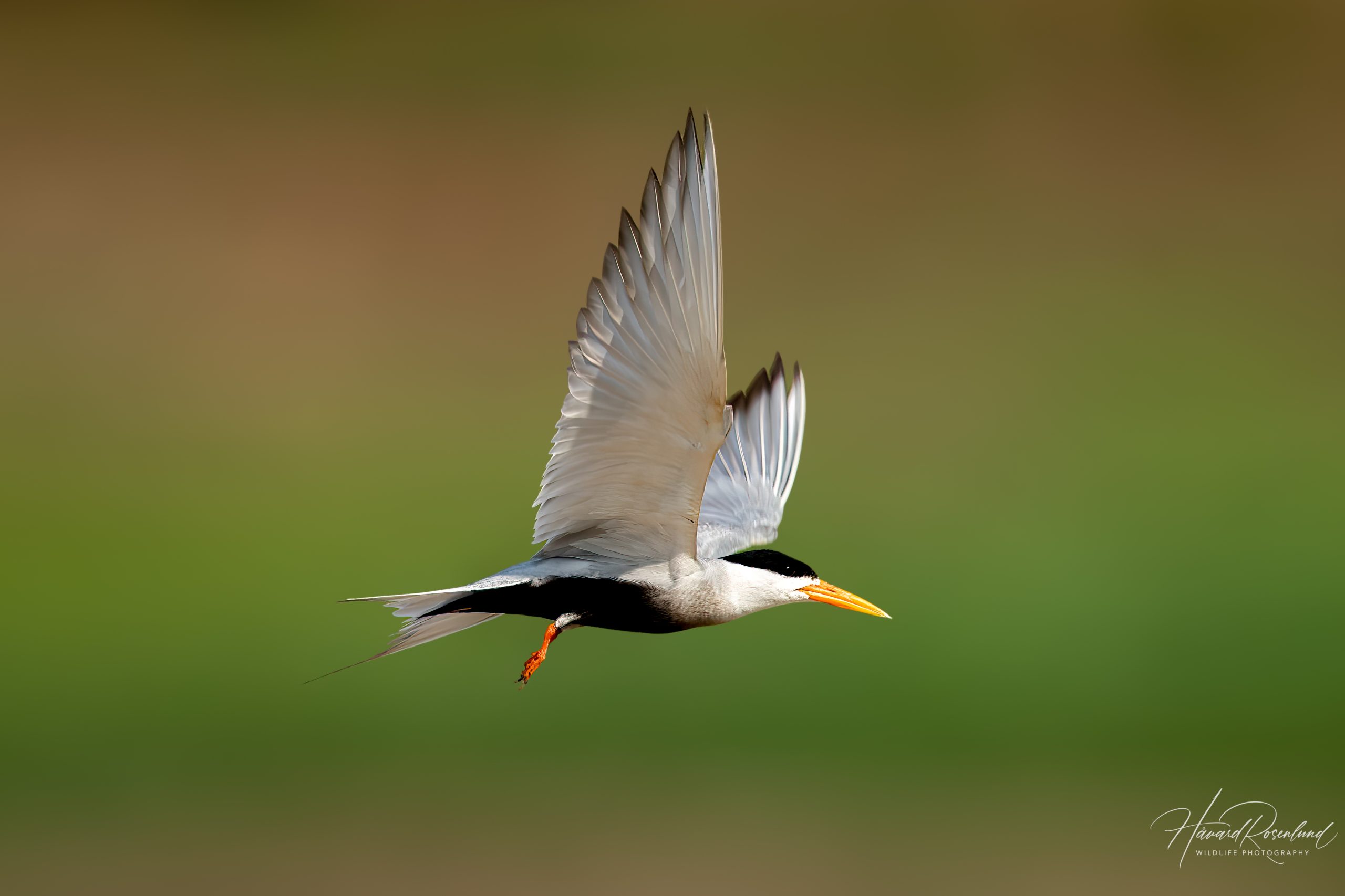
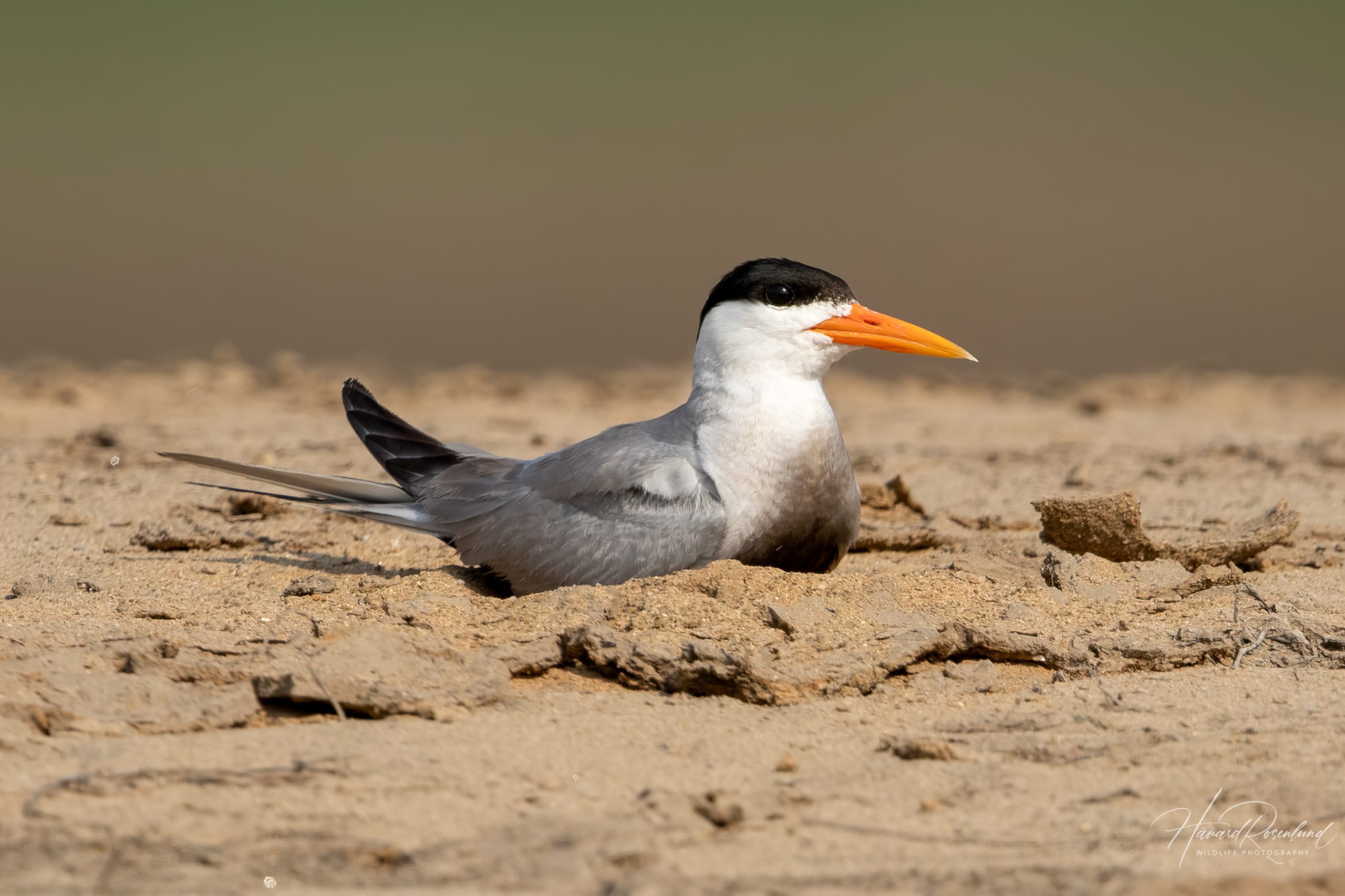
The black-bellied tern (Sterna acuticauda) is a rare river tern about 32–35 cm long, with a wingspan of roughly 60–70 cm. Breeding adults have a glossy black cap and nape, dark grey breast, blackish belly and vent, a deeply forked tail, bright orange to orange-yellow bill and red legs. Outside breeding, the belly becomes white, the tail is shorter and the bill develops a dark tip.
River tern (Sterna aurantia) is the most likely confusion species in India. It is larger, has a heavier yellow bill and lacks the black belly of breeding black-bellied tern. The smaller size, slimmer build and deeply forked tail of S. acuticauda are also useful when the belly is pale outside breeding.
Habitat
Black-bellied terns are specialised birds of large inland rivers and associated freshwater wetlands. They feed along broad river channels, lakes and reservoirs but depend especially on exposed sandbars, sandy islands and open riverbanks for resting and breeding.
These sites appear and disappear as water levels change. Breeding requires exposed nesting ground during the hot dry season and productive shallow water nearby for feeding, making the species closely tied to the seasonal flow of large rivers.
Diet
Small freshwater fish form an important part of the diet, together with crustaceans, aquatic and terrestrial insects, tadpoles and other small aquatic prey. Observations from the National Chambal Sanctuary published in 2025 also documented frogs as opportunistic prey, including a common skittering frog (Euphlyctis cyanophlyctis) caught during the nesting season.
Hunting
Black-bellied terns hunt low over rivers and wetlands, repeatedly scanning the surface for prey. Fish, crustaceans and tadpoles are taken by shallow or oblique plunge-dives, while insects can be picked from the water surface or caught by low aerial hawking over water and nearby ground.
The birds tend to avoid the strongest current and concentrate feeding where prey becomes accessible in shallower or slower water. They can use both skimming surface captures and deeper dives, allowing them to shift technique with prey position and local river conditions. During breeding, adults repeatedly carry prey back to chicks on nearby sandbars.
Behaviour
Black-bellied terns are resident through much of their surviving range and are usually seen in pairs or small groups rather than the very large flocks formed by some other terns. They may rest alongside river terns (Sterna aurantia), Indian skimmers (Rynchops albicollis) and other waterbirds associated with open riverbars.
The flight is quick and buoyant, and birds move locally between feeding, resting and roosting sites as water levels change. Small groups may gather on exposed sandbars between activity periods.
Breeding
Breeding coincides with the dry season, when falling river levels expose temporary sandy islands and bars. Along the Mahanadi River in Odisha, breeding in 2018 occurred from January to April and peaked in March. Nests were simple scrapes in bare sand, and field records from the same river found one to three camouflaged eggs per nest.
A detailed Mahanadi study found an incubation period of 19–21 days, averaging 20.4 days. Both parents defend the nesting area and care for the young after hatching. Regional work on large rivers in Myanmar has reported about 25–30 days from hatching to fledging.
Only 46% of the 24 monitored Mahanadi nests produced chicks, and about 63% of the hatched chicks reached the fledgling stage. Flooding caused most recorded nest failures, followed by predation and trampling.
Status
The black-bellied tern is classified as endangered on the IUCN Red List, with a decreasing global population. The current assessment places the population in the order of only about 800–1,600 mature individuals, with India holding the great majority of the surviving birds.
The species has disappeared or become extremely rare across much of its former Southeast Asian range and now survives mainly in India, Pakistan, Nepal and Bangladesh, with a very small remnant population in Myanmar. State of India’s Birds 2025 classifies it as High Priority. Long-term national trend data are insufficient. The current annual point estimate is about −0.69%, but the uncertainty spans both decline and increase and therefore shows no clear recent direction.
Threats
Alteration of river systems is a major threat. Dams and sudden water releases can flood nests, while water abstraction and changed flow patterns can prevent suitable sandbars from forming. Sand and gravel extraction physically removes breeding habitat, and cultivation, fishing activity and transport increase disturbance on exposed islands.
Egg collection, trampling by people and livestock, free-ranging dogs and other predators, pollution and competition for fish add further pressure. The remaining population is small and concentrated in a limited number of river systems, so repeated breeding failure at important sites can affect a substantial part of the population.
Conservation
The National Mission for Clean Ganga programme includes black-bellied tern among the threatened sandbar-nesting birds monitored along major stretches of the Ganga basin. Local Nest Guardians and River Watchers protect breeding sites, while the programme also works with water-resource authorities where sand mining, livestock disturbance and water-level changes affect colonies.
Nature Conservation Foundation monitors black-bellied terns along the Kaveri and Kollidam in southern India. Work along Nepal’s Koshi River is mapping population status, threats and important breeding habitat, while research on the Mahanadi has documented the pressures faced by nesting birds on temporary river islands.
Image gallery
Loading map and observations…
Have you seen this species?
Independent species archive
Did you find this species page useful?
Wildlife Vagabond is independently built and maintained. Voluntary support helps cover hosting, maps, data storage and continued improvements to the species archive.
Support Wildlife VagabondSpecies content will remain freely available.
References
Information about the species’ global distribution and status is based primarily on global Red List data. See the references below for details.
- AviList. (n.d.). v2025 – Global avian checklist. https://www.avilist.org/
- BirdLife International. (n.d.). Black-bellied Tern species factsheet. https://datazone.birdlife.org/species/factsheet/black-bellied-tern-sterna-acuticauda
- Himalayan Nature. (n.d.). Black-bellied Tern population and threats along the Koshi River, Nepal. https://www.himalayannature.org/works/projects/investigating-population-status-and-prevalent-threats-of-endangered-black-bellied-tern-along-the-koshi-river-nepal/
- International Union for Conservation of Nature. (n.d.). Black-bellied Tern (Sterna acuticauda). The IUCN Red List of Threatened Species. https://www.iucnredlist.org/species/22694711/207933556
- Kar, T., & Debata, S. (2019). Breeding Ecology of the Endangered Black-Bellied Tern (Sterna acuticauda) in Eastern India and Implications for Conservation. Waterbirds, 42(3), 314. https://doi.org/10.1675/063.042.0307
- Kar, T., Palei, H. S., & Debata, S. (2018). Breeding reports and conservation implications of the Endangered Black-bellied Tern Sterna acuticauda J.E. Gray, 1831 (Aves: Charadriiformes: Laridae) in Odisha, eastern India. Journal of Threatened Taxa, 10(13), 12840-12843. https://doi.org/10.11609/jott.4106.10.13.12840-12843
- National Mission for Clean Ganga. (n.d.). Safeguarding Breeding Habitats of Indian Skimmer and Sympatric Sandbar-Nesting Birds in the Ganga Basin. https://www.nmcg.nic.in/conservation_aquatic_birds.aspx
- Nature Conservation Foundation. (n.d.). Riverine birds of Kaveri and Kollidam in South India. https://www.ncf-india.org/endangered-birds/riverine-birds-of-kaveri-and-kollidam-in-south-india
- Shaikh, P., & Athalye, V. V. (2025). Frog in diet of the Black-bellied Tern <i>Sterna acuticauda</i> from the National Chambal Sanctuary, India. Indian BIRDS, 21(2), 46. https://indianbirds.in/vol-21-no-2/
- State of India's Birds. (2025). State of India’s Birds (2025 update) – Black-bellied Tern. https://stateofindiasbirds.in/species/blbter1/
- Wildlife Conservation Society. (n.d.). WCS Myanmar – Survey and conservation of River Tern and Black-bellied Tern in the Ayeyarwady and Chindwin Rivers. https://programs.wcs.org/myanmar/News/articleType/ArticleView/articleId/11291.aspx