
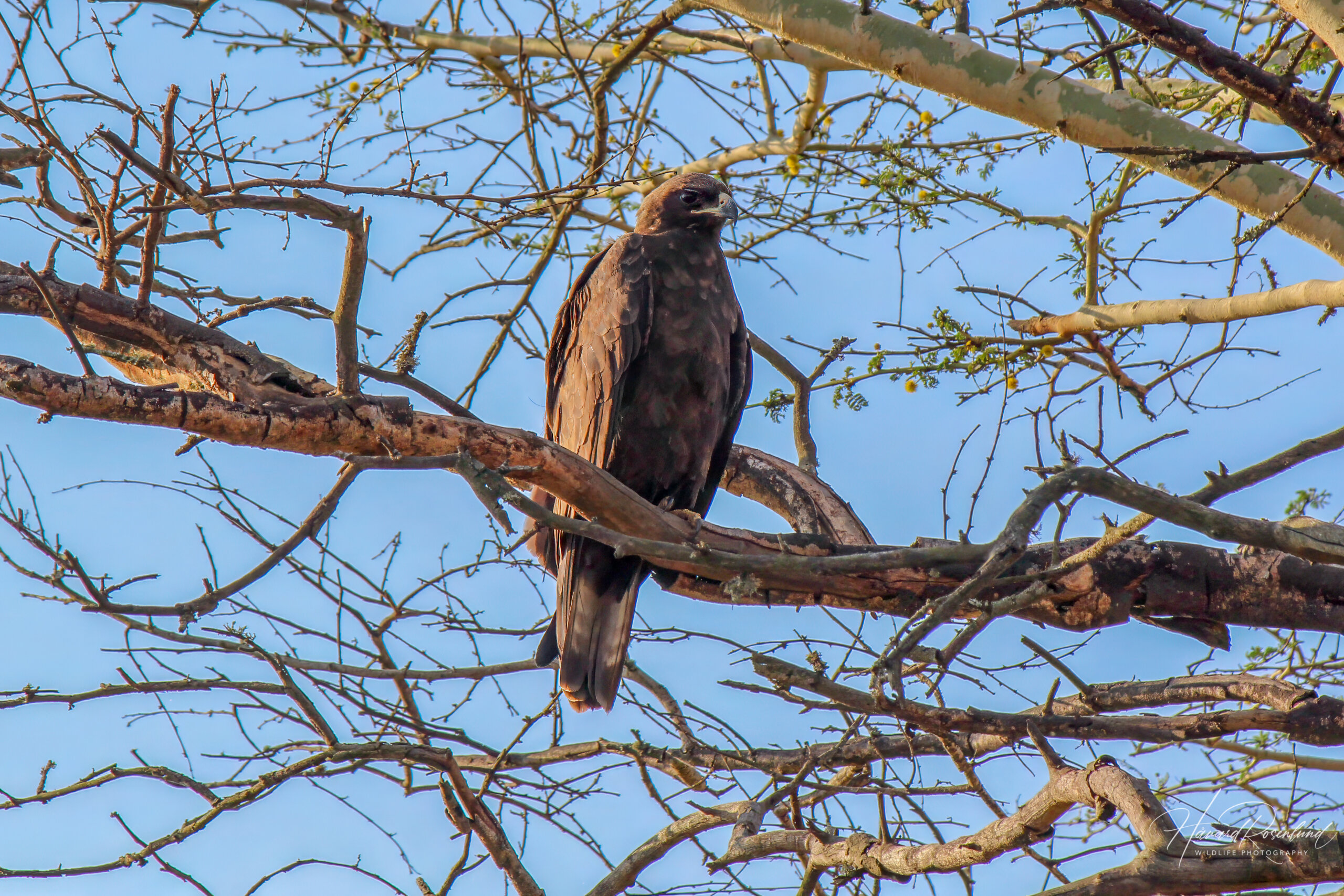
Wahlberg’s Eagle
Hieraaetus wahlbergi
At a glance
Habitat
- Wooded savanna, open woodland and cultivated land with tall trees
Diet
- Birds, reptiles, small mammals, amphibians and large invertebrates
Activity
- Diurnal
Size
- Length: 53–61 cm Weight: 437–1,400 g
Range
- Widespread in sub-Saharan Africa; many populations are migratory
Description
Wahlberg’s eagle (Hieraaetus wahlbergi) is a small African eagle measuring about 53–61 cm in length, with a wingspan of 130–146 cm and a weight of roughly 437–1,400 g. The species shows pronounced colour polymorphism, meaning that the plumage occurs in several markedly different colour forms. Most birds are dark brown, while pale cream and intermediate forms also occur, including individuals with contrasting pale heads or bodies.
Useful structural features include a short, often slightly ragged crest, round nostrils, long straight-edged wings and a relatively long, narrow tail with a square-ended appearance. No subspecies are currently recognised.
The extreme colour variation can make Wahlberg’s eagle resemble several other brown eagles, particularly lesser spotted eagle (Clanga pomarina), tawny eagle (Aquila rapax) and steppe eagle (Aquila nipalensis). Structure is therefore often more useful than colour alone. Wahlberg’s is smaller and more lightly built than the latter two, and in flight the long, straight-edged wings and long, narrow, straight-ended tail create a characteristic cross-like silhouette. Identification is safest when several features are used together rather than relying on a single plumage character.
Habitat
Wahlberg’s eagle favours wooded savanna, open woodland, riverine habitats, thornbush and cultivated landscapes where tall trees remain. It generally avoids dense lowland rainforest and the driest treeless regions and occurs from sea level to around 1,800 metres in much of its range.
Large trees are especially important because they provide nesting sites and elevated hunting perches, while a mosaic of woodland and more open ground gives access to a wide range of prey.
Diet
The diet is broad and includes birds, lizards and other reptiles, small mammals, frogs and large insects. Lizards can be particularly important in many areas, but the species readily switches among prey types as local conditions change.
After heavy rains, Wahlberg’s eagles may gather with other raptors where insects, frogs or other temporarily abundant prey become concentrated.
Hunting
Wahlberg’s eagle hunts both from exposed perches and on the wing. From a tree or other vantage point it can watch open ground and vegetation before making a rapid descent, while aerial searching allows it to locate prey across a larger area.
The hunting style is opportunistic rather than narrowly specialised. Birds can take prey from the ground or vegetation and readily exploit short-lived concentrations of food after rain, switching between reptiles, birds, mammals, amphibians and large invertebrates according to availability. The species also practises kleptoparasitism, meaning it steals prey captured by other animals, including long-crested eagles (Lophaetus occipitalis).
Migration
Wahlberg’s eagle is strongly migratory across much of its range, but migration strategies vary greatly. A study of adults from South Africa and Kenya found that the South African long-distance migrants moved about 3,400 km on average after breeding, while the Kenyan short-distance migrants moved about 500 km. Important non-breeding areas lay in Sudan, South Sudan, the Central African Republic, Uganda and Chad.
After reaching areas north of the equator, some individuals continue gradually northwards as rainfall and food availability change through the season. Wahlberg’s eagles therefore adjust their movements to conditions along the route rather than following one completely fixed migration pattern.
Breeding
Pairs are monogamous and territorial around established breeding areas after returning from migration. Both adults build a relatively small stick nest high in a large tree or palm and line it with fresh green leaves. One egg is usual, although two are laid on rare occasions.
The female performs most of the incubation, which lasts roughly 44–46 days, while the male supplies food. After hatching, the young eagle remains in the nest for about ten weeks and typically fledges after roughly 70–75 days. When two chicks hatch, siblicide occurs: the older chick attacks and kills the younger, so only one young is reared.
Status
Wahlberg’s eagle remains classified as Least Concern on the IUCN Red List and is widespread across sub-Saharan Africa. More recent monitoring nevertheless shows severe declines in several regions.
Long-term road surveys from several parts of Africa produced a median decline of about 74% over three generations across the areas studied. This is not a global population estimate, but it shows that the species is less secure than its broad range alone might suggest. Important pressures include conversion and degradation of wooded savanna, loss of large nesting trees, poisoning, persecution and other human-caused mortality.
Image gallery
Loading map and observations…
Have you seen this species?
Independent species archive
Did you find this species page useful?
Wildlife Vagabond is independently built and maintained. Voluntary support helps cover hosting, maps, data storage and continued improvements to the species archive.
Support Wildlife VagabondSpecies content will remain freely available.
References
Information about the species’ global distribution and status is based primarily on global Red List data. See the references below for details.
- AviList. (2026). v2025b. https://www.avilist.org/checklist/v2025b/
- BirdLife International. (n.d.). Wahlberg’s Eagle species factsheet. https://datazone.birdlife.org/species/factsheet/wahlbergs-eagle-hieraaetus-wahlbergi
- Buij, R., McCabe, J. D., Botha, A., Kapila, S. R., Parmuntoro, L., Thomsett, S., & Tate, G. (2025). Different migration patterns of Wahlberg's eagles Hieraaetus wahlbergi across Africa. Journal of Avian Biology, 2025(2), e03208. https://doi.org/10.1111/jav.03208
- International Union for Conservation of Nature. (n.d.). Wahlberg’s Eagle. The IUCN Red List of Threatened Species. https://www.iucnredlist.org/species/22696072/206474462
- Oiseaux-Birds. (n.d.). Wahlberg’s Eagle species account, including kleptoparasitism of Long-crested Eagles. https://www.oiseaux-birds.com/card-wahlberg-s-eagle.html
- Shaw, P., Ogada, D., Dunn, L., Buij, R., Amar, A., Garbett, R., Herremans, M., Virani, M. Z., Kendall, C. J., Croes, B. M., Odino, M., Kapila, S., Wairasho, P., Rutz, C., Botha, A., Gallo-Orsi, U., Murn, C., Maude, G., & Thomsett, S. (2024). African savanna raptors show evidence of widespread population collapse and a growing dependence on protected areas. Nature Ecology & Evolution, 8(1), 45-56. https://doi.org/10.1038/s41559-023-02236-0
- The Peregrine Fund. (n.d.). Wahlberg’s Eagle. https://peregrinefund.org/explore-raptors-species/eagles/wahlbergs-eagle