
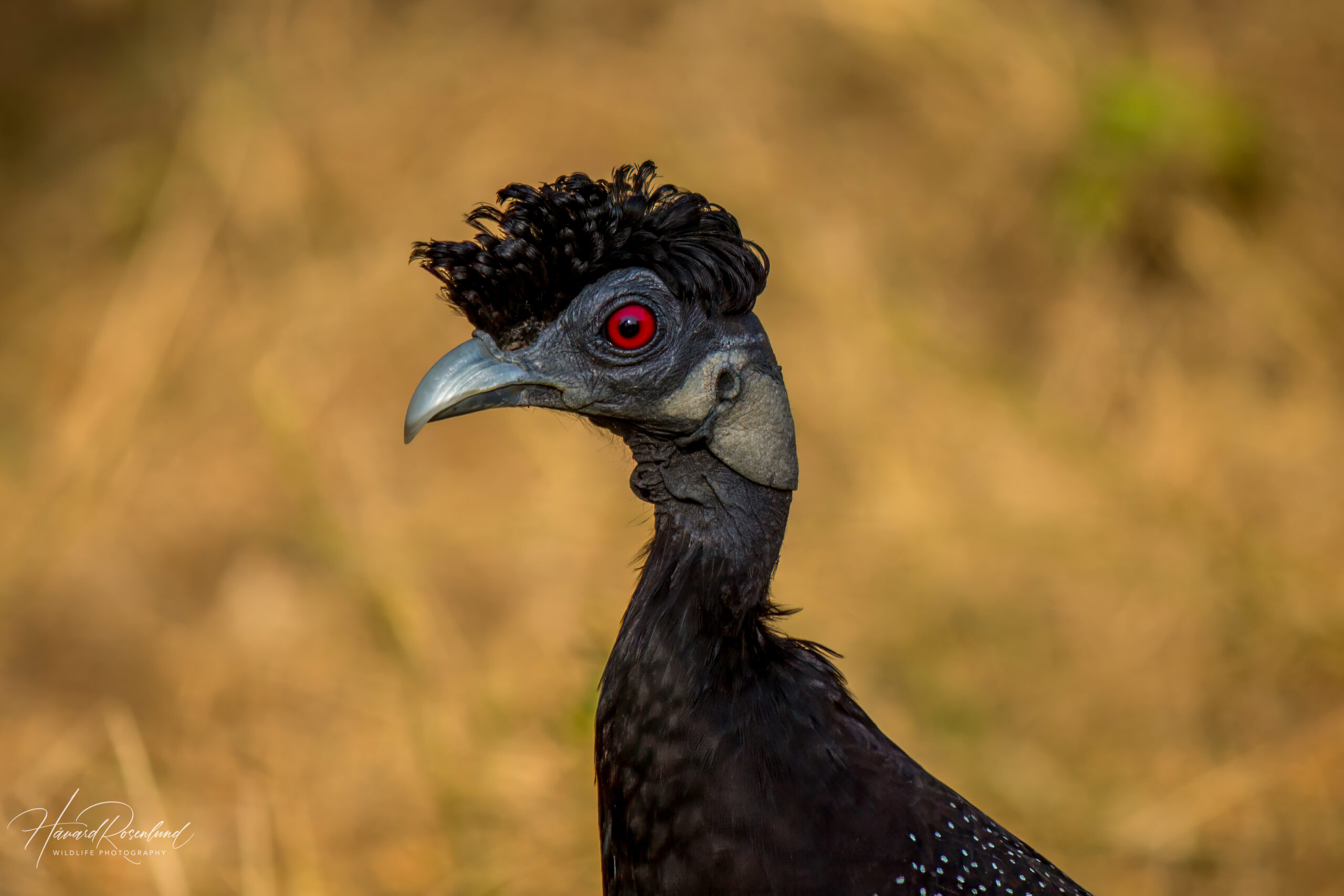
Southern Crested Guineafowl
Guttera edouardi
At a glance
Habitat
- Miombo, coastal and gallery woodland; vegetated savanna
Diet
- Omnivore: seeds, fruit, plant matter and invertebrates
Activity
- Diurnal; mainly ground-foraging
Size
- Length: About 50 cm Weight: 0.7–1.5 kg
Range
- Southeastern Africa, from southeastern Tanzania and Zambia to northeastern South Africa
Description
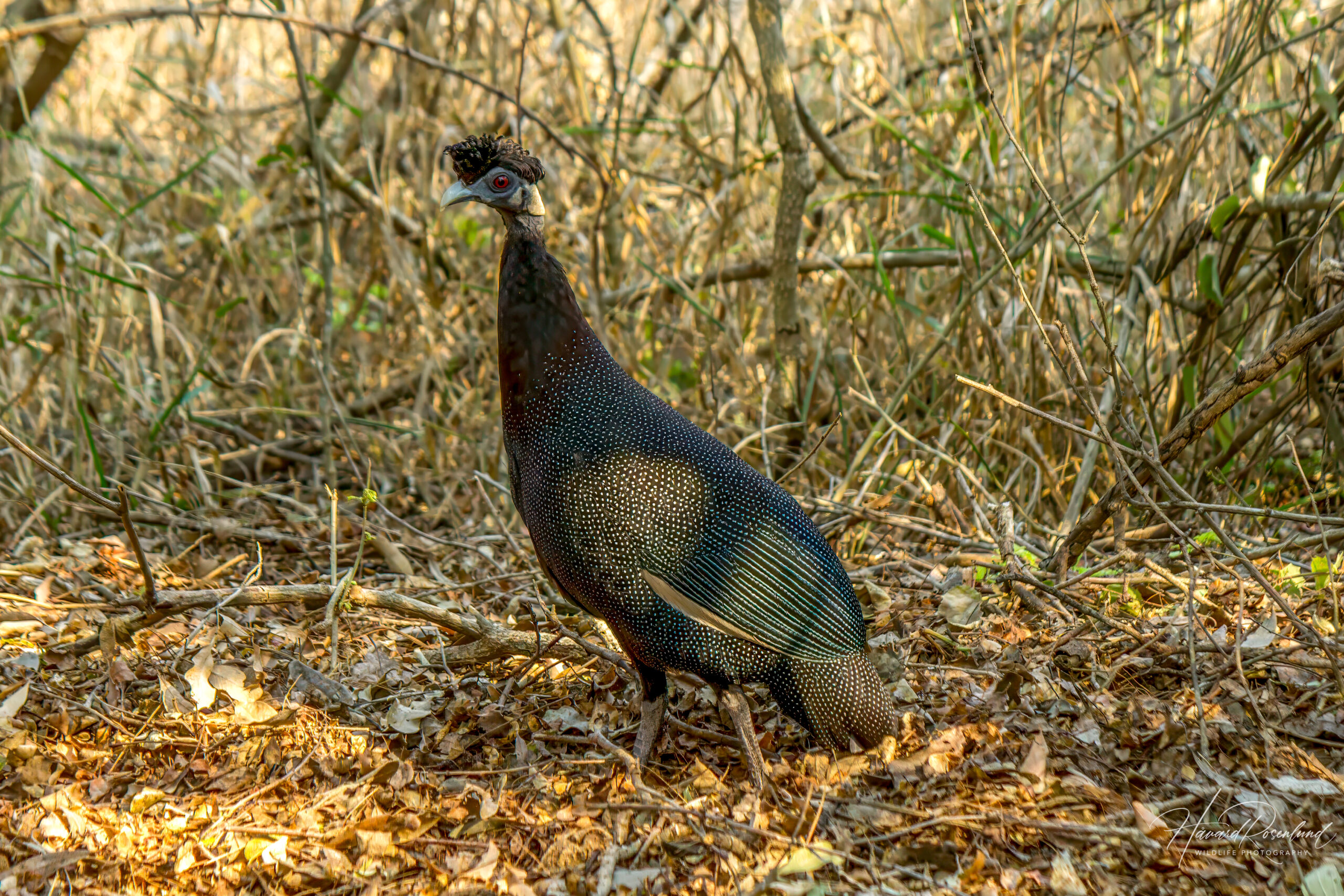
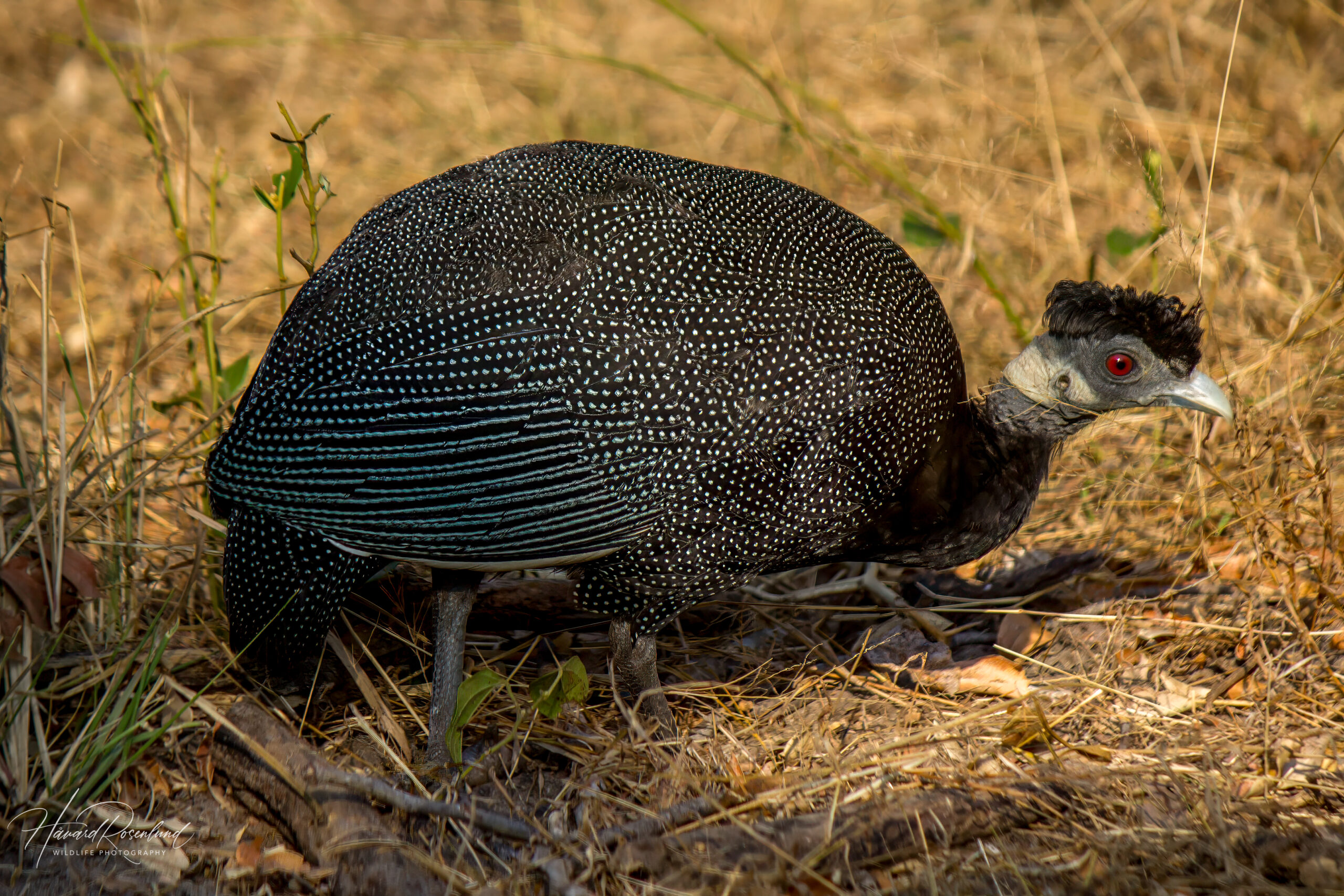
The southern crested guineafowl (Guttera edouardi) is a forest dwelling guineafowl of southeastern Africa. It measures about 50 cm and weighs roughly 0.7–1.5 kg. The dark plumage is densely spotted white, while the head and upper neck are largely bare and topped by a black, tightly curled crest. Greyish-blue facial skin and a conspicuous pale ear patch help distinguish it from the other crested guineafowl species.
Taxonomy
The species was formerly included in a broadly defined crested guineafowl, Guttera pucherani, but current global checklists including AviList recognise southern, eastern and western crested guineafowl as separate species. The split reflects morphological differences—differences in physical form—such as the bare facial and neck skin and crest structure, together with differences in vocalisations, including calls and other sounds. Under the current treatment, G. edouardi includes the subspecies G. e. edouardi and G. e. barbata.
Habitat
Southern crested guineafowl inhabit lowland and foothill woodland, including miombo, coastal and gallery forest, as well as forest margins and well-vegetated savanna. The range extends from southeastern Tanzania and parts of Zambia, Malawi and Mozambique south to northeastern South Africa. They spend most of the day walking through the ground layer, usually beneath good woody cover.
Diet
The diet is broad and omnivorous. Seeds, fruit, berries, leaves, shoots, bulbs and roots are taken alongside insects, spiders and other invertebrates. Birds spend much of the day walking and scratching through leaf litter and soil.
They also search through the dung of large herbivores such as elephants, rhinoceroses and hippopotamuses for edible plant material and invertebrates, providing an additional food source in landscapes used by large mammals.
Social behaviour
This is a strongly social forest bird. Outside the breeding season, southern crested guineafowl live in close-knit flocks whose members can be difficult to see in dense undergrowth. A field study in KwaZulu-Natal described eight types of vocalisations, meaning different calls and other sounds. Most were used to keep flock members together when visual contact was poor or to repel intruders; undisturbed birds were often quiet and exchanged only soft contact calls.
The species also forms striking associations with blue monkeys (Cercopithecus mitis). A 2022 study in South Africa found that crested guineafowl stayed with monkey groups longer than would be expected from chance encounters and spent less time keeping watch when the monkeys were present. This suggests that the monkeys make the surroundings safer for the birds, allowing them to devote more time to activities such as feeding.
Breeding
During the breeding season the birds form monogamous pairs. Lifelong pairing has not been established. Breeding timing varies geographically and commonly follows the onset of seasonal rain.
The nest is a shallow scrape on the ground, usually concealed beneath a bush or in dense vegetation. Clutches can contain two to twelve eggs, with four to seven more typical, and incubation lasts about 23 days. The chicks are precocial, meaning they are well developed and mobile when they hatch. They leave the nest soon afterwards and remain with the adults as they learn to forage.
Status
The southern crested guineafowl is listed as Least Concern on the IUCN Red List and occurs in numerous protected areas across southeastern Africa. A precise global population estimate is not available.
Its global category should not obscure its dependence on wooded habitat. Research in South Africa has shown that southern crested guineafowl are sensitive to forest fragmentation and changes in land use. Maintaining sufficiently large, connected patches of natural woodland and forest is therefore particularly important for local populations, especially near the southern edge of the range.
Image gallery
Loading map and observations…
Have you seen this species?
Independent species archive
Did you find this species page useful?
Wildlife Vagabond is independently built and maintained. Voluntary support helps cover hosting, maps, data storage and continued improvements to the species archive.
Support Wildlife VagabondSpecies content will remain freely available.
References
Information about the species’ global distribution and status is based primarily on global Red List data. See the references below for details.
- AviList. (n.d.). Guttera edouardi: current species and subspecies treatment. https://www.avilist.org/checklist/v2025b/
- BirdLife International. (n.d.). Southern Crested Guineafowl Guttera edouardi species factsheet. https://datazone.birdlife.org/species/factsheet/southern-crested-guineafowl-guttera-edouardi
- International Union for Conservation of Nature. (n.d.). Guttera edouardi (Southern Crested Guineafowl). The IUCN Red List of Threatened Species. https://www.iucnredlist.org/species/22725223/94887589
- Lawes, M. J., Fly, S., & Piper, S. E. (2006). Gamebird vulnerability to forest fragmentation: patch occupancy of the crested guineafowl (Guttera edouardi) in Afromontane forests. Animal Conservation, 9(1), 67-74. https://doi.org/10.1111/j.1469-1795.2005.00006.x
- Leemans, J. J., Linden, B., & van Langevelde, F. (2022). Crested Guineafowl and samango monkey associations. African Zoology, 57(3), 154-164. https://doi.org/10.1080/15627020.2022.2137432
- Maseko, M. S. T., Ramesh, T., Kalle, R., & Downs, C. T. (2017). Response of Crested Guinea-fowl (Guttera edouardi), a forest specialist, to spatial variation in land use in iSimangaliso Wetland Park, South Africa. Journal of Ornithology, 158(2), 469-477. https://doi.org/10.1007/s10336-016-1406-7
- van Niekerk, J. H. (2015). Vocal behavior of Crested Guineafowl (Guttera edouardi) based on visual and sound playback surveys in the Umhlanga Lagoon Nature Reserve, KwaZulu-Natal province, South Africa. Avian Research, 6(1), 13. https://doi.org/10.1186/s40657-015-0022-1