
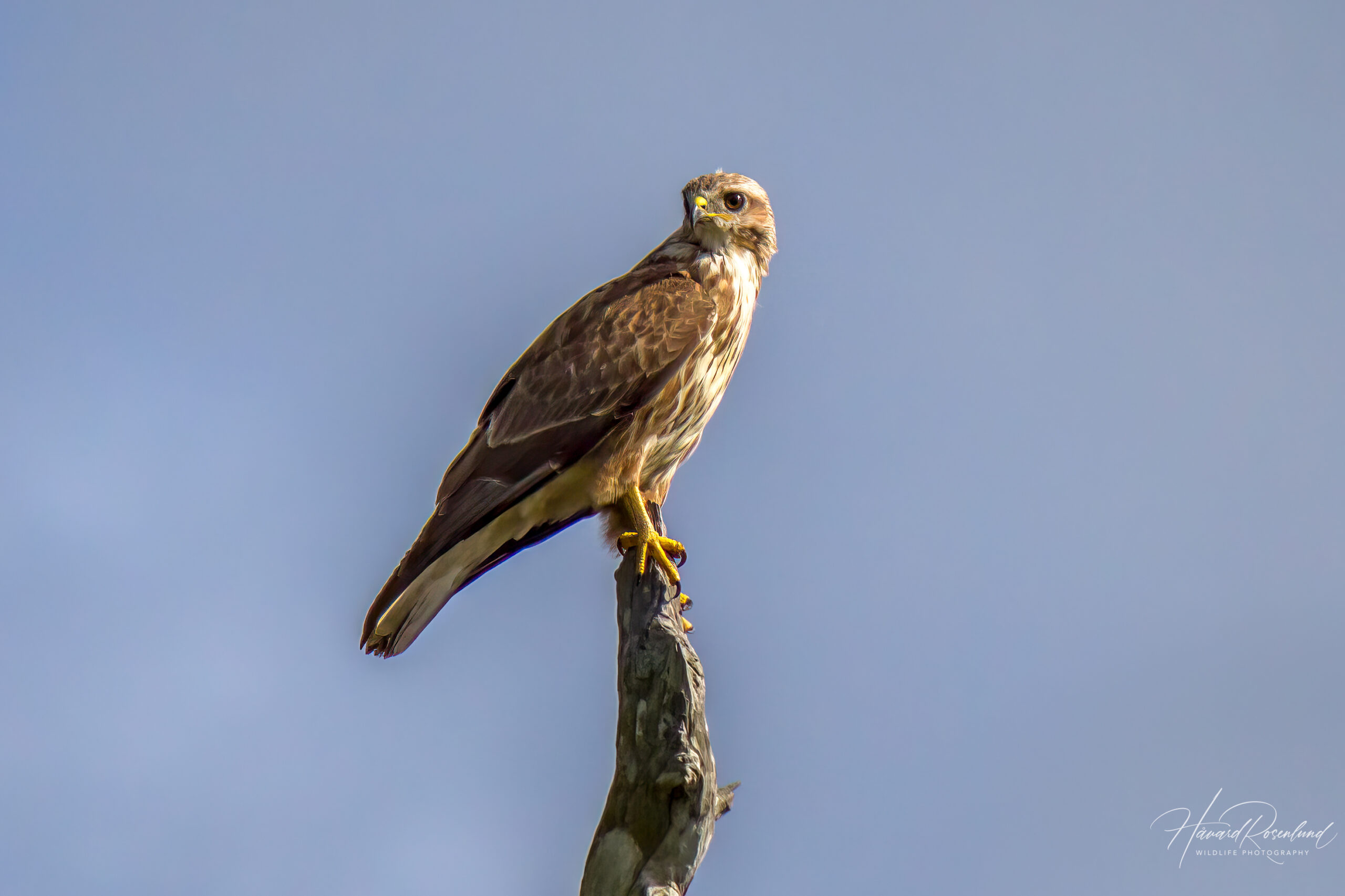
Forest Buzzard
Buteo trizonatus
At a glance
Habitat
- Afromontane forest, forest edges and nearby pine or eucalyptus plantations
Diet
- Small mammals, birds, reptiles, frogs and large invertebrates
Activity
- Diurnal; mainly hunts from perches
Size
- Length: 45 cm Weight: 570–660 g
Range
- Patchily distributed in southern and eastern South Africa, Lesotho and Eswatini
Description
The forest buzzard (Buteo trizonatus) is a medium-sized buzzard endemic to southern Africa and strongly associated with forested landscapes. Adults are about 45 cm long and weigh roughly 570–660 g, with females generally larger than males. The upperparts are dark brown, while the underparts are white with highly variable brown streaking and blotching. The tail is barred, the legs and cere are yellow, and adults usually have medium to dark brown eyes.
Identification is difficult because migrant common buzzards (Buteo buteo), especially the Steppe Buzzard form B. b. vulpinus, are abundant in southern Africa during summer and overlap extensively in plumage. Forest buzzards tend to have shorter wings that do not reach the tail tip at rest, darker eyes and often more white below, but no single feature is completely reliable. Season, habitat, structure and several plumage characters should be assessed together; occasional common buzzards remain through winter, and possible hybridisation has also been reported.
Taxonomy
The forest buzzard was long treated as a southern subspecies of the mountain buzzard (Buteo oreophilus) but is now recognised as the separate species Buteo trizonatus. It is monotypic, with no currently recognised subspecies.
The split reflects differences in morphology, plumage and distribution between the southern African forest birds and the East African mountain buzzard.
Habitat
Forest buzzards occur in indigenous Afromontane and escarpment forest and along adjacent forest edges. They also use plantations of introduced trees, especially pine and eucalyptus, and may have expanded into parts of the Western Cape as plantations created additional tall nesting trees.
Plantations do not appear to be a complete substitute for native forest. Plantation nests are typically associated with nearby indigenous forest, while nests have not been found in pine stands isolated from native forest. A mixed landscape of mature trees, forest edge and surviving indigenous forest therefore appears particularly important.
Diet
Prey include small mammals, birds, snakes, lizards, chameleons, frogs and a wide variety of large invertebrates. The broad prey spectrum fits life along structurally varied forest edges, and diet appears to shift with local prey availability rather than being centred on one specialised prey type.
Hunting
The forest buzzard is mainly a perch hunter. It watches from a branch before dropping onto prey on the ground or in low vegetation, making forest edges and other places where trees overlook small open patches particularly useful hunting habitat.
Migration
The species is partly migratory. Forest buzzards are recorded throughout the year in the Western Cape, indicating that at least part of the population is resident, while records in northeastern South Africa are concentrated mainly from June to August outside the principal southern breeding season.
Ringing recoveries of young birds show that individuals can move long distances between Limpopo and the Western Cape. How much of the population migrates, which age groups are most likely to move and exactly how southern breeding areas connect with northeastern non-breeding areas remain poorly understood.
Breeding
Forest buzzards form monogamous territorial pairs and nest separately rather than in colonies. Breeding is concentrated mainly in the southern Cape. The stick nest is placed high in an indigenous or plantation tree and lined with fresh green leaves; neighbouring pairs may nest one to several kilometres apart.
Clutches normally contain two eggs. Egg laying occurs from late September into early March, with hatching concentrated from late October into December. Young generally fledge from mid-December to late January after roughly seven weeks in the nest and can remain dependent on their parents for as long as about four months after fledging.
Status
The forest buzzard is globally classified as near threatened on the IUCN Red List. BirdLife South Africa's 2025 regional Red Data Book for South Africa, Lesotho and Eswatini also classifies it as near threatened and estimates roughly 670–6,700 mature individuals in the region.
Between the 2007–2015 and 2016–2023 atlas periods, the species' area of occupancy was estimated to have declined by 24.3%. The true population size and population trend remain poorly known.
Threats
Loss and degradation of forest are thought to be the main drivers of decline. Tree cover within the species' range has fallen substantially, and although forest buzzards can use pine and eucalyptus plantations, plantation habitat is temporary because stands are eventually harvested. The birds also appear to depend partly on nearby indigenous forest.
Other recorded causes of mortality include electrocution, persecution and collisions with vehicles. Their importance to the population as a whole remains unclear.
Conservation
No species-specific conservation programme is currently in place. Several protected areas safeguard parts of the breeding range, including Garden Route and Wilderness national parks and provincial reserves such as Goukamma and Grootvadersbosch, but much of the non-breeding distribution lies outside protected areas. The species is also listed in CITES Appendix II.
Retaining indigenous forest around plantation landscapes is particularly important. Important areas outside the breeding season remain poorly mapped, and population size and mortality from infrastructure and persecution are still poorly known. Better understanding of seasonal movements will make it easier to protect both the southern breeding range and the northeastern wintering areas.
Image gallery
Loading map and observations…
National Red List status
| Country | Status | Assessment | Source |
|---|---|---|---|
| South Africa | NTNear Threatened | Regional Red Data Book of Birds of South Africa, Lesotho and Eswatini 2025 | BirdLife South Africa – Forest Buzzard, Regional Red Data Book 2025 |
Have you seen this species?
Independent species archive
Did you find this species page useful?
Wildlife Vagabond is independently built and maintained. Voluntary support helps cover hosting, maps, data storage and continued improvements to the species archive.
Support Wildlife VagabondSpecies content will remain freely available.
References
Information about the species’ global distribution and status is based primarily on global Red List data. See the references below for details.
- BirdLife International. (n.d.). Forest Buzzard species factsheet. https://datazone.birdlife.org/species/factsheet/forest-buzzard-buteo-trizonatus
- BirdLife South Africa. (2025). Forest Buzzard. 2025 Red Data Book of Birds of South Africa, Lesotho and Eswatini, BirdLife South Africa. https://www.birdlife.org.za/red-list/forest-buzzard/
- Gwynn. (2015). The identity, origin and impact of a 'new' buzzard species breeding in South Africa. University of Cape Town MSc thesis. https://open.uct.ac.za/items/4e6064fc-26dd-4936-8089-6853b6da26a2
- Hustler & Dean. (2005). Forest Buzzard Buteo trizonatus. Roberts Birds of Southern Africa, 7th ed.; summary via Biodiversity Explorer. https://www.biodiversityexplorer.info/birds/accipitridae/buteo_trizonatus.htm
- International Union for Conservation of Nature. (2021). Buteo trizonatus. The IUCN Red List of Threatened Species. https://www.iucnredlist.org/species/22735392/206649395
- Store norske leksikon. (n.d.). skogvåk, current Norwegian name and biometrics. https://snl.no/skogvåk