
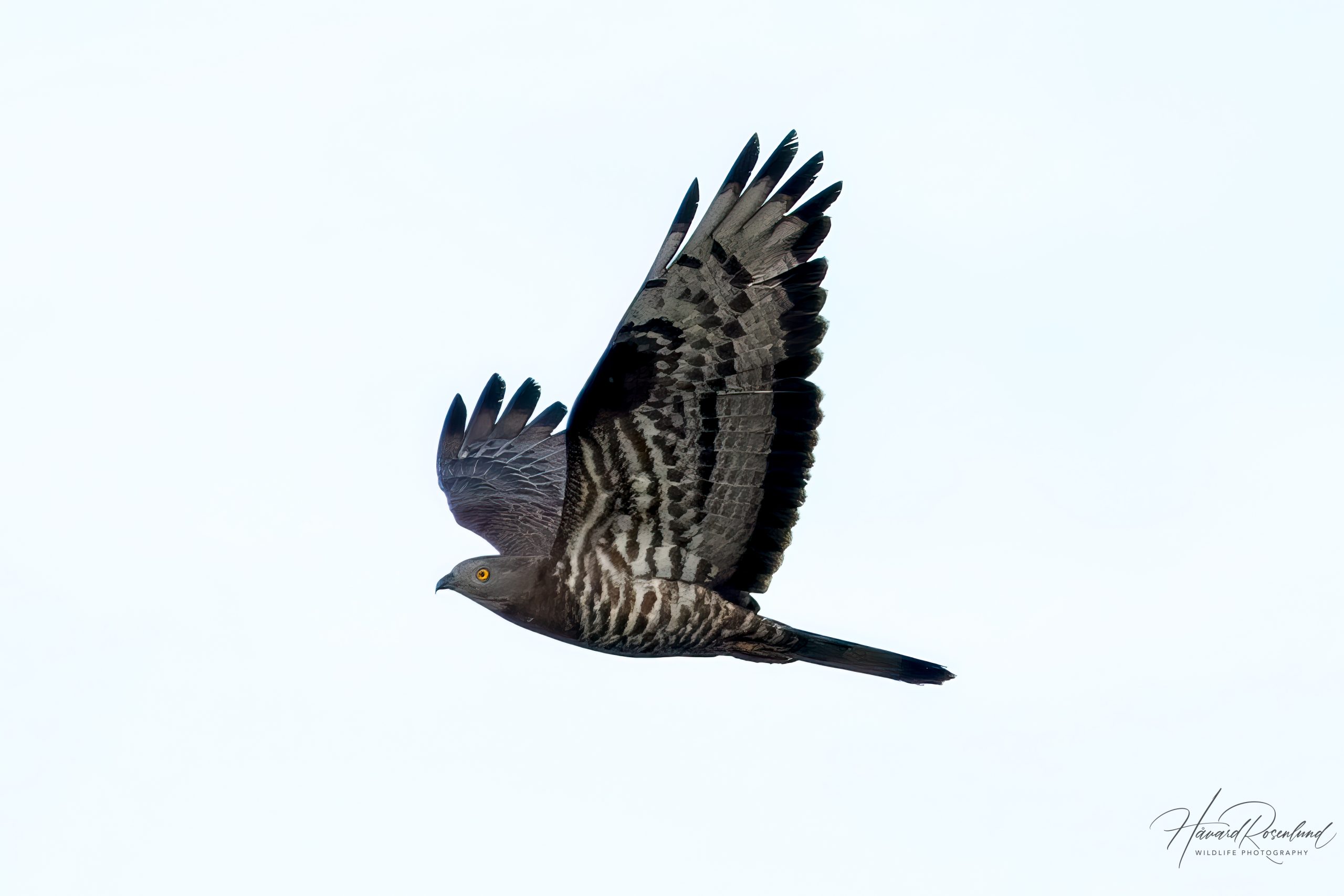
European Honey-buzzard
Pernis apivorus
At a glance
Habitat
- Productive deciduous and mixed woodland with clearings, meadows and other open feeding areas nearby
Diet
- Strongly specialised on social wasps, especially larvae and pupae from underground nests; takes other small prey when needed
Activity
- Diurnal
Size
- Length: 52–60 cm Weight: about 600–1,100 g
Range
- Breeds across Europe and western Asia; winters in tropical sub-Saharan Africa
Description
The European honey-buzzard (Pernis apivorus) is a medium-sized bird of prey that breeds across much of Europe and western Asia and spends the winter in tropical Africa. Adults are about 52–60 cm long, have a wingspan of roughly 118–150 cm and weigh around 600–1,100 g. Females are usually slightly larger than males.
Plumage varies enormously, from very pale birds to dark brown individuals. The species can resemble the common buzzard (Buteo buteo), but has a smaller, more pigeon-like head, longer neck and tail, narrower wings and a different pattern of dark bars on the tail and flight feathers. The yellow eyes are especially striking at close range.
Habitat
Honey-buzzards are mainly birds of productive deciduous and mixed woodland, but they need open areas nearby for feeding. Forest clearings, meadows, field edges, wetlands and lightly farmed landscapes can all be important where social wasps are abundant.
The species is often difficult to detect on the breeding grounds because it spends much of its time quietly inside woodland. A varied landscape with mature nesting trees and sunny open patches is especially valuable: the trees provide secure nest sites, while warm, flower-rich open areas support the insects on which wasp colonies depend.
Diet
The European honey-buzzard is one of Europe’s most specialised raptors. Social wasps dominate much of the diet, especially larvae and pupae taken from underground nests. When wasps are scarce, the diet broadens to include other insects, frogs, reptiles, small mammals, young birds and some fruit. This flexibility is particularly important early in the breeding season, before large wasp colonies have developed.
Foraging
Finding and opening wasp nests is a highly specialised form of hunting. A honey-buzzard may watch adult wasps returning to a nest, land nearby and follow their flight paths until it locates the entrance. It then digs into the soil with its feet and bill until it reaches the combs containing larvae and pupae.
Several features help during these raids. The feathers around the face are short and dense, the nostrils are narrow rather than wide and exposed, and the feet are well suited to digging. These adaptations do not make the bird immune to stings, but they reduce how exposed the most sensitive parts of the head are while it breaks open a nest.
Behaviour
On the breeding grounds, honey-buzzards are quiet and often surprisingly secretive for a large raptor. They spend long periods perched inside woodland or moving low between trees while searching for wasp activity. When soaring, the long wings and relatively small head give a different shape from the stockier common buzzard.
Migration
The European honey-buzzard is a long-distance migrant. Birds leave Europe mainly in August and September and cross into Africa before continuing to wintering areas south of the Sahara. They return north in spring, with many reaching the breeding grounds in May. Outside breeding they are mainly solitary, although migration can concentrate thousands of birds at narrow sea crossings and other bottlenecks.
A satellite-tracking study published in 2026 followed 12 adults breeding in Germany for up to five years. Females left the breeding area about eight days earlier than males. All tracked birds wintered in West or Central Africa, from Liberia and Nigeria south to Gabon and the Republic of the Congo. Most autumn journeys passed through France and Spain and crossed to Africa at the Strait of Gibraltar, although some individuals made longer sea crossings.
The same birds did not always follow exactly the same route each year. Distances between breeding and wintering areas ranged from about 6,100 to 8,600 km, and spring routes generally passed farther east than autumn routes. The study shows that the broad migration pattern is consistent while individual route choices remain flexible.
Breeding
Honey-buzzards return from Africa late in spring and begin breeding soon afterwards. Pairs become conspicuous in territorial and courtship displays, including rising flight followed by a series of wingbeats held high above the back, often described as wing-clapping. The pair builds or renovates a stick nest high in a tree, often adding fresh green branches and leaves. One or two eggs are usual.
Both adults incubate for roughly a month and both feed the chicks. Wasp combs containing larvae and pupae are carried to the nest and become increasingly important as summer colonies grow. The young remain in the nest for about five to six weeks and continue to receive food after their first flights.
The timing of breeding is closely tied to insect availability. A cool or very wet summer can reduce wasp numbers and leave adults with fewer rich nests to bring back to their young, which helps explain why breeding success can vary considerably between years.
Status
The European honey-buzzard is classified as least concern on the IUCN Red List and remains widespread across Europe and western Asia. Its secretive behaviour makes local numbers difficult to assess, and trends differ between regions.
Loss of varied woodland landscapes, intensive agriculture and pesticide use can reduce both nesting habitat and insect prey. Illegal shooting remains a serious problem along parts of the migration route. Because the species depends so strongly on wasps, changes in summer weather and insect populations can also affect breeding success even when the forest itself remains intact.
Image gallery
Loading map and observations…
Have you seen this species?
Independent species archive
Did you find this species page useful?
Wildlife Vagabond is independently built and maintained. Voluntary support helps cover hosting, maps, data storage and continued improvements to the species archive.
Support Wildlife VagabondSpecies content will remain freely available.
References
Information about the species’ global distribution and status is based primarily on global Red List data. See the references below for details.
- BirdLife International. (n.d.). European Honey-Buzzard species factsheet. https://datazone.birdlife.org/species/factsheet/european-honey-buzzard-pernis-apivorus
- International Union for Conservation of Nature. (n.d.). European Honey-Buzzard. The IUCN Red List of Threatened Species. https://www.iucnredlist.org/species/22694989/206749274
- Meyburg, B.-U., & Ziesemer, F. (2026). Migration and wintering of adult European honey buzzards (Pernis apivorus) breeding in Germany, as revealed by satellite telemetry. Raptor Journal. https://doi.org/10.2478/srj-2026-0006
- Royal Society for the Protection of Birds. (n.d.). Honey buzzard. https://www.rspb.org.uk/birds-and-wildlife/honey-buzzard
- Ziesemer & Meyburg. (2015). Home range, habitat use and diet of honey buzzards during the breeding season. https://britishbirds.co.uk/content/home-range-habitat-use-and-diet-honey-buzzards-during-breeding-season