
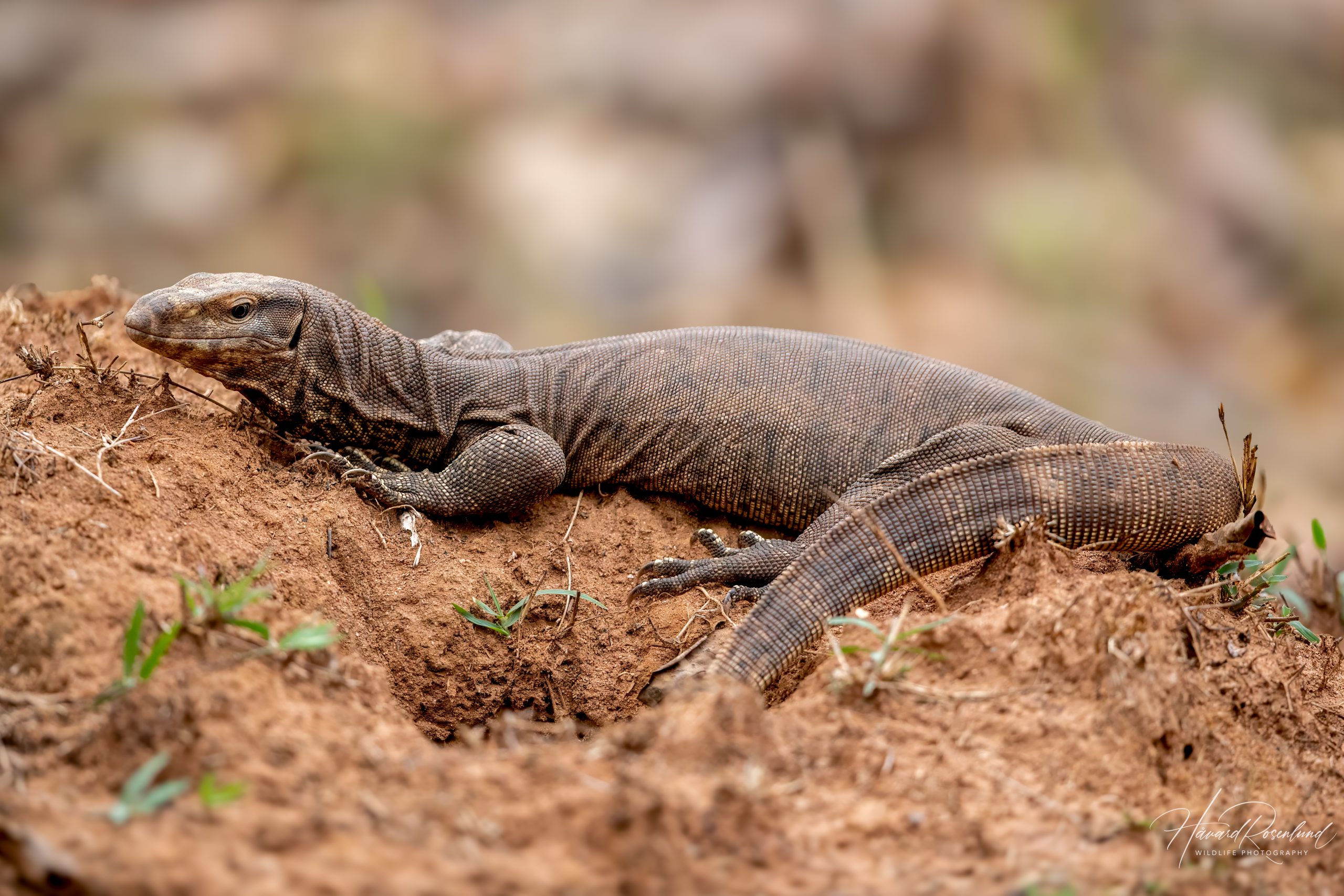
Bengal Monitor
Varanus bengalensis
At a glance
Habitat
- Forests, scrub, grassland, farmland and other areas with suitable shelter
Diet
- Invertebrates, frogs, fish, reptiles, birds, eggs, small mammals and carrion
Activity
- Diurnal
Size
- Length: 61–175 cm Weight: Up to ca. 7.2 kg
Range
- Indian subcontinent and neighbouring parts of western and Southeast Asia
Description
The Bengal monitor (Varanus bengalensis) is a large monitor lizard widespread across the Indian subcontinent and neighbouring parts of western and Southeast Asia. Adults range from about 61 to 175 cm in total length, and exceptionally heavy wild males can reach roughly 7.2 kg. Males are usually larger and more heavily built than females.
The body is robust, with strong clawed limbs, a long muscular tail and a forked sensory tongue. Adults are generally grey-brown with darker mottling or crossbands, while juveniles are more strongly patterned with yellowish spots and dark bars. The clouded monitor (Varanus nebulosus) was formerly included in the same species complex but is now recognised as a separate species. Clouded monitors have a series of enlarged scales above the eyes, whereas these scales are not enlarged in the Bengal monitor; the two also differ in scale counts and colour pattern.
Habitat
Bengal monitors are highly adaptable and occupy dry and moist forests, forest edges, scrub, grassland, plantations, farmland and some settlements. They are mainly terrestrial and use burrows, rock crevices, tree hollows, buildings and abandoned termite mounds as shelter.
Young animals climb frequently, and adults are also capable climbers and strong swimmers. A 2024 field study from Chandpur District in Bangladesh recorded the lizards moving through terrestrial, arboreal and wetland settings.
Diet
The Bengal monitor is an opportunistic predator and active forager. Much of the diet consists of beetles, grubs and other invertebrates, but larger individuals also take frogs, fish, reptiles, birds, eggs and small mammals. Carrion is eaten when available.
While searching for food, the lizard repeatedly flicks its forked tongue and transfers scent particles to the vomeronasal, or Jacobson's, organ in the roof of the mouth. This highly developed chemical sense allows it to follow scent trails and locate prey, eggs or carrion even when food is hidden from view.
Its opportunism also extends to human food waste. Observations from Sri Lanka have recorded Bengal monitors scavenging kitchen refuse, including cooked and uncooked vegetables, grain and fruit, particularly around homesteads. Plant material in these observations came from scavenged human food rather than normal herbivory.
Behaviour
Bengal monitors are diurnal and usually solitary. A field study published in 2024 followed 16 adults and 15 sub-adults in Chandpur District, Bangladesh, from May to December 2020. Resting accounted for about 33.1% of observed activity time, basking 26.0% and foraging 22.8%. Adults and sub-adults basked more during the dry season, while adults rested and foraged more during the wet season. In adults, rising air temperature was associated with less basking and more movement.
The species is primarily terrestrial but climbs well, particularly when young, and readily swims when crossing water or escaping disturbance. Individuals commonly retreat into burrows, tree hollows, rock crevices or other secure shelters when alarmed. If escape is blocked, a monitor may hiss, inflate its body, raise itself defensively, lash with the muscular tail, scratch or bite. Such defensive behaviour is most likely when retreat is no longer possible.
Predation
Bengal monitors themselves are prey for a wide range of larger animals. A field note published in 2022 summarised known predators from at least five reptile, eleven bird and nine mammal species. The same paper documented an Indian cobra (Naja naja) swallowing a 75–80 cm Bengal monitor in Gujarat, an Indian ratsnake (Ptyas mucosa) swallowing a 45–50 cm juvenile, and two feral dogs cornering a large adult before it escaped into a rock crevice. Juveniles are particularly vulnerable, but even large adults can be taken by sufficiently powerful predators.
Reproduction
Breeding activity is concentrated in the warmer months, with courtship and mating occurring mainly before and during the monsoon. Males can engage in ritualised wrestling contests in which they rise against one another and attempt to force the rival to the ground; this competition is directly associated with breeding and access to females.
Females dig nesting burrows in soil or banks and may also use termite mounds, where relatively stable temperature and humidity can favour egg development. Clutches of about 8–32 eggs are documented, with larger females generally producing more. Most females lay one clutch a year, while two can occur in regions with two monsoon seasons. Incubation is strongly affected by temperature and humidity and has been recorded at roughly 168–254 days, about five and a half to eight and a half months. Hatchlings receive no extended parental care and are more arboreal than adults, spending considerable time climbing trees and other elevated structures.
Status
The Bengal monitor is classified as near threatened on the IUCN Red List. It remains widespread across a very large part of South Asia and can still be locally common, but the global population is considered to be decreasing.
Its broad habitat tolerance allows the species to persist in farmland and other modified landscapes. Extensive exploitation and local loss of secure shelters and areas with abundant prey can still drive declines.
Threats
Direct exploitation is one of the most important pressures on Bengal monitors. Animals are killed for meat, skins, fat and other body parts and may also be captured for illegal trade. In India, dried hemipenes from Bengal and yellow monitors have been sold as hatha jodi, presented as rare plant roots and used as talismans. Persecution can add further mortality where large lizards are feared or regarded as pests.
Habitat loss and degradation can compound these pressures by removing large trees, burrows, termite mounds, rocky refuges and areas with abundant prey. Local populations can therefore decline when shelter, prey and connected habitat are reduced, especially where direct exploitation continues.
Conservation
Varanus bengalensis is listed in CITES Appendix I, under which international commercial trade is generally prohibited. Protection from illegal hunting and trafficking is important alongside the retention of trees, burrows, rocky refuges and other shelter sites in both natural and human-modified landscapes.
Population size and trends remain poorly known in many parts of the range because Bengal monitors are widespread, secretive and exposed to exploitation that is difficult to measure. It is therefore often unclear which local populations are stable and where the species is declining.
Image gallery
Loading map and observations…
Have you seen this species?
Independent species archive
Did you find this species page useful?
Wildlife Vagabond is independently built and maintained. Voluntary support helps cover hosting, maps, data storage and continued improvements to the species archive.
Support Wildlife VagabondSpecies content will remain freely available.
References
Information about the species’ global distribution and status is based primarily on global Red List data. See the references below for details.
- Animal Diversity Web. (n.d.). Varanus bengalensis (Bengal monitor). https://animaldiversity.org/accounts/Varanus_bengalensis/
- Convention on International Trade in Endangered Species of Wild Fauna and Flora. (n.d.). Varanus bengalensis – Appendix I. https://cites.org/eng/taxonomy/term/4152
- International Union for Conservation of Nature. (2021). Varanus bengalensis. The IUCN Red List of Threatened Species. https://www.iucnredlist.org/species/164579/1058949
- Jaman, M. F., Ahmed, S., Hossain, S., & Rabbe, M. F. (2024). Activity budget of Bengal Monitor : Effect of daytime, season, age and temperature. Heliyon, 10(7), e28504. https://doi.org/10.1016/j.heliyon.2024.e28504
- Karunarathna, D. M. S. S., Surasinghe, T. D., Dissanayake, D. S. B., Botejue, M., Gabadage, D., & Madawala, M. (2017). Dietary habits and the predators of the Bengal Monitor <i>Varanus bengalensis</i> in Sri Lanka. Biawak, 11(1), 28–39. https://www.varanidae.org/11_1.pdf
- The Reptile Database. (n.d.). Varanus bengalensis. https://reptile-database.reptarium.cz/Varanus/bengalensis
- Vyas, R., Bhatt, Y., & Mori, D. (2022). Predators of the Bengal Monitor (<i>Varanus bengalensis</i>). Reptiles & Amphibians, 29(1), 264–265. https://doi.org/10.17161/randa.v29i1.16861