
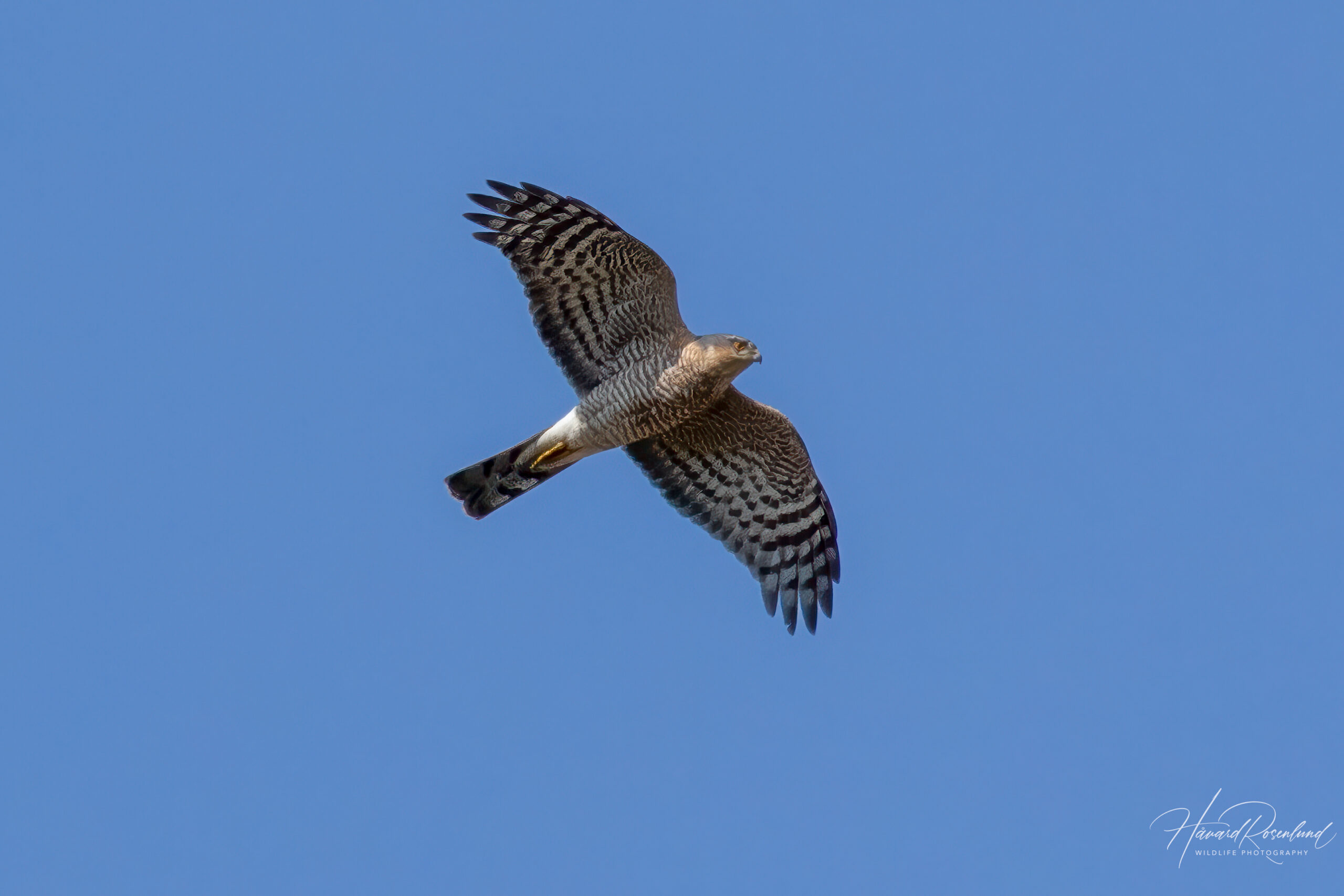
Eurasian Sparrowhawk
Accipiter nisus
At a glance
Habitat
- Woodland and forest mosaics with cover for ambush hunting; also farmland, parks and urban areas
Diet
- Mostly birds; females take substantially larger prey than males
Activity
- Diurnal
Size
- Length: ♂ 29–34 cm; ♀ 35–41 cm Weight: ♂ about 151 g; ♀ about 266 g
Range
- Europe, North Africa and temperate Asia; northern populations are more migratory
Description
The Eurasian sparrowhawk (Accipiter nisus) is a small, agile forest hawk widespread across Europe, North Africa and temperate Asia. It shows extreme reversed sexual size dimorphism, with females much larger than males. Males are about 29–34 cm long and average roughly 151 g, while females are 35–41 cm long and average around 266 g. Adult males have blue-grey upperparts and finely barred orange-rufous underparts; females are larger, brown-grey above and barred grey-brown below. Juveniles are browner and more coarsely marked.
The larger northern goshawk (Astur gentilis) is the main confusion species. Goshawks are heavier and more powerful, with broader wings, a more prominent pale eyebrow and generally slower, deeper wingbeats. Sparrowhawks have a compact body, relatively short rounded wings and a long tail suited to rapid manoeuvring between trees.
Habitat
Sparrowhawks are woodland predators but use a broad range of landscapes wherever trees, hedges or buildings provide cover for surprise attacks. They occur in coniferous and deciduous forest, farmland with wooded edges, parks and towns.
Breeding territories usually combine concealed nest sites in woodland with nearby hunting areas. The species has adapted particularly well to fragmented and suburban landscapes because hedges, gardens and buildings can provide the cover needed to approach prey unseen.
Diet
Birds dominate the diet. Small passerines form much of the prey taken by males, while the larger females can handle substantially bigger birds, including thrushes, starlings and pigeons. Mammals and other prey are taken only occasionally.
The prey-size difference between the sexes reduces overlap in the food they exploit. A 2022 study analysed 666 photographs posted online of sparrowhawks with prey and found strong sex-specific differences in prey mass throughout the year, matching the large size difference between males and females.
Hunting
Sparrowhawks specialise in close-range surprise attacks. They often fly low and fast behind hedges, woodland edges, buildings or other cover before accelerating toward a bird at short distance. Their compact build allows abrupt turns and rapid changes of direction among trees and other obstacles.
Many attacks fail, so the bird repeatedly uses terrain and concealment to reduce the time prey has to react. Gardens and bird feeders can become hunting sites because small birds gather there, but the sparrowhawk is exploiting prey concentration rather than the feeder itself.
Migration
Migration varies with latitude, age and local conditions. Many adults in western and central Europe remain within or near their breeding regions year-round, while birds from northern and eastern populations move south in autumn. Juveniles are generally more mobile than established adults.
Wintering birds occur across western and southern Europe, North Africa and southern parts of Asia. Movements are relatively flexible because sparrowhawks can follow concentrations of bird prey and remain where winter conditions allow effective hunting.
Breeding
Pairs breed in woodland and usually place a stick nest in a conifer or deciduous tree, often within a stand that provides concealment and easy access to hunting areas. A new nest is commonly built each year, although the same territory may be occupied for many seasons.
A typical clutch contains four to five eggs. The female does nearly all the incubating for about 33 days, while the male supplies much of the food. After hatching, the female broods the young and divides prey while the male initially remains the principal hunter. The chicks usually leave the nest at around 27–30 days and can remain dependent on their parents for about another three to four weeks before dispersing.
The size difference develops early. Measurements of wild nestlings found that females reached about 1.6 times the final body mass of males and required an estimated 1.4 times as much energy through the nestling stage. Raising a daughter is therefore substantially more energetically demanding than raising a son.
Status
The Eurasian sparrowhawk is classified as least concern on the IUCN Red List and remains widespread across its enormous Old World range.
The species is also a classic example of raptor recovery after organochlorine pesticide restrictions. Populations in parts of Europe fell sharply during the mid-twentieth century as contamination increased, then recovered as residues of compounds derived from aldrin, dieldrin and DDT declined. In Britain, the breeding population index was 35% higher in 2024 than in 1975, largely reflecting recovery up to the mid-1990s. The population then stabilised, although a more recent moderate decline has occurred in England.
Image gallery
Loading map and observations…
Have you seen this species?
Independent species archive
Did you find this species page useful?
Wildlife Vagabond is independently built and maintained. Voluntary support helps cover hosting, maps, data storage and continued improvements to the species archive.
Support Wildlife VagabondSpecies content will remain freely available.
References
Information about the species’ global distribution and status is based primarily on global Red List data. See the references below for details.
- BirdLife International. (n.d.). Eurasian Sparrowhawk species factsheet. https://datazone.birdlife.org/species/factsheet/eurasian-sparrowhawk-accipiter-nisus
- British Trust for Ornithology. (n.d.). Sparrowhawk. https://www.bto.org/learn/about-birds/birdfacts/sparrowhawk
- International Union for Conservation of Nature. (n.d.). Eurasian Sparrowhawk. The IUCN Red List of Threatened Species. https://www.iucnredlist.org/species/22695624/199751254
- Newton, I., & Wyllie, I. (1992). Recovery of a Sparrowhawk Population in Relation to Declining Pesticide Contamination. The Journal of Applied Ecology, 29(2), 476. https://doi.org/10.2307/2404515
- Panter, C. T., & Amar, A. (2022). Using web-sourced photographs to examine temporal patterns in sex-specific diet of a highly sexually dimorphic raptor. Royal Society Open Science, 9(10), 220779. https://doi.org/10.1098/rsos.220779
- Vedder, O., Dekker, A. L., Visser, G. H., & Dijkstra, C. (2005). Sex-specific energy requirements in nestlings of an extremely sexually size dimorphic bird, the European sparrowhawk (Accipiter nisus). Behavioral Ecology and Sociobiology, 58(4), 429-436. https://doi.org/10.1007/s00265-005-0926-6