
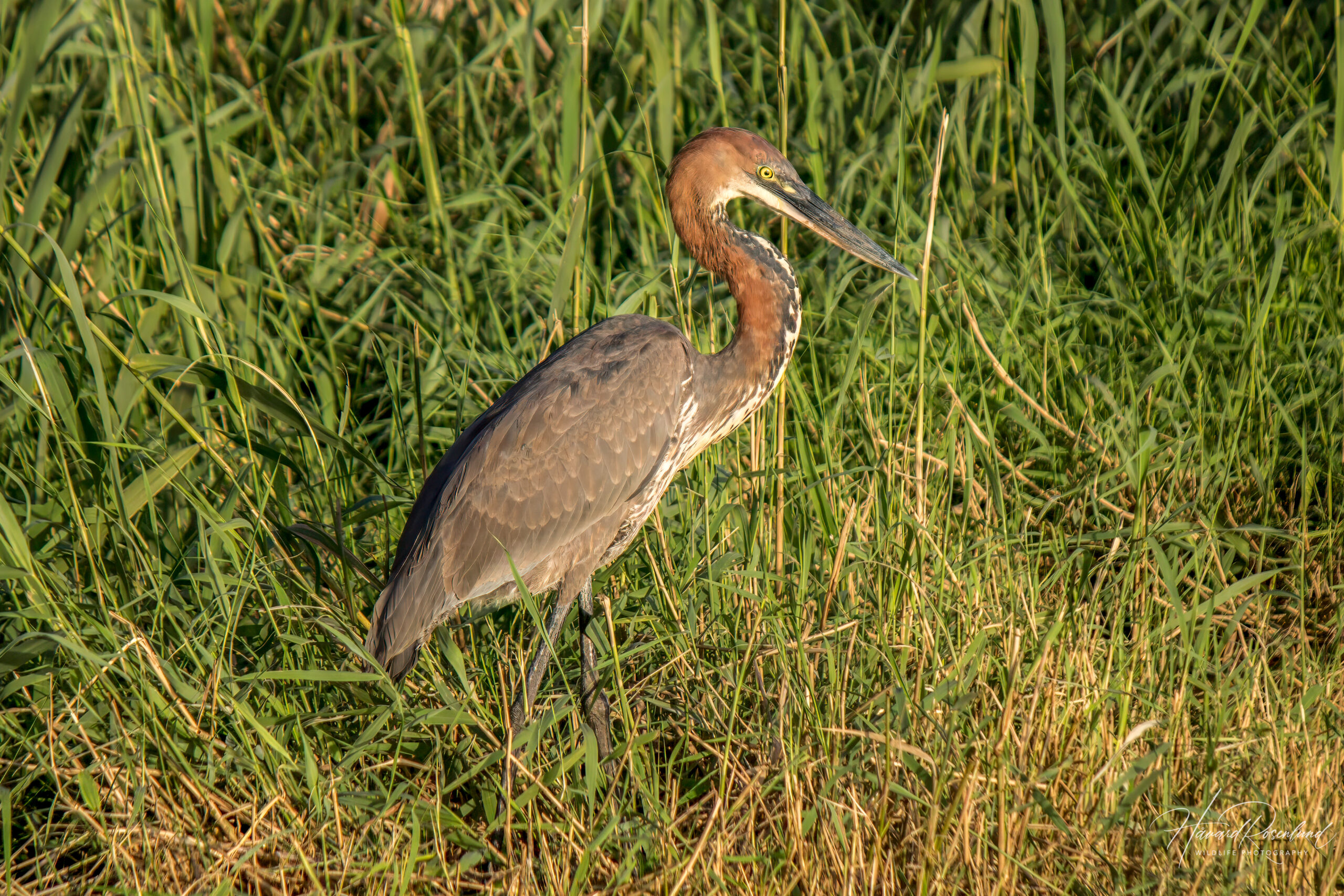
Goliath Heron
Ardea goliath
At a glance
Habitat
- Shallow freshwater and coastal wetlands, lakes, rivers, estuaries, lagoons and mangroves
Diet
- Primarily large fish; also frogs, crustaceans, reptiles and small mammals
Activity
- Mostly diurnal; hunts by prolonged stationary waiting and slow stalking
Size
- Length: 135–150 cm Weight: about 2.6–4.5 kg
Range
- Mainly sub-Saharan Africa, with smaller populations in parts of southwest Asia
Description
The goliath heron (Ardea goliath) is the world's largest living heron. Adults stand about 135–150 cm tall, have a wingspan of roughly 210–230 cm and can weigh more than 4 kg. The huge dagger-like bill, very long legs and massive body allow it to work deeper water and handle prey far larger than those taken by most other herons.
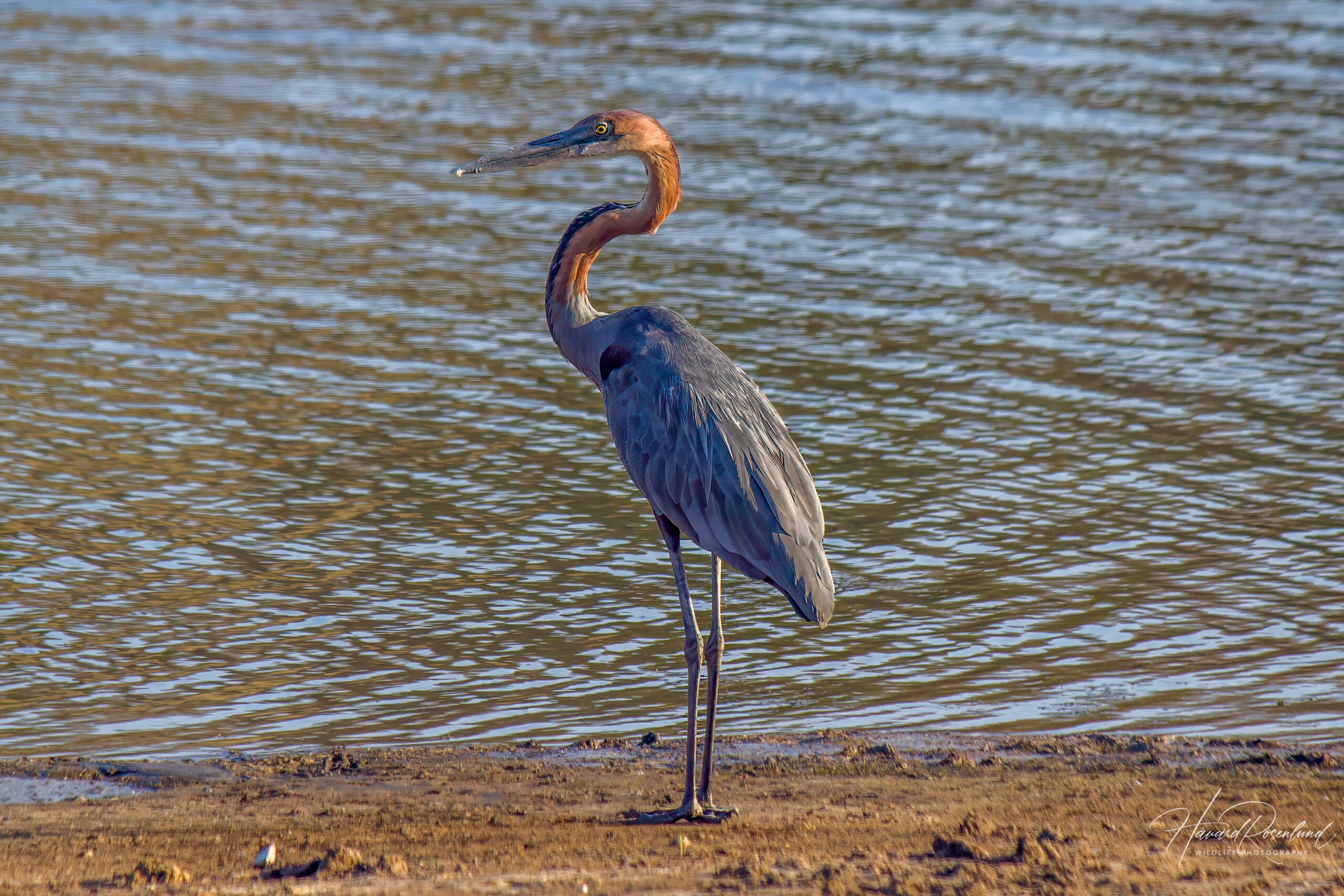
The head and neck are rich chestnut, with black-and-white streaking down the front of the neck and breast, while the back and wings are slate-grey. The sexes look similar, although females average smaller. The species is centred on sub-Saharan Africa, with much smaller and more local populations extending into parts of southwest Asia.
Habitat
Goliath herons are strongly tied to water and occur at lakes, large rivers, marshes, estuaries, coastal lagoons and mangroves. They favour relatively quiet areas with extensive shallow or moderately deep water and good populations of large fish.
The long legs allow them to forage farther from shore and in deeper water than many other herons. Floating vegetation can also be useful as a landing platform or as a surface on which a large struggling fish can be subdued.
Diet
Large fish dominate the diet. At Lake St Lucia in South Africa, captured fish averaged about 30 cm in length and an estimated 500–600 g, far larger than the typical prey of most heron species.
Frogs, crustaceans, reptiles and small mammals are also taken opportunistically, but the species' body size and feeding ecology are clearly centred on obtaining relatively large aquatic prey.
Hunting
Goliath herons usually hunt alone and defend large feeding territories from other goliath herons. Their hunting strategy is unusually patient and highly specialised. A study published in 1980 at Lake St Lucia in South Africa found that birds stood almost motionless for roughly three quarters of their hunting time and caught only about 2.3 fish per day. Because each fish was large, however, those few successful strikes still supplied substantial energy. It is a kind of “jackpot” strategy: few captures, but a large energetic payoff each time.
Large fish are struck or stabbed with the bill, often near the gill region, and brought to the surface before swallowing. Handling can take almost two minutes while the heron repeatedly repositions and subdues the prey. This creates a vulnerable period in which fish eagles and other fish-eating birds may attempt to steal the catch; about 11% of observed captures in the St Lucia study were lost to such interference.
The slow, energy-saving search contrasts sharply with the more active hunting of many smaller herons. It is an adaptation to prey that are comparatively rare but so profitable that a small number of successful captures can meet much of the bird's daily energy requirement.
Breeding
Breeding patterns vary. Goliath herons often nest as isolated pairs, but loose colonies can be common locally, and the species also nests alongside other waterbirds. Breeding timing varies with water conditions and rainfall, and in South Africa birds may skip breeding in some years when conditions are unfavourable. Nests are large platforms of sticks and reeds placed in trees, shrubs, reedbeds or low vegetation on protected islands and wetland margins.
Clutches contain two to five eggs, usually three or four. Both parents incubate for about 24–30 days and care for the young after hatching. The young leave the nest after around five weeks, but the parents may continue to care for them for a further roughly 40–80 days. A successful nest usually produces only one or two young.
Status
The goliath heron is classified as least concern on the IUCN Red List. It has a broad African distribution and remains locally common in suitable wetlands, but is thinly distributed across much of its range.
Wetland alteration, disturbance and changes in fish communities can affect local populations. In South Africa, dams and reservoirs historically created additional habitat and contributed to an increase and range expansion in parts of the country. Large, productive and relatively undisturbed wetland systems remain particularly valuable for a species whose feeding strategy depends on access to sizeable fish.
Image gallery
Loading map and observations…
Have you seen this species?
Independent species archive
Did you find this species page useful?
Wildlife Vagabond is independently built and maintained. Voluntary support helps cover hosting, maps, data storage and continued improvements to the species archive.
Support Wildlife VagabondSpecies content will remain freely available.
References
Information about the species’ global distribution and status is based primarily on global Red List data. See the references below for details.
- BirdLife International. (n.d.). Goliath Heron (Ardea goliath) species factsheet. https://datazone.birdlife.org/species/factsheet/goliath-heron-ardea-goliath
- HeronConservation. (n.d.). Goliath Heron – ecology, behaviour and conservation. https://heronconservation.org/herons-of-the-world/list/goliath-heron/
- International Union for Conservation of Nature. (n.d.). Goliath Heron (Ardea goliath). The IUCN Red List of Threatened Species. https://www.iucnredlist.org/species/22697017/93598961
- Mock, D. W., & Mock, K. C. (1980). Feeding Behavior and Ecology of the Goliath Heron. The Auk, 97(3), 433–448. https://doi.org/10.1093/auk/97.3.433
- Oiseaux.net. (n.d.). Goliath Heron (Ardea goliath): biometrics and distribution. https://www.oiseaux.net/birds/goliath.heron.html