
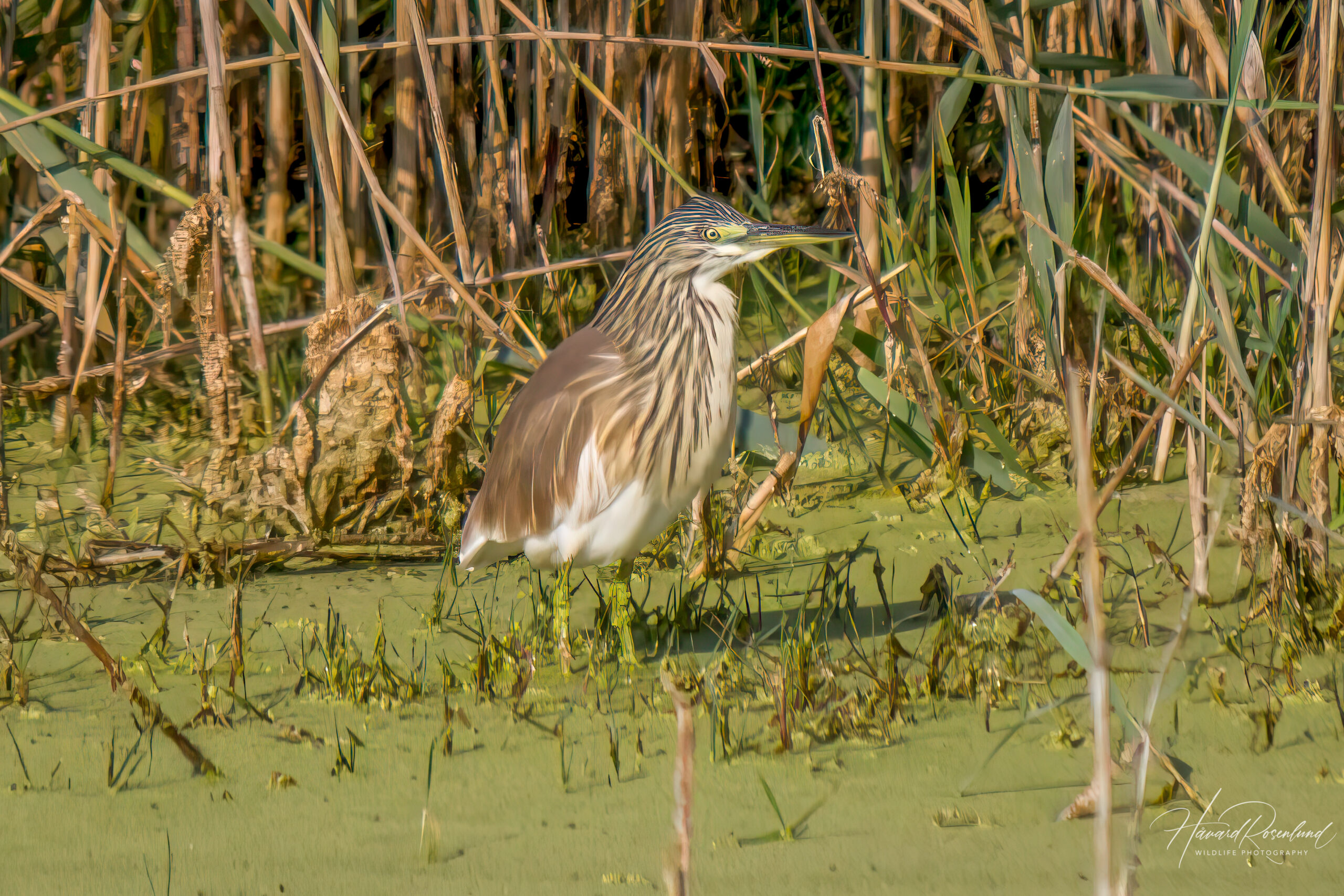
Squacco Heron
Ardeola ralloides
At a glance
Habitat
- Freshwater marshes, reedbeds, river margins, flooded vegetation and shallow lagoons
Diet
- Aquatic insects, fish, frogs and other small wetland prey
Activity
- Mostly diurnal and crepuscular
Size
- Length: 42–47 cm Weight: 250–330 g
Range
- Southern Europe, Africa and western to central Asia; northern populations winter mainly in Africa
Description
The squacco heron (Ardeola ralloides) is a small, stocky pond heron distributed across southern Europe, Africa and western to central Asia. Adults measure about 42–47 cm and weigh roughly 250–330 g. At rest the bird appears mainly buff and brown, with a short-looking neck and streaked head. In flight, however, the broad pure-white wings, rump and tail suddenly become conspicuous and create a striking contrast with the brown body.
Breeding adults develop warmer cinnamon-buff plumage, long pale head and neck plumes and brighter bare-part colours. Outside the core European range the species can resemble other Ardeola pond herons, but the combination of range, plumage and extensive white wings in flight is useful for identification. The English name Squacco comes from dialectal Italian sguacco, an old local name for the species.
Habitat
Squacco herons favour shallow freshwater wetlands with abundant emergent or floating vegetation, including marshes, reedbeds, river margins, floodplains, rice fields and vegetated lake edges. Dense cover provides sheltered feeding and nesting areas, while nearby patches of shallow open water give access to prey.
The species can also use reservoirs, drainage channels and other modified wetlands where water levels and vegetation remain suitable. The birds depend on productive shallow water, so changes in flooding, water abstraction or vegetation structure can quickly make a site less suitable.
Diet
The diet consists mainly of aquatic insects and their larvae, small fish and frogs, with other invertebrates and small vertebrates taken opportunistically. A study in the Danube Delta in Romania found that insects dominated numerically, while fish and amphibians formed larger individual prey.
Hunting
Squacco herons usually hunt alone, stalking slowly through shallow water or standing motionless beside emergent or floating vegetation before striking rapidly with the bill when prey comes within reach.
The combination of patient ambush and slow, deliberate movement allows the bird to search dense wetland margins without disturbing prey unnecessarily.
Migration
Northern populations breeding in Europe and western Asia are migratory. Most leave between August and November and cross the Mediterranean, Middle East and Sahara on a broad front to winter in tropical Africa. Spring return begins from February and continues into May.
The limited ringing recoveries suggest a broad east–west connection between breeding and wintering areas: birds from western Europe tend to winter farther west in Africa than birds from eastern Europe. African populations are more complex; many are resident or make local seasonal movements in response to rainfall and changing wetland conditions, and their ranges overlap in winter with migrants arriving from Europe and Asia.
Breeding
Squacco herons breed colonially, often alongside other herons, egrets and ibises. Nests are loose platforms of sticks or reeds placed in reedbeds, shrubs or low trees over or close to water. Both parents participate in incubation and chick care.
Clutch size varies among colonies and years. Mediterranean colonies commonly have around four eggs per clutch, and a breeding study published in 2014 in northern Tunisia recorded a mean of about 4.5 eggs. Incubation lasts roughly three weeks, and the young remain at the nest and on surrounding branches for several more weeks before becoming fully capable of flight.
Long-term work in the Camargue in southern France found that breeding success and chick condition varied among colony sites and through time. Water levels and food availability can therefore produce large differences between colonies even within the same region.
Status
The squacco heron is classified as least concern on the IUCN Red List. It has a large range spanning Europe, Africa and western to central Asia.
Its dependence on productive shallow wetlands makes local populations sensitive to drainage, altered flooding regimes, water abstraction, reedbed loss and pollution. Migratory birds depend on suitable breeding, stopover and wintering wetlands throughout the annual cycle.
Image gallery
Loading map and observations…
Have you seen this species?
Independent species archive
Did you find this species page useful?
Wildlife Vagabond is independently built and maintained. Voluntary support helps cover hosting, maps, data storage and continued improvements to the species archive.
Support Wildlife VagabondSpecies content will remain freely available.
References
Information about the species’ global distribution and status is based primarily on global Red List data. See the references below for details.
- Agreement on the Conservation of African-Eurasian Migratory Waterbirds. (n.d.). Squacco Heron (Ardeola ralloides). https://www.unep-aewa.org/species/ardeola-ralloides
- BirdLife International. (n.d.). Squacco Heron species factsheet. https://datazone.birdlife.org/species/factsheet/squacco-heron-ardeola-ralloides
- Delord, K., Kayser, Y., Barbraud, C., & Hafner, H. (2003). Variability in breeding parameters of the Squacco HeronArdeola ralloides. Bird Study, 50(3), 300-305. https://doi.org/10.1080/00063650309461323
- EURING. (n.d.). Squacco Heron. EURING Eurasian-African Bird Migration Atlas. https://migrationatlas.org/node/1578
- Gauthier-Clerc, M., Kayser, Y., & Kiss, J. B. (2004). Diet and clutch size of Squacco Heron (<i>Ardeola ralloides</i>) in the Danube Delta (Romania). Scientific Annals of the Danube Delta Institute, 10, 1–3. https://doi.org/10.7427/DDI.10.03
- International Union for Conservation of Nature. (n.d.). Squacco Heron. The IUCN Red List of Threatened Species. https://www.iucnredlist.org/species/22697123/131940696
- Nefla, A., Tlili, W., Ouni, R., & Nouira, S. (2014). Breeding Biology of Squacco Herons (Ardeola ralloides) in Northern Tunisia. The Wilson Journal of Ornithology, 126(2), 393-401. https://doi.org/10.1676/13-130.1