
Yellow-footed Green-Pigeon
Treron phoenicopterus
At a glance
Habitat
- Deciduous woodland, open forest, scrub, plantations, orchards, parks and other tree-rich landscapes
Diet
- Mostly fruit, especially figs and other soft fruits; an important seed disperser for some forest trees
Activity
- Diurnal
Size
- Length: about 33 cm Weight: 226–248 g
Range
- Indian subcontinent east into mainland Southeast Asia
Description
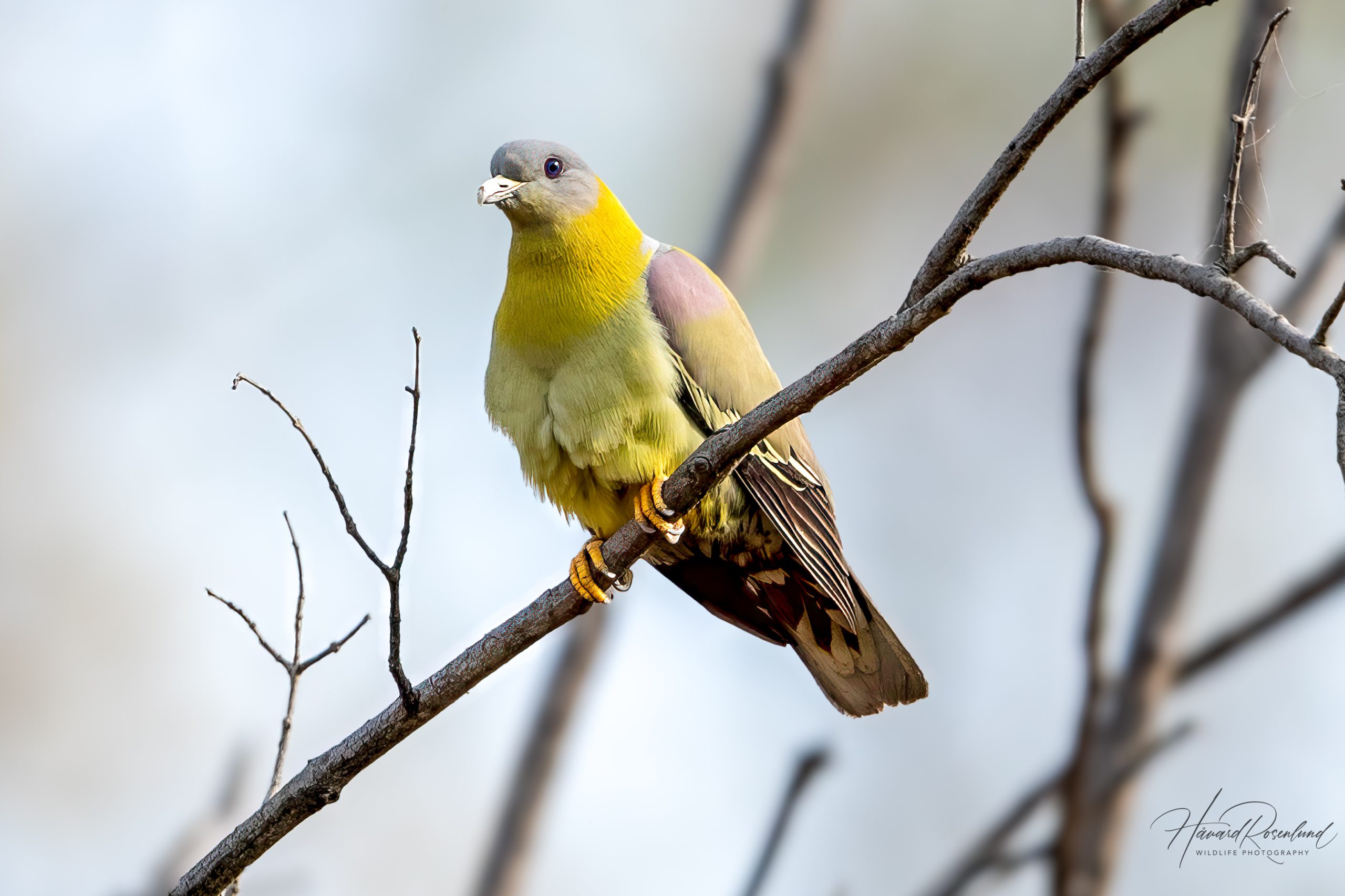
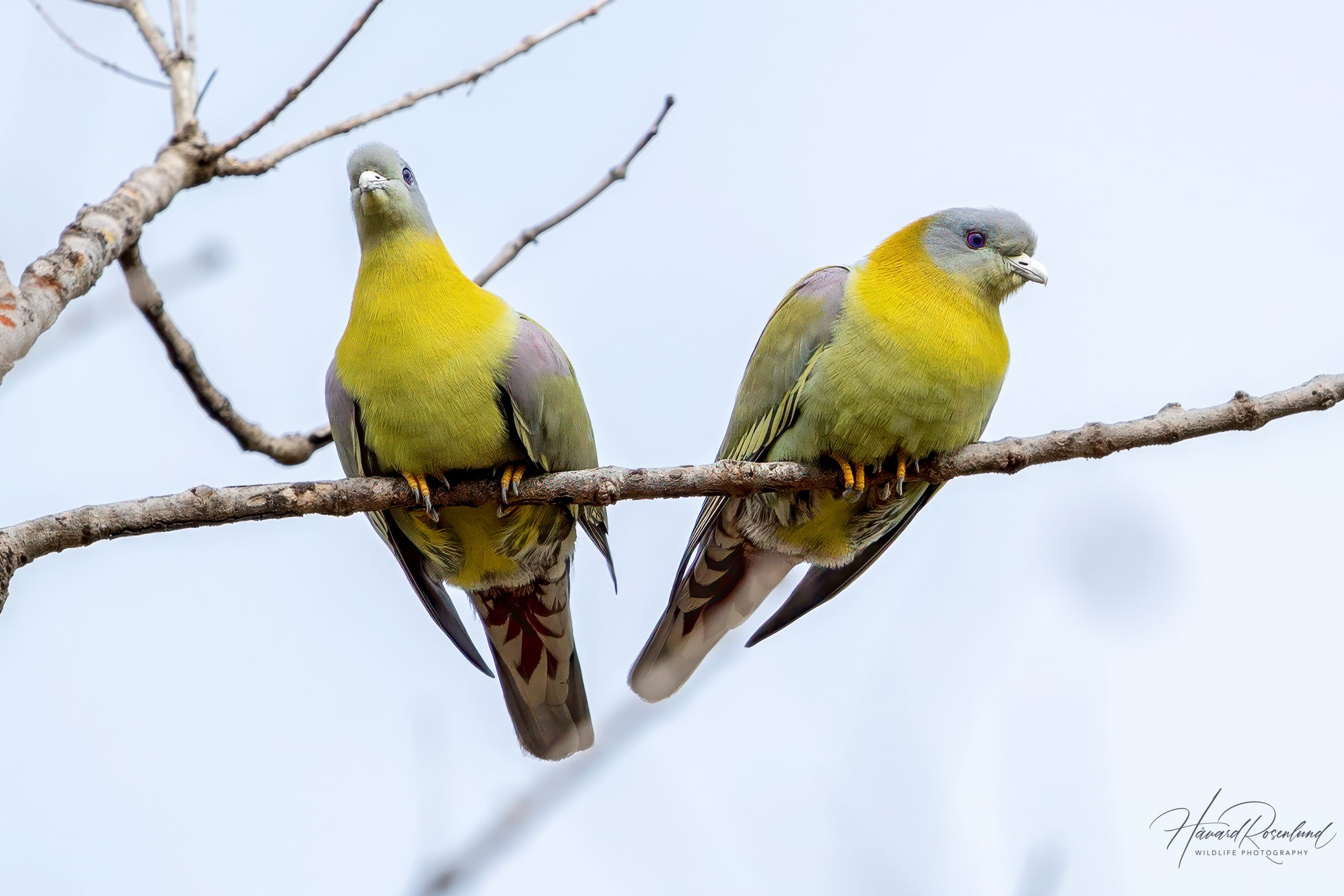
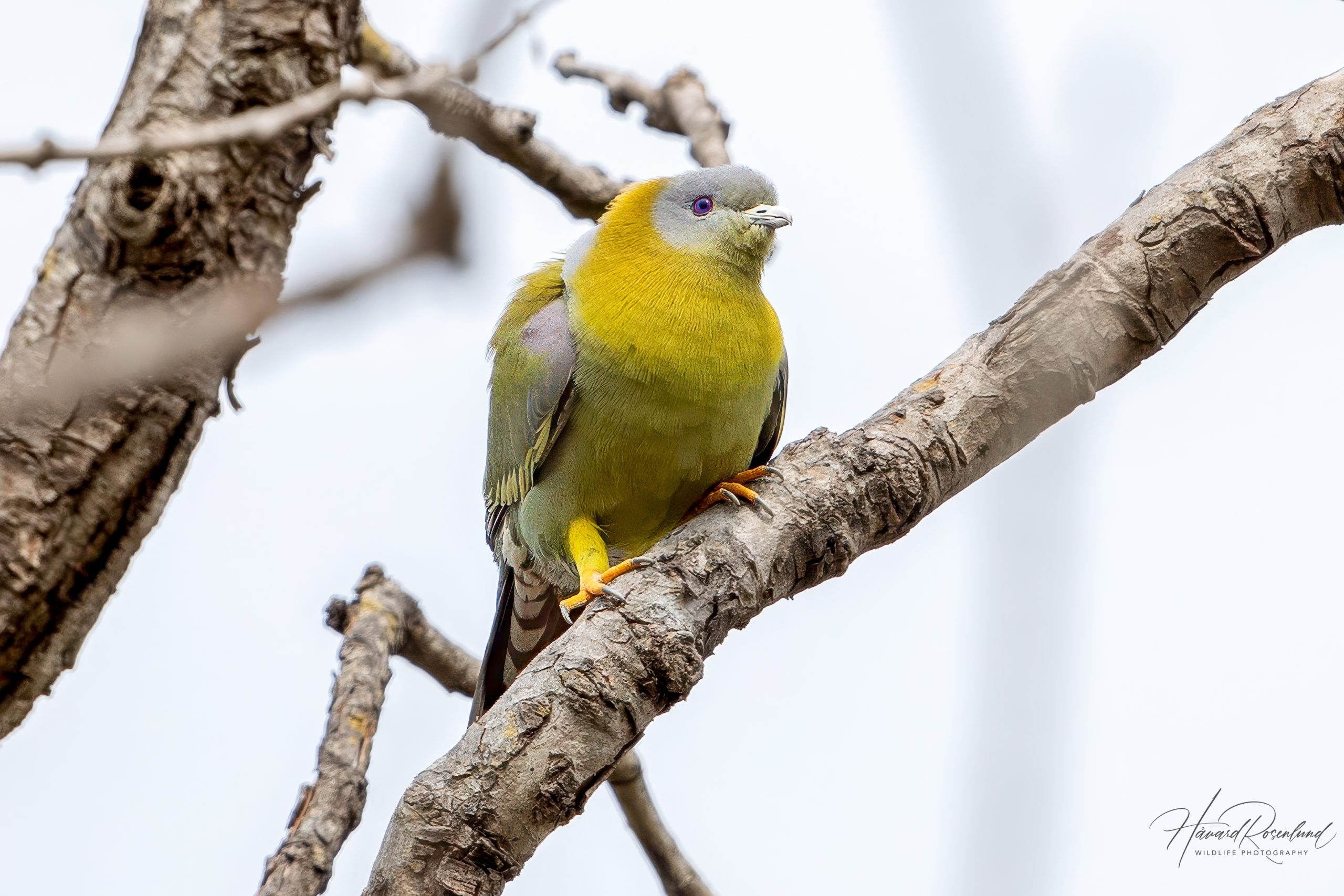
The yellow-footed green-pigeon (Treron phoenicopterus) is a robust, predominantly arboreal pigeon of the Indian subcontinent and neighbouring parts of Southeast Asia. Adults are about 33 cm long and weigh roughly 226–248 g. The plumage is dominated by green and yellow-green tones, with conspicuous yellow legs and feet. Adult males show a greyer crown and a distinct lilac-maroon patch across the shoulder and upper wing, while females are generally duller and show the coloured shoulder patch less strongly.
The green plumage provides excellent camouflage among foliage, and flocks feeding quietly in a fruiting tree can be surprisingly difficult to notice. It can be confused with other Treron green-pigeons where ranges overlap; the combination of yellow legs, the male's shoulder patch and the overall head and wing pattern is useful for identification. The voice is a series of soft, musical whistles rather than the familiar cooing of many other pigeons.
Habitat
Yellow-footed green-pigeons use deciduous and open forest, scrub, wooded farmland, plantations, orchards, parks and tree-rich settlements. They spend most of their time in the canopy and move locally between feeding areas as different trees come into fruit.
The species tolerates substantial habitat modification as long as mature trees remain available for feeding, roosting and breeding. This allows it to occur not only in natural woodland but also in agricultural and urban landscapes with enough tree cover.
Diet
The species is strongly frugivorous, with figs and other soft fruits forming a large part of the diet. A study published in 2022, based on observations at Pench and Kanha in Madhya Pradesh, also documented birds feeding on the fleshy corollas of mahua (Madhuca longifolia). Birds clamber through outer branches and may hang or stretch into awkward positions to reach food rather than dropping to the ground to feed.
Yellow-footed green-pigeons also play an important ecological role as seed dispersers. A study published in 2015 in a moist deciduous forest in India found the species among the effective dispersers of the large-fruited tree Dillenia pentagyna, swallowing fruits and carrying viable seeds away from parent trees. Such interactions link fruit-eating birds directly with forest regeneration.
Breeding
Yellow-footed green-pigeons build the simple twig platform typical of many pigeons, usually in a tree with enough foliage to conceal the nest. Both members of the pair take part in nest construction and incubation. A study published in 2012 from Jeypore Reserve Forest in Assam found breeding from April to June, while a study published in 2023 from Aligarh in Uttar Pradesh found breeding beginning in March with re-nesting attempts continuing into July. Breeding timing therefore varies clearly between regions.
One or two white eggs are usually laid. Observations in Jeypore found the parents alternating incubation through the day, with incubation lasting about 20–23 days. After hatching, both parents feed the young with nutrient-rich crop milk produced in the crop before increasingly adding other food. The Aligarh study also showed that the species can breed successfully in heavily modified landscapes where suitable mature trees remain.
Status
The yellow-footed green-pigeon is classified as least concern on the IUCN Red List. It remains widespread across the Indian subcontinent and uses both natural woodland and tree-rich human-modified habitats.
State of India's Birds lists the species as a low conservation priority. Its 2025 update shows a long-term national increase of about 171% and a more recent annual increase of roughly 3.4%. Local populations still depend on mature fruiting and nesting trees.
Image gallery
Loading map and observations…
Have you seen this species?
Independent species archive
Did you find this species page useful?
Wildlife Vagabond is independently built and maintained. Voluntary support helps cover hosting, maps, data storage and continued improvements to the species archive.
Support Wildlife VagabondSpecies content will remain freely available.
References
Information about the species’ global distribution and status is based primarily on global Red List data. See the references below for details.
- BirdLife International. (n.d.). Yellow-footed Green-Pigeon species factsheet. https://datazone.birdlife.org/species/factsheet/yellow-footed-green-pigeon-treron-phoenicopterus
- Chatterjee, S., & Basu, P. (2015). Avian frugivory and seed dispersal of a large fruited tree in an Indian moist deciduous forest. Acta Oecologica, 65-66, 32-40. https://doi.org/10.1016/j.actao.2015.04.003
- Corlett, R. T. (2017). Frugivory and seed dispersal by vertebrates in tropical and subtropical Asia: An update. Global Ecology and Conservation, 11, 1-22. https://doi.org/10.1016/j.gecco.2017.04.007
- Devi, O., & Saikia, P. (2012). Notes on the nesting behaviour of Yellow-footed Green Pigeon Treron phoenicoptera (Columbidae) at Jeypore Reserve Forest, Assam, India. Journal of Threatened Taxa, 4(3), 2470-2475. https://doi.org/10.11609/JoTT.o2715.2470-5
- International Union for Conservation of Nature. (n.d.). Yellow-footed Green-Pigeon. The IUCN Red List of Threatened Species. https://www.iucnredlist.org/species/22691203/93305971
- Mohammad Maslehuddin, A., & Kumar, S. (2023). Notes on nesting behavior of Yellow-footed Green Pigeon Treron phoenicopterus (Latham, 1790) in Aligarh Muslim University campus and its surroundings, Uttar Pradesh, India. Journal of Threatened Taxa, 15(8), 23742-23749. https://doi.org/10.11609/jott.8390.15.8.23742-23749
- Oiseaux.net. (n.d.). Yellow-footed Green Pigeon species account. https://www.oiseaux.net/en/oiseaux/yellow-footed.green.pigeon.html
- State of India's Birds. (2025). 2025 – Yellow-footed Green Pigeon. https://stateofindiasbirds.in/species/kl-yefpig1/
- Tobias, J. A., Sheard, C., Pigot, A. L., Devenish, A. J. M., Yang, J., Sayol, F., Neate‐Clegg, M. H. C., Alioravainen, N., Weeks, T. L., Barber, R. A., Walkden, P. A., MacGregor, H. E. A., Jones, S. E. I., Vincent, C., Phillips, A. G., Marples, N. M., Montaño‐Centellas, F. A., Leandro‐Silva, V., Claramunt, S., … Schleuning, M. (2022). AVONET: morphological, ecological and geographical data for all birds. Ecology Letters, 25(3), 581-597. https://doi.org/10.1111/ele.13898