
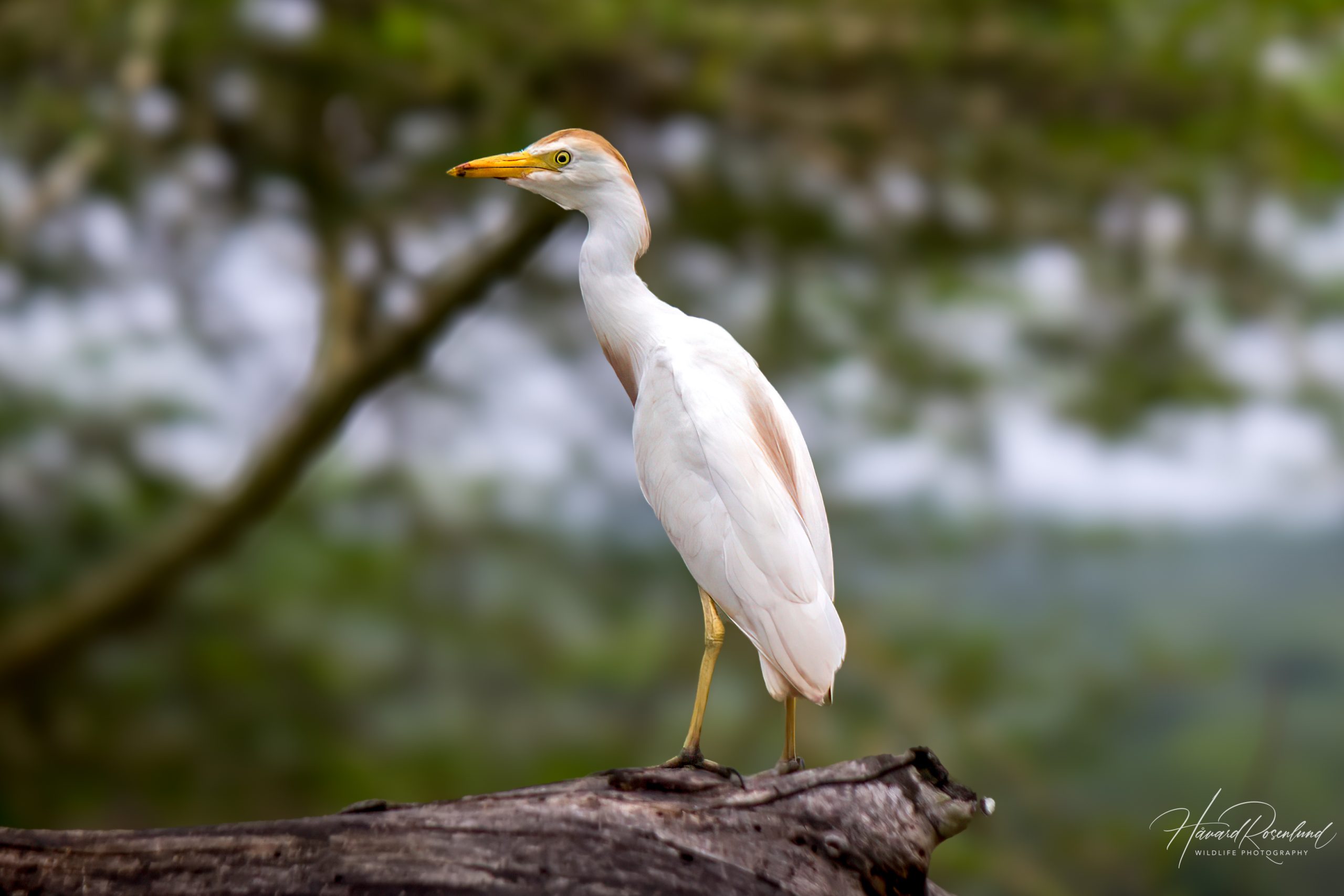
Western Cattle Egret
Ardea ibis
At a glance
Habitat
- Grassland, savanna, pasture, farmland, wetlands and other open habitats, often around large mammals
Diet
- Mainly insects and other small animals flushed by grazing mammals; also frogs, small reptiles and other opportunistic prey
Activity
- Diurnal; usually forages while walking close to livestock or wild herbivores
Size
- Length: 46–56 cm Weight: 270–512 g
Range
- Native to Africa, southern Europe and parts of the Middle East; naturally colonised much of the Americas
Description
The western cattle egret (Ardea ibis) is a compact, short-necked heron about 46–56 cm long, with a wingspan of roughly 88–96 cm and a weight of around 270–512 g. Outside the breeding season it is almost entirely white, with a yellow bill and dark legs. Breeding adults develop warm buff-orange plumes on the crown, breast and back, while the bill, facial skin and legs can briefly become much more intensely coloured.
It is closely related to the eastern cattle egret (Ardea coromanda), which develops substantially more extensive orange-buff breeding plumage across the head, neck and upper breast. The western species is generally paler and less extensively coloured in breeding plumage.
Taxonomy
Cattle egrets were long placed in the separate genus Bubulcus, and the western form was widely known as Bubulcus ibis. The eastern form was also often treated as a subspecies within the same species.
AviList v2025b places both cattle egrets in Ardea and recognises them as separate species: western cattle egret Ardea ibis and eastern cattle egret A. coromanda. Older field guides and Red List material may therefore still use the broader Bubulcus ibis concept.
Habitat
Western cattle egrets favour open landscapes such as savanna, grassland, pasture, farmland and wetland margins. They are far less dependent on shallow water than most herons and frequently forage many kilometres from wetlands.
The presence of large grazing mammals is often more important than water itself. Livestock pasture, game reserves and other open areas with abundant insects can therefore provide excellent habitat even in relatively dry landscapes.
Diet
Insects form most of the diet, especially grasshoppers, crickets, beetles, flies and other prey disturbed from vegetation. Spiders, frogs, small reptiles and other small vertebrates are also taken opportunistically.
The exact diet varies strongly with season and local conditions. Rainfall, grazing intensity and outbreaks of abundant insects can all change which prey dominates at a particular place and time.
Foraging
Following large herbivores is the defining foraging strategy of the western cattle egret. Birds walk close beside cattle, buffalo, antelope and other large mammals and seize prey flushed by their feet as they move through grass. A study published in 1982 in southern Africa found that feeding success was highest when the animals they followed moved at a moderate pace. When hosts moved too slowly or too quickly, the egrets switched more often to another animal.
The relationship is therefore primarily about access to disturbed prey rather than specialised tick removal. Egrets use the same strategy around tractors, mowers and other machinery that expose insects in grass or cultivated fields. This flexibility is one reason the species has adapted so successfully to agricultural landscapes.
Behaviour
Western cattle egrets are diurnal and spend much of the day walking through open ground in search of prey. Birds readily move between herds, fields and resting sites as feeding conditions change and may commute considerable distances between daytime foraging areas and evening roosts.
Individuals can be assertive around rich food sources, but the species is generally tolerant of close proximity to other egrets and often exploits temporary concentrations of insects together with large numbers of conspecifics.
Social behaviour
The species is strongly social. Feeding flocks form around productive herds or fields, while communal roosts can gather large numbers of birds. Outside breeding, these groups are fluid and birds regularly join or leave as local food conditions change.
Breeding
Western cattle egrets breed colonially, often alongside other herons, egrets, ibises and cormorants. Pair formation takes place at the breeding colony, where females observe displaying males before choosing a partner. Colonies are usually in trees, shrubs or reedbeds near water even when the adults forage far away in dry pasture.
Both sexes contribute to a stick nest. Clutches usually contain three or four eggs, although clutches from one to nine have been recorded. Both parents incubate for about 21–26 days and feed the young after hatching. The young begin to fly at around 25–30 days and become independent at about 45 days. Females can also lay eggs in nests belonging to other cattle egrets, adding intraspecific brood parasitism to the breeding system.
Relationship with humans
The western cattle egret has undergone one of the most striking natural range expansions among modern birds. It crossed the Atlantic without deliberate introduction and reached northeastern South America as early as 1877–1882. During the twentieth century it spread rapidly through the Caribbean, Central America and much of North America.
Human land use helped make that expansion possible. The worldwide spread of livestock farming, pasture and mechanised agriculture created huge areas where grazing animals and machinery continually expose terrestrial prey. The egret's natural feeding behaviour happened to fit these new landscapes exceptionally well.
Status
The current global Red List assessment still covers the older combined cattle-egret concept and classifies it as least concern. AviList v2025b, however, treats western and eastern cattle egrets as two separate species.
The western species is widespread and abundant across its enormous range and is not considered threatened. A separate global Red List assessment of the currently delimited western cattle egret is not yet available.
Image gallery
Loading map and observations…
Have you seen this species?
Independent species archive
Did you find this species page useful?
Wildlife Vagabond is independently built and maintained. Voluntary support helps cover hosting, maps, data storage and continued improvements to the species archive.
Support Wildlife VagabondSpecies content will remain freely available.
References
Information about the species’ global distribution and status is based primarily on global Red List data. See the references below for details.
- AviList. (n.d.). Western Cattle-Egret Ardea ibis and Eastern Cattle-Egret Ardea coromanda. https://explore.avilist.org/
- BirdLife International. (n.d.). Cattle Egret species factsheet and global assessment. https://datazone.birdlife.org/species/factsheet/cattle-egret-bubulcus-ibis
- Burger, J., & Gochfeld, M. (1982). Host Selection as an Adaptation To Host-Dependent Foraging Success in the Cattle Egret (Bubulcus Ibis). Behaviour, 79(2-4), 212-229. https://doi.org/10.1163/156853982X00265
- Butler. (2006). Feeding association between cattle egrets and mammal hosts in the central Free State, South Africa. https://journals.satnt.aosis.co.za/index.php/satnt/article/view/139
- Butler. (2007). Habitat preference, feeding distance and flight direction of cattle egrets in the central Free State. https://journals.satnt.aosis.co.za/index.php/satnt/article/view/133/0
- Cornell Lab of Ornithology. (n.d.). Western Cattle-Egret identification and biometrics. https://www.allaboutbirds.org/guide/Cattle_Egret/id
- HeronConservation. (n.d.). Cattle Egret – breeding biology and life history. https://www.heronconservation.org/herons-of-the-world/list-of-herons/cattle-egret
- International Union for Conservation of Nature. (n.d.). Cattle Egret (assessment treating western and eastern forms together). The IUCN Red List of Threatened Species. https://www.iucnredlist.org/species/22697109/155477521